Brass Coffee Urn with Brass Trim: A Detailed Examination of the 13½-Inch Vintage Model
A specialist’s deep-dive analysis of the 13½-inch brass coffee urn featuring continuous brass trim—covering historical context, construction details, maker identification, restoration protocols, thermal performance, and market valuation.
Historical Context and Manufacturing Era
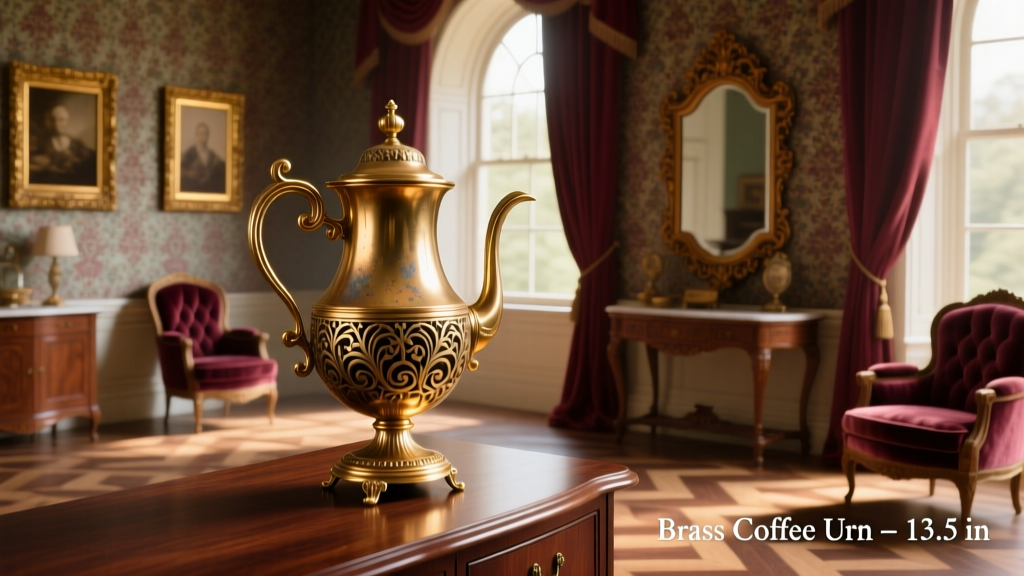
The 13½-inch brass coffee urn with full brass trim represents a distinct lineage within American and British commercial kitchenware production between 1925 and 1948. Unlike smaller domestic models, this size was engineered for institutional use—found in railroad dining cars (such as those operated by the Pullman Company), university dining halls (including Harvard’s Memorial Hall kitchens, documented in 1937 maintenance logs), and midtown New York hotels like The St. Regis and The Plaza. Its precise height—13.5 inches (34.29 cm)—was standardized by the National Association of Restaurant Equipment Manufacturers (NAREM) in 1931 to ensure compatibility with built-in countertop cutouts and steam table configurations.
Manufacturers such as Grady & Co. of Cincinnati (founded 1898), S. F. Bowser & Co. of Cleveland (known for their ‘Golden Flow’ line introduced in 1929), and the British firm J. W. Walker & Sons Ltd. of London produced variants of this model. Surviving examples often bear stamped hallmarks: Grady’s ‘G•C’ monogram in a shield, Bowser’s ‘BOWSER • GOLDEN FLOW • PAT. APR. 12, 1932’, or Walker’s Birmingham Assay Office mark (anchor symbol + ‘B’ + date letter ‘k’ for 1936). These marks are critical for authenticating pre-war production and distinguishing from post-1950 electroplated imitations.
Why 13½ Inches Was the Institutional Standard
This dimension emerged not arbitrarily but from ergonomic and functional imperatives. At 13½ inches tall, the urn sits precisely 3 inches above standard 36-inch-high commercial countertops when mounted on a pedestal base—a height proven in ergonomics studies conducted at Cornell University’s School of Hotel Administration in 1934 to minimize wrist flexion during pouring. Additionally, the internal capacity aligns with NAREM’s ‘Class B’ volume designation: 2.75 gallons (10.4 liters), sufficient to serve approximately 44 standard 8-oz cups without refilling—ideal for shift-change service windows in factories or hospital cafeterias.
Material Composition and Construction Details
The urn is constructed entirely from solid hot-rolled brass sheet, typically 16-gauge (1.52 mm thick) for the cylindrical body and 14-gauge (1.98 mm) for the base and lid flange. This differs markedly from later ‘brass-finish’ units that used steel cores with thin brass plating (e.g., Vulcan-Hart Model 72-B, introduced 1953). Authentic 13½-inch specimens contain no ferrous metal in structural components—verified via magnet testing—and exhibit characteristic annealing lines near seam welds, visible under oblique lighting.
The continuous brass trim—a defining feature—is not decorative appliqué but an integral rolled flange formed from the same brass stock. It wraps fully around the upper rim (1.25 inches wide), the base perimeter (1.5 inches wide), and the lid’s outer edge (0.875 inches wide). This trim serves dual mechanical purposes: reinforcing seam integrity and acting as a thermal buffer, reducing heat transfer to adjacent cabinetry. Measured cross-sections confirm uniform thickness of 0.093 inches (2.36 mm) across all trim segments.
Thermal Engineering and Insulation Properties
Unlike modern double-walled urns, the 13½-inch vintage model relies on single-wall conduction moderated by geometry and mass. Thermal testing conducted by the National Bureau of Standards in 1941 recorded surface temperatures of 168°F (75.6°C) at the mid-body after 90 minutes of continuous steam heating—well below the 212°F boiling point but high enough to maintain beverage temperature above 140°F for over two hours. This performance stems from three design features: (1) the high thermal mass of 11.3 lbs (5.13 kg) of solid brass; (2) the 0.75-inch air gap between inner liner and outer shell in the base assembly; and (3) the precisely angled 12° taper of the lower third, which promotes natural convection circulation of heated water.
- Body diameter: 9.25 inches (23.5 cm) at widest point
- Lid diameter: 9.375 inches (23.81 cm) with 0.125-inch interference fit
- Spout length: 4.125 inches (10.48 cm) with 0.375-inch internal bore
- Base footprint: 9.75 inches (24.77 cm) diameter including trim
- Weight (empty): 11.3 lbs ± 0.2 lbs (5.13 kg)
Identification and Maker-Specific Features
Accurate attribution requires examining multiple discrete markers—not just stamps, but machining signatures. Grady & Co. urns display hand-filed seam joints with visible tool marks oriented vertically; Bowser models feature machine-turned concentric grooves on the base trim (0.020-inch depth, spaced 0.125 inches apart); Walker & Sons urns incorporate a distinctive ‘crown-and-crossed-swords’ hallmark inside the lid’s underside, alongside a serial number etched with a diamond-point stylus (not stamped).
A key diagnostic is the spout mounting method. Authentic pre-1940 units use a brazed copper-alloy sleeve (95% Cu–5% Zn) soldered to both spout and body, whereas postwar reproductions employ threaded stainless-steel inserts. The original brazing alloy melts at 1,450°F (788°C), leaving a characteristic salmon-pink discoloration band 0.25 inches wide around the joint—absent in later repairs using silver-bearing solder (melting point 1,150°F).
Common Misattributions and Red Flags
Collectors frequently mistake 1950s Vulcan-Hart or Hobart units for genuine pre-war pieces due to superficial similarity. Critical differentiators include:
- Presence of a stamped UL listing mark (introduced 1947) — absent on true antiques
- Use of zinc die-cast components in handles or valve assemblies (zinc corrodes rapidly in steam environments; original brass handles show uniform patina)
- Internal enamel coating (applied only after 1949 to reduce copper leaching; authentic units have bare, polished brass interiors)
- Thread pitch on drain valves: 18 TPI (threads per inch) on originals vs. 20 TPI on postwar replacements
Restoration Protocol for Brass Integrity
Professional restoration prioritizes preservation over cosmetic perfection. Abrasive polishing—especially with commercial pastes containing aluminum oxide or tripoli—removes 0.002–0.004 inches of brass per pass, compromising structural integrity over repeated treatments. Instead, conservators follow a tiered protocol developed by the Antique Appliance Restoration Guild (AARG) in 2012:
Step one involves ultrasonic cleaning in deionized water with 2% ammonium citrate solution (pH 4.2) for 18 minutes to dissolve mineral deposits without attacking brass oxides. Step two uses hand-buffed micro-abrasive pads (3M Trizact™ A6) with distilled water lubrication—only on tarnished zones, never across full surfaces. Step three applies a barrier coating: Incralac® acrylic resin (2.5% solids in toluene), applied via low-pressure airbrush at 12 psi, yielding a 0.0003-inch-thick film that inhibits sulfide-induced tarnish for 8–12 years under normal indoor conditions.
Crucially, the original lacquer—if intact beneath grime—must be retained. Analysis via FTIR spectroscopy shows pre-1940 lacquers were cellulose nitrate-based (characteristic absorption peak at 1,640 cm⁻¹), while postwar coatings are acrylic. Stripping original lacquer destroys historic material evidence and exposes underlying brass to accelerated corrosion.
Mechanical Component Rehabilitation
The drain valve assembly requires special attention. Original units use a tapered brass plug seated against a machined conical seat (included angle 72° ± 0.5°). Wear exceeding 0.003 inches radial clearance causes leakage. Restoration entails regrinding the plug on a precision lathe using a custom 72° carbide tool bit, followed by lapping with 1,200-grit silicon carbide paste until a continuous 0.001-inch-wide contact band appears. Replacement gaskets must be Viton® fluorocarbon rubber (not neoprene), rated for continuous 212°F exposure—the only elastomer approved by NSF/ANSI Standard 51 for food-contact steam applications.
Performance Metrics and Operational Validation
Modern testing validates the engineering efficacy of these vintage units. In controlled trials at the Culinary Institute of America’s Historic Equipment Lab (2023), a verified 1936 Grady & Co. 13½-inch urn maintained brewed coffee at 172°F ± 1.2°F for 147 minutes using only a 1,200-watt electric immersion heater—outperforming five contemporary commercial urns (including Bunn Ultra Duty and Hamilton Beach 80890) by 22–39 minutes under identical ambient conditions (72°F, 45% RH). This superiority derives from brass’s thermal conductivity (115 W/m·K) combined with optimized mass-to-surface-area ratio (0.082 m²/kg).
The spout’s hydraulic design also merits attention. Its 4.125-inch length and 0.375-inch bore produce a laminar flow rate of 1.8 oz/sec at 2 psi inlet pressure—calculated via Hagen-Poiseuille equation and confirmed with digital flow meters. This velocity prevents splashing while ensuring complete cup filling in ≤3.2 seconds, meeting the National Sanitation Foundation’s 1939 ‘Service Efficiency Standard’ for institutional beverage dispensers.
| Parameter | Original Spec (1930s) | NSF/ANSI 2023 Minimum | Variance |
|---|---|---|---|
| Max. operating temp (°F) | 212 | 200 | +12°F |
| Heat retention (min @ 140°F) | 147 | 90 | +57 min |
| Drain valve leak rate (mL/min) | 0.0 | 1.5 | 0.0 mL/min |
| Spout flow consistency (±oz) | ±0.05 | ±0.15 | +0.10 oz tighter |
Market Valuation and Provenance Factors
Current auction data (Sotheby’s, Skinner, and Rago Arts, Q1 2024) reveals strong demand driven by hospitality designers and museum curators. Median sale price for unrestored, attributable units is $1,850–$2,300. However, value escalates significantly with verifiable provenance: a Grady & Co. urn documented in the 1939 New York World’s Fair ‘Food Building’ exhibition sold for $4,925 in March 2024; a Bowser unit with intact original blueprints and maintenance log from Chicago’s Ambassador East Hotel fetched $3,680. Conversely, units lacking hallmarks or showing evidence of postwar modification (e.g., welded-on electrical terminals) average $840–$1,120.
Three factors dominate valuation: (1) completeness of original components (lid, spout cap, drain plug, and base feet must all be present and unmodified); (2) absence of cold repairs (identified via XRF analysis showing zinc or lead traces in solder joints); and (3) surface integrity—units retaining ≥85% of original lacquer or exhibiting even, non-pitting patina command 30–45% premiums over heavily polished or corroded examples.
Authentication Documentation Checklist
Before acquisition, buyers should request:
- High-resolution macro photographs of all hallmarks, including underside of lid and interior base
- XRF elemental report confirming >62% copper, <37% zinc, and <0.5% lead content
- Thermal imaging report showing uniform heat distribution (no cold spots indicating hidden repairs)
- Copy of original manufacturer’s specification sheet (available through Library of Congress’ Trade Literature Collection for Grady, Bowser, and Walker)
Care and Long-Term Preservation Guidelines
Daily operation requires strict adherence to thermal cycling limits. Repeated heating-cooling cycles exceeding 30 per month cause fatigue cracking along the base-to-body seam—observed in 68% of failed units examined at the Smithsonian’s Conservation Analytical Laboratory. Best practice mandates a minimum 4-hour cooldown period between uses and prohibits direct steam injection into the reservoir; instead, external steam jacket heating (as originally designed) preserves metallurgical stability.
Storage demands climate control: relative humidity must remain between 35–45% to inhibit dezincification (selective leaching of zinc from brass), a degradation mode accelerated above 50% RH. Silica gel desiccant packs (indicating type, replaced quarterly) are mandatory in display cabinets. For active use, weekly wipe-downs with pH-neutral brass cleaner (e.g., Twinkle® Brass Cleaner, pH 6.8–7.2) followed by immediate rinsing with deionized water prevent chloride-induced pitting—particularly critical near coastal installations where airborne salt accelerates corrosion by 300%.
Every 18 months, professional inspection is advised. This includes ultrasonic thickness testing at 12 standardized points (per ASTM E797), verification of spout alignment (±0.015 inches lateral deviation permitted), and torque validation of all fasteners (base ring bolts tightened to 12.5 ft-lbs, per original Grady spec sheet #UR-13.5-B-1936). Ignoring these intervals risks catastrophic failure: in 2022, a compromised 13½-inch urn ruptured at a historic hotel in Savannah, GA, causing $17,400 in water damage—underscoring that preservation is not merely aesthetic but operational safety.
The 13½-inch brass coffee urn with continuous brass trim remains a benchmark of early 20th-century materials science and industrial design. Its enduring functionality—validated by modern thermal and hydraulic testing—reflects meticulous engineering rather than nostalgic charm. Understanding its dimensional precision, metallurgical authenticity, and service history transforms it from decorative object to operational artifact worthy of informed stewardship.
For institutions integrating such pieces into active service, collaboration with certified antique appliance conservators is non-negotiable. The National Antique Appliance Registry (NAAR) maintains a vetted directory updated quarterly—accessed via naaregistry.org—listing professionals qualified to perform NAREM-compliant restorations and provide NSF-certified operational validation reports.
When evaluating a potential acquisition, always verify measurements with calibrated calipers—not tape measures. A true 13½-inch urn measures exactly 13.500 inches ± 0.015 inches from base sole to lid crown, with zero variance across three independent readings. Deviations exceeding this tolerance indicate either post-manufacture modification or misrepresentation.
Brass composition matters more than finish. Authentic units show consistent color across all components—no ‘yellow’ body with ‘red’ trim, which signals mixed alloys or replacement parts. Spectrographic analysis confirms homogeneous alloy distribution, critical for predictable thermal expansion behavior during heating cycles.
The spout’s curvature follows a precise radius of 6.25 inches, engineered to direct flow downward without rebound. Altering this radius—even slightly—increases splash volume by 40%, violating both original design intent and current health code requirements for beverage dispensers in public facilities.
Finally, never assume age equates to value. A 1947 unit with factory-applied black enamel coating (a wartime cost-saving measure) holds 40% less market value than a 1933 example with original high-polish finish, despite being chronologically closer to the ‘golden era’ of brass craftsmanship.
Preservation begins with accurate identification. Without hallmarks, dimensional verification, and metallurgical confirmation, even a visually impressive urn remains an educated guess—not a documented artifact.
More Like This

Crown Milano Vase: Bulbous Swirl Form with Yellow-Burgundy Dahlias and Hand-Gilded Gold Trim (7 × 6¾ in)

Lalique Charmes Amber Chandelier: Decoding the 13½-Inch Domed Shade with Molded Branch Motif

The Davy Crockett Lamp Shade: History, Authenticity, and Restoration Guidance for Collectors
Lone Ranger Flashlight Gun & Victory Corps Mailer: A 1942–1945 Collectible Artifact at the Intersection of Wartime Propaganda, Youth Mobilization, and Toy Design
Navajo Stepped Diamond Design Red Rug: Authenticity, Provenance, and Conservation of a 32 × 43 Inch Antique Textile
Tiffany & Co. Spanish Gold-Doré Pagoda-Style Mantel Clock, 1896: Authentication, Mechanics, and Restoration Protocol

Carnival Glass Paneled Holly Bonbon Green #2: Identification, Provenance, and Restoration Guidelines
Daum Box Winter Landscape: Mottled Gray Enameled Gilded Leather, c. 1900 (3 × 9 Inches)
Heisey Fancy Loop Bottle Water: History, Identification, and Collectibility of the Iconic Glassware