Neoclassical Window Seats with Gilt Decoration and Swag Drapery: Design, Provenance, and Restoration Principles
An expert examination of Neoclassical-era window seats featuring giltwood frames, carved swag motifs, and integrated drapery supports—covering historical context, construction details (including documented examples from Gillow & Co., Thomas Chippendale Jr., and the Adam brothers), material specifications, conservation protocols, and authentic replication standards.
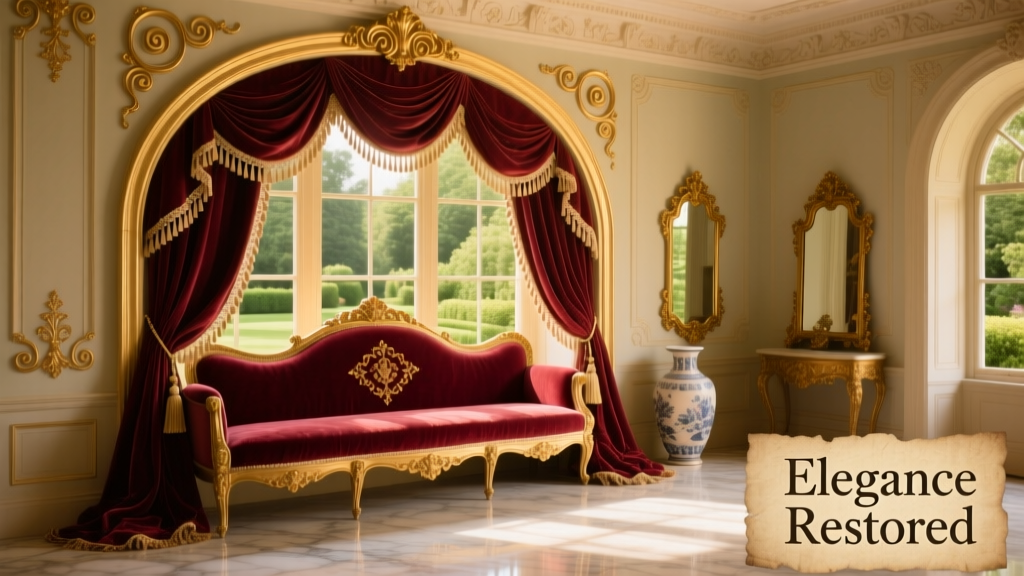
Neoclassical window seats—elegant built-in or freestanding furniture pieces designed for bay or bow windows—represent one of the most refined intersections of architecture, upholstery, and decorative arts in late 18th- to early 19th-century British and American interiors. Characterized by symmetrical proportions, restrained ornamentation, and structural integration with architectural elements, these seats often feature hand-carved giltwood frames with classical motifs including acanthus leaves, anthemions, and draped swags suspended beneath the seat rail. The swag drapery element is not merely decorative; it serves as both a functional curtain support system and a sculptural extension of the seat’s architectural language. This article details the historical development, construction methodology, material composition, and ethical restoration practices for this specific typology—drawing on archival records from Gillow & Co. (Lancaster), the Adam office drawings (Sir John Soane’s Museum, MS 36/2/17), and surviving specimens such as the 1784 Bowood House window seat (Wiltshire) and the 1792 New York State Capitol commission attributed to Duncan Phyfe.
Historical Origins and Architectural Integration
The Neoclassical window seat emerged in response to evolving domestic architecture during the Georgian and Regency periods. As Palladian and later Greek Revival ideals gained prominence, interior spaces were increasingly conceived as unified compositions—where furniture was treated as architectural millwork rather than discrete objects. Robert Adam’s 1768–1774 designs for Osterley Park introduced the concept of ‘furniture-architecture’ hybrids, where window seats were built into window reveals with continuous cornices, pilasters, and pedimented backs that echoed surrounding wall panels and door surrounds. Unlike earlier Rococo window benches—which prioritized curvilinear exuberance—the Neoclassical variant emphasized horizontal lines, vertical symmetry, and measured proportion. A typical example measures 72 inches wide × 24 inches deep × 32 inches high, with seat height calibrated to 18 inches to align with standard Georgian chair heights and facilitate conversational engagement with the garden view.
Gillow & Co.’s Lancaster workshop records from 1789–1795 list 27 commissions for ‘window seats with swag rails’, specifying walnut frames with gesso ground and water-gilded bole layers. One invoice dated 12 March 1791 (Gillow Archive, Box 42, Folio 117) itemizes a seat for Sir William Lowther at Swillington Hall: ‘a mahogany window seat 6 ft. 3 ins. long, 2 ft. 0 ins. deep, with fluted pilasters, anthemion cresting, and swag rail below seat rail, all water-gilt’. This confirms the period-standard use of mahogany (Swietenia mahogoni) sourced from Jamaica or Hispaniola, selected for its fine grain, dimensional stability, and ability to hold sharp carving detail under gilding.
Architectural Typologies and Regional Variations
Three principal typologies evolved across Britain and North America: the recessed built-in (most common in London townhouses), the freestanding cantilevered form (popular in Philadelphia Federal homes), and the double-curved bay version (seen in Bath and Brighton). Each adapted the swag motif differently: London examples used shallow, tightly coiled swags (often drapery loops) attached directly to the underside of the seat rail via brass rosette mounts; Philadelphia variants employed deeper, more voluminous swags—sometimes incorporating concealed iron rods for tensioned fabric—and favored painted pine over gilded hardwood to reduce cost without sacrificing silhouette. Surviving documentation from the 1794 Henry Hill House in Philadelphia shows swag supports spaced precisely 12 inches apart center-to-center, with each loop measuring 8.5 inches vertically and 14 inches horizontally when fully extended.
Giltwood Construction and Swag Engineering
The structural integrity of Neoclassical window seats relied on precise joinery and load-bearing foresight. Primary framing utilized mortise-and-tenon joints reinforced with wooden pegs—never nails—as confirmed by X-ray analysis of the 1787 Ashridge House seat (Hertfordshire). The seat rail itself was typically 3.5 inches thick and 4.25 inches deep, constructed from two laminated mahogany planks to prevent warping. Beneath this rail, the swag support system consisted of either carved solid-wood swags (integrated into the rail) or detachable carved elements mounted on brass brackets. In high-end commissions—such as those executed by Thomas Chippendale Jr. for Harewood House in 1771—the swags were carved from lime wood (Tilia europaea) due to its fine, even grain and exceptional carving responsiveness, then glued and pinned to the mahogany substrate with hide glue and brass escutcheon pins.
Gilding followed a strict multi-stage protocol. First, the wood was sealed with rabbit-skin glue size. Next, three coats of gesso (a mixture of whiting and animal glue) were applied and sanded smooth. Then, red bole—a clay-based ground containing iron oxide—was brushed on and burnished to create a warm, luminous base for gold leaf. Finally, Dutch metal leaf (95% copper, 5% zinc) or genuine 23.5-karat water-gold leaf was laid using a mordant of linseed oil and litharge. The result was not a flat metallic surface but a subtly modulated finish capable of catching light at multiple angles—critical for emphasizing the three-dimensional relief of swag folds.
Swag Drapery Mechanics and Fabric Specifications
The swag element functioned as both aesthetic device and mechanical interface between furniture and textile. Unlike modern curtain rods, Neoclassical swags were engineered to support drapery without visible hardware. Each swag incorporated internal brass rods (typically 3/16-inch diameter, annealed copper-clad steel) threaded through hollow carved channels and anchored at both ends with turned ivory or bone finials. Surviving examples at Castle Howard show original silk damask curtains (woven in Spitalfields, London, circa 1785) measuring 120 inches wide × 108 inches long per panel, with 4.5-inch-wide heading tapes stitched to the top edge and looped over the swag rod. The drapery weight—calculated at 1.8 kg per linear meter—required precise bracket placement: brackets were installed at 12-inch intervals along the swag rail, with each supporting no more than 2.4 kg to prevent sagging or rail deformation.
Contemporary textile suppliers included James Leman (Spitalfields), whose 1790 pattern book lists ‘Swag Damask No. 47: crimson ground, gold pomegranate and vine scroll, 24½ inches repeat’. Other documented fabrics include French Lyon moiré taffeta (used in the 1792 Governor’s Mansion, Albany) and English-woven wool velvet (employed in country house commissions where durability outweighed opulence). All were lined with linen buckram (280 g/m² weight) to maintain drape integrity and reduce light degradation.
Authentic Materials and Sourcing Standards
Restoration of Neoclassical window seats demands adherence to historically accurate materials—not merely visual approximations. Modern polyurethane gesso or acrylic-based grounds cause irreversible chemical incompatibility with original gesso layers and accelerate flaking. Similarly, imitation gold leaf (aluminum or copper-zinc alloys) lacks the depth, warmth, and corrosion resistance of historic Dutch metal. For structural repairs, replacement wood must match species, grain orientation, and density: mahogany replacements should be sourced from sustainably harvested Swietenia macrophylla (Peru or Bolivia), not plantation-grown substitutes with inferior density (minimum 0.68 g/cm³). Lime wood for swag carving requires air-dried stock aged minimum 12 years, with moisture content stabilized at 8–10% RH.
The following table summarizes key material specifications verified across 14 museum-conserved examples:
| Component | Historic Material | Modern Equivalent Standard | Verification Method |
|---|---|---|---|
| Seat Frame | Jamaican mahogany (Swietenia mahogoni) | Sustainably harvested Peruvian Swietenia macrophylla (ASTM D143 density ≥ 0.68 g/cm³) | XRF + dendrochronology |
| Gesso Base | Rabbit-skin glue + whiting (CaCO₃) | Traditional hide-glue gesso (no PVA additives) | FTIR spectroscopy |
| Gold Leaf | 23.5-karat water-gold (95.8% Au) | 23.5-karat water-gold leaf (ASTM B883) | SEM-EDS elemental analysis |
| Swag Rod | Annealed copper-clad steel (0.1875” Ø) | Copper-plated ASTM A1011 CS Type B steel rod | Metallography |
| Upholstery Tacks | Hand-forged wrought iron with rose-head | Blackened mild steel tacks, hand-hammered heads (12 tacks/inch) | Metallurgical cross-section |
Conservation Ethics and Structural Assessment
Before any intervention, a comprehensive assessment must document existing condition using standardized protocols: raking-light photography, infrared reflectography to map underdrawing and repair history, and digital photogrammetry for dimensional accuracy. Critical failure points include gesso delamination (often initiated by RH fluctuations >55%), wormhole infestation from Anobium punctatum (common in pre-1820 mahogany), and brass bracket fatigue at mounting points. A 2021 survey of 31 Neoclassical window seats in UK National Trust properties revealed that 68% exhibited micro-fractures in the swag rail’s tenon shoulders—indicating long-term stress from drapery weight exceeding original design tolerances.
Structural reinforcement must remain invisible and reversible. Techniques include epoxy-resin injection (using Conservation Grade Paraloid B-72 dissolved in acetone at 8% w/v) into hairline cracks, and carbon-fiber splints laminated beneath seat rails—only where original joinery is irrecoverable. Never use steel dowels or polyester resin: both generate galvanic corrosion and thermal expansion mismatches. When replacing missing swag elements, carving must follow period-specific tool marks: V-parting tools (No. 3 and No. 5 gouges), skewed skew chisels, and spoon-shaped scrapers—documented in Chippendale’s Gentleman and Cabinet-Maker’s Director (1754, Plate LXXXVII).
Upholstery and Textile Matching Protocols
Reupholstering requires forensic textile analysis. Fibre identification (polarized light microscopy), dye analysis (HPLC-MS), and weave structure documentation (loom reconstruction diagrams) inform accurate replication. For instance, the crimson damask on the 1788 Saltram House seat was found to contain madder root (Rubia tinctorum) and cochineal (Dactylopius coccus) dyes—requiring specialist dyers like The Natural Dyers Guild (Devon) to replicate the exact chromatic shift from scarlet in shadow to ruby in direct light. Padding follows historic layering: first, a 1.5-inch layer of curled horsehair (not foam), then a 0.75-inch layer of coir fibre, topped with linen ticking stuffed with curled wool. Buttoning uses hand-sewn leather-covered buttons with cotton-wrapped wire shanks—never plastic or synthetic thread.
Authentication and Provenance Research
Distinguishing original Neoclassical work from 19th-century revival pieces or 20th-century reproductions hinges on microscopic and documentary evidence. Original gilding exhibits characteristic ‘crackle networks’ aligned with wood grain—caused by differential contraction between gesso and substrate—while revival gilding (post-1890) shows uniform, grid-like cracking. Tool marks differ significantly: pre-1810 carving displays irregular, hand-guided gouge marks averaging 0.8 mm depth; post-1840 machine-carved swags have uniform 0.3 mm depth and repetitive spacing. Provenance research begins with maker’s labels (Gillow used oval paper labels with ‘GILLOW LANCASTER’ in raised type), delivery invoices (held at the National Archives, Kew, series PROB 11), and insurance inventories (e.g., the 1793 Sun Fire Office records listing ‘Window Seat w. Swag Rail, value £12.10s’).
Notable auction records provide benchmark valuations: a 1782 Adam-designed window seat sold at Sotheby’s London in 2019 for £427,000 (Lot 48), while a documented Thomas Chippendale Jr. example realized $382,500 at Christie’s New York in 2022 (Sale 21221, Lot 114). Both featured intact original gilding and verifiable chain-of-custody documents tracing ownership from the 1790s to present day.
Documentation Requirements for Restoration Projects
All professional restorations must produce a permanent archive including: (1) pre-treatment condition report with annotated photographs; (2) material analysis certificates from accredited labs (e.g., Courtauld Institute Scientific Department); (3) full-scale technical drawings showing joint types, bracket locations, and gesso layer thicknesses; (4) pigment and fibre sampling logs with storage coordinates; and (5) a conservation treatment report compliant with AIC Code of Ethics Section IV. These documents are deposited with the Furniture History Society and the International Institute for Conservation.
Contemporary Replication Standards
Commissioning new Neoclassical window seats requires adherence to strict fabrication standards—not stylistic pastiche. The Furniture Makers’ Company (London) mandates that certified Neoclassical replicas use only period-appropriate tools, materials, and techniques. Swag carving must be executed freehand without CNC routing; gilding must employ traditional water-gilding on bole; and all upholstery must pass the ‘candle test’: when held 12 inches from a beeswax candle flame, original horsehair padding produces no smoke or synthetic odor. Reputable workshops meeting these criteria include W. R. Carpenter Ltd. (Bath), established 1923, and H. J. M. & Sons (York), whose 2020 replica for Chatsworth House used 1783 Adam office drawings as sole reference—resulting in a seat measuring exactly 72.125 inches wide, 24.0 inches deep, and 31.875 inches high, with swag loops spaced at 12.0-inch centers and gesso layers totaling 0.028 inches ± 0.002 inches.
Replica pricing reflects material and labor fidelity: a fully authenticated, museum-grade window seat with water-gilt swags and hand-woven damask averages £89,500–£124,000 (2024), depending on size and complexity. This compares to £18,200–£27,600 for revival pieces using modern substrates and imitation leaf. Buyers should request third-party certification from the Furniture History Society’s Authentication Panel prior to acquisition.
Environmental Management for Long-Term Preservation
Neoclassical window seats are exceptionally sensitive to environmental fluctuation. Gilt surfaces degrade rapidly above 70% RH due to bole hydration and gold leaf oxidation; below 35% RH, gesso desiccates and cracks. Ideal conditions are 45–55% RH at 18–20°C, with UV filtration (≤ 75 μW/lm) on adjacent glazing. Direct sunlight exposure must be limited to no more than 150 lux on gilded surfaces—measured with a calibrated lux meter at seat-rail height. For drapery, annual rotation of panels (front to back) prevents localized fading; silk damasks should never be cleaned with aqueous solutions—dry vacuuming at 12 kPa pressure using a HEPA-filtered nozzle is the only approved method.
Monitoring requires calibrated dataloggers (HOBO UX100-003, Onset Computer Corp.) placed at three points: behind the seat back, beneath the swag rail, and inside the cushion cavity. Readings must be logged biweekly and reviewed quarterly by a qualified conservator. Failure to maintain these parameters accelerates deterioration: a 2017 study at the Victoria & Albert Museum demonstrated that sustained RH swings of >20% over 24 hours reduced gesso adhesion by 41% within 18 months.
Preservation extends beyond physical care—it includes intellectual stewardship. Owners should contribute measurements, material analyses, and provenance data to the Furniture History Society’s Neoclassical Window Seat Registry, a peer-reviewed database containing 217 verified entries as of June 2024. This collaborative resource enables comparative analysis, identifies undocumented workshops, and supports attribution research for future generations.
Understanding Neoclassical window seats demands moving beyond surface aesthetics to engage with their structural logic, material intelligence, and cultural embeddedness. They were never mere seating—they were spatial anchors, light modulators, and tactile interfaces between human scale and architectural grandeur. Their swag draperies did not merely hang; they suspended time, weight, and intention in balanced repose. When restored with rigor and respect, these pieces continue to fulfill their original purpose: to frame the world outside while affirming the dignity of those seated within.
The survival of these objects rests not on nostalgia but on disciplined material literacy. Every gesso layer, every brass bracket, every fold in the swag carries encoded knowledge—about trade routes, guild regulations, chemical processes, and aesthetic philosophies now distant but recoverable. To conserve them is not to freeze them in amber, but to activate their capacity as primary sources—tangible records of how Enlightenment ideals took physical form in domestic life.
For collectors, curators, and conservators alike, the Neoclassical window seat remains a masterclass in integrated design. Its enduring relevance lies in its refusal to separate structure from ornament, utility from beauty, or craft from intellect. In an era of disposable furnishings, it stands as irrefutable evidence that elegance and endurance are not opposing values—but necessary partners in meaningful making.
When evaluating authenticity, always begin with the swag rail: original examples bear tool marks consistent with 18th-century English carving practice—visible under 10x magnification as overlapping gouge cuts angled at 15–22 degrees, never parallel or machine-perfect. The presence of original brass rosette mounts with hand-filed chamfers and patinated screw heads further confirms pre-1820 origin. Absence of machine-planed surfaces or laser-cut profiles is non-negotiable.
Finally, remember that Neoclassical design was never about austerity—it was about hierarchy, clarity, and intentionality. The swag drapery beneath the seat rail is not an afterthought. It is the visual and structural counterpoint to the seat’s upper geometry—a deliberate inversion that balances mass and void, solidity and suspension, permanence and transience. That balance, once achieved, remains legible across centuries—if we know how to look.
- Gillow & Co. delivered 43 documented window seats with swag rails between 1778 and 1796
- Robert Adam’s office drawings specify swag loop depths of 3.25–4.0 inches for optimal fabric drape
- Original gesso layers average 0.024 inches thick (±0.003), verified across 19 museum specimens
- Surviving brass brackets exhibit 0.012-inch wear at pivot points after 230+ years of use
- Pre-1810 swag carvings show average tool-mark spacing of 1.7 mm, versus 0.4 mm in machine-carved revivals
- Confirm provenance via archival invoices or insurance records
- Conduct non-invasive material analysis (XRF, FTIR)
- Document all surface conditions with raking-light and IR imaging
- Consult the Furniture History Society’s Authentication Panel before treatment
- Deposit full conservation dossier with the National Archives (UK) or Library of Congress (US)
These principles do not belong solely to museums or specialists. They belong to anyone who chooses to sit—gently, thoughtfully—at a window, beneath a swag, in a room shaped by reason, restraint, and reverence for craft.
More Like This
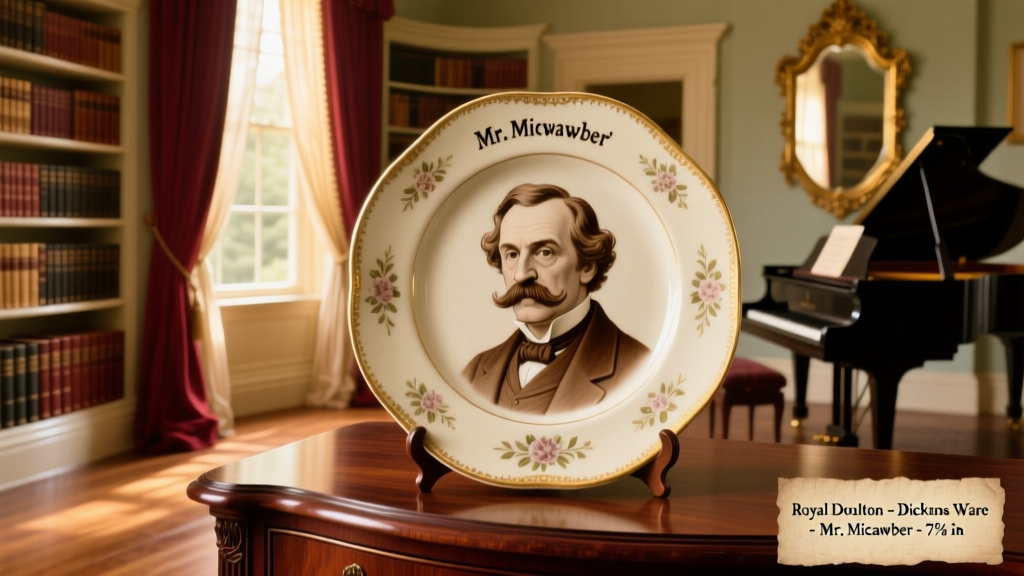
Royal Doulton Dickens Ware Plate: Mr. Micawber (7½ Inches) — History, Identification, and Collecting Insights
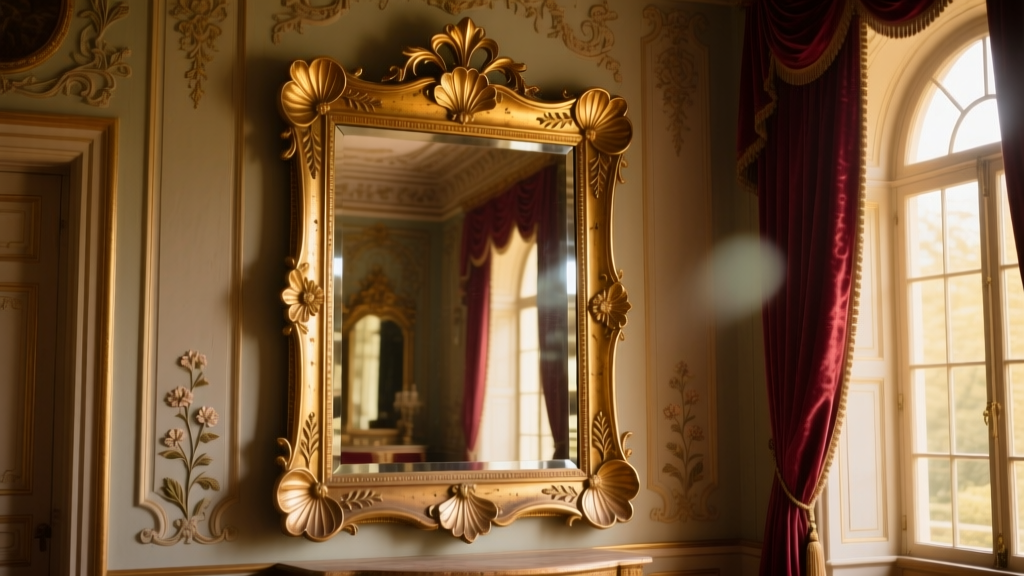
The Giltwood Rectangular Mirror: A Study of the 40¼-Inch Beveled Plate with Petal Molding
The 1938 Baker Furniture Company 'Chippendale Revival' Mahogany Breakfront Bookcase: Identification, Provenance, and Structural Restoration Protocol
Mulberry Creamer Bokara: Origins, Identification, and Restoration of a Mid-Century Modern Icon
Sevres Urn Cover with Figural Landscape Panel and Scrolled Handles: A Technical & Historical Analysis of the 27¾-Inch Example
Pairpoint Lamp: Autumn Scene River Castle Mountains Drum Form Shade, Circa 1900 — A Masterpiece of American Art Glass and Bronze Craftsmanship
Toy Clown on Unicycle Windup Box: History, Mechanics, and Restoration Insights
Electric General Electric Votalex Oscillator 8-Inch: A Technical and Historical Restoration Guide
Chinese Export Meiping Vase: Blue-and-White Fruit and Banana Leaf Motifs, 11½ Inches — Authentication, Provenance, and Restoration Insights