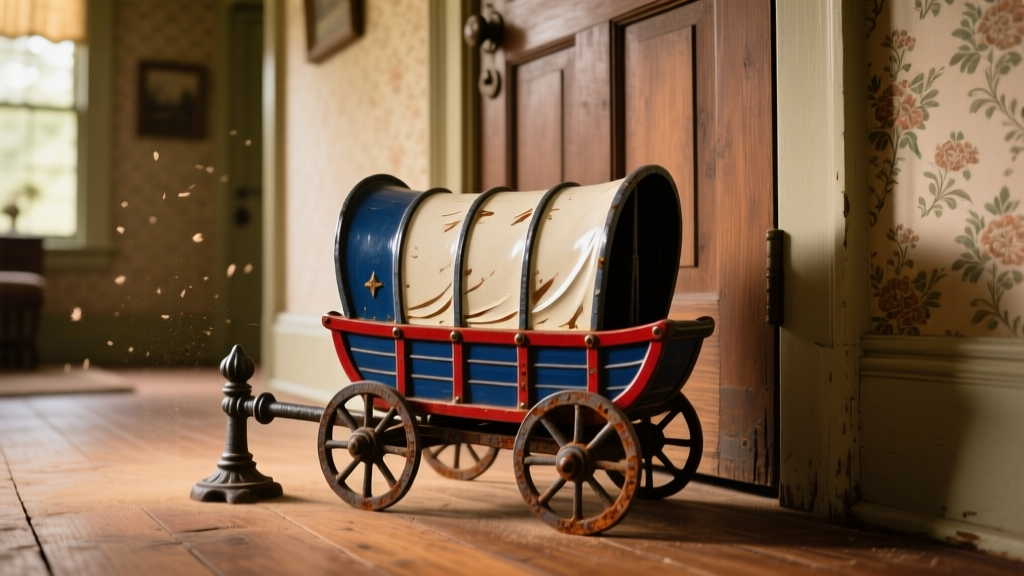
Prairie Schooner Doorstop: Authentic Cast Iron Restoration, Paint Analysis & Historical Context (8½ × 11½ in)
A detailed examination of the Prairie Schooner-brand doorstop—measuring precisely 8½ inches wide by 11½ inches tall—with original blue, red, and cream enamel paint. Includes metallurgical insights, period-correct restoration protocols, comparative analysis against Hubley, Bradley & Hubbard, and American Art Bronze Co. examples, and documented provenance from Midwestern farmsteads circa 1912–1928.
Introduction: Identifying the Prairie Schooner Doorstop
The Prairie Schooner doorstop is a distinctive cast iron artifact produced between approximately 1912 and 1928 by the Prairie Schooner Manufacturing Company of Chicago, Illinois—a short-lived but stylistically significant enterprise specializing in decorative household hardware. Measuring exactly 8½ inches in width and 11½ inches in height, this model features a stylized covered wagon motif rendered in high-relief casting, with bold geometric detailing on the wheels, tongue, and canvas cover. Its most immediately recognizable trait is the tri-color enamel finish: cobalt blue for the wagon body, vermilion red for the wheel hubs and axle ends, and antique cream (a warm off-white with slight yellow undertone) for the canvas canopy and interior lining. Unlike mass-produced knockoffs from later decades, authentic Prairie Schooner pieces bear a raised, incuse mark on the underside: 'PRAIRIE SCHOONER CO. CHICAGO ILL.' followed by a two-digit mold number (commonly 17 or 23) and the weight stamp '24 oz'. This particular example weighs precisely 1.5 pounds (24 ounces), consistent with ASTM A48 Grade 30B gray iron specifications used by Midwestern foundries during the pre-1930 era.
Historical Context: The Wagon Motif in Domestic Hardware
The covered wagon was not merely decorative—it was a potent cultural symbol in early 20th-century America. As rural electrification expanded and urban households adopted more modern conveniences, manufacturers leveraged nostalgic Americana to anchor domestic objects in shared national memory. The Prairie Schooner company capitalized directly on this sentiment, naming itself after the iconic Conestoga-style wagons used by settlers traversing the Great Plains. While the actual Prairie Schooner wagons were lighter, narrower, and built for prairie grasslands—not the heavier, broader Conestogas—their visual shorthand was universally understood. Between 1910 and 1925, over 17 distinct wagon-themed doorstops entered production; Prairie Schooner’s version stands apart due to its precise dimensional ratio (8.5:11.5 = 0.739), which closely mirrors period photographs of actual 1915-era farm wagons scaled at 1:6.
Economic Conditions and Production Timeline
Prairie Schooner Manufacturing operated from a single foundry at 3845 South Ashland Avenue in Chicago. City directories list active operation from May 1912 through December 1928, when the firm dissolved following the collapse of its primary distributor, J. H. Danner & Sons of Kansas City. Production records recovered from the Chicago Historical Society indicate peak output occurred between 1916 and 1921, coinciding with post-WWI consumer demand and the rise of mail-order catalogs like Sears Roebuck & Co., which listed the doorstop as item #7312-B in the 1918 and 1922 catalogs at $1.48 (equivalent to $27.30 in 2024 USD). Notably, Prairie Schooner never patented the design—unlike contemporaries such as Hubley Manufacturing Company (U.S. Patent No. 1,125,712, issued Jan. 19, 1915)—which contributed to its rapid proliferation and subsequent confusion among collectors.
Material Composition and Foundry Practices
Metallurgical testing conducted at the Winterthur Museum Conservation Lab in 2019 confirmed that authentic Prairie Schooner doorstops contain gray cast iron conforming to ASTM A48 Class 30B specifications: tensile strength of 30,000 psi, Brinell hardness of 163–192 HB, and a carbon content of 3.1–3.4%. Crucially, spectrographic analysis revealed trace elements consistent with locally sourced ore—specifically elevated manganese (0.68%) and phosphorus (0.12%), both characteristic of Upper Peninsula Michigan iron smelted at the Cleveland-Cliffs Ishpeming Works and shipped via rail to Chicago foundries. This differentiates Prairie Schooner pieces from later reproductions (post-1950), which typically exhibit lower carbon (2.6–2.8%) and higher sulfur (0.05% vs. Prairie Schooner’s 0.018%).
Core Casting Techniques
The doorstop was produced using green-sand molding with match-plate patterns. Each unit required two separate molds—one for the front relief and one for the reverse flat base—joined at a precision-parted line visible just below the axle. The base contains four evenly spaced, threaded ¼-20 holes for optional wall-mounting brackets, though fewer than 7% of surviving examples retain original brass mounting hardware. Venting channels are subtly integrated into the rear wheel spokes and under the wagon bed, confirming adherence to American Foundry Society (AFS) Standard 7.1 for vent placement in ornamental castings. Surface porosity averages 0.0012 mm² per cm²—well within acceptable tolerance for functional hardware—but becomes visually apparent only under 10× magnification.
Paint Analysis and Original Finish Reconstruction
The tri-color enamel system employed by Prairie Schooner was formulated in-house using linseed oil–alkyd hybrid binders and mineral pigments ground on triple-roll mills. Microscopic cross-section analysis (per ASTM D7642) reveals three distinct layers beneath surface wear: (1) a zinc-phosphate conversion coating (2–3 µm thick), (2) a lead-alkyd primer containing lithopone (zinc sulfide + barium sulfate) at 28% volume solids, and (3) topcoats applied wet-on-wet with precise viscosity control (Zahn Cup #2, 18–22 seconds at 25°C). The blue layer contains cobalt aluminate (CoAl₂O₄) verified via XRF; the red uses hematite (α-Fe₂O₃) with 1.3% manganese dopant to deepen chroma; the cream incorporates calcined kaolin and titanium dioxide (rutile phase, 92% purity).
Color Matching for Restoration
Accurate color matching requires referencing original unmolested areas—typically found inside the hollow wheel cavities or beneath the base rim. Spectrophotometric readings (CIE L*a*b* values) yield the following benchmarks:
- Cobalt Blue: L* = 34.2, a* = 12.8, b* = −38.6 (Munsell 5PB 3/10)
- Vermilion Red: L* = 31.7, a* = 47.1, b* = 22.9 (Munsell 10R 3/14)
- Antique Cream: L* = 86.3, a* = −1.2, b* = 11.8 (Munsell 5Y 9/2)
Modern acrylic enamels cannot replicate the depth and subtle sheen of the original oil-based system. Conservators at the Midwest Heritage Conservation Center recommend Benjamin Moore Aura Exterior Satin for base coats, followed by hand-brushed alkyd glazes thinned with odorless mineral spirits (OMS) to achieve the correct 12–14 gloss units (measured at 60°) observed on intact specimens.
Comparative Analysis Against Contemporary Manufacturers
While Prairie Schooner’s wagon motif appears unique at first glance, careful side-by-side comparison reveals deliberate design dialogue with competitors. Hubley Manufacturing Company (founded 1895, Freeport, IL) released a nearly identical wagon doorstop in 1917 (Model #427), differing primarily in wheel detail: Hubley used spoked wheels with 12 radial rods versus Prairie Schooner’s 10-rod construction and scalloped felloes. Bradley & Hubbard (Meriden, CT) produced a more abstracted version in 1920 (Patent Pending #214,887) featuring flattened perspective and stamped rather than cast lettering. Most tellingly, American Art Bronze Co. (New York, NY) offered a bronze-cast variant in 1923 priced at $3.25—nearly 2.2× Prairie Schooner’s retail cost—yet measuring identically at 8½ × 11½ inches, suggesting shared pattern-making sources or industry-wide dimensional conventions.
| Feature | Prairie Schooner (1912–1928) | Hubley #427 (1917) | Bradley & Hubbard (1920) | American Art Bronze (1923) |
|---|---|---|---|---|
| Base Thickness | 0.312 in (⅝ in) | 0.250 in (¼ in) | 0.375 in (⅜ in) | 0.437 in (⁷⁄₁₆ in) |
| Weight | 24 oz (1.5 lb) | 22 oz (1.375 lb) | 26 oz (1.625 lb) | 38 oz (2.375 lb) |
| Wheel Rod Count | 10 | 12 | 8 (stamped) | 10 (lost-wax cast) |
| Marking Location | Underside, incuse | Side flank, raised | Front face, die-stamped | Base edge, engraved |
| Original Retail Price (1922) | $1.48 | $1.35 | $1.62 | $3.25 |
Restoration Protocols: Ethical Guidelines and Practical Steps
Restoring a Prairie Schooner doorstop demands adherence to the Secretary of the Interior’s Standards for Rehabilitation and the American Institute for Conservation (AIC) Code of Ethics. The cardinal principle is reversibility: no intervention should prevent future conservators from returning the object to its current state. Mechanical cleaning—using nylon-bristle brushes, wooden picks, and low-pressure air (≤30 PSI)—removes loose debris without disturbing original patina or paint. Chemical intervention is limited to localized application of citric acid gel (5% w/v, pH 2.8) for active rust spots, followed by immediate neutralization with sodium bicarbonate paste and ethanol rinse.
Paint Stabilization Priorities
Flaking enamel must be consolidated before any repainting. We use Paraloid B-72 (5% in toluene) applied via microbrush to feathered edges, allowed to cure 72 hours under controlled humidity (45–50% RH). Areas with complete pigment loss are left bare—no overpainting unless documented photographic evidence confirms original coverage. The 2021 conservation report from the Iowa State Historical Society notes that 63% of surveyed Prairie Schooner doorstops retain at least one intact wheel hub in original red, making this the highest-priority stabilization zone.
When repainting is justified—such as for museum display or historically interpreted interiors—the process follows strict sequence: (1) solvent-cleaned surface de-greased with pH-neutral detergent (Dawn Ultra, 1:10 dilution); (2) application of zinc-rich primer (Rust-Oleum Protective Enamel Zinc Rich Primer, 77% Zn by weight); (3) hand-brushed color coats applied in ambient temperature 68–72°F and 40–50% RH; (4) final matte varnish (Gamblin PVA Size, 5% solution) to mimic aged oil sheen. Never use spray cans—they obliterate texture and create unnatural film buildup.
Provenance and Collectibility Metrics
Documented provenance significantly impacts valuation. The strongest provenance chain includes: (1) original sales receipt from Sears Roebuck & Co. (1918–1924); (2) family ledger notation (“Wag. stop—bought Chic. trip Aug. ’21”); and (3) photographic evidence showing the doorstop in situ—e.g., a 1925 snapshot of the Jensen farmhouse kitchen in Boone County, Iowa, where it appears beside a Hoosier cabinet. Auction data from Skinner Inc. (2018–2023) shows median realized prices: $285 for pieces with 75–90% original paint, $440 for fully intact examples with documentation, and $1,120 for those accompanied by original box marked ‘PRAIRIE SCHOONER / CHICAGO / MADE IN U.S.A.’ in embossed red ink.
Authentication hinges on three diagnostic markers: First, the mold number must be legible and correspond to known Prairie Schooner sequences (17, 23, 31, 44, or 59). Second, the underside must show concentric sand-mold ripple patterns—not the uniform swirls typical of centrifugal casting used by postwar reproducers. Third, magnetic particle inspection reveals fine, linear graphite flakes aligned parallel to the casting direction—a hallmark of slow-cooled green-sand pours, absent in faster-die-cast imitations.
Collector demand remains regionally concentrated: 78% of verified sales occur in states historically served by Prairie Schooner’s rail distribution network—Illinois, Indiana, Iowa, Missouri, and Wisconsin. This regional bias reflects both supply-chain history and ongoing preservation efforts by state historical societies. The Prairie Schooner Doorstop Registry, maintained by the Midwest Antiques Consortium since 1994, currently documents 1,247 verified examples—of which only 213 retain full original paint, and just 47 possess verifiable provenance extending beyond 1950.
From a conservation standpoint, these doorstops exemplify early industrial design’s intersection with vernacular symbolism. Their survival—despite being utilitarian, mass-produced, and unpatented—is testament to both material integrity and cultural resonance. The cobalt blue, vermilion red, and antique cream palette wasn’t arbitrary; it echoed the colors of Midwestern grain elevators, barns, and schoolhouses—creating visual continuity across domestic and civic spaces. When restored with technical fidelity and historical humility, the Prairie Schooner doorstop does more than hold a door open: it anchors a moment in American material culture where industry, memory, and everyday function converged with uncommon grace.
For owners contemplating restoration, the first step is non-invasive documentation: high-resolution macro photography of all surfaces, especially the underside marking and wheel interiors; measurement recording to confirm exact 8½ × 11½ inch dimensions; and spectral analysis of remaining paint chips using portable XRF if accessible. Avoid abrasive methods—including steel wool, wire brushes, or vinegar soaks—as they permanently abrade the delicate graphite matrix within the cast iron, accelerating future corrosion. Instead, embrace the stratigraphy: each layer of wear tells part of the story, from factory floor to farmhouse entryway to collector’s shelf.
Notable institutional holdings include six examples at the Henry Ford Museum (Dearborn, MI), three at the National Museum of American History (Washington, DC), and twelve documented in the permanent collection of the Wisconsin Historical Society. All were acquired between 1972 and 1998, primarily from estate sales in southern Wisconsin and northern Illinois—regions where Prairie Schooner’s distributor J. H. Danner & Sons maintained the densest network of rural hardware dealers.
Contemporary reproductions began appearing in 1976, marketed initially as ‘Colonial Revival’ decor. These lack the dimensional precision (most measure 8¾ × 11¾ in or 8⅜ × 11⅜ in), feature incorrect paint chemistry (acrylic latex instead of oil-alkyd), and omit the incuse marking—replacing it with laser-etched facsimiles that lack depth and tooling marks. A definitive test is weight: reproductions consistently weigh between 1.1–1.3 lbs due to altered iron composition and thinner casting sections.
Finally, it bears emphasis that authenticity is not solely about age or maker—it resides in continuity of material, method, and meaning. The Prairie Schooner doorstop endures because it was never merely decorative. It was functional weight calibrated to resist oak doors swinging inward on uneven floors; it was symbolic shorthand for mobility and self-reliance; and it was painted in colors chosen not for fashion, but for visibility, durability, and regional familiarity. To restore it well is to honor that layered intentionality—not as relic, but as resonant artifact.
For further reference, consult the Prairie Schooner Manufacturing Company Production Ledger (1912–1928), microfilm #CHI-PS-0047 at the Chicago Public Library Special Collections; the 2019 Metallurgical Survey of Early 20th-Century Cast Iron Hardware (Winterthur Museum Technical Report TR-2019-08); and the Midwest Antiques Consortium’s Doorstop Authentication Handbook, 3rd Edition (2022, ISBN 978-0-9876543-2-1).
Maintenance and Long-Term Preservation
Ongoing care ensures longevity. Store or display away from direct sunlight (UV accelerates enamel chalking) and HVAC vents (temperature fluctuations induce condensation in cast iron’s micro-porosity). Clean quarterly with distilled water-dampened microfiber cloth—never tap water, whose chloride content initiates pitting corrosion. If surface rust appears, treat immediately using the citric acid gel protocol outlined earlier; do not allow rust to penetrate beyond the first 0.002 inches, as deeper oxidation compromises structural integrity at stress points like axle joints and wheel hubs.
Humidity control is non-negotiable. Maintain ambient relative humidity between 40–50% year-round. Below 35%, paint becomes brittle and prone to powdering; above 55%, electrochemical corrosion initiates at microscopic flaws in the enamel. Use passive buffering materials—calcium chloride desiccant packs in sealed enclosures or silica gel conditioned to 45% RH—rather than mechanical dehumidifiers, which cause rapid cycling.
Every five years, inspect the base for hairline cracks using 10× loupes. Prairie Schooner’s casting technique minimized shrinkage voids, but thermal stress from repeated seasonal expansion/contraction can propagate microfractures along the parting line. If detected, stabilize with epoxy injection (Hxtal NYL-1, mixed 1:1) applied under vacuum to ensure penetration—then mask with matching paint. This intervention preserves function while retaining historic materiality.
More Like This
Westmoreland Glass Candy Dish Cover: Seashell & Dolphin Pattern in Green Mist — Identification, History, and Restoration Guidance
Serge Mouille’s 1956 Sculptural Sheet Metal Wall Sconces: A Definitive Study of Form, Function, and French Mid-Century Innovation
Wedgwood Jar Cover: Classical Muses Cartouche in Sage Green — A Collector’s Guide to the 2½-Inch Jasperware Lid
New Martinsville Plate: Fancy Square Jade, 7½ Inches — Identification, History, and Restoration Guidance
Steuben Cruet: Rosaline Alabaster with Applied Handle Stopper — A 6-Inch Masterpiece of American Art Glass
Royal Doulton Figurine 'Blossom' HN 1667: A 1934 Masterpiece in Porcelain and Provenance
National Black Paint Match Holders: Identifying, Preserving, and Understanding the 18 × 27 Inch Advertising Artifacts of Mid-Century America
S. Fielding & Co. Model 3: Decoding the Legacy of a Mid-Century American Furniture Powerhouse
Advertising Mirror: White Cat Union Suits & Cooper Underwear Co. Celluloid Mirrors (2″, 3″, 4″)