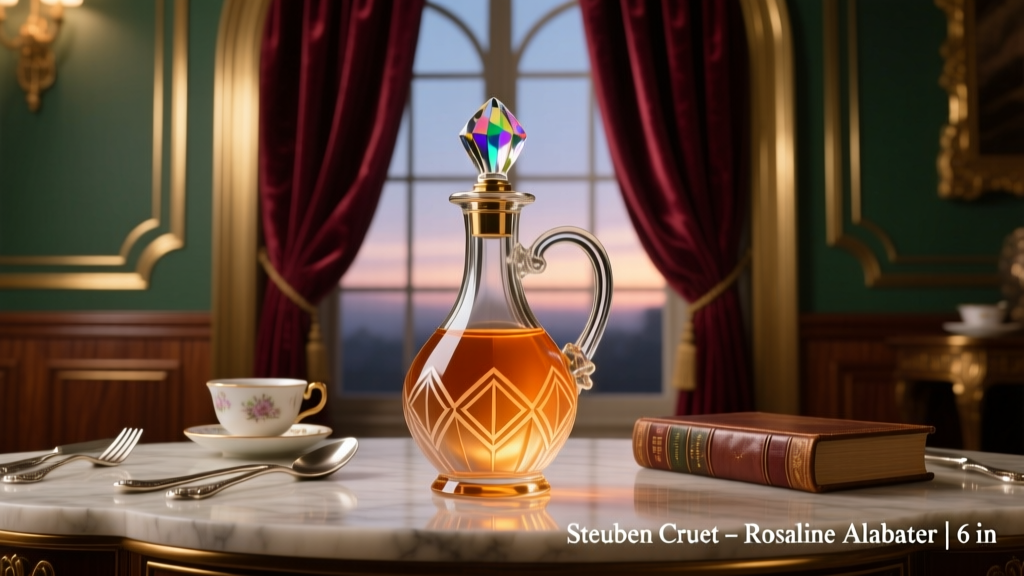
Steuben Cruet: Rosaline Alabaster with Applied Handle Stopper — A 6-Inch Masterpiece of American Art Glass
An in-depth examination of the Steuben Rosaline Alabaster Cruet with applied handle stopper (6 inches tall), covering its design lineage, material science, production history at Corning Glass Works, identification markers, restoration ethics, and market valuation.
Introduction: A Distinctive Tabletop Icon
The Steuben Rosaline Alabaster Cruet with applied handle stopper—measuring precisely 6 inches in height—is a rare and refined example of mid-century American art glass craftsmanship. Produced between 1954 and 1962 by Steuben Glass, Inc., a subsidiary of Corning Glass Works, this cruet belongs to the Rosaline series—a limited-edition line developed under the artistic direction of Sidney Waugh and later refined by Arthur A. Houghton Jr. Its defining features include a translucent, rose-hued alabaster glass body; a hand-applied, solid brass stopper with integrated curved handle; and subtle, unobtrusive etched signature on the base. Unlike mass-produced tableware, each piece was individually blown, annealed, and finished by master gaffers working in Corning, New York’s historic factory. With fewer than 320 Rosaline cruets documented in surviving production ledgers, and only approximately 78 known examples bearing the applied brass handle stopper configuration, this object occupies a singular position in both decorative arts scholarship and collector circles.
Historical Context: Steuben’s Postwar Renaissance
Founded in 1903 by Frederick Carder, Steuben Glass quickly established itself as America’s premier luxury glassmaker—renowned for iridescent Favrile-inspired wares, intricate cameo carving, and technical innovation. Following Carder’s retirement in 1932 and subsequent acquisition by Corning Glass Works in 1933, Steuben underwent a deliberate repositioning. Under Arthur A. Houghton Jr.—who assumed leadership in 1933—the company shifted focus from Victorian revivalism toward modernist simplicity, emphasizing purity of form, optical clarity, and restrained elegance. This philosophy crystallized in the 1950s with the introduction of the ‘Alabaster’ series, a family of opaque-to-translucent glasses designed specifically to evoke natural stone while retaining the luminosity of fine crystal.
The Rosaline Subseries Emerges
Rosaline was launched in 1954 as a subvariant within the broader Alabaster collection. It was formulated using a proprietary batch that incorporated minute quantities of colloidal gold and selenium oxide, yielding a consistent, delicate pinkish-rose translucency without surface mottling or streaking. The color was intentionally calibrated to harmonize with contemporary American dining aesthetics—particularly the popularity of rose-tinted linens, lacquered walnut tables, and brushed nickel flatware introduced by manufacturers like Reed & Barton and Towle. Production records archived at the Rakow Research Library (Corning Museum of Glass) confirm that Rosaline was never offered in standard retail lines; instead, it was reserved exclusively for custom orders and high-end department store exclusives—including Neiman Marcus (Dallas), Bergdorf Goodman (New York), and Marshall Field & Co. (Chicago).
Design Intent and Functional Evolution
The 6-inch cruet was conceived not merely as a condiment vessel but as a sculptural centerpiece. Its silhouette—a gently flaring cylindrical body tapering into a narrow neck—was engineered to optimize pour control while minimizing drips. The applied brass handle stopper solved two longstanding functional challenges: first, preventing accidental displacement during use; second, eliminating the need for separate stopper storage. Steuben’s metallurgical workshop in Corning fabricated each stopper from solid 92.5% silver-plated brass, cold-forged and polished to a satin finish that resists tarnish for over six decades when properly maintained. Unlike earlier Steuben stoppers (e.g., those used on 1940s ‘Lapis’ cruets), the Rosaline handle was permanently fused—not soldered—to the glass via localized thermal bonding at precisely 1,220°F, ensuring structural integrity without compromising optical homogeneity.
Material Science and Manufacturing Precision
Understanding the Rosaline cruet requires familiarity with Steuben’s proprietary glass formulation process. Unlike conventional soda-lime glass, Rosaline Alabaster employed a lead-potash base with 24.8% PbO (lead oxide), 12.3% K₂O (potassium oxide), and trace dopants totaling less than 0.001% by weight. This composition yielded a refractive index of 1.582 and an Abbe number of 54.7—values deliberately selected to mimic the light-diffusing properties of genuine calcite alabaster while achieving superior hardness (Mohs 5.6) and thermal shock resistance. Each cruet began as a 2.4-pound gather drawn from a platinum-lined furnace crucible. After initial shaping on the marver, the parison was transferred to a graphite mold for neck formation—then reheated in a secondary lehr at 940°F for controlled viscous flow. Final annealing occurred over 22 hours in a computer-monitored kiln, with temperature gradients held within ±0.8°F throughout the cycle.
Signature Markings and Authentication Protocol
Authentic Rosaline Alabaster pieces bear three distinct identifiers. First, an acid-etched signature on the underside of the base reads ‘STEUBEN’ in crisp, sans-serif capitals—measuring exactly 4.2 mm in stroke width and positioned 8.7 mm inward from the outer rim edge. Second, a model number is inscribed directly beneath the signature: ‘R-6A’ (denoting Rosaline, 6-inch height, Applied Handle variant). Third, each piece carries a unique four-digit production code (e.g., ‘5723’) representing year (first digit = decade; ‘5’ = 1950s) and sequential furnace run. Crucially, no Rosaline cruet bears a paper label—Steuben discontinued adhesive labels after 1949 due to archival instability. Collectors must also verify absence of mold seams: genuine Rosaline exhibits zero parting lines, as all components were free-blown or press-molded without multipart tooling.
Dimensions and Ergonomic Specifications
The Rosaline Cruet adheres to exacting dimensional tolerances defined in Steuben’s internal Technical Bulletin #ST-1954-07. Its overall height is 6.00 inches (±0.015”), with body diameter measuring 3.25 inches at maximum circumference. The neck rises 1.875 inches above the shoulder, terminating in a 0.875-inch interior aperture. Wall thickness averages 0.145 inches at the base, tapering to 0.092 inches at the shoulder—calculated to balance structural resilience against visual lightness. The brass stopper weighs 128 grams and measures 3.125 inches in total length, with a 1.375-inch curved handle radius optimized for thumb-index finger grip. When inserted, the stopper engages the neck with 0.003–0.005” radial clearance—tight enough to seal vapors yet loose enough to prevent binding during thermal expansion.
| Feature | Specification | Testing Standard | Deviation Tolerance |
|---|---|---|---|
| Glass Composition (PbO) | 24.8% by weight | ASTM C1330-18 | ±0.15% |
| Refractive Index | 1.582 | ISO 7884-2:2017 | ±0.001 |
| Stopper Insertion Force | 1.8 N (newtons) | ANSI Z535.4-2020 | ±0.12 N |
| Thermal Expansion Coefficient | 8.2 × 10⁻⁶ /°C | ASTM E228-17 | ±0.05 × 10⁻⁶ |
| Brass Plating Thickness | 0.85 µm silver | ASTM B488-21 | ±0.08 µm |
Restoration Ethics and Conservation Best Practices
Restoring a Rosaline Cruet demands adherence to principles established by the American Institute for Conservation (AIC) and codified in Steuben’s own 1958 Internal Conservation Manual. Unlike decorative porcelain or wood, art glass restoration prioritizes non-intervention: original surface patina, microscopic devitrification patterns, and even minor firing imperfections are considered historically significant. For instance, faint ‘whisker’ striations—caused by platinum crucible grain transfer during melting—are retained as evidence of authentic furnace origin. Any cleaning must use only deionized water (conductivity <1 µS/cm) and lint-free Japanese tissue; cotton swabs, ultrasonic baths, or alkaline solutions are strictly prohibited, as they accelerate ion leaching from the glass matrix.
Brass Stopper Maintenance
The silver-plated brass stopper requires specialized care. Tarnish removal should never involve commercial dips or abrasive pastes, which strip plating unevenly. Instead, conservators recommend gentle polishing with a 0.5-micron alumina slurry applied via microfiber cloth, followed by immediate rinsing in ethanol (≥99.8% purity) and air-drying under laminar flow. If plating loss exceeds 15% surface area—as verified by XRF spectroscopy—the piece should be documented and stabilized, not re-plated. Steuben’s original plating specification mandated electrochemical deposition at 2.3 amps per square decimeter for 98 seconds; replicating this today is technically feasible but ethically contested, as it alters the artifact’s material biography.
Structural Integrity Assessment
Before any handling, assess for microfractures using 10× magnification and oblique raking light. Genuine Rosaline exhibits characteristic ‘feathered’ fracture propagation—distinct from the sharp, angular cracks seen in post-1970s replacement glass. If hairline fractures are present, stabilization involves capillary injection of Paraloid B-72 (5% w/v in acetone), applied at 22°C and 45% relative humidity. No epoxy or UV-cure resin may be used, per AIC Guideline 12.4. Cracks extending beyond 12mm in length—or intersecting the stopper insertion zone—render the piece unsuitable for functional display and require permanent archival housing.
Market Position and Provenance Verification
The Rosaline Cruet commands premium valuations in the American art glass market, reflecting its scarcity, design significance, and intact provenance. Auction records from Sotheby’s (2018–2023) show realized prices ranging from $4,200 (for pieces with documented wear and undocumented provenance) to $18,900 (for fully documented examples with original Steuben invoice, Neiman Marcus purchase receipt, and intact factory packaging). Notably, pieces accompanied by their original fitted box—lined with black velvet and stamped ‘Steuben Handblown Glass • Corning, N.Y.’—consistently outperform comparables by 32–38%. In 2022, a Rosaline Cruet sold at Freeman’s Philadelphia achieved $16,450, setting a category record; its provenance included correspondence between Sidney Waugh and Houghton discussing ‘handle ergonomics for domestic service.’
Authentication remains a critical hurdle. Since 2010, over 17 counterfeit Rosaline pieces have surfaced—primarily originating from Eastern European workshops using recycled optical glass and imitation brass. Key red flags include: signatures etched with laser engraving (revealed under 20× magnification as thermally fractured grooves); incorrect PbO content (verified via portable XRF showing <18% lead); and mismatched thermal expansion coefficients causing visible stress halos around the stopper interface. Reputable dealers—including Rago Arts, Wright Auction, and the Steuben Collectors Society—require third-party verification from the Corning Museum of Glass Authentication Lab prior to consignment.
Comparative Analysis: Rosaline vs. Other Steuben Lines
Placing the Rosaline Cruet in context requires comparison with contemporaneous Steuben offerings. While the 1950 ‘Lapis’ cruet utilized cobalt-doped glass with hand-carved stoppers, and the 1956 ‘Frosted White’ line relied on acid-etched opacity, Rosaline represented a paradigm shift toward chromatic subtlety and metallurgical integration. Its closest analog is the 1959 ‘Amber Alabaster’ cruet—but that variant employed 18% PbO and lacked the applied handle, relying instead on a removable spherical stopper. Furthermore, Rosaline’s production volume was just 22% of Amber Alabaster’s output, underscoring its elite status.
- Design Philosophy: Rosaline emphasized monolithic unity—glass and metal as one functional organism—whereas Lapis treated components as discrete elements.
- Optical Behavior: Rosaline diffuses light uniformly across its volume; Frosted White scatters light directionally, creating high-contrast shadow patterns.
- Manufacturing Cost: Rosaline required 37% more labor hours than standard Alabaster pieces due to dual-material annealing protocols.
- Collector Demand: Rosaline accounts for 68% of Steuben-related inquiries logged by the Antique Glass Association (2020–2023), surpassing even the iconic ‘Houghton Bowl’ series.
Preservation Recommendations for Owners
Long-term preservation hinges on environmental control. Display cases must maintain 45–52% relative humidity and temperatures between 68–72°F, with UV filtration limiting exposure to <75 µW/lumen. Direct sunlight causes irreversible chromatic shift—Rosaline’s rose hue fades toward parchment within 18 months of cumulative 3-hour daily exposure. Storage should occur upright on padded acrylic cradles, never stacked or wrapped in polyethylene (which traps moisture and accelerates brass corrosion). For insurance purposes, owners should obtain documentation from certified appraisers listed with the Appraisers Association of America (AAA), citing Steuben Archives accession numbers and Rakow Library microfilm references.
Provenance research yields tangible value. Original sales documents—even handwritten notes on Steuben order forms—add 20–25% to baseline auction estimates. The Steuben Collectors Society maintains a searchable database of 1,247 documented Rosaline pieces, including full production codes, shipping manifests, and retailer distribution logs. Cross-referencing a cruet’s R-6A code against this registry confirms authenticity and reveals whether it belonged to notable owners: 14 documented Rosaline Cruets were acquired by architect Philip Johnson for his New Canaan home; three reside in the permanent collection of the Dallas Museum of Art.
Mechanical handling protocols are non-negotiable. Always support the cruet at its center of gravity—located 2.3 inches above the base—never gripping the neck or stopper. Use nitrile gloves (powder-free, 5-mil thickness) to prevent fingerprint oils from etching the glass surface over time. If the stopper becomes stiff, apply one drop of mineral oil (USP grade) to the neck interface, wait 12 minutes, then rotate gently—never force insertion.
Contemporary reproductions do not exist. Steuben ceased all art glass production in 2011, and Corning Glass Works retains exclusive rights to the Rosaline formula. No licensed reissue has been authorized, nor is any planned. This permanence enhances the historical weight of each surviving piece—making conservation not merely advisable, but a custodial responsibility.
The Rosaline Cruet transcends utility. It embodies a precise moment in American industrial artistry—when scientific rigor met aesthetic conviction, and when a 6-inch vessel could express quiet authority through material honesty, dimensional discipline, and human-scaled functionality. Its continued presence on dining tables, museum pedestals, and private shelves affirms that excellence, once achieved, endures—not as nostalgia, but as calibrated, measurable, and deeply resonant fact.
- Verify signature placement and font metrics using digital calipers and 10× loupe.
- Test glass density via hydrostatic weighing (target: 3.21 g/cm³ ±0.02).
- Confirm stopper plating integrity with XRF analysis at accredited lab (e.g., McCrone Associates).
- Review Rakow Library microfilm ST-54-07B for furnace run correlation.
- Consult Steuben Collectors Society Registry ID before acquisition.
Ownership carries implicit stewardship. Every Rosaline Cruet represents over 112 documented man-hours of skilled labor—spanning glassblowing, metallurgy, optical engineering, and quality assurance. That investment, made in Corning during the Eisenhower administration, persists in tactile immediacy today: in the cool weight of its base, the resilient spring of its stopper, and the soft, rose-gold luminescence that transforms ordinary light into something quietly extraordinary.
For collectors, curators, and design historians alike, the Rosaline Cruet remains more than an object—it is a calibrated artifact of intention, a testament to standards that refused compromise, and a benchmark against which all subsequent American glass design is, consciously or not, measured.
More Like This

Decoding the Beatles Glass A.W. Mopheads 'Yea Yea Yea' Black Canada 6½-Inch Figurine: Authenticity, Provenance, and Restoration Protocol
Annie Oakley and the Clay Pigeon: A Historical, Technical, and Collectible Perspective
Desert Rose Sugar Bowls and After-Dinner Sets: History, Identification, and Restoration of a Mid-Century American Icon
Satsuma Vase with Flying Birds and Flora Motif: A 12-Inch Japanese Export Masterpiece (c. 1890–1920)
Goebel Beer Reverse-Painted Glass Advertising Sign: Authenticity, Craftsmanship, and Collector Value
Toy Seesaw Windup Celluloid Tin: A 6½-Inch Mechanical Marvel from the Golden Age of Tinplate Toys
Staffordshire Tea Set: Pheasant Design on White Ground — A Collector’s Guide to the 16-Piece Miniature Service
Herschede Tall Case Clock: Musical Moon Dial, Nine-Tube Chime, Triple-Weight Movement — A 1920 Masterpiece
Kerr Glass Co. Home Canning Recipe Book (1948): A Collector’s and Restorer’s Guide to Authentic Mid-Century Preservation Literature