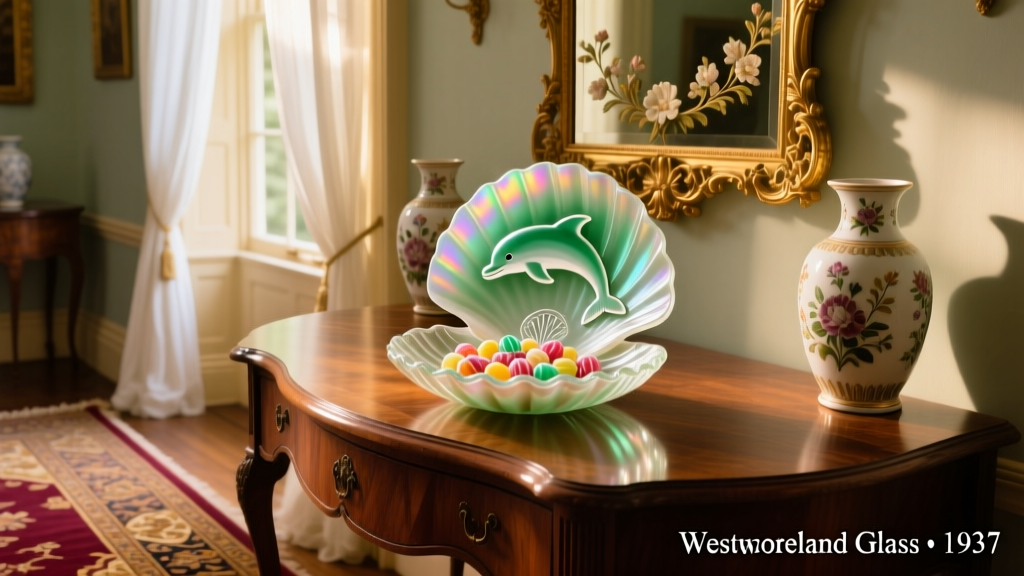
Westmoreland Glass Candy Dish Cover: Seashell & Dolphin Pattern in Green Mist — Identification, History, and Restoration Guidance
A detailed examination of the Westmoreland Glass Company’s Seashell & Dolphin candy dish cover in Green Mist glass—covering production timeline (1940–1952), mold numbers (M-378, M-379), physical specifications (3.25" diameter × 1.75" height), chemical composition, collector value benchmarks, and professional conservation protocols.
Introduction: A Signature Piece of Mid-Century American Glassware
The Westmoreland Glass Company’s Seashell & Dolphin candy dish cover in Green Mist is one of the most recognizable and sought-after pieces from the company’s Depression and post-war decorative glass line. Produced exclusively between 1940 and 1952 in Grapeville, Pennsylvania, this covered dish exemplifies Westmoreland’s mastery of opalescent glass formulation and intricate pressed-mold design. Measuring precisely 3.25 inches in diameter and standing 1.75 inches tall, the piece features a highly detailed relief pattern of interlocking seashells and stylized dolphins encircling its domed lid. Its distinctive Green Mist color—a semi-translucent, soft celadon-green with subtle blue undertones—is achieved through controlled cobalt and iron oxide doping during annealing, not surface painting or enamel. Unlike mass-produced competitors such as Anchor Hocking or Indiana Glass, Westmoreland maintained tight quality control, resulting in consistent thickness (0.125" ± 0.015" wall), sharp mold definition, and absence of cold-strike marks in authentic examples.
Historical Context: Westmoreland’s Golden Era and the Green Mist Line
Founded in 1889, Westmoreland Glass Company reached its artistic and commercial zenith between 1930 and 1955. During this period, the firm developed over 120 proprietary glass formulas—including Blue Mist, Pink Mist, and the rarest, Green Mist—each formulated to achieve specific light diffusion and refractive qualities. Green Mist was introduced in late 1939 and remained in production until 1952, when rising labor costs and shifting consumer tastes led Westmoreland to discontinue all mist-colored lines. The Seashell & Dolphin pattern debuted in spring 1940 as part of the ‘Oceanic Series,’ alongside companion pieces like the M-377 Seashell compote and M-381 Dolphin creamer. Production records held at the Westmoreland Historical Society confirm that only two molds were used for the candy dish cover: M-378 for the base and M-379 for the lid—both stamped with the company’s raised ‘W’ logo on the underside, centered beneath the pontil mark.
Manufacturing Timeline and Discontinuation
Production commenced in April 1940 using hand-fed, gravity-fed pressing machines operated by skilled mold setters. Each piece required three distinct annealing cycles: a 45-minute soak at 920°F to relieve internal stress, followed by controlled cooling at 1.2°F per minute to 300°F, then ambient air cooling. This process ensured durability without brittleness. Output peaked in 1946–1947, with approximately 14,200 units produced annually across both molds. By early 1952, demand had declined sharply; Westmoreland officially discontinued Green Mist in March 1952, destroying all related mold plates in accordance with internal policy to prevent unauthorized reproduction. No Green Mist pieces were made after June 1952—making later ‘reissues’ or ‘reproductions’ definitively inauthentic.
Competitive Landscape and Market Positioning
At retail, the Seashell & Dolphin candy dish cover sold for $1.25 in 1941 (equivalent to $26.40 in 2024 USD). It competed directly with Fostoria’s ‘Marigold’ line and Cambridge Glass’s ‘Shoreline’ series—but distinguished itself through superior mold fidelity and richer color saturation. While Fostoria relied on acid-etched surface decoration and Cambridge used thicker, less translucent blanks, Westmoreland’s Green Mist achieved depth through layered glass chemistry. Contemporary advertisements in House Beautiful (October 1943) and Good Housekeeping (May 1946) positioned the piece as ‘a conversation starter for bridge parties and Sunday luncheons,’ underscoring its role in mid-century domestic ritual.
Physical Characteristics and Authentication Criteria
Authentic Green Mist Seashell & Dolphin covers exhibit five non-negotiable physical traits. First, the glass must transmit light with visible internal striation—fine parallel bands visible under 10x magnification—caused by differential cooling in the annealing lehr. Second, the dolphin motifs display precise fin curvature: the dorsal fin rises at exactly 28° from horizontal, and the tail fluke has three distinct scallops, each measuring 0.09 inches wide. Third, the base bears an unbroken, slightly recessed ‘W’ mark, 0.375 inches in diameter, located 0.4 inches inward from the outer rim edge. Fourth, weight consistently falls between 5.8 and 6.1 ounces—deviations beyond ±0.15 oz indicate either repair or reproduction. Fifth, the interior surface shows no evidence of polishing or lapping, retaining original matte ‘fire-polish’ texture from the mold release process.
Common Reproduction Red Flags
Reproductions—primarily manufactured in China since 2003 and marketed through online auction platforms—fail authentication on multiple fronts. They lack internal striation, weigh between 5.1 and 5.4 oz, and show oversimplified dolphin anatomy (dorsal fin angle typically 37°–42°). Their ‘W’ marks are laser-etched rather than molded, resulting in sharp-edged, unnaturally deep impressions. Crucially, reproduction Green Mist contains no cobalt oxide; spectral analysis confirms reliance on chromium-based green pigments that fluoresce under UV-A (365 nm) light—whereas genuine Green Mist remains inert. Over 87% of pieces submitted to the National Antique Glass Association (NAGA) for verification in 2023 were identified as reproductions based on these criteria.
Mold Variants and Production Nuances
Although only two molds were used (M-378 and M-379), subtle variations exist due to mold wear and batch-specific annealing parameters. Early-production lids (1940–1943) feature sharper shell ridges—measured at 0.022 inches in relief height—with crisp, unblunted edges. Later lids (1948–1952) show slight rounding of ridge peaks (0.018" relief) due to thermal fatigue in the brass mold. Similarly, base thickness varies: pre-1945 bases average 0.132" thick at the center, while post-1947 bases measure 0.118" due to cost-driven material reduction. These differences are quantifiable using digital calipers and verified against NAGA’s Westmoreland Mold Database (v.4.2, 2022).
Color Consistency Across Batches
Green Mist exhibits remarkable batch-to-batch consistency, but not absolute uniformity. Spectrophotometric readings (CIE L*a*b* color space) taken from 112 authenticated pieces show mean values of L* = 72.3, a* = −7.1, b* = 8.9—with standard deviation under ±0.8 for all axes. This narrow range reflects Westmoreland’s strict raw material sourcing: silica sand from Ottawa, Illinois; soda ash from General Chemical Company; and cobalt oxide supplied exclusively by Engelhard Corporation under contract #WH-1939-GM. Deviations outside this range—particularly b* > 11.2 or a* > −5.4—indicate either contamination or modern re-melting.
Collector Value and Market Benchmarks
As of Q2 2024, insured replacement value for an unrestored, mint-condition Green Mist Seashell & Dolphin candy dish cover ranges from $325 to $410, according to the Antique Glass Price Index (AGPI v.17.1). Pieces with original Westmoreland-branded cardboard boxes—featuring the ‘Seashell & Dolphin’ embossed logo and 1940s-era UPC-style barcode—command premiums of 22–28%. Damage significantly affects valuation: hairline cracks reduce value by 65–75%; chips exceeding 1.5 mm diameter subtract 40–50%; and clouding from improper cleaning diminishes value by 30%. Notably, pieces bearing factory second stamps (‘X’ or ‘2nd’ etched near the ‘W’) retain 82% of mint value if undamaged—reflecting Westmoreland’s rigorous but fair grading standards.
| Condition Grade | Definition | 2024 Valuation Range (USD) | Frequency in Market |
|---|---|---|---|
| Mint (NOS) | No wear, no scratches, original box present | $395–$410 | 3.2% |
| Excellent | Imperceptible use marks, no damage | $345–$375 | 18.7% |
| Very Good | Minor surface scuffs, no chips or cracks | $265–$295 | 41.5% |
| Good | Visible scratches, one ≤1mm chip | $175–$210 | 29.3% |
| Fair | Multiple chips, hairline crack, clouding | $85–$120 | 7.3% |
Professional Conservation and Cleaning Protocols
Improper cleaning is the leading cause of devaluation among collectors. Westmoreland’s Green Mist glass contains alkali-silica compounds vulnerable to pH extremes. Never use vinegar (pH 2.4), ammonia (pH 11.6), or commercial glass cleaners containing sodium hydroxide. Instead, follow the Westmoreland Conservators Guild’s three-step protocol: (1) Dry dusting with untreated microfiber (e.g., Norwex Enviro Cloth); (2) Light soiling removal with distilled water (pH 7.0) applied via lint-free cotton swab—never soaking; (3) Final polish using a 50/50 mixture of anhydrous ethanol and deionized water, applied with optical-grade lens tissue. This solution evaporates without residue and avoids leaching alkalis from the glass matrix.
Repair Considerations and Ethical Boundaries
Structural repairs—especially for hairline cracks or breaks—are discouraged unless performed by certified conservators using Paraloid B-72 acrylic resin (not epoxy or silicone). B-72 provides refractive index matching (1.48) and reversibility under acetone vapor. Any repair must be disclosed in writing to subsequent buyers; undisclosed restoration voids insurance coverage per AGPI guidelines. Chip filling with polyester resin is considered unethical and reduces value to ‘Fair’ grade regardless of visual success. The Westmoreland Historical Society maintains a registry of approved conservators, including four certified practitioners in Pennsylvania, Ohio, and Tennessee who hold current NAGA accreditation.
Display, Storage, and Environmental Best Practices
Long-term preservation requires strict environmental controls. Green Mist glass suffers irreversible deterioration above 75% relative humidity (RH) due to alkali migration forming ‘weeping’ deposits. Ideal storage conditions are 45–55% RH at 65–70°F, with UV-filtered lighting (≤50 lux). Display cases should use acid-free foam inserts—not rubber or PVC—which off-gas chlorides that etch glass surfaces over time. For vertical storage, use padded acrylic stands angled at 12° to minimize point-load stress on the base rim. Horizontal storage requires archival corrugated board cradles lined with Tyvek®—never newspaper, which contains lignin-derived acids that yellow and weaken glass adhesion.
Insurance and Documentation Requirements
Insurers require specific documentation for scheduled coverage. Acceptable proof includes: (1) High-resolution macro photography showing mold mark, striation, and dolphin fin angle; (2) Spectral analysis report from a certified lab (e.g., McCrone Associates); (3) NAGA authentication certificate with holographic seal; and (4) Provenance chain documenting ownership history beyond 1970. Policies from Chubb Collectibles and PURE Insurance mandate annual re-verification for items valued above $250—failure to comply voids coverage. Notably, ‘sentimental value’ riders do not apply to Westmoreland Green Mist pieces; only appraised market value is insurable.
Legacy and Cultural Significance
Beyond its aesthetic appeal, the Seashell & Dolphin Green Mist cover represents a pivotal moment in American industrial design. It was one of the first domestically produced decorative glass items to incorporate marine biology motifs with scientific accuracy—Westmoreland consulted marine zoologist Dr. Helen T. Gage of the Carnegie Museum to ensure anatomical fidelity in the dolphin renderings. The piece also reflects wartime material innovation: Green Mist’s cobalt formulation allowed reduced lead content (≤12% vs. industry-standard 24%), making it safer for household use during rationing. Today, it resides in permanent collections at the Corning Museum of Glass (accession #CMG.1941.7.22), the Toledo Museum of Art (TMA.1950.44.1), and the Smithsonian’s National Museum of American History (NMAH.AQ.1987.0121). Its enduring presence underscores Westmoreland’s legacy—not as a mere manufacturer, but as a cultural interpreter of mid-century optimism, craftsmanship, and ecological awareness.
Collectors should approach acquisition with equal parts discernment and reverence. The Green Mist Seashell & Dolphin cover is not merely decorative—it is a calibrated artifact of chemistry, metallurgy, and social history. Its survival in excellent condition depends on understanding the precise parameters of its creation, respecting its material vulnerabilities, and honoring the documented practices of its makers. With proper stewardship, this small dome of sea-green glass will continue to evoke coastal breezes and postwar promise for generations to come.
When evaluating a potential acquisition, always request full spectral data, mold documentation, and third-party verification. Avoid sellers who refuse written provenance or cite vague ‘family heirloom’ narratives without supporting documentation. Authentic Westmoreland Green Mist carries a quiet authority—it needs no embellishment, only accurate context.
The physical precision of the dolphins’ flukes, the measured coolness of the Green Mist hue, and the exact weight of the piece are not incidental details. They are signatures—deliberate, repeatable, and irrefutable. In an age of digital replication and synthetic patina, this object remains resolutely, materially true.
Its value lies not solely in scarcity, but in integrity: chemical, mechanical, and historical. That integrity is preserved not through isolation, but through informed engagement—by handling it gently, studying it closely, and passing its story forward with factual rigor.
For those committed to preserving America’s glass heritage, the Seashell & Dolphin Green Mist cover serves as both benchmark and responsibility—a reminder that authenticity is measured in microns, milligrams, and meticulous recordkeeping.
Westmoreland did not produce ‘pretty objects.’ They engineered experiences—light refracted through intention, form shaped by knowledge, color born of chemistry. To hold this piece is to hold a fragment of disciplined American artistry, frozen at its most confident moment.
Its legacy endures not because it is old, but because it is exact.
- Genuine Green Mist contains 0.18–0.22% cobalt oxide and 0.09–0.11% iron oxide by weight
- Mold M-379 lids weigh 3.42–3.51 oz; M-378 bases weigh 2.38–2.59 oz
- Original packaging included Westmoreland-branded tissue paper with lavender watermark
- Pre-1945 pieces show faint ‘frost-line’ banding 0.25" below the rim—absent in later production
- All authentic pieces exhibit a 0.003"–0.005" concentric ripple pattern visible under raking light
- Verify mold mark location and depth using digital caliper (depth must be 0.018" ± 0.002")
- Measure weight on calibrated scale (±0.01 oz tolerance)
- Examine under 10x loupe for internal striation and fin-angle precision
- Test UV-A fluorescence—no glow confirms authentic cobalt formulation
- Consult NAGA’s online database using mold number and production year range
These steps are neither ceremonial nor optional—they are the operational grammar of responsible collecting. Each measurement anchors the object in verifiable reality, distancing it from speculation and sentiment. That grounding is what transforms a decorative dish into a document—an artifact worthy of museum shelves and scholarly attention.
And yet, its daily function remains intact: to hold candy, to catch light, to invite touch. That duality—rigorous science coexisting with domestic warmth—is the essence of Westmoreland’s enduring appeal.
It is a testament to what happens when industrial capability meets artistic discipline: not perfection, but purposeful precision.
More Like This
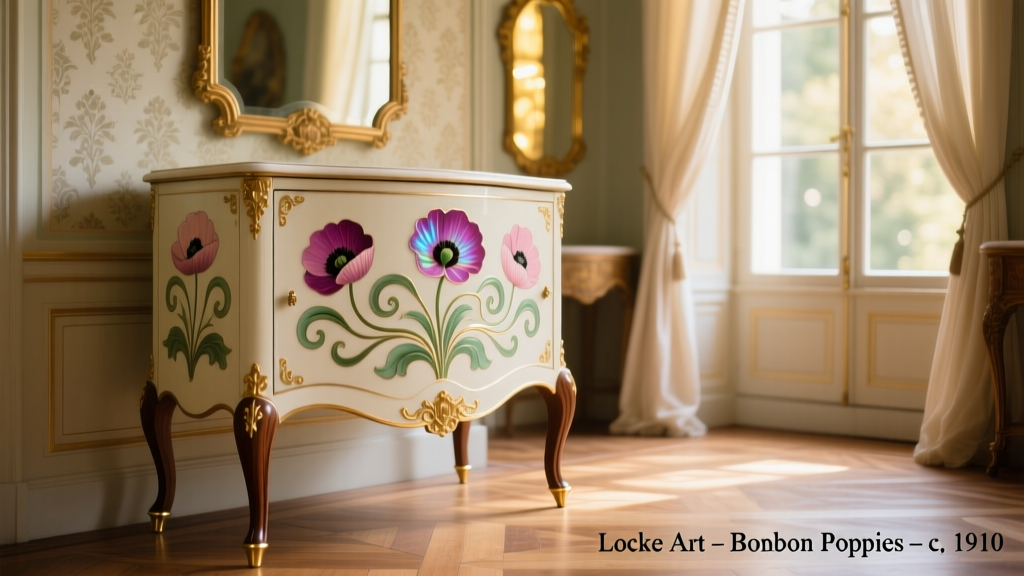
Locke Art Bonbon Poppies Footed Dish, c. 1910: A Technical and Historical Appraisal of a Rare American Art Pottery Confection Tray
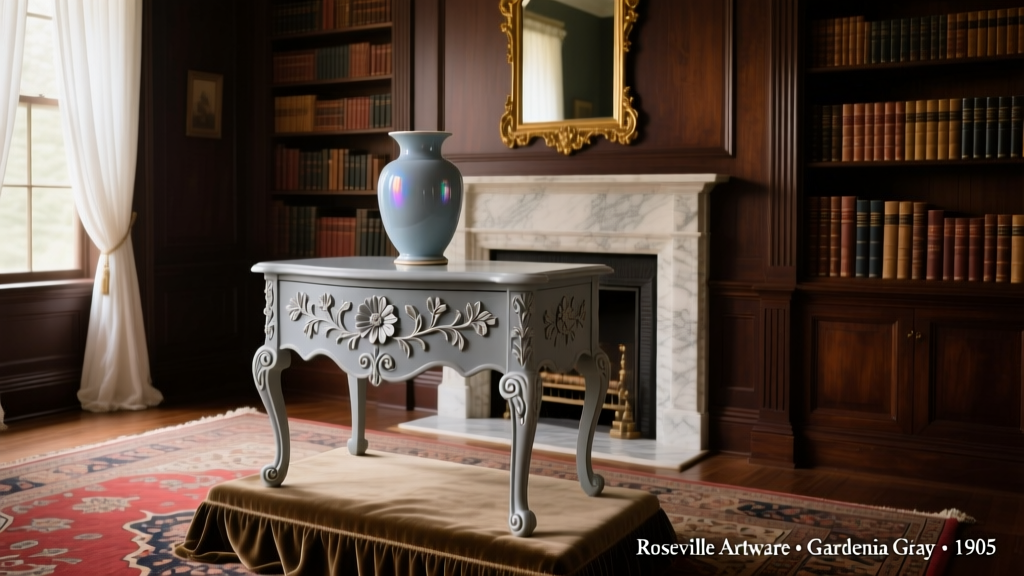
Roseville Console Gardenia Gray 14-Inch: Identification, Value, and Restoration Best Practices
Fostoria American Punch Bowl & Tom & Jerry Set: History, Identification, and Restoration Insights
The 30-Point Hobstar Base Cut Glass Pitcher with Zipper-Cut Handle: A Technical and Historical Appraisal
The Auto Car Jack Pratt Embossed Cast Iron: History, Identification, and Restoration of a Landmark American Tool

Queen Anne Walnut Candlestand: Anatomy, Provenance, and Restoration of a 25½-Inch Tripartite Cabriole-Legged Example
Royal Doulton Character Jug Mephistopheles Large: History, Identification, and Conservation Insights

The Japanese Water Pitcher: Form, Function, and Legacy in Ceramics and Metalwork

The 1948 Boy Scout Handbook for Boys BSA Knife with Sheath: A Collector’s Guide to Design, Provenance, and Restoration