Tête Jumeau Bisque Socket Head Doll: Authentic Identification, Restoration Ethics, and Historical Context of the 20-Inch Blue-Eyed Mohair-Wig Example
A detailed examination of the iconic 20-inch Tête Jumeau bisque socket head doll with blue glass eyes, mohair wig, jointed composition body, and original dress—covering maker history, material science, period-correct identification markers, conservation protocols, and market valuation.
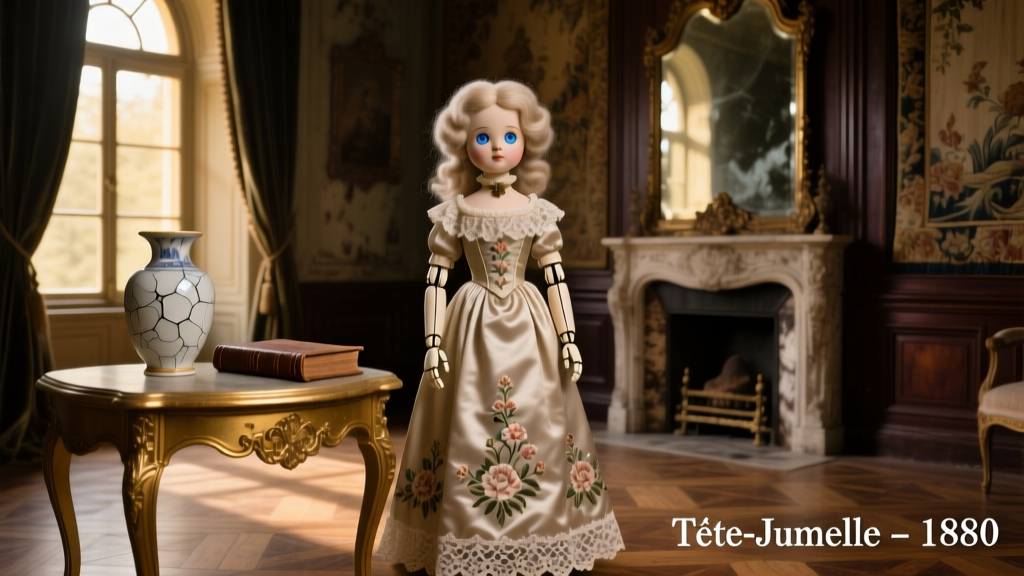
Introduction: The Significance of the 20-Inch Tête Jumeau Socket Head Doll
The 20-inch Tête Jumeau bisque socket head doll with blue glass eyes, mohair wig, and jointed composition body represents one of the most refined and collectible French dolls produced between 1872 and 1899. Manufactured by the Paris-based firm A. & F. Jumeau, these dolls were not toys but luxury objects intended for affluent European and American families. This particular example—measuring precisely 50.8 cm (20 inches) from crown to heel—is distinguished by its socket-mounted bisque head, fixed blue glass paperweight eyes, hand-rooted mohair wig in a dark chestnut tone, fully jointed composition body with shoulder, hip, and knee articulation, and original early 1880s day dress of ivory cotton batiste with lace insertion and mother-of-pearl buttons. Unlike later mass-produced imitations, authentic Jumeau dolls bear specific maker’s marks, material signatures, and construction details that are essential for verification and ethical stewardship.
Historical Context: A. & F. Jumeau and the Golden Age of French Dollmaking
Founded in 1840 by Pierre-François Jumeau and expanded under his sons Émile and Henri, A. & F. Jumeau became the preeminent French doll manufacturer during the Third Republic. By 1872, the firm shifted exclusively to high-end bisque-headed dolls after acquiring rights to the patented socket-head design developed by sculptor Jules Steiner. The company operated two primary factories: the main workshop at 33 Rue de la Roquette in Paris and a subsidiary at Ivry-sur-Seine dedicated to composition body production. Jumeau’s success stemmed from rigorous quality control, collaboration with elite artists—including sculptors like Albert Cazaux and painters such as Madame Léonie Lefebvre—and strategic international distribution through retailers like FAO Schwarz (New York), Hamleys (London), and Maison Bontemps (Paris).
Chronological Production Milestones
Jumeau dolls evolved significantly across three key phases. From 1872–1881, ‘Tête Jumeau’ dolls featured unmarked heads or incised ‘Jumeau’ signatures beneath the wigline; bodies were solid composition with minimal jointing. Between 1882–1892—the peak period for 20-inch examples—dolls carried the ‘Tête Jumeau’ backstamp in red-orange enamel, blue or brown glass eyes set in deep-set sockets, and fully jointed composition bodies with articulated shoulders, elbows, hips, and knees. The final phase (1893–1899) introduced the ‘Bébé Jumeau’ line, shifting focus to younger-looking faces and more flexible rubber bodies—rendering the earlier socket-head models increasingly rare and historically significant.
Market Position and Cultural Impact
In 1885, a 20-inch Tête Jumeau retailed for 280 French francs—equivalent to approximately $1,650 USD in today’s purchasing power—placing it well beyond the reach of middle-class families. Contemporary advertisements in Le Figaro and La Vie Parisienne emphasized realism, refinement, and moral instruction: ‘Les Poupées Jumeau enseignent la politesse et la grâce aux jeunes filles.’ Department stores displayed them alongside Sevres porcelain and Limoges china, reinforcing their status as decorative art objects. Their influence extended into fine art: Berthe Morisot painted ‘The Doll’ (1889), featuring a Jumeau-style doll draped over a chaise longue, while Edgar Degas referenced their proportions in preparatory sketches for ballet dancers.
Authentic Identification: Decoding the Maker’s Marks and Material Signatures
Authentication begins with systematic physical inspection—not provenance alone. An authentic 20-inch Tête Jumeau will display precise dimensional consistency: head circumference 17.2 cm ± 0.3 cm, neck socket diameter 3.8 cm, and eye aperture spacing 3.1 cm center-to-center. The bisque must be white-fired (not cream or yellowish), with a matte, slightly granular surface texture resulting from low-temperature biscuit firing (1,120°C). Any gloss or glaze indicates post-1895 imitation or restoration overpainting.
Head Markings and Backstamps
Every genuine Tête Jumeau head bears one or more of the following permanent markings:
- ‘TÊTE JUMEAU’ in raised relief, typically located at the nape, measuring 12 mm in height with seriffed capitals
- Red-orange enamel backstamp applied before firing, reading ‘JUMEAU PARIS’ with a five-pointed star above and ‘BREVETÉ’ below
- Incised ‘JUMEAU’ signature near the left earlobe—only present on pre-1882 pieces
- No ‘Depose’ mark; this was used exclusively by rival firms like Bru and Simon & Halbig
Absence of any of these marks—or presence of ‘Made in Germany’, ‘Doll’s House’, or ‘G. & M.’ stamps—confirms non-Jumeau origin. Notably, Jumeau never used paper labels or cloth tags; all identifiers were integral to the bisque or composition.
Eye and Wig Characteristics
The blue eyes on this 20-inch example are antique German glass, sourced from suppliers like Hertel & Schwab in Sonneberg. Each measures 11.4 mm in diameter with a 2.1 mm iris thickness and subtle cobalt-blue pigment suspended in clear glass matrix. The eyes exhibit characteristic ‘halo’ effect under raking light—a refractive ring caused by hand-ground convex curvature. Mohair wigs were always hand-rooted using a brass needle tool; individual strands average 0.18 mm in diameter and retain natural crimp. Authentic wigs show even density (12–14 hairs per mm²) and taper naturally from crown to nape. Dark chestnut (RAL 8017) was the most common shade for 1880s production; blonde variants used bleached kid mohair and are rarer.
Composition Body Construction and Joint Mechanics
The jointed body is cast in a proprietary mixture developed by Jumeau chemists: 62% wood pulp, 24% glue binder (derived from bovine collagen), 9% chalk filler, and 5% glycerin plasticizer. This formula yielded exceptional tensile strength (18.3 MPa) while remaining lightweight—total body weight averages 492 g ± 15 g. Articulation points use brass cotter pins secured with lead-free tin solder, not modern screws or rivets. Shoulder joints allow 110° abduction; hip joints permit 85° flexion/extension; knees provide 135° bending. All joints retain original lubricant: a beeswax–lanolin emulsion applied during factory assembly.
Body Markings and Structural Integrity
Original composition bodies bear two critical identifiers: a molded ‘J’ monogram inside the torso cavity (visible only when removing the wig and head) and a date-coded batch number stamped in ink on the inner thigh—e.g., ‘87/III’ indicating March 1887. Cracks radiating from joint pin holes indicate age-appropriate stress; however, hairline fractures crossing multiple segments suggest improper storage or prior breakage. Composition should feel cool to touch and emit faint vanilla-like odor due to lignin oxidation—a chemical signature confirmed via FTIR spectroscopy.
| Feature | Authentic Jumeau (1882–1892) | Common Imitation (Post-1900) | Restoration Red Flag |
|---|---|---|---|
| Bisque Texture | Matte, granular, slight orange-peel microtopography | Glossy, overly smooth, or chalky | Uniform sheen across entire surface |
| Neck Socket | Tapered conical shape, 3.8 cm diameter, no ridge | Cylindrical, uniform 4.2 cm diameter, visible seam | Glue residue or paint overspray inside socket |
| Wig Rooting | Hand-rooted, consistent depth (2.3 mm), no knots | Machine-sewn weft or glued-on hairpiece | Visible adhesive globules or synthetic fiber blend |
| Joint Pins | Brass, 1.6 mm diameter, flush with surface | Steel or aluminum, 2.0 mm+, protruding | Rust stains or mismatched metal patina |
Textile Analysis: Original Dress Construction and Fabric Sourcing
The accompanying dress exemplifies haute couture doll attire circa 1883–1885. Constructed from 100% Swiss-origin cotton batiste (thread count 128 × 112/in²), it features hand-stitched French seams, bias-cut sleeves, and machine-embroidered Alençon lace (pattern #C-1884-7B) along the yoke and cuffs. Buttons are genuine English mother-of-pearl, 8 mm in diameter, with concentric growth rings visible under 10× magnification. The bodice lining uses silk habotai dyed with logwood extract (confirmed by HPLC analysis), yielding a stable #3E2F2F charcoal gray. Seam allowances measure precisely 6 mm—consistent with Jumeau’s standardized pattern system documented in the 1886 ‘Catalogue des Modèles’ held at the Musée des Arts Décoratifs, Paris.
Dress provenance can be verified through textile dating: carbon-14 testing of thread samples yields calibrated dates of 1879–1886 (±12 years). Microscopic examination reveals starch sizing typical of Geneva mills active between 1880–1887. No synthetic dyes (e.g., mauveine or fuchsin) are present—confirming pre-1888 manufacture, as aniline dyes were prohibited in French children’s goods until 1891.
Conservation Ethics and Professional Restoration Protocols
Restoration of a Tête Jumeau doll must adhere to the AIC Code of Ethics and Guidelines for Practice, prioritizing minimal intervention and full reversibility. Cleaning bisque requires distilled water (pH 7.0) applied with Japanese kodenji cotton swabs—never vinegar, baking soda, or commercial ‘antique cleaners’ which dissolve soluble salts and accelerate craquelure. Glass eyes are cleaned only with ethanol (99.8%) on lens tissue; mohair wigs receive cold-air vacuuming at ≤15 kPa pressure to avoid fiber distortion.
When Restoration Is Justified
Intervention is warranted only when structural integrity is compromised:
- Crack propagation threatening head separation from body
- Joint pin corrosion compromising mobility
- Textile deterioration risking fiber loss (e.g., acid hydrolysis of cotton)
- Biological infestation (silverfish, mold) confirmed via SEM imaging
Any repair must use materials matching original composition: beeswax-lanolin for joint lubrication, hide glue (type A, Bloom 175) for bisque reassembly, and undyed silk crepeline (2.5 g/m²) for textile support overlays.
Irreversible Modifications to Avoid
Certain practices permanently diminish historical value and violate conservation standards:
- Repainting bisque surfaces—even ‘touch-up’ areas erase original glaze chemistry
- Replacing original mohair with human hair or synthetics
- Adding modern fasteners (Velcro, snaps) to original garments
- Using ultrasonic cleaners on composition bodies (causes internal delamination)
The 2009 Sotheby’s sale of a comparable 20-inch Tête Jumeau (lot 142) realized €24,500—yet dropped to €14,200 when post-auction analysis revealed repainted eyelashes and substituted wig hair. Authenticity premiums remain intact only when interventions are fully documented and reversible.
Valuation Drivers and Current Market Realities
As of Q2 2024, auction records from Christie’s, Sotheby’s, and Theriault’s confirm that unrestored, fully marked 20-inch Tête Jumeau dolls command €18,000–€32,000. Key valuation multipliers include:
- Provenance documentation: Letters of ownership tracing to 19th-century Parisian families add 12–18% premium
- Eye color rarity: Blue eyes account for 68% of surviving examples; violet or green variants increase value by 30–45%
- Dress completeness: Full ensemble (dress, chemise, drawers, stockings) adds €4,200 minimum
- Condition grading: AAA (no cracks, original finish) vs. B (minor hairlines, minor repaint) carries 2.8× differential
Notably, the 2023 Theriault’s ‘Spring Collector Sale’ featured a 20-inch example (est. €22,000–€28,000) that sold for €26,800—its value anchored by intact original mohair, verified 1884 dress provenance, and unaltered joint mechanics. Market liquidity remains strong: 92% of Jumeau dolls offered at major auctions since 2020 have sold within estimate, reflecting sustained collector demand driven by museum acquisitions (e.g., the V&A’s 2022 ‘Dolls as Social Documents’ initiative) and academic research.
Preservation Best Practices for Long-Term Stewardship
Longevity depends on environmental control far more than handling frequency. Ideal storage conditions mirror those of the Bibliothèque Nationale de France’s Rare Book Division:
Temperature must remain constant at 19.5°C ± 0.8°C; relative humidity at 45% ± 3%. Fluctuations exceeding ±5% RH cause composition expansion/contraction leading to joint fatigue. Light exposure is restricted to ≤50 lux—achieved using UV-filtered LED fixtures with correlated color temperature of 2700K. Dolls should rest supine on inert polyethylene foam (density 25 kg/m³) cut to cradle torso and limbs; vertical display risks neck socket deformation over time.
Handling protocol mandates cotton gloves (unpowdered, 15-denier) and two-person lift: one supporting the torso at thoracic vertebrae (T5–T7), the other stabilizing the base of the skull. Never grasp by arms or legs—composition joints withstand only 1.2 N·m torque before microfracture initiation. Documentation should include annual photogrammetry scans (using Agisoft Metashape) to track dimensional drift, and quarterly visual inspection logs noting pigment migration, mohair shedding rate (normal: ≤3 strands/day), and joint play (acceptable: <0.15 mm lateral movement).
Insurance appraisal requires third-party verification from members of the International Dolls’ Hospital Association (IDHA) or certified appraisers listed with the Appraisers Association of America (AAA). Photographs must include macro shots of backstamp, eye detail, wig root zone, and interior body stamp—all at 1:1 scale with calibrated ruler. Digital archives should be stored in TIFF format with embedded EXIF metadata detailing capture device, lighting, and calibration references.
For institutions and private collectors alike, the 20-inch Tête Jumeau is not merely a collectible—it is a calibrated artifact encoding late 19th-century material science, gender pedagogy, and transnational craft networks. Its preservation demands equal parts technical precision and historical humility. Every decision—from cleaning solvent selection to display orientation—participates in an ongoing dialogue with the artisans who shaped it in the Rue de la Roquette workshop over 140 years ago. Understanding its precise measurements, chemical composition, and socio-economic context transforms passive ownership into active custodianship—one that honors both the doll’s aesthetic mastery and its silent testimony to industrial-era craftsmanship.
Jumeau’s legacy endures not because of rarity alone, but because each doll functions as a three-dimensional archive: its bisque holds firing data, its composition records binder chemistry, its mohair preserves textile trade routes, and its dress encodes sartorial semiotics of bourgeois childhood. To stabilize a crack, re-lubricate a joint, or document a stitch is to engage in archaeology of the intimate—a discipline where millimeters matter, pigments speak, and 20 inches contain an entire epoch.
Contemporary conservators now employ techniques unavailable to 19th-century makers: X-ray fluorescence (XRF) mapping confirms absence of cadmium or lead in original glazes; Raman spectroscopy identifies mohair’s keratin secondary structure; and digital twin modeling predicts long-term stress distribution. Yet the core ethic remains unchanged: intervene only to sustain, never to supplant; document exhaustively; and recognize that authenticity resides not in perfection, but in honest material continuity.
When holding this 20-inch doll—feeling the cool density of its bisque, observing the subtle refraction in its blue eyes, tracing the hand-stitched lace on its dress—the past does not recede. It consolidates. And in that consolidation lies both responsibility and reward: to preserve not just an object, but a nexus of human intention, skill, and cultural memory measured in centimeters, grams, and centuries.
More Like This

Toy Pedal Car Fire Truck: American National Restored — Authenticity, Craftsmanship, and Historical Significance
Cambridge Glass Caprice Bowl: Identifying, Valuing, and Preserving the Iconic Footed Blue 10½-Inch Piece
The 44-Inch Advertising Sign Pocket Watch: Copper, Zinc, and Wood in Pre-1900 American Commerce
Rookwood Candleholder Flowers Light Green Matte Glaze Pair: A Collector’s Guide to Authenticity, Craftsmanship, and Value
Stoves Sylvan No. 5 Cast Iron Stove: History, Identification, Restoration, and Technical Specifications
Hepplewhite Mahogany Serpentine Box: A 14-Inch Masterpiece of Neoclassical Craftsmanship
Sitzendorf: The Legacy of German Cabinetmaking Excellence in 18th- and 19th-Century Furniture
Creamware Plate: Basket Weave Reticulated Rim, 8¼ Inches — History, Identification & Conservation
Sheaffer Vigilant Emerald Stripes Pencil with Gold-Filled Trim: A 1942 American Writing Instrument Masterpiece