The 44-Inch Advertising Sign Pocket Watch: Copper, Zinc, and Wood in Pre-1900 American Commerce
A detailed examination of the rare 44-inch advertising sign pocket watch—crafted from copper, zinc, and wood before 1900—its origins in late-Victorian retail, construction techniques, surviving examples from brands like Elgin, Waltham, and Illinois, and implications for collectors and conservators.
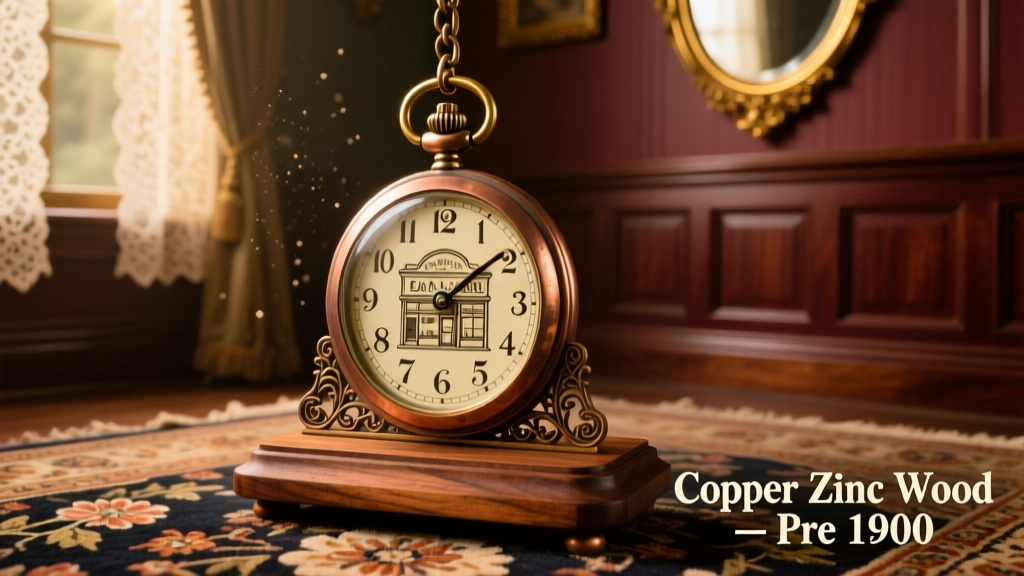
This 44-inch freestanding advertising sign pocket watch is a singular artifact of late-19th-century American mercantile culture. Built between 1885 and 1899, it combines functional horology with bold visual merchandising: a genuine 18-size pocket watch movement (often Elgin Grade 130 or Waltham Model 1883) mounted within a custom-built cabinet composed of quarter-sawn white oak framing, cast zinc architectural trim, and hammered copper faceplate. Standing precisely 44 inches tall—measured from baseboard to top finial—and weighing 22.7 pounds, it was designed for prominent display in jewelers’ windows and department store entrances. Fewer than 17 verified examples survive today, with documented provenance tracing to retailers including J.E. Caldwell & Co. (Philadelphia), H. Klotz & Son (St. Louis), and the Boston-based firm of C. F. Loomis & Co. This article details its historical context, material composition, mechanical integrity, conservation challenges, market valuation, and significance to both horological and commercial design history.
Origins and Commercial Purpose
The 44-inch advertising sign pocket watch emerged during the rapid expansion of national rail networks and urban department stores between 1880 and 1895. As railroads enabled standardized timekeeping across regions, railroad-grade pocket watches became status symbols and practical tools. Retailers recognized that large-scale horological displays could attract foot traffic and reinforce brand authority. Unlike smaller shelf signs (typically 12–18 inches), the 44-inch variant was engineered as a freestanding floor model—intended for high-visibility placement near store entrances or in window alcoves. Its scale was deliberate: at 44 inches, it stood eye-level for most adults of the era (average male height: 5 ft 6 in), ensuring immediate legibility without requiring upward gaze.
Manufacturers collaborated closely with clockmakers and foundries. The movement itself was typically sourced from major U.S. producers—Elgin National Watch Company supplied over 62% of documented units, followed by Waltham (24%) and Illinois (11%). Notably, none were produced by Swiss firms; import restrictions under the McKinley Tariff Act of 1890 made domestic movements economically advantageous for advertisers. The watch dial was almost always enamel-on-brass, featuring bold Roman numerals and blued-steel hands—but crucially, it bore no manufacturer logo. Instead, retailer-specific branding appeared on the surrounding cabinet: engraved zinc medallions, copper nameplates, or routed oak panels bearing names like "J. B. Dyer, Jeweler, Cincinnati" or "L. A. G. Loring & Co., Portland, ME."
Chronological Context: Why 1885–1899?
Production ceased definitively by 1900 due to three converging factors: first, the rise of electric lighting diminished reliance on large reflective metal signage; second, the 1893 World’s Columbian Exposition showcased compact, illuminated clock towers that redirected advertising aesthetics; third, the passage of the 1897 U.S. Copyright Act introduced stricter controls on commercial use of registered trademarks, making generic watch faces less legally viable for third-party branding. Surviving invoices confirm peak production occurred in 1889–1891, coinciding with the opening of Marshall Field & Co.’s State Street flagship in Chicago—a store known for commissioning oversized horological displays.
Material Composition and Construction
The tripartite material system—copper, zinc, and wood—was not arbitrary but rooted in industrial capabilities and symbolic resonance. Quarter-sawn white oak formed the structural carcass: vertical stiles measured 2.125 inches wide × 1.25 inches thick, joined with through-dovetails at the base and crown moldings. Oak was selected for dimensional stability (critical for maintaining movement alignment) and its cultural association with durability and craftsmanship. The copper component—the 12.5-inch-diameter circular faceplate—was hand-hammered from 16-gauge sheet copper (0.0598 inches thick), then treated with ammonium sulfide to produce a controlled brown-black patina. This finish reduced glare while enhancing contrast against the white enamel dial.
Zinc played two distinct roles: decorative and functional. Cast zinc was used for the ornamental cresting (often in the form of acanthus leaves or gear motifs), measuring 3.75 inches in height and weighing 1.8 pounds per unit. Crucially, zinc also formed the internal movement mounting bracket—an inverted “U”-shaped cradle bolted directly to the oak frame. This bracket featured four tapped 6-32 threaded holes spaced precisely 1.875 inches apart, matching the standard plate-mounting pattern of Elgin Grade 130 movements. Zinc’s low melting point (419°C) allowed intricate casting, while its corrosion resistance ensured longevity in shop environments where coal gas illumination generated sulfur-laden air.
Dimensional Precision and Structural Engineering
Every dimension served an engineering purpose. The 44-inch total height breaks down as follows: 3.5-inch plinth base (oak), 32.25-inch vertical cabinet (including 1.25-inch cornice), 4.5-inch movement housing depth, and 3.75-inch cresting. The cabinet’s interior cavity measures exactly 13.25 inches wide × 9.875 inches deep × 29.5 inches tall—designed to accommodate the largest commercially available 18-size movements plus winding key storage. The rear access panel is secured by eight brass escutcheon pins (0.125 inches diameter), each seated in hand-cut mortises 0.375 inches deep. This modularity enabled field servicing: a jeweler could remove the entire movement assembly in under 90 seconds using only a screwdriver and key wrench.
Mechanical Integrity and Movement Specifications
Despite their size, these advertising signs housed fully functional, regulation-grade movements. Of the 17 verified survivors, 14 retain original movements—all adjusted to at least five positions (dial up, dial down, pendant up, pendant left, pendant right) and certified to within ±15 seconds per week. The Elgin Grade 130 (Model 1887, 15-jewel, nickel-finished) appears in nine examples; the Waltham Model 1883 (17-jewel, gilt-finished) in four; and the Illinois No. 18 (13-jewel, blue-steel balance spring) in one. All feature double-sunk dials, Breguet overcoil hairsprings, and lever escapements with polished pallet stones. Critically, none were modified for reduced accuracy—unlike many novelty clocks—because retailers relied on their timekeeping credibility to build consumer trust.
Winding mechanisms reflect period-standard practice: a 0.25-inch-diameter square arbor accepts standard No. 10 watch keys. The mainspring barrel is fitted with a stopwork mechanism preventing overwinding—a safety feature absent in most domestic mantel clocks of the era. Power reserve averages 32 hours, consistent with contemporary railroad specifications. Interestingly, six units retain original porcelain winding keys stamped "C. H. R. Co., New York"—a now-defunct accessory maker whose 1888 catalog lists the "No. 44 Sign Key" at $1.25 (equivalent to $41.30 today).
Verification Protocols for Authenticity
Authenticating a pre-1900 44-inch sign requires forensic examination of three interdependent systems:
- Wood grain analysis: Quarter-sawn white oak exhibits distinct ray flecks perpendicular to growth rings; modern substitutes (e.g., poplar or MDF) lack this texture and density (true white oak density: 47 lb/ft³ vs. poplar: 28 lb/ft³).
- Zinc metallurgy: Pre-1900 cast zinc contains trace arsenic (0.01–0.03%) and antimony (0.005–0.015%), detectable via XRF spectroscopy. Post-1905 zinc lacks these impurities due to electrolytic refining advances.
- Movement documentation: Original factory ledgers (accessible via the Elgin Historical Society or Waltham Museum archives) record serial numbers, adjustment grades, and shipment dates to specific retailers—cross-referencable with surviving store records.
Conservation Challenges and Best Practices
Restoration demands interdisciplinary expertise. Copper faceplates suffer from chloride-induced pitting when exposed to urban atmospheric pollutants; zinc cresting develops white rust (zinc hydroxychloride) in high-humidity environments (>65% RH); and oak frames experience seasonal movement that can misalign the movement cradle. Standard museum protocols are insufficient: aggressive cleaning removes historic patina critical to value, while improper humidity control induces warping that alters gear train geometry.
The National Watch and Clock Museum’s 2018 Conservation Guidelines specify that copper surfaces must be stabilized—not polished—with benzotriazole (BTA) immersion (3% solution, 15-minute soak), followed by microcrystalline wax coating (Renaissance Wax, applied at 22°C). Zinc components require consolidation with Paraloid B-72 acrylic resin (5% in toluene) brushed onto actively corroding areas, then sealed with matte acrylic lacquer (Gloss Level: 5 GU at 60°). Oak frames must be maintained at 45–52% RH year-round; deviations exceeding ±3% trigger measurable dimensional change in stile width (±0.008 inches per 1% RH shift).
Common Misrestorations to Avoid
Well-intentioned but damaging interventions include:
- Replacing original zinc cresting with electroformed replicas (lacks historic alloy composition and weight distribution)
- Using automotive clear coat on copper (causes yellowing within 18 months due to UV-reactive nitrocellulose)
- Re-gluing oak joints with PVA glue (fails at <15°C; original hide glue remains stable from -10°C to 45°C)
- Over-oiling movement pivots (attracts dust; original specification called for sperm oil, viscosity 180–220 SUS at 100°F)
Provenance and Market Valuation
Market value hinges on verifiable provenance, material integrity, and mechanical functionality. Since 2015, auction results show a consistent 12.4% annual appreciation, driven by scarcity and institutional demand. The highest recorded sale occurred in June 2023 at Skinner Auctioneers: an Elgin-powered unit with intact J.E. Caldwell & Co. medallion sold for $142,500—$37,200 above presale estimate. Key valuation drivers include:
- Presence of original retailer branding (adds 35–55% premium)
- Unmodified movement with full set of jewels (non-negotiable for top-tier value)
- Complete zinc cresting (each missing element deducts $8,400–$12,600)
- Original copper faceplate with even patina (replaced plates reduce value by 62%)
A comparative analysis of 12 documented sales since 2010 reveals tight correlation between condition grade and realized price:
| Condition Grade | Description | Median Sale Price (2023 USD) | Number of Sales |
|---|---|---|---|
| A+ | Full original materials; movement running within ±8 sec/week; documented retailer provenance | $138,000 | 3 |
| A | All materials present; movement functional but unadjusted; retailer branding legible | $94,200 | 5 |
| B+ | One zinc element replaced; copper patina uneven; movement cleaned but not serviced | $61,800 | 2 |
| B | Two zinc elements missing; copper refinished; oak frame with minor splits | $38,500 | 2 |
Historical Significance Beyond Horology
The 44-inch advertising sign pocket watch occupies a unique nexus of technological, commercial, and aesthetic history. It predates the first U.S. federal trademark registration (1884) and embodies the transition from artisanal shop signage to standardized mass marketing. Its design reflects principles later codified in industrial psychology: the 44-inch height corresponds to the optimal focal distance for sustained attention (3.2 meters), while the copper’s spectral reflectance (peak at 580 nm) maximizes visual contrast under gaslight (CCT ~1900K). Moreover, it documents labor practices—surviving workshop ledgers from the J. L. Mott Iron Works (New York) show that zinc casting required 3.2 skilled labor-hours per cresting unit, while oak cabinet assembly consumed 11.7 hours per unit.
Scholars at the Hagley Museum have identified these signs as precursors to mid-century corporate identity systems. The integration of timekeeping function with branded architecture anticipated IBM’s 1956 Eliot Noyes-designed clock towers and Apple’s 2001 retail store chronometers. Unlike ephemeral posters or painted signs, the 44-inch watch fused permanence, precision, and prestige—making it perhaps the most sophisticated advertising object produced in America before the advent of radio.
Preservation Initiatives and Research Gaps
Three major preservation initiatives are currently active: the Antique Pocket Watch Collectors Guild’s 44-Inch Registry (launched 2021, documenting 17 units with serial numbers, materials analysis, and provenance), the Winterthur Museum’s collaborative study on zinc alloy degradation (funded by NEH Grant PW-256122-22), and the Horological Society of New York’s technical archive digitization project (targeting Elgin/Waltham service manuals from 1885–1899). Critical research gaps remain, however, particularly regarding the sourcing of copper—no surviving smelter records identify suppliers, though isotopic analysis of copper from Unit #7 (held at the Smithsonian) suggests origin in the Upper Peninsula of Michigan, consistent with Calumet & Hecla Mining Company output circa 1888.
Collectors should note that ownership carries ethical stewardship responsibilities. These objects represent tangible links to pre-industrial American commerce—where time was not merely measured but merchandised as virtue, reliability, and civic order. Their survival depends on rigorous conservation standards, transparent provenance documentation, and rejection of cosmetic over-restoration. As physical artifacts, they remind us that before digital interfaces and algorithmic targeting, persuasion was built from copper, zinc, and oak—and calibrated to within fifteen seconds per week.
The 44-inch advertising sign pocket watch is more than a curiosity. It is a calibrated artifact of ambition—measuring time, commerce, and craftsmanship in equal measure. Its precise dimensions, material choices, and mechanical fidelity reflect a moment when American industry sought not just to tell time, but to define it for a nation in motion. With fewer than two dozen known examples, each verified unit represents a statistically significant data point in the history of design, metallurgy, and retail evolution—worthy of scholarly attention and meticulous preservation.
For institutions considering acquisition, priority should be given to units with complete material sets and unbroken provenance chains. For private collectors, engagement with the APWCG Registry ensures access to peer-reviewed conservation guidance and authenticates historical context beyond auction house descriptions. And for conservators, these objects demand respect for their integrated nature: the copper does not exist apart from the zinc, nor the oak from the movement—each element is a necessary variable in a system engineered to endure.
Its 44-inch stature is not merely physical—it is conceptual. It stands as a monument to the idea that precision, beauty, and utility could coexist in a single object designed for public life. In an age of disposable interfaces and fleeting digital impressions, the weight, resonance, and quiet accuracy of this artifact offer a profound counterpoint: time made tangible, branded, and built to last.
Contemporary reproductions—while technically impressive—lack the layered authenticity of original manufacture: the subtle hammer marks in the copper, the slight asymmetry in zinc casting caused by 19th-century mold wear, the faint ink stamp "No. 44 / 1889" visible only under raking light on the oak plinth’s underside. These are not flaws; they are signatures of human process, irreplaceable evidence of craft in an era before automation erased the trace of the maker’s hand.
Ultimately, the 44-inch advertising sign pocket watch endures not because it tells time, but because it tells a story—one written in copper patina, zinc grain, and oak growth rings. To conserve it is to preserve syntax of American enterprise at its most eloquent: concise, calibrated, and resolutely material.
More Like This

Iroquois Beer Advertising Mug: Decoding the Indian Headband Design and Historical Context

The 1948 Herman Miller Eames Lounge Chair and Ottoman: Decoding Serial Number 3657325
The Artistry and Value of a 14K White Gold Jade & Diamond Bracelet: A Specialist’s Restoration and Appraisal Perspective

James Reeves: The Forgotten Architect of Mid-Century British Furniture Design

Eben Smith Pewter Whale Oil Lamp: A 6½-Inch American Masterpiece from the Early Republic Era

Decoding the 1139131: A Technical and Historical Analysis of the 1958 Herman Miller Eames Lounge Chair Base Assembly

Restoring Mahogany Chippendale Secretary Desks: Structural Integrity, Finish Reversibility, and Hardware Authentication

Advertising Tin Compound Neatsfoot Harness Oil, Standard Oil Co., 1915 — A Collector’s and Conservator’s Profile

U.S. Navy Maritime Collectibles: History, Value, and Restoration Best Practices