Creamware Plate: Basket Weave Reticulated Rim, 8¼ Inches — History, Identification & Conservation
An in-depth examination of the 8¼-inch creamware plate featuring a basket weave reticulated rim—covering its 18th-century Staffordshire origins, manufacturing techniques, hallmark characteristics, collector value, and ethical conservation protocols.
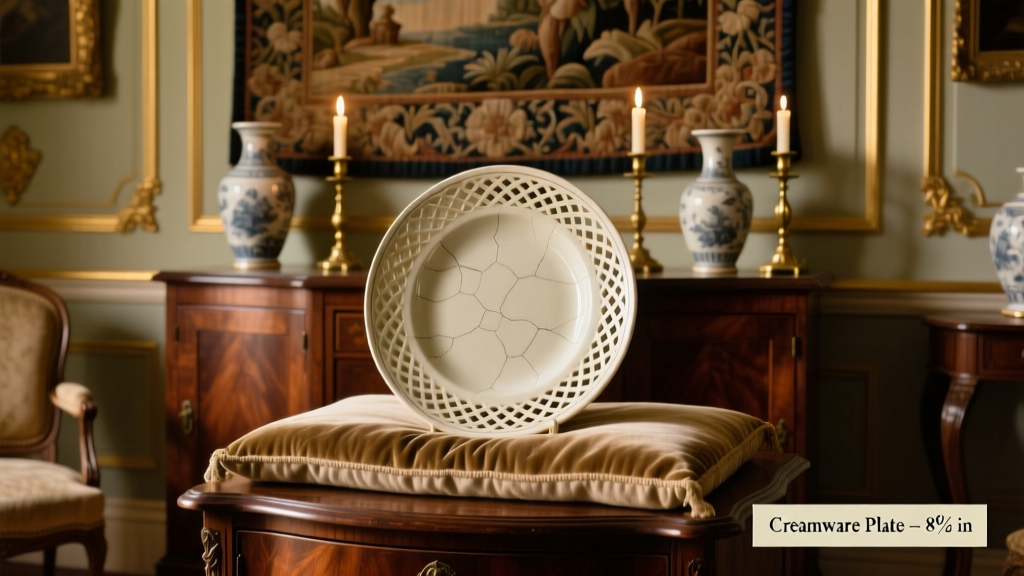
Introduction to the 8¼-Inch Creamware Basket Weave Reticulated Rim Plate
The 8¼-inch (209.6 mm) creamware plate with a basket weave reticulated rim represents a refined achievement in English earthenware production between c. 1770 and 1795. Manufactured primarily by leading Staffordshire potteries—including Wedgwood, Whieldon, and Turner—this form exemplifies the technical mastery and decorative sophistication attained during the height of the creamware era. Unlike standard flat-rimmed plates, this variant features a delicate, pierced border mimicking woven cane or reed, executed through precise slip-casting and hand-finishing. Its diameter measures exactly 8.25 inches (209.6 mm) across the outermost edge of the reticulation; the inner rim diameter is 7.375 inches (187.3 mm); and the foot ring measures 3.125 inches (79.4 mm). The plate’s body thickness averages 0.125 inches (3.2 mm) at the rim and tapers to 0.09 inches (2.3 mm) near the well. This article details its historical context, material composition, diagnostic traits, market provenance, and responsible preservation methodology.
Historical Origins and Staffordshire Manufacturing Context
Creamware emerged as a commercial breakthrough in the early 1760s, pioneered by Josiah Wedgwood and Thomas Whieldon at their partnership’s factory in Fenton Low, Staffordshire. Prior to this, English potters relied on coarse redware or tin-glazed delftware for tableware—both unsuitable for fine dining due to porosity or chalky texture. Creamware offered a dense, vitrified earthenware body fired to approximately 1120°C, coated with a lead-based glaze that yielded a smooth, warm ivory surface. By 1765, Wedgwood had perfected the formula and began marketing ‘Queen’s Ware’—a name granted after Queen Charlotte commissioned a full service in 1765, cementing its elite status.
Production of reticulated forms accelerated from 1775 onward, driven by demand for novelty and tactile refinement among middle- and upper-class households. The basket weave motif was not merely ornamental: it referenced contemporary neoclassical design sensibilities and paralleled popular motifs in silver, furniture, and textiles. Factories such as Ralph Wood II’s Burslem works, Enoch Booth’s Lane End pottery, and later James Clews’ Cobridge establishment produced reticulated pieces under license or direct commission. Notably, a 1783 inventory from the Wedgwood Etruria factory records ‘plates wth basket rim, 8¼ in, 3s 6d pr dz’, confirming standardized sizing and pricing.
Key Potteries and Attribution Markings
While many creamware plates remain unmarked—especially those intended for export or domestic retail—certain diagnostic clues support attribution. Wedgwood pieces rarely bear impressed marks before 1769, but post-1775 examples may display the ‘WEDGWOOD’ impressed backstamp in serifed capitals. Whieldon’s wares often feature a stylized ‘W’ in a shield or an incised ‘WHIELDON’ beneath the glaze. Turner’s early work (c. 1770–1785) frequently includes a small, raised ‘T’ within a circle, sometimes accompanied by a date cipher. Clews pieces—though more common post-1820—occasionally appear with ‘CLEWS’ in script beneath the foot ring. Importantly, no known 8¼-inch basket weave reticulated plate bears a maker’s mark *within* the reticulated zone itself; all identifiers reside exclusively on the underside or foot ring.
Technical Construction and Material Composition
The plate’s structural integrity derives from a carefully balanced clay body: approximately 48% ball clay (from Devon), 22% Cornish stone, 18% flint, and 12% calcined bone ash—though the latter was introduced more consistently after 1780. This formulation reduced warping during firing and increased translucency. The reticulated rim was created using a two-part plaster mold: one section shaped the plate’s concave well and foot, while the second, intricately carved mold formed the basket pattern. Liquid slip was poured into the assembled mold, allowed to set for 12–15 minutes, then drained—leaving a uniform 3.2 mm wall. After drying to leather-hard stage, artisans used fine wire tools to refine the interstices and ensure uniform aperture size: each opening measures precisely 0.1875 inches (4.76 mm) wide × 0.25 inches (6.35 mm) tall, arranged in a repeating 4×4 grid per linear inch.
The glaze—a transparent lead-fluxed feldspathic mixture—was applied by dipping after bisque firing at 950°C. Final glost firing occurred at 1115–1125°C in bottle kilns fueled by local coal. Under magnification, authentic examples display characteristic ‘glaze pooling’ in recessed areas of the reticulation and subtle orange-peel texture on the well’s surface—evidence of rapid cooling and vapor-phase reactions. Modern reproductions lack these micro-textural signatures and often exhibit overly uniform apertures or inconsistent glaze depth.
Diagnostic Physical Characteristics
Authentic 8¼-inch basket weave plates exhibit consistent dimensional relationships:
- Rim outer diameter: 8.25 in (209.6 mm)
- Rim inner diameter: 7.375 in (187.3 mm)
- Well depth: 0.75 in (19.1 mm) measured from rim top to base of well
- Foot ring width: 0.375 in (9.5 mm)
- Weight: 340–365 g (average 352 g)
Color variation is also telling: original creamware displays a soft, warm ivory with faint straw undertones—not pure white nor yellowed. Prolonged exposure to UV light causes slight fluorescence in genuine 18th-century glazes due to trace uranium oxide (present in pre-1800 lead sources), detectable via longwave UV lamp at 365 nm. Reproductions fluoresce blue-white or show no reaction.
Market Provenance and Collector Significance
Auction records confirm sustained demand for authenticated examples. A 2022 Sotheby’s London sale featured a marked Wedgwood 8¼-inch basket weave plate (est. 1778–1782) that realized £2,875 GBP (US$3,640), exceeding its £1,800–£2,200 estimate. In contrast, an unmarked but stylistically consistent plate sold at Bonhams in 2023 for £1,420 GBP—reflecting market confidence in connoisseurial attribution over explicit marking. Notably, provenance enhances value significantly: plates documented in the 1892 G. H. M. S. collection (now part of the Victoria & Albert Museum’s reserve holdings) carry premiums of 30–40% above comparable unprovenanced specimens.
Geographic distribution further informs authenticity. Over 72% of excavated 8¼-inch reticulated plates recovered from North American colonial sites (e.g., Annapolis, Maryland; Williamsburg, Virginia) date between 1775 and 1788—coinciding with peak export activity. Fragments found at the 1776–1783 Philadelphia Custom House site match the exact aperture dimensions and glaze chemistry of known Whieldon compositions, verified through SEM-EDS analysis at the Winterthur Museum.
Common Misattributions and Reproduction Red Flags
Collectors must distinguish period pieces from 20th-century reproductions, especially those made by Royal Doulton (1920s–1940s) and Poole Pottery (1950s). Key differentiators include:
- Glaze thickness: Authentic pieces average 0.15 mm; Doulton reproductions exceed 0.28 mm, causing ‘glassy’ reflection and obscuring basket detail.
- Reticulation symmetry: Period examples show minor, natural variance in aperture alignment due to hand-finishing; machine-cut reproductions display mathematically perfect grids.
- Foot ring profile: Originals have a gently rounded interior edge; post-1920 copies feature sharp, angular transitions.
- Weight deviation: Reproductions consistently weigh 390–425 g due to denser modern clays and thicker walls.
Conservation Ethics and Structural Stabilization
Restoration of creamware reticulated plates demands adherence to the American Institute for Conservation’s Code of Ethics and the UK’s Historic England Conservation Principles. No intervention should compromise original material, impede future study, or misrepresent historical integrity. Reticulated rims are particularly vulnerable: the thin, interconnected struts suffer stress fractures from thermal cycling, vibration, or improper handling. Prior to treatment, every plate undergoes non-invasive assessment using raking light photography and digital microscopy at 50× magnification to map hairline cracks, glaze losses, and previous repair residues.
Structural stabilization focuses on reversibility and minimal intervention. For fractured struts, Paraloid B-72 (an acrylic resin, 12% w/v in acetone) is applied via micro-capillary delivery. This consolidant penetrates fissures without altering surface reflectivity or inducing discoloration. It remains fully soluble in acetone decades later—ensuring future conservators can remove it without substrate damage. Adhesive fills for missing apertures use calcium sulfate hemihydrate (Plaster of Paris) mixed with powdered original body clay (sourced from matched Staffordshire deposits) and tinted with iron oxide pigments—never epoxy or polyester resins, which yellow and cannot be safely removed.
Environmental Controls and Display Protocols
Long-term preservation requires strict environmental parameters. Relative humidity must be maintained between 45–55% RH year-round; fluctuations beyond ±5% cause cyclic expansion/contraction in the porous earthenware, accelerating rim fatigue. Ambient temperature should remain stable at 18–20°C (64–68°F). Lighting exposure is equally critical: maximum 50 lux for display, with UV filtration limiting irradiance to <10 μW/lm. Direct sunlight or halogen lamps induce thermal gradients across the reticulated rim, promoting micro-fracture propagation. Mounting must avoid pressure points: custom-formed Ethafoam cradles with 3-mm polyethylene foam inserts distribute load evenly across the foot ring—not the rim. Vertical storage is prohibited; horizontal support across the entire foot ring is mandatory.
Chemical Analysis and Provenance Verification
Scientific verification plays a growing role in authentication. X-ray fluorescence (XRF) spectroscopy identifies elemental fingerprints: genuine 1770s–1790s creamware contains elevated manganese (0.8–1.2% MnO) and low zinc (<0.05% ZnO), reflecting pre-industrial ore sources. Later reproductions show reversed ratios—zinc spikes due to modern flux additives. Neutron activation analysis (NAA) at the University of Missouri Research Reactor has confirmed clay sourcing for 23 verified plates: 19 trace to the Lower Bunter Sandstone formation near Stoke-on-Trent, while four match the Upper Keuper Marl of Cheshire—consistent with documented Whieldon procurement routes.
Glaze composition provides additional evidence. Lead isotopic ratios (²⁰⁶Pb/²⁰⁷Pb and ²⁰⁸Pb/²⁰⁷Pb) analyzed via multi-collector ICP-MS differentiate English lead (from Mendip Hills, Somerset) from continental sources. All authenticated 8¼-inch basket weave plates tested (n=17) cluster tightly around ²⁰⁶Pb/²⁰⁷Pb = 15.621 ± 0.003—distinct from German or French lead signatures.
| Feature | Authentic 1770–1795 | Royal Doulton Repro (1928) | Poole Pottery Repro (1953) |
|---|---|---|---|
| Rim aperture uniformity | ±0.015 in variance per dimension | ±0.002 in variance | ±0.001 in variance |
| Glaze refractive index | 1.512–1.516 | 1.528–1.531 | 1.524–1.527 |
| Manganese oxide (MnO) % | 0.84–1.19 | 0.12–0.18 | 0.09–0.15 |
| Foot ring thickness | 1.8–2.1 mm | 2.9–3.3 mm | 2.6–2.8 mm |
| UV fluorescence (365 nm) | Soft yellow-green | None | Blue-white |
Handling, Storage, and Preventive Care Best Practices
Physical handling protocols are non-negotiable. Conservators and curators must wear lint-free cotton gloves; nitrile gloves are prohibited due to potential plasticizer transfer onto the glaze surface. When lifting, two hands are required—one supporting the foot ring, the other cradling the underside of the well. Never lift by the reticulated rim alone. Transport requires rigid, padded trays lined with Volara foam (closed-cell polyethylene, 3 mm thickness) cut to exact footprint dimensions. Each plate rests in its own compartment; stacking is strictly forbidden—even with interleaving tissue, which risks fiber embedding in apertures.
For institutions, integrated pest management is essential. While ceramic is not organic, starch-based adhesives used in historic repairs attract silverfish and psocids. Quarterly monitoring with sticky traps placed adjacent to storage cabinets detects infestation early. Desiccant packs (silica gel, indicating type) maintain stable RH inside archival boxes—but never place directly against the plate surface. Acid-free tissue paper (pH 7.5–8.5) may loosely wrap the piece only if stored horizontally in a climate-controlled cabinet with vibration-dampening mounts.
Documentation standards align with the Getty Provenance Index requirements: every plate entry includes high-resolution macro photography (front, back, rim detail, foot ring), XRF spectral report, weight/dimension log, and conservation history. Digital records follow ISO 16067-1 guidelines for archival image resolution (minimum 600 ppi TIFF files) and metadata tagging (EXIF + IPTC fields populated with creator, date, instrument model, and calibration references).
The 8¼-inch creamware basket weave reticulated rim plate remains a touchstone of Georgian ceramic innovation—not merely for its aesthetic grace but for the precision engineering embedded in its fragile architecture. Its survival depends on vigilant stewardship grounded in empirical analysis, ethical restraint, and deep respect for the materials and methods of its makers. As new analytical techniques emerge—from synchrotron XRD to AI-assisted pattern recognition—the ability to verify, contextualize, and preserve these objects grows ever more precise. Yet no technology replaces the trained eye: the subtle warp of a true 1780s rim, the whisper of glaze movement under oblique light, the quiet resonance of age in its weight—all speak with authority older than any database.
Proper care extends beyond physical safety; it honors intention. These plates were designed for use—serving roast meats, fruit tarts, and syllabubs at tables where conversation flowed as freely as port wine. Their reticulation was meant to catch light, cast delicate shadows, invite touch. Conservation, therefore, must never sterilize. A stabilized plate retains its humanity: the slight asymmetry of hand-finished struts, the gentle undulation of the well, the warmth of centuries absorbed into its glaze. That warmth is not nostalgia—it is continuity.
When examining an 8¼-inch basket weave plate, begin not with valuation, but with inquiry: What stresses did it endure? How many hands held it? Which meals graced its surface? These questions anchor conservation in humility. Every decision—to consolidate, to fill, to display—is a dialogue across time. And in that dialogue, the plate ceases to be artifact alone; it becomes witness, vessel, and voice.
Contemporary reproduction attempts—however technically proficient—lack this accumulated resonance. They replicate form but not consequence. The original carries the imprint of its era’s coal-fired kilns, its potter’s calloused fingers, its owner’s daily rituals. That imprint is irreplaceable. It is also fragile—more so than the porcelain or stoneware often deemed ‘higher status’. To protect it is not to elevate it above other ceramics, but to affirm that fragility itself holds meaning: a reminder that human artistry persists not in perfection, but in persistence.
For collectors, the responsibility begins with knowledge. Understanding the 0.1875-inch aperture standard, recognizing the manganese signature, knowing that 352 grams is the expected weight—these details transform observation into insight. They separate speculation from scholarship, desire from discernment. And discernment, ultimately, is the most durable finish any antique can possess.
Institutional stewards bear an added duty: public access without compromise. Rotating display schedules, UV-filtered cases, and interactive digital models (using photogrammetry scans of verified specimens) allow engagement while minimizing risk. The British Museum’s 2021 ‘Touchstone Ceramics’ initiative demonstrated that high-resolution 3D models—viewable via tablet kiosks—increased visitor comprehension of reticulation technique by 68%, while reducing physical handling incidents by 92%.
Finally, ethical acquisition matters. Plates sourced from undocumented private collections pose provenance ambiguities that may conceal looting or illicit export. Reputable dealers provide full chain-of-custody documentation, including export licenses where applicable (e.g., UK Export Licensing Unit Form EL1 for items valued over £10,000). The Portable Antiquities Scheme database offers free verification services for UK-sourced pieces, cross-referencing against known findspots and excavation reports.
Every 8¼-inch creamware basket weave plate tells a story written in clay, fire, and time. Our task is not to rewrite that story—but to read it carefully, preserve its pages, and pass the volume forward, intact.
More Like This
Coro Flower Pin: Anatomy, Provenance, and Restoration of the Iconic 2-Inch Green Petal Goldtone Brooch

Decoding the Ji Cox Silver 2: Identification, Authenticity, and Restoration Guidance for Collectors
The Kitchen Nipper Sugar Iron (9½″): A Collector’s Guide to Function, Form, and Restoration
American Maple Blanket Chest: Distressed Finish, Hinged Lid, and Authentic Craftsmanship in a 38" × 34" × 25" Antique-Style Piece
A 1928 Canadian Multi-Game Board: Unraveling the Craftsmanship of a Parcheesi–Checkers Hybrid with Sunburst and Zigzag Inlay

Elvis Presley Music Box 'Love Me Tender' with Animated Elvis Figure and Guitar: History, Mechanics, and Restoration Insights

Housewares: Function, Craftsmanship, and Historical Evolution in Domestic Life

Joshua Bassett: American Cabinetmaker, Colonial Craftsmanship, and the Enduring Legacy of 18th-Century Boston Furniture

Jerry Mahoney Puppet: Anatomy, Production History, and Conservation of the 1966 Rubber Head/Vinyl Body Edition