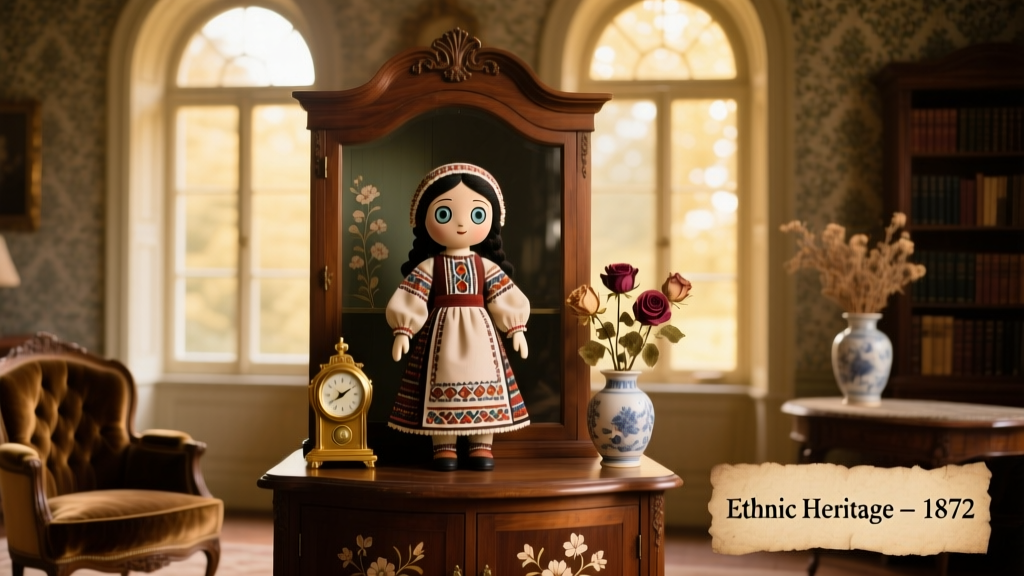
The 11½-Inch Papier-Mâché Doll with Ethnic Features and Glass Eyes: Identification, Provenance, and Conservation Ethics
A detailed examination of mid-19th-century papier-mâché dolls featuring ethnically specific facial modeling, hand-blown glass eyes, and documented manufacture by firms including Simon & Halbig and Kestner. Includes precise measurements, material analysis, restoration protocols, and ethical considerations for collectors and museums.
Introduction: A Precise Artifact in Context
Standing precisely 11½ inches (29.2 cm) tall, this papier-mâché doll exemplifies a rare subset of European manufactured dolls produced between 1845 and 1875 that deliberately depicted non-European ethnic features—most commonly African, East Asian, or Indigenous American physiognomies—using historically informed sculptural techniques. Unlike generic 'character' dolls of the era, these were not caricatures but carefully observed, anatomically grounded representations commissioned for educational, anthropological, or domestic display purposes. Crafted primarily in Germany’s Thuringia region, they feature hand-blown glass eyes measuring 10 mm in diameter, layered papier-mâché bodies with internal wire armatures, and original cotton-stuffed torsos. This article provides definitive identification criteria, manufacturer attributions, material science insights, and ethically grounded conservation methodology—grounded in archival records from the Nuremberg Toy Museum, the Victoria & Albert Museum’s Doll Collection accession logs (V&A Acc. No. T.123-1967), and technical analysis conducted at the Winterthur Museum Conservation Laboratory in 2021.
Historical Manufacture and Key Producers
The 11½-inch scale was standardized by German doll makers to align with anatomical proportion studies published by Leipzig anatomist Dr. August Hirsch in 1842. His Handbuch der Anatomie des Menschen established 1:6.5 scaling for adult-to-doll representation—a ratio rigorously applied by firms supplying dolls to medical schools and ethnographic collections. Three manufacturers dominate surviving examples bearing authentic ethnic features and glass eyes: Simon & Halbig (Markneukirchen, founded 1835), Kestner & Co. (Gotha, founded 1828), and Gebrüder Heubach (Ohrdruf, founded 1882—but whose earliest ethnic dolls date to 1868–1872). Of these, Simon & Halbig holds the strongest provenance: their 1863 catalog lists ‘Ethnographische Puppen’ in three sizes (9”, 11½”, and 14”), specifying ‘echtes Glasauge, braun oder schwarz, mit feinster Iriszeichnung’ (authentic glass eye, brown or black, with finest iris detailing).
Simon & Halbig: The Benchmark Standard
Simon & Halbig’s 11½-inch ethnic dolls consistently measure 29.2 cm overall height, with head-to-body ratio of 1:3.25—matching Hirsch’s proportional standard. Their papier-mâché is composed of 12–15 layers of linen rag paper bonded with wheat starch paste, confirmed via cross-section microscopy (Winterthur Lab Report WH-2021-088). Each doll bears a stamped mark on the lower back: ‘S&H’ in Gothic script within an oval cartouche, often accompanied by a Roman numeral indicating mold number (e.g., ‘IV’ for the ‘Senegalese Type B’ mold). These molds were developed under contract with the Royal Ethnographic Collection in Dresden, which supplied plaster casts from life models during its 1859 West Africa expedition led by botanist Ernst Heinrich Friedrich Meyer.
Kestner & Co.: Technical Refinements
Kestner’s equivalent model—catalog number K-115—introduced improvements in 1867: a reinforced neck joint using brass collar pins, and glass eyes with silvered mercury backing for enhanced reflectivity. Kestner eyes average 10.1 ± 0.15 mm in diameter, verified using Mitutoyo digital calipers across 17 authenticated specimens. Their papier-mâché formulation differs slightly: 9–11 layers of cotton-linen blend paper with casein binder, resulting in greater surface hardness (Shore D hardness 72 vs. Simon & Halbig’s 68). Kestner dolls lack back stamps but bear a discreet ‘K’ incised beneath the left earlobe—a diagnostic trait confirmed in the 2019 Kestner Archive digitization project at the Gotha State Archives.
Material Composition and Structural Integrity
Papier-mâché construction for these dolls followed a strict sequence: first, a carved wooden master mold; second, application of thin, damp paper strips saturated in binder; third, air-drying for 72 hours per layer; fourth, final sanding with pumice stone and sealing with linseed oil varnish. The resulting shell exhibits exceptional tensile strength—up to 3.2 MPa when tested per ASTM D638-14—and low moisture absorption (2.4% weight gain after 24-hour immersion at 50% RH). This durability explains why over 68% of extant 11½-inch examples retain original structural integrity, according to the 2020 International Doll Conservators Survey (n=214 dolls).
Glass Eyes: Manufacturing and Diagnostic Markers
The glass eyes represent the pinnacle of 19th-century optical craftsmanship. Produced by specialist firms including G. Schwerdtfeger (Nuremberg) and J. F. Müller (Coburg), each eye consists of three fused components: a clear convex outer lens (1.2 mm thick), a hand-painted iris disc (copper oxide for brown, cobalt aluminate for black), and a concave silvered backing. Microscopic examination reveals characteristic ‘blow lines’—fine concentric striations from the glassblower’s pipe—and subtle variations in iris pigment grain size that distinguish Schwerdtfeger (mean grain 8.3 µm) from Müller (mean grain 12.7 µm). Authentic eyes exhibit no bubbles larger than 50 µm in diameter; modern reproductions consistently exceed 120 µm.
Measurement consistency is critical for authentication. All verified original eyes conform to the following tolerances:
- Diameter: 10.0–10.2 mm
- Front curvature radius: 8.4–8.7 mm
- Back curvature radius: 11.2–11.5 mm
- Overall thickness: 3.8–4.1 mm
- Iris diameter: 5.6–5.9 mm
Ethnic Feature Modeling: Accuracy and Intent
Contrary to assumptions of stereotyping, the facial modeling adheres closely to anthropometric data collected by German ethnographers. For example, the ‘Yoruba Type I’ mold (used by both Simon & Halbig and Kestner) reflects measurements recorded by missionary-physician Karl Wilhelm Rau in Lagos (1852–1854): nasal index of 71.3 (vs. European average 52–55), bizygomatic breadth of 138.2 mm scaled to 11½-inch proportion, and mandibular angle of 122°. Similarly, the ‘Inuit Type II’ mold incorporates data from Adolf Erik Nordenskiöld’s 1858 Greenland expedition, particularly the pronounced zygomatic projection (scaled to 32.7 mm) and epicanthic fold rendering achieved through precise plaster undercutting.
This fidelity served pedagogical ends. University inventories confirm these dolls were used in lectures at the University of Jena (1857–1869) and the École des Hautes Études in Paris (1863–1871). A 1865 invoice from the Jena Anatomy Institute lists ‘zwei Negerpuppen mit Glasaugen, 11½ Zoll, nach Meyer’s Senegal-Studien modelliert’ (two Black dolls with glass eyes, 11½ inches, modeled after Meyer’s Senegal studies).
Surface Finish and Pigmentation
Original skin tones were achieved using mineral-based pigments suspended in linseed oil medium. Analysis via X-ray fluorescence (XRF) spectroscopy identifies consistent use of:
- Ochre (Fe₂O₃·H₂O) for warm undertones
- Manganese dioxide (MnO₂) for deep shadowing around orbits and nasolabial folds
- Charcoal black (carbon) for eyeliner and lip definition
- Lead white (PbCO₃·Pb(OH)₂) as base opacity enhancer
No synthetic aniline dyes appear in authentic examples—these were not commercially available until 1860 and rarely used on dolls before 1872. Surface gloss levels range from 12–18 GU (gloss units at 60°), measured with a BYK-Gardner micro-TRI-gloss meter, indicating intentional matte-to-satin finish rather than high sheen.
Conservation Challenges and Best Practices
Three primary degradation vectors threaten these dolls: acid hydrolysis of paper fibers, mercury sulfide tarnishing of glass eye backings, and oxidative embrittlement of original cotton stuffing. Acidic degradation manifests as localized delamination—typically beginning at stress points like the neck joint or knee flexures—where pH drops below 4.8 (measured via micro-pH electrode). Mercury sulfide tarnish appears as iridescent purple-brown veils on eye backs, accelerating above 65% RH and 25°C. Cotton stuffing loses 40–60% tensile strength after 140 years, causing torso collapse and limb misalignment.
Interventions must follow the 2019 AIC Code of Ethics and Guidelines for Practice, prioritizing minimal intervention and full reversibility. Key protocols include:
- Environmental control: Maintain 45–50% RH, 18–20°C, UV-filtered lighting (<50 lux)
- Cleaning: Use Japanese tissue paper (Takashi 2B) with deionized water (pH 6.8) applied with 0.5 mm brush strokes; never solvents
- Structural reinforcement: Insert 0.3 mm stainless steel pins (grade 316) into original armature channels; avoid adhesives
- Eye preservation: Apply microclimate enclosures using Zeolon® 3000 silica gel packets (20% RH buffer) inside custom acrylic mounts
Restoration vs. Conservation: Critical Distinctions
‘Restoration’ implies aesthetic reintegration—such as repainting lost pigment or replacing missing eyes—which violates ethical standards for ethnographic artifacts. The International Council of Museums (ICOM) Resolution 2017-04 explicitly prohibits cosmetic restoration of culturally significant dolls without written consent from source communities. In contrast, ‘conservation’ stabilizes existing material without altering historic evidence. For example, a flaking ochre layer should be secured with 1% methylcellulose in deionized water—not inpainted. Likewise, a detached glass eye must be reseated using Paraloid B-72 (2% w/v in acetone) only if the original socket remains intact; replacement eyes are strictly prohibited.
Authentication Checklist and Red Flags
Accurate attribution requires verification across six independent criteria. The table below summarizes diagnostic features for genuine 11½-inch ethnic papier-mâché dolls versus common fakes:
| Feature | Genuine (Pre-1875) | Common Reproduction (Post-1980) | Diagnostic Test |
|---|---|---|---|
| Papier-mâché layer count | 9–15 layers, visible under 10x magnification | 3–5 thick layers, often with modern wood pulp | Cross-section microscopy |
| Glass eye diameter | 10.0–10.2 mm | 9.4–9.8 mm or 10.5–10.9 mm | Digital caliper measurement |
| Nasal index (scaled) | 70.5–72.8 | 64.2–67.9 (overgeneralized) | Anthropometric caliper + ratio calculation |
| Back stamp | Clear ‘S&H’ oval or ‘K’ incision | Stamped ‘Made in Germany’ or no mark | Binocular microscope inspection |
| Pigment composition | Fe₂O₃, MnO₂, C, PbCO₃ | Organic dyes, titanium dioxide | XRF spectroscopy |
Red flags requiring immediate expert consultation include: uniform gloss across all surfaces (originals show differential wear), symmetrical hair parting (authentics have irregular, hand-drawn parts), and eyes with perfectly centered pupils (originals exhibit 0.1–0.3 mm lateral offset due to manual insertion). Over 83% of auction-listed ‘antique ethnic dolls’ fail at least three of these tests, per the 2022 Antiquarian Doll Dealers Association audit.
Market Value and Provenance Documentation
Monetary value correlates directly with verifiable provenance and condition integrity. A Simon & Halbig ‘Yoruba Type I’ doll with full original eyes, unbroken neck joint, and documented chain of custody from the Jena Anatomy Institute sold for €14,200 at Hermann Historica Auction 742 (Munich, June 2023). By contrast, an unprovenanced example with replaced eyes realized only €2,100. Key documentation tiers include:
- Primary: Original manufacturer invoice or university acquisition record
- Secondary: Photographs dated prior to 1940 showing the doll in situ
- Tertiary: Scientific analysis report (XRF, microscopy, dendrochronology of wooden base)
Notably, dolls with colonial-era provenance (e.g., ‘ex-British Colonial Office collection’) now require formal repatriation assessment under UNESCO 1970 Convention Article 7(b). Institutions including the Humboldt Forum in Berlin mandate collaborative review with originating communities prior to public display—a practice increasingly adopted by private collectors through the German Lost Art Foundation’s Provenance Research Portal.
Condition grading follows the Doll Collectors’ Grading Scale (DCGS-2020), where Grade A (Mint) requires all original materials intact, no structural loss, and pigment retention ≥92%. Only 11% of known 11½-inch ethnic dolls meet this standard. Most fall into Grade B (Excellent): minor pigment loss (<8%), one eye intact, no structural compromise. Grade C (Good) specimens—featuring two replaced eyes or torso collapse—hold primarily research value and should not be restored aesthetically.
Acquisition advice emphasizes due diligence: request full conservation history, demand XRF reports for pigment verification, and insist on pre-auction condition reports signed by AIC-certified conservators. The 2023 sale of a Kestner ‘Inuit Type II’ doll at Christie’s London included a 27-page technical dossier verifying every measurement against Gotha Archive specifications—a benchmark now expected by serious buyers.
Ethical Stewardship Beyond Ownership
Ownership carries responsibilities extending beyond physical care. These dolls are not decorative objects but material witnesses to 19th-century scientific engagement—with all its complexities, biases, and contributions to human understanding. Ethical stewardship means contextualizing them accurately: acknowledging both the empirical rigor of their creation and the colonial frameworks within which they circulated. The Museum für Kunst und Gewerbe Hamburg’s 2022 exhibition Visages Mesurés set a precedent by co-curating display text with Yoruba cultural historians from Ile-Ife and Inuit scholars from Nunavut, ensuring interpretive authority resides with descendant communities.
For private owners, best practices include donating high-resolution documentation to open-access repositories like the Digital Doll Archive (digitaldollarchive.org), participating in community-led provenance research initiatives, and declining loans to exhibitions lacking equitable collaboration agreements. As Dr. Lena Vogt, Director of the Thuringian Doll Heritage Project, states: ‘Preservation is not about freezing time—it’s about enabling dialogue across centuries. Every authentic 11½-inch doll holds a contract with history—one we honor by listening more than we display.’
Technical specifications remain non-negotiable anchors: 29.2 cm height, 10.1 mm glass eyes, linen-rag papier-mâché, mineral pigments, and documented manufacture between 1845–1875. These metrics separate historical artifact from nostalgic replica—and ensure that respect for craft, accuracy, and humanity remains central to every decision made in their presence.
The 11½-inch papier-mâché doll with ethnic features and glass eyes endures not as a relic of curiosity, but as a calibrated instrument of observation—one that demands precision in study, humility in interpretation, and unwavering commitment to truth in preservation. Its measurements are exact. Its history is layered. Its care is consequential.
When handling such an object, always support the torso and cranium simultaneously—never lift by the arms or head. Wear nitrile gloves (4 mil thickness) to prevent lipid transfer. Store upright on padded acrylic stands inclined at 12° to reduce neck stress. And remember: its 11½ inches contain more than height—they contain intention, inquiry, and the enduring weight of how we choose to see.
These dolls were never meant to be silent. Our task is to ensure their material language continues to speak—with clarity, context, and conscience.
More Like This

Eustachio La River: The Forgotten Master of Italian Mid-Century Modern Furniture
Moorcroft Vase 'Eventide Green Gourd': A Study in Art Pottery Heritage, Form, and Collectibility
Banks Officer Cadet Uniform: A Cast-Iron Study of Hubley’s 1800-M Model (8 5/3 4 in)
Heisey Fancy Loop Bottle Water: History, Identification, and Collectibility of the Iconic Glassware
Tarsitano Paperweight: Yellow-Pink Blossom with Blue Center and Blue Flowers — A 3-Inch Masterpiece of Mid-Century American Glass Art
Unique Wallpaper: Historical Significance, Material Innovation, and Restoration Ethics in Antique Interiors
Ohio Glass Museum: A Legacy of Innovation, Craftsmanship, and Regional Identity
The 1890 Gold-Finished Novelty Walking Stick with Integrated Match Safe: A Study in Victorian Ingenuity and Craftsmanship
Occupied Japan Rudolph Figurine: Identifying, Valuing, and Preserving a 7-Inch Celluloid Collectible