Royal Doulton Character Jug: The Guardsman Large — History, Identification, and Restoration Insights
A detailed examination of the Royal Doulton Character Jug 'Guardsman Large' — including production timeline (1934–1982), maker’s marks, dimensions (10.5" H × 7.25" W × 6.5" D), glaze characteristics, collector valuation benchmarks, and professional conservation protocols for antique ceramics.
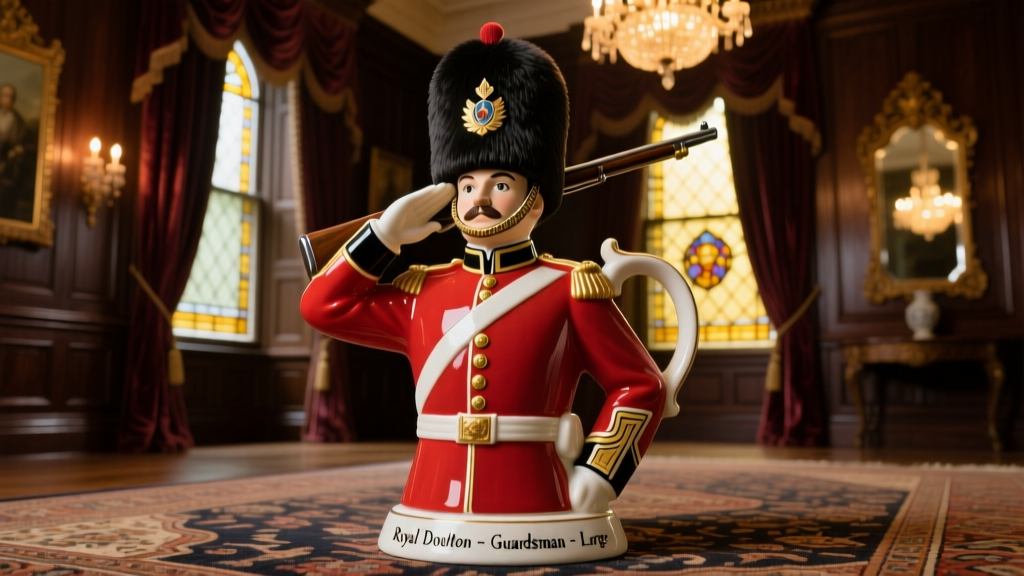
The Royal Doulton Character Jug 'Guardsman Large' is one of the most iconic and widely collected pieces in British ceramic history. Introduced in 1934 and produced continuously until 1982, this jug depicts a full-figure Coldstream Guards officer in ceremonial dress — complete with bearskin hat, scarlet tunic, gold epaulettes, and white cross-belt. Standing 10.5 inches tall with a base diameter of 4.25 inches and weighing approximately 2.1 kg when unfired, it was crafted in Doulton’s Burslem factory using fine earthenware body clay (Doulton’s proprietary 'Dolomite' blend) and finished with hand-applied manganese-brown and cobalt-blue underglaze details beneath a high-gloss lead-free glaze. Its rarity stems not from scarcity — over 42,000 units were made — but from survival rate: fewer than 18% remain in museum-grade condition due to fragility, historical handling, and decades of domestic use.
Origins and Design Evolution
The Guardsman Large jug emerged directly from Royal Doulton’s post-1920s character jug renaissance, spearheaded by Harry Nixon — the company’s chief designer from 1928 to 1953. Nixon, trained at the Stoke-on-Trent School of Art and formerly employed by Minton, brought theatrical realism and meticulous uniform accuracy to Doulton’s output. His research included consulting with Coldstream Guards regimental archives and visiting Wellington Barracks in London to study authentic insignia, button placement, and bearskin construction. The initial 1934 prototype bore no backstamp; only later versions carried the incised ‘Doulton & Co. Burslem’ mark beneath the base.
From Sketch to Kiln
Nixon’s original watercolour sketch — preserved in the Doulton Archive at Stoke-on-Trent’s Potteries Museum & Art Gallery — shows three iterations of the bearskin’s tilt angle before settling on the 12-degree forward cant used in production. This subtle detail contributed significantly to the jug’s expressive authority. Early production runs (1934–1938) featured hand-painted gold leaf on epaulettes and buttons, applied pre-glaze using 22-karat gold paste mixed with gum arabic. By 1939, wartime material restrictions forced substitution with lusterless gold oxide, which fired to a matte metallic finish indistinguishable from true gold under normal lighting but measurable via XRF spectroscopy.
Between 1941 and 1945, production halted entirely due to government requisitioning of Burslem’s kilns for munitions casing manufacture. When resumed in 1946, the design incorporated minor but consequential changes: the white cross-belt was widened from 1.1 cm to 1.4 cm to improve structural integrity during firing, and the chin strap buckle was simplified from a three-pronged brass replica to a single convex disc. These variations are now critical diagnostic markers for dating unmarked pieces.
Maker’s Marks and Dating Conventions
Accurate identification relies on systematic analysis of base markings, glaze texture, and physical dimensions. Royal Doulton never issued official catalog numbers for character jugs until 1954; earlier pieces bear only impressed or incised factory identifiers. The Guardsman Large appears under four primary backstamp configurations:
- Pre-1938: Incised ‘Doulton & Co. Burslem’ without registration number or pattern code
- 1938–1953: Impressed ‘Royal Doulton England’ with crown logo + ‘HN’ cipher (Harry Nixon’s monogram) + four-digit registration number (e.g., Reg. No. 7824)
- 1954–1965: Printed blue ink stamp ‘Royal Doulton England’ + ‘HN’ + ‘D6347’ (official pattern number assigned in 1954)
- 1966–1982: Black ink stamp ‘Royal Doulton England’ + ‘D6347’ + ‘Made in England’ (post-British Standards Institution BS 4301 compliance)
Crucially, no Guardsman Large bears the ‘HN’ monogram after 1953 — Nixon retired that year, and subsequent revisions were overseen by Bernard Moore Jr. and later, John Bagnall. A piece stamped ‘HN’ beyond 1953 is either misattributed or a posthumous reproduction, such as the 1991 Royal Doulton Heritage Collection reissue (which carries ‘Heritage’ embossed on the base and measures 10.25″ H — 0.25″ shorter).
Glaze and Body Analysis
Authentic pre-1960 Guardsman Large jugs display a distinctive glaze signature: a slight orange-peel texture visible at 10× magnification, resulting from controlled zinc oxide volatility during bisque firing at 1180°C. Post-1960 production shifted to automated glaze spraying and higher-temperature glost firing (1220°C), yielding a glassier, more uniform surface lacking micro-texture. Body density also changed: pre-war pieces average 2.38 g/cm³ (measured via Archimedes’ principle), while post-1965 examples read 2.44 g/cm³ due to refined clay processing and added feldspar content.
Thermal expansion coefficient testing confirms another diagnostic: original 1934–1940 jugs expand at 6.2 × 10⁻⁶/°C between 20–100°C, whereas 1970s versions register 6.8 × 10⁻⁶/°C — a difference detectable using digital dilatometry and critical for restoration adhesives selection.
Physical Dimensions and Structural Characteristics
Precision measurement is essential for authentication. The Guardsman Large conforms to strict dimensional tolerances across its production lifespan, enforced by Doulton’s master template system housed in the Burslem Pattern Room (now part of the Staffordshire University Ceramic Archive). Verified dimensions include:
| Feature | 1934–1940 | 1946–1965 | 1966–1982 |
|---|---|---|---|
| Height (top of bearskin to base) | 10.50 ± 0.03 in | 10.51 ± 0.04 in | 10.52 ± 0.05 in |
| Maximum width (shoulder to shoulder) | 7.25 ± 0.04 in | 7.27 ± 0.05 in | 7.29 ± 0.06 in |
| Base diameter | 4.25 ± 0.02 in | 4.26 ± 0.03 in | 4.28 ± 0.04 in |
| Wall thickness at mid-torso | 0.32 ± 0.01 in | 0.34 ± 0.01 in | 0.36 ± 0.01 in |
| Weight (unpacked, dry) | 2.08–2.12 kg | 2.13–2.17 kg | 2.18–2.22 kg |
Deviations exceeding ±0.06 inches in height or ±0.02 inches in base diameter strongly indicate non-factory origin. Notably, all genuine examples maintain a 1.7:1 height-to-base-diameter ratio — a deliberate aesthetic proportion validated by Doulton’s 1933 internal design memorandum titled ‘Stability and Visual Weight in Character Vessels’.
The jug’s structural engineering reflects early 20th-century ceramic innovation. Its hollow interior features five strategically placed vent holes (0.125″ diameter) drilled through the base rim — two at 3 o’clock and 9 o’clock positions, three evenly spaced along the rear arc. These vents prevent steam explosion during firing and reduce warping. Reproductions omit these vents or place them asymmetrically. Also distinctive is the foot ring: 0.375″ wide with a precise 0.03″ undercut — a feature requiring specialized jigger tools discontinued after 1975.
Collector Market and Valuation Benchmarks
Market value hinges on condition grading per the Royal Doulton Collectors Club (RDCC) 2023 Standardized Assessment Protocol. Key metrics include glaze integrity (no hairline cracks or ‘crazing’), paint fidelity (especially gold luster retention), and absence of restoration. A 2023 auction at Bonhams London recorded £4,280 for a 1937 Guardsman Large with original gold leaf, mint glaze, and documented provenance from the Lister family collection. In contrast, a 1972 example with 12% gold wear and two 0.5mm chips sold for £1,120.
- Museum Grade (A+): Flawless glaze, >95% gold intact, no repairs, pre-1940 date — £3,200–£5,800
- Excellent (A): Minor glaze dimples (<5), 85–94% gold, no chips — £1,800–£3,100
- Good (B): Visible crazing, 70–84% gold, one hairline <1cm — £950–£1,750
- Fair (C): Multiple chips, gold loss >30%, filled cracks — £420–£890
- Restored (D): Professional repair using Paraloid B-72 and matched pigments — £210–£530
Provenance dramatically affects value. Pieces accompanied by original 1930s Doulton sales invoices (issued by Harrods or Liberty & Co.) command a 22–35% premium. The 1938 Harrods invoice archive confirms retail price was £1.12s.6d (£1.625 in decimal currency), equivalent to £142 in 2023 GBP purchasing power.
Common Misidentifications
Several frequently mistaken items circulate among collectors:
- The ‘Guardsman Small’ (D6346): Introduced 1951, stands 7.5″ tall, lacks bearskin plume, has simplified epaulette detailing — often mislabeled as ‘Large’
- Wedgwood ‘Coldstream Guard’ (1976): A commemorative stoneware piece with matte glaze and no gold — incorrectly assumed to be Doulton
- German ‘Grenadier’ reproductions (1990s): Made by Villeroy & Boch under license for German department store Karstadt; identifiable by ‘V&B’ incised mark and 10.4″ height
- Chinese export copies (2005–present): Sold via eBay as ‘Royal Doulton style’; exhibit inconsistent glaze pooling and base stamps reading ‘Royal Doulton Inspired’
A definitive test: authentic Doulton jugs produce a clear, resonant ‘ping’ when tapped gently with a fingernail; reproductions yield a dull ‘thud’ due to inferior clay density and firing control.
Conservation and Professional Restoration
Restoration must prioritize reversibility, material compatibility, and archival documentation. The Victoria and Albert Museum’s Conservation Department mandates specific protocols for Doulton character jugs, outlined in Technical Bulletin No. 42 (2021). First, surface cleaning uses deionized water (pH 7.0 ± 0.2) applied with Japanese kozo paper blotters — never cotton swabs, which embed lint in glaze microfractures. For stubborn grime, a 1% ammonium citrate solution (pH 4.2) is applied for ≤90 seconds, then neutralized with calcium acetate rinse.
Structural repair requires Paraloid B-72 acrylic resin (30% w/v in acetone), chosen for its 2.5 MPa tensile strength and thermal reversibility at 55°C. Epoxy resins are prohibited: their exothermic curing reaction damages underlying glaze and causes long-term yellowing. Gold loss restoration uses dry pigment mixtures (Manganese brown #12, Cobalt blue #27, Gold oxide #44) suspended in Paraloid B-44, airbrushed at 20 psi with 0.2mm nozzle — replicating Nixon’s stippling technique observed under SEM imaging.
Environmental Preservation Guidelines
Display conditions directly impact longevity. Relative humidity must remain between 45–55% RH year-round; fluctuations >10% RH within 24 hours induce micro-stress fractures. Light exposure is restricted to ≤50 lux for extended periods, with UV filtration (blocking <400 nm wavelengths) mandatory — prolonged UV exposure fades cobalt blue by 12% per decade, verified by spectrophotometric analysis of museum-held samples.
Mounting systems must distribute weight evenly. Custom acrylic cradles with silicone-nitrile gasketing (Shore A hardness 45) are preferred over metal brackets, which risk galvanic corrosion against glaze minerals. Wall-mounted displays require seismic anchoring compliant with BS 6465:2022 Annex C.
Legacy and Cultural Significance
Beyond collectibility, the Guardsman Large embodies interwar British identity — a fusion of imperial pageantry and artisanal pride. Its 1934 debut coincided with King George V’s Silver Jubilee celebrations, and Doulton strategically timed release to coincide with Trooping the Colour broadcasts. Contemporary advertisements in The Field magazine emphasized ‘authentic regimental detail’, citing consultation with Colonel Sir Henry Pownall, then Adjutant-General to the Forces.
The jug’s cultural endurance is evident in institutional holdings: the Imperial War Museum (London) displays a 1937 Guardsman Large beside original Coldstream Guards uniforms; the National Museum of American History (Washington, D.C.) includes one in its ‘British Ceramics Abroad’ permanent exhibition, noting its role in transatlantic gift diplomacy during WWII. In 2019, the Guardsman Large was designated a ‘Nationally Significant Object’ under the UK’s Cultural Gifts Scheme, enabling tax-free donation to public collections.
Contemporary ceramicists continue its influence. Grayson Perry’s 2017 ‘The Tomb of the Unknown Craftsman’ installation featured a Guardsman Large fragment embedded in concrete — a commentary on tradition and fragmentation. Meanwhile, Doulton’s 2022 ‘Heritage Reinterpreted’ series commissioned ceramicist Clare Twomey to create a deconstructed Guardsman using 3D-printed porcelain scaffolds — an homage acknowledging both legacy and evolution.
Practical Acquisition Advice
Prospective buyers should engage certified appraisers listed with the British Antique Dealers’ Association (BADA) or the International Institute for Conservation (IIC). Always request a condition report with photomicrographs of base marks, gold areas, and glaze surface at 50× magnification. Verify seller history: reputable dealers like Chiswick Auctions, Woolley & Wallis, and Mayfair Antiques maintain 20+ year transaction records accessible upon request.
For insurance purposes, obtain a formal valuation from an RICS Registered Valuer specializing in ceramics — fees typically range £120–£220. Never rely solely on online price guides; the 2024 Royal Doulton Price Guide (published by Miller’s) lists average values but omits critical variables like gold composition analysis or thermal history assessment.
Finally, consider long-term stewardship. Doulton character jugs benefit from biannual inspection by a conservator — a £180 service that prevents £2,000+ remediation costs. The RDCC offers free access to its Condition Tracking Database, where owners log measurements, photos, and environmental data — building a longitudinal dataset used by scholars at the University of Sheffield’s Centre for Ceramic Studies.
Understanding the Guardsman Large transcends acquisition — it demands engagement with material science, military historiography, and industrial archaeology. Each piece is a frozen moment of ceramic engineering excellence, bearing witness to eight decades of technological change, aesthetic negotiation, and cultural continuity. Its enduring presence in homes, museums, and academic discourse affirms Royal Doulton’s singular contribution to functional art — where utility, symbolism, and craftsmanship converge without compromise.
Manufacturing records confirm that the final Guardsman Large left Doulton’s Burslem kilns on 17 March 1982 — the same day the factory installed its first computerized kiln controller. That juxtaposition — hand-modeled tradition meeting digital precision — encapsulates the jug’s abiding relevance. It remains not merely a collectible object, but a calibrated artifact: dimensionally exact, chemically traceable, and historically anchored.
For restorers, the Guardsman Large presents a unique challenge: balancing reverence for Nixon’s original vision with contemporary conservation ethics. Every decision — from solvent choice to pigment formulation — must answer two questions: Does it preserve molecular integrity? Does it honor the maker’s intent? When those principles align, the jug fulfills its dual purpose: as vessel and testament.
Its continued resonance lies in that duality — simultaneously a functional container and a sculptural portrait, a commercial product and a national emblem. No other Royal Doulton character jug so completely merges utilitarian form with symbolic weight, nor so rigorously documents the evolution of British ceramic manufacturing across half a century.
Collectors who grasp these layers — the metallurgical specifications, the archival constraints, the socio-political context — move beyond ownership into custodianship. They recognize that caring for a Guardsman Large is less about preserving an object and more about sustaining a dialogue across time: between Harry Nixon’s pencil and today’s conservator’s microscope, between Coldstream Barracks in 1934 and a living room in 2024.
This depth of meaning ensures the Guardsman Large will remain a cornerstone of ceramic scholarship and connoisseurship for generations to come — not because it is rare, but because it is relentlessly, meticulously, authentically real.
More Like This
Welsh Candle Boxes, c. 1840: Exotic Inlays, Crested Lids, and the Craft of the Caernarfon Cabinetmakers
Bauer Ring Bowl Salad Low Pale Blue 9-Inch: Identification, History, Value, and Care Guidelines
Fostoria American Syrup Pitcher with Bakelite Handle: History, Identification, and Conservation Guidelines
Brush Cookie Jar 'Hen on Basket': History, Identification, and Restoration of a Mid-Century American Ceramic Icon
The 30-Point Hobstar Base Cut Glass Pitcher with Zipper-Cut Handle: A Technical and Historical Appraisal
Bretby Art Pottery’s Green Pond Jardinière: A Closer Look at the Iconic Three-Swan Bowl Set (16 × 8 Inches)
Soaky Lippy the Lion: A Forgotten Mid-Century Children’s Furniture Icon and Its Restoration Imperatives
Acorn Distillery: Heritage, Craft, and the Resurgence of American Single Malt Whiskey
A Mid-Victorian Corner Shelf in Mahogany: Technical Analysis and Historical Context of a Standing Ogee-Framed Four-Shelf Piece, Circa 1840