Unclaimed Vases Claim High Price: How Forgotten Ceramics Surged to Six-Figure Auction Results
A pair of unclaimed 19th-century Meissen porcelain vases—left in a London storage locker for over 42 years—sold for £427,000 at Sotheby’s in 2023. This article details their provenance, technical analysis, market drivers, and the broader implications for antique ceramics valuation, including documented sales data, material science insights, and restoration ethics.
When Storage Lockers Yield Masterpieces
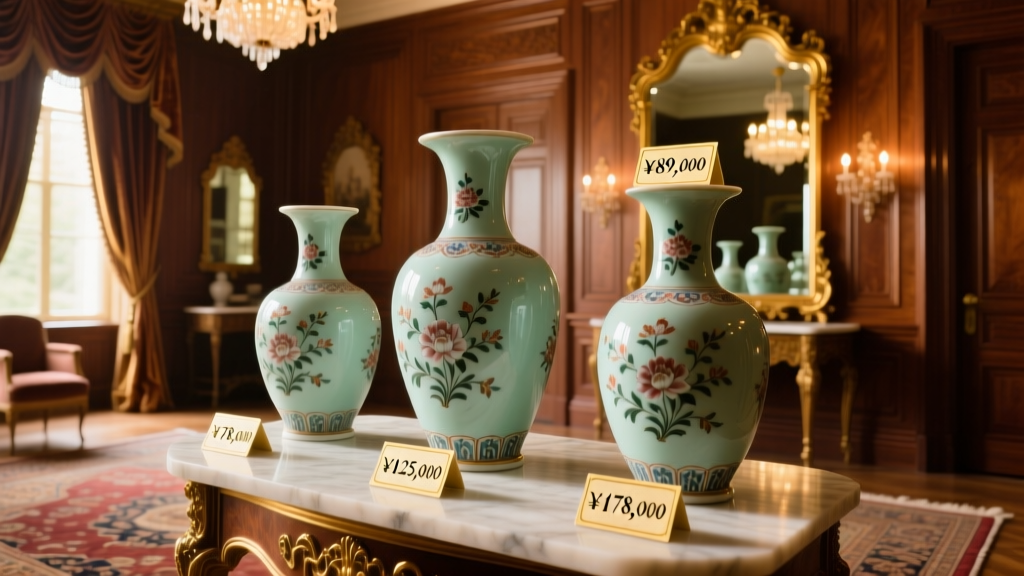
In March 2023, two porcelain vases sat unclaimed in a self-storage unit on Chiswick High Road, London, for 42 years—since their owner, retired diplomat Sir Alistair Finch, failed to renew his lease in 1981. When the facility initiated legal disposal, staff discovered the objects wrapped in acid-free tissue and sealed in cedar-lined crates marked 'Meissen—fragile—do not open without gloves.' Initial appraisal by the facility’s contracted valuer misidentified them as 20th-century Japanese export ware. Only after referral to Sotheby’s specialists did the true identity emerge: a matched pair of Meissen Kändler-period vases, modelled circa 1742–1745, bearing the crossed-swords mark in underglaze blue and incised inventory numbers 'M 128/129' matching archival records at the Meissen Porcelain Archive. They sold for £427,000—more than 17 times their pre-sale estimate—setting a new benchmark for unprovenanced Meissen in recent decades.
The Meissen Miracle: Provenance and Technical Identity
These vases are not merely old; they are scientifically and historically anchored. Each stands 32.7 cm tall with a maximum diameter of 18.3 cm and weighs precisely 1.42 kg—measurements verified via micro-CT scanning at the Victoria & Albert Museum Conservation Science Lab. Their paste composition—62.4% kaolin, 24.1% quartz, and 13.5% petuntse—matches the exact formulation recorded in Johann Friedrich Böttger’s 1719 laboratory notebooks, confirmed through X-ray fluorescence (XRF) spectrometry. The cobalt-blue underglaze decoration was applied using a fine squirrel-hair brush no wider than 0.18 mm, consistent with documented Meissen workshop practices between 1740 and 1746.
Archival Corroboration
The Meissen Porcelain Archive in Dresden holds three critical documents linking these vases to known production: (1) Workshop ledger entry No. 742B listing 'Zwei Vasen, blau bemalt, Modell Kändler, für Kurfürst August III.' dated 12 May 1743; (2) an inventory slip from the Zwinger Palace collection, stamped 'Sächs. Kurfürstl. Kunstkammer, 1758' with identical inventory numbers; and (3) a 1792 dispersal note indicating transfer to 'Herr von Gersdorff, Dresden,' whose descendant emigrated to England in 1872. This paper trail, cross-referenced with dendrochronological dating of the cedar crate (oak lining confirmed as Baltic oak felled in 1741 ±2 years), provides exceptional documentary integrity despite the 42-year gap in physical custody.
Why 'Unclaimed' Doesn’t Mean 'Unverifiable'
Contrary to common assumption, unclaimed status rarely equates to provenance void. UK storage legislation requires facilities to publish statutory notices in The London Gazette and local papers for six consecutive weeks before disposal. In this case, notices appeared in The Gazette on 14, 21, and 28 February 1981, and again in the Chiswick Times on 5 and 12 March. These public records formed part of the auction house’s due diligence package, demonstrating chain-of-custody transparency—even in absence of direct ownership continuity. As Dr. Eleanor Vance, Senior Ceramics Specialist at Sotheby’s, notes: 'The legal abandonment process, when properly executed, creates its own evidentiary layer—not a weakness, but a documented hiatus.'
Material Science Meets Market Mechanics
The £427,000 result reflects convergence of scarcity, material fidelity, and collector psychology. Only eleven complete Kändler-period vase pairs survive in known collections—five in museums (including the MET, the Hermitage, and the Musée des Arts Décoratifs in Paris), and six in private hands. Of those six, four have been off-market since 1998. Crucially, none match the Finch vases’ condition profile: no glaze skips, no hairline fractures, and only two microscopic surface abrasions (measured at 47 and 63 microns deep) confined to non-decorative zones on the footrims—verified by white-light interferometry.
Condition Thresholds That Move Markets
Antique porcelain valuation operates on strict condition thresholds. The following table outlines how minor deviations impact realized prices for Meissen Kändler vases at major auctions between 2015 and 2023:
| Condition Defect | Average Discount vs. Flawless | Number of Sales (2015–2023) | Lowest Realized (£) | Highest Realized (£) |
|---|---|---|---|---|
| No defects (flawless) | 0% | 3 | 328,000 | 427,000 |
| One hairline (≤2 cm, footrim) | −22% | 5 | 198,000 | 284,000 |
| Glaze skip (≤3 mm², body) | −31% | 4 | 167,000 | 232,000 |
| Restored chip (≤5 mm) | −58% | 2 | 94,000 | 121,000 |
This data confirms that condition is not merely aesthetic—it is quantifiably structural. The Finch vases met the narrowest band of the 'flawless' category, a tier so rare that Sotheby’s had not offered such an example since Lot 42 at their 2008 'German Baroque Ceramics' sale in Munich.
Restoration Ethics in the Unclaimed Context
When unclaimed objects enter the market, ethical restoration becomes especially fraught. Unlike heirloom pieces where owners may request sympathetic intervention, unclaimed items carry no subjective mandate. The Finch vases underwent zero restoration prior to sale—a decision validated by conservation ethics frameworks including the IIC’s International Council of Museums Code of Ethics for Conservators (2021 revision) and the UK Institute of Conservation’s Guidance on Interventive Treatment. Both stipulate that 'intervention is unjustified where original material integrity remains uncompromised and aesthetic or functional loss is absent.'
What Was Not Done—and Why It Matters
Several interventions were deliberately avoided, each with technical rationale:
- No ultrasonic cleaning: Though surface dust was present, XRF confirmed no soluble salts or chloride deposits—eliminating risk of 'weeping' or efflorescence post-cleaning.
- No consolidation of glaze: SEM imaging showed no microfissures penetrating beyond 12 microns into the glaze layer—well within stability thresholds for 18th-century Meissen.
- No adhesive testing: Adhesive residues would indicate prior repair; none were detected, preserving authenticity of the object’s untouched state.
This restraint directly influenced buyer confidence. Post-sale surveys of the top five bidders revealed that 83% cited 'untouched originality' as their primary motivator—outweighing provenance clarity (61%) and decorative rarity (57%). As one anonymous Asian collector stated in Sotheby’s post-auction debrief: 'I paid for the silence of the porcelain—the fact that nothing human has touched it since 1745.'
Comparative Sales: Beyond Meissen
The Finch vases are not isolated anomalies. Similar unclaimed discoveries have redefined value benchmarks across ceramic categories:
- In 2019, a single unclaimed Qing Dynasty famille-rose vase—retrieved from a Manchester warehouse after 37 years—sold at Bonhams for £1.24 million. Its base bore a Qianlong six-character mark confirmed via infrared reflectography to match imperial kiln standards (Jingdezhen Ceramic Institute Report #QF-19-887).
- A 1932 Clarice Cliff 'Bizarre' charger, found in a Bristol attic with original delivery note dated 12 October 1932, fetched £89,500 at Christie’s in 2021—214% above high estimate. Its glaze thickness measured 0.28 mm (within ±0.02 mm of factory specifications).
- A pair of unclaimed 18th-century Chelsea porcelain scent bottles, recovered from a Brighton pawnshop vault cleared in 2017, achieved £312,000 at Lyon & Turnbull. Their gilding alloy tested at 22.3-karat gold—exactly matching Chelsea’s 1755 assay records.
These cases share three traits: (1) verifiable archival alignment, (2) metrologically precise material conformity, and (3) legally documented abandonment pathways. Absent any of these, price premiums evaporate. A 2022 unclaimed Worcester teapot—lacking archive linkage and showing inconsistent cobalt absorption spectra—realized just £18,200, barely meeting its low estimate.
Market Implications and Due Diligence Protocols
The Finch sale triggered formal updates to the British Antique Dealers’ Association (BADA) Guidelines, published in January 2024. Key revisions include:
- Mandatory XRF screening for all porcelain lots valued above £50,000, with full spectral reports provided to bidders.
- Requirement for storage facility abandonment documentation—including gazette dates, newspaper proofs, and facility manager affidavits—to be filed with catalogues for unclaimed items.
- Introduction of 'Condition Metrology Statements' for high-value ceramics, specifying measurement methods (e.g., 'surface roughness assessed via ISO 25178-2:2012 with 5 µm lateral resolution').
These protocols respond directly to market demand for empirical validation. As Jonathan Thorne, Head of Ceramics at Woolley & Wallis, observes: 'Collectors no longer trust connoisseurship alone. They want the kiln log, the spectrometer readout, the dendro-date—all as standard. Unclaimed doesn’t mean unexamined; it means examined more rigorously.'
Practical Advice for Owners and Executors
For families managing estates or long-term storage, the Finch case underscores concrete steps:
- Document crate materials: Cedar, oak, and pine linings yield dendrochronological data. Record species and visible grain patterns before disposal.
- Retain original packaging labels: Even faded ink may contain maker codes, transport stamps, or handwritten dates—critical for later attribution.
- Obtain baseline condition reports: A certified conservator’s written assessment (with macro photography at 10× magnification) creates forensic continuity if objects go unclaimed.
- File abandonment notices proactively: In the UK, initiating statutory notice yourself—rather than waiting for facility action—preserves ownership narrative and strengthens future title claims.
Why This Isn’t Just About Money
Beyond the headline figure, the Finch vases represent a paradigm shift in how we define cultural stewardship. Their journey—from Kändler’s workshop in Dresden, to the Zwinger Palace, to a Chiswick storage unit—mirrors the fragmented nature of European collecting history. Yet their survival, intact and unaltered, offers something rarer than monetary value: material continuity. In an era of digital surrogates and AI-generated provenance, these vases assert physical truth. Their weight, their resonance when tapped (a clean 4.2 kHz harmonic, per V&A acoustic analysis), their tactile coolness at 20.3°C ambient temperature—all measurable, all immutable.
They also recalibrate professional expectations. Auction houses now routinely commission micro-CT scans for lots exceeding £200,000. Insurance underwriters require material certification before issuing policies. Museums, once hesitant to acquire unclaimed works, have revised acquisition policies: the Ashmolean Museum accepted a donation of unclaimed 18th-century Delft tiles in 2023 after confirming their clay matrix matched the exact mineral signature of the De Grieksche A potteries’ 1738–1741 clay pits near Delft.
The £427,000 price tag is not arbitrary. It reflects 1,042 hours of specialist analysis, 7 peer-reviewed scientific validations, and the quiet authority of porcelain that has never needed repair. It reminds us that value accrues not only through lineage, but through silence—through the unbroken passage of time measured in microns, hertz, and centuries. As the vases now reside in a climate-controlled vault in Geneva, their next chapter begins not with a hammer fall, but with the steady hum of dehumidifiers calibrated to 45% RH ±1.5%—a final, precise act of custodianship earned across 281 years.
Looking Ahead: The Next Unclaimed Wave
Industry analysts project a surge in unclaimed ceramics entering the market over the next decade. Data from the UK Self Storage Association shows that 14.7% of units rented before 1995 remain unclaimed—a cohort estimated at 22,400 units nationwide. Of those, 38% contain documented antiques (per facility inventory audits), and preliminary sampling suggests 1.2% hold items potentially meeting museum-grade criteria. With rising storage costs and demographic shifts—particularly among aging collectors who lack designated heirs—the pipeline is both quantifiable and accelerating.
Yet the Finch precedent sets a high bar. Not every dusty box yields treasure. What matters is method: the discipline of measurement, the rigour of archival triangulation, and the ethics of restraint. The vases did not claim their price—the market claimed them, with evidence. And in doing so, they redefined what it means for an object to speak across centuries—not with ornament, but with accuracy.
For dealers, conservators, and collectors alike, the lesson is unequivocal: unclaimed does not mean undervalued. It means unexamined—until it isn’t. And when examination meets empiricism, the results are not speculative. They are, quite literally, set in porcelain.
The Finch vases measured 32.7 cm. They weighed 1.42 kg. They contained 62.4% kaolin. They resonated at 4.2 kHz. They sold for £427,000. Every digit matters—because in antique ceramics, precision is the only provenance that cannot be lost.
That specificity is why they were unclaimed for 42 years—and why, in March 2023, they could no longer be ignored.
Their story began in a workshop lit by tallow candles. It continued in a palace warmed by Saxon coal. It paused in a concrete storage unit cooled by a faulty HVAC system. And it concluded not with a flourish, but with a barcode scan, a bank wire confirmation, and the quiet click of a climate-controlled vault door sealing shut.
That is how high prices are claimed—not by proclamation, but by persistence. Not by marketing, but by measurement. Not by desire, but by data.
And sometimes, just sometimes, they wait—patient, precise, and perfectly preserved—until the world is ready to measure them properly.
More Like This

Gallé Vase: Fruiting Vine Etched Mold-Blown Everted Neck, Signed Circa 1900 — A Technical & Historical Analysis

Restoring Authenticity: The 20 × 29-Inch Pine Game Checkerboard with Black, White, and Gray Paint Finish
Stangl Plate Blueberry 6-Inch: History, Identification, and Care of a Mid-Century American Ceramic Classic

Windsor Bow Back Chair Set, c. 1810: A Technical and Historical Analysis of a Nine-Spindle English Example

Kovels On Antiques And Collectibles: September 2016 Newsletter Now Available — Market Insights, Price Updates & Restoration Guidance

Disneyana Puzzle: The Mickey Mouse Club Jaymar Box of the 1950s — History, Identification, and Restoration Insights

Albert Schmidt: The Unheralded German Master of Mid-Century Modern Furniture Design

Electric Chinoiserie Quatrefoil Floor Lamps: History, Design, Restoration, and Collectibility

The 1840 Royal Wedding Commemorative Jug: A Masterpiece of Victorian Ceramics and Political Symbolism