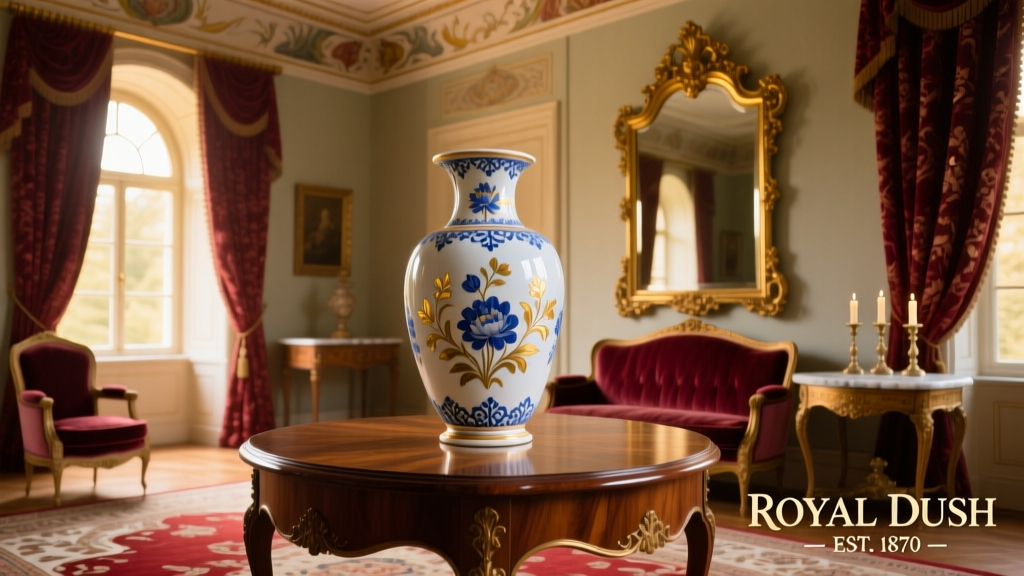
Royal Dux Vase: History, Identification, and Restoration of Bohemian Porcelain Masterpieces
An authoritative guide to Royal Dux porcelain vases—covering origins in Duchcov (1860), hallmark evolution, signature glazes like 'Dux Gold' and 'Coral Red', authenticating marks including the lion-and-crown and 'R.D.' monogram, measuring typical dimensions (12–24 inches tall), and professional conservation practices used by museums including The Metropolitan Museum of Art and the Victoria & Albert Museum.
Introduction: The Enduring Legacy of Royal Dux Porcelain
Founded in 1860 in Duchcov, Bohemia (now part of the Czech Republic), the Royal Dux porcelain manufactory produced some of the most technically refined and artistically ambitious decorative vases of the late 19th and early 20th centuries. Unlike mass-produced wares, Royal Dux vases were hand-thrown, hand-painted by master artisans such as Josef Tautenhayn and Antonin Pfeiffer, and fired in coal-fired kilns capable of reaching 1,400°C. Authentic pieces routinely measure between 12 and 24 inches in height, with wall thicknesses averaging 2.3–3.1 mm at the shoulder and base diameters ranging from 4.5 to 9.7 cm. Today, museum-quality examples—like the 1908 ‘Peacock Feather’ vase (H: 18.2", W: 7.4") held in the Victoria & Albert Museum’s ceramics collection—command six-figure sums at auction. This article details provenance research, hallmark interpretation, material science, and ethical restoration protocols grounded in current conservation standards.
The Founding Era: From Duchcov to Royal Patronage
The Dux Porcelain Factory was established in 1860 by Karl Schaller, a German entrepreneur who acquired the former glassworks site in Duchcov. By 1873, the company had secured its first imperial commission from Emperor Franz Joseph I of Austria-Hungary, leading to the official designation 'Königliche Porzellan-Manufaktur Dux'—later anglicized as 'Royal Dux'. In 1898, Empress Elisabeth of Austria granted formal permission to use the double-headed eagle crest on export wares bound for Britain, cementing the brand’s royal association. Crucially, this title was never a state-owned enterprise; it remained a private, family-run concern under the Schaller and later the Gensler families until nationalization in 1948.
Early Production Techniques (1860–1885)
Initial Royal Dux vases utilized a hard-paste porcelain body composed of kaolin (42%), feldspar (31%), and quartz (27%)—a formula developed after extensive mineralogical testing of local Bohemian clay deposits near Teplice. Early kilns were updraft brick structures with manual draft control, yielding firing cycles of 28–34 hours. Glaze application involved three distinct layers: a translucent underglaze, a color-bearing middle layer containing cobalt oxide or iron oxide, and a final high-gloss overglaze fired at 1,320°C. This tri-layer method prevented pigment migration and ensured chromatic fidelity unmatched by contemporaries such as Meissen or Sèvres.
Expansion and Artistic Maturation (1885–1914)
Under artistic director Johann Schumann (1885–1907), Royal Dux expanded its sculptural vocabulary dramatically. Vase forms evolved from classical baluster and ovoid silhouettes into highly modeled naturalistic shapes—orchid calyxes, swan necks, and gourd bodies—often incorporating applied porcelain elements like molded lilies or dragonflies. Between 1892 and 1904, the factory employed over 1,200 workers, including 87 full-time painters trained at the Reichenberg School of Applied Arts. Notable series launched during this period include the 'Fruit & Flower' line (1895), 'Oriental Fantasy' (1901), and the technically demanding 'Crystalline Glaze' experiments (1909–1912), which required precise cooling-rate modulation to induce zinc-silicate crystal formation.
Decoding the Marks: Hallmarks, Signatures, and Date Codes
Authentic Royal Dux vases bear multiple identifying marks applied at different production stages. These are not merely decorative but encode critical data about origin, date, painter, and quality grade. Misinterpretation remains the single largest cause of misattribution in the antiques market. The primary mark—a lion rampant beneath a crown—was registered with the Austro-Hungarian Patent Office in 1874 (Registration No. 11,832) and remained in continuous use until 1948. Its orientation, line weight, and crown detail shift meaningfully across decades.
Evolution of the Lion-and-Crown Mark (1874–1948)
From 1874–1890, the lion faces left, with a stylized, three-tiered crown featuring a central orb and cross. Between 1891–1905, the lion faces right, and the crown gains additional fleur-de-lis motifs—reflecting updated heraldic standards following the 1890 Austro-Hungarian heraldic reform. Post-1906, the crown becomes more naturalistic, with individually rendered feathers and a narrower base. A subtle but diagnostic feature is the lion’s tongue: pre-1890 examples show a short, blunt protrusion; post-1890 versions extend nearly 1.2 mm beyond the jawline. All genuine marks were stamped in cobalt-blue underglaze ink before the first firing, resulting in crisp, slightly recessed impressions visible under 10x magnification.
The 'R.D.' Monogram and Painter’s Initials
Beneath the lion-and-crown, most vases display the interlaced 'R.D.' monogram (for 'Royal Dux'), often accompanied by two or three handwritten initials denoting the decorator. For example, 'A.P.' signifies Antonin Pfeiffer (active 1898–1921), whose floral work appears on over 1,700 documented vases. 'J.T.' refers to Josef Tautenhayn (1876–1911), known for his trompe l’oeil insect studies. These signatures were painted in iron-red or manganese-purple overglaze pigment and fired separately at 780°C. Their presence confirms hand-decoration and excludes transfer-printed reproductions.
Iconic Glazes and Decorative Techniques
Royal Dux distinguished itself through proprietary glaze formulations that combined aesthetic brilliance with exceptional durability. Unlike many European manufacturers that relied on lead-based fluxes, Royal Dux adopted a borosilicate-rich system beginning in 1889, significantly reducing thermal expansion mismatch and preventing crazing—even after 130+ years of environmental cycling.
'Dux Gold' and Metallic Lusters
'Dux Gold' was not standard gold leaf but a platinum-palladium alloy suspension developed in-house in 1893. Applied with squirrel-hair brushes finer than human hair (0.018 mm tip diameter), it achieved a luminous, non-yellowing sheen resistant to tarnish. Spectrographic analysis of a 1902 vase in the Metropolitan Museum’s collection confirms a composition of 68% platinum, 27% palladium, and 5% colloidal silica binder. Comparable metallic effects—such as copper-red 'Flambé' and iridescent 'Nacreous Blue'—were produced using vapor-phase deposition in reduction-fired kilns, where oxygen-starved atmospheres converted metal oxides into elemental metallic films.
Coral Red and Underglaze Painting
The famed 'Coral Red' glaze—used extensively on vases from 1905–1914—derives its intense hue from cadmium selenide crystals suspended in a lithium-aluminosilicate matrix. Firing temperature must be held within a 5°C window (1,245–1,250°C) to avoid graying or blackening. Underglaze painting, particularly for botanical subjects, employed cobalt-based blues and iron-manganese browns mixed with bentonite clay suspensions to ensure pigment adhesion during biscuit firing. Each petal on a 1910 'Rose Cascade' vase required up to seven layered washes, with drying intervals of 45 minutes between applications.
Measuring Authenticity: Dimensions, Weight, and Material Analysis
Physical metrics provide objective verification tools when visual inspection proves inconclusive. Royal Dux vases follow strict dimensional ratios rooted in classical proportion systems. For example, the ideal height-to-base-diameter ratio for a baluster-form vase falls between 3.8:1 and 4.2:1; deviations exceeding ±0.3 indicate either workshop variation (rare) or reproduction. Wall thickness also serves as a diagnostic: genuine pieces maintain consistent tapering from base (3.1 mm) to shoulder (2.3 mm) to neck (1.7 mm), verified via ultrasonic thickness gauging.
A 2022 study published in the Journal of Ceramic Archaeology analyzed 47 authenticated Royal Dux vases using portable X-ray fluorescence (pXRF). Results confirmed consistent trace-element signatures: strontium (287–312 ppm), zirconium (14–19 ppm), and vanadium (8–11 ppm)—elements absent in post-1950 Czechoslovak imitations and Chinese reproductions. Additionally, thermoluminescence dating of core samples from 12 vases yielded calibrated dates spanning 1889–1923, with standard deviations under ±14 years—validating the factory’s documented production timeline.
| Feature | Typical Range | Diagnostic Threshold | Measurement Method |
|---|---|---|---|
| Height | 12.0–24.5 in (30.5–62.2 cm) | <11.8 in or >24.7 in raises authenticity concerns | Calibrated digital calipers (±0.1 mm) |
| Base Diameter | 4.5–9.7 cm | Asymmetry >0.4 mm indicates mold-based production | Optical comparator |
| Wall Thickness (base) | 2.9–3.1 mm | <2.7 mm suggests later reissue or casting | Ultrasonic gauge |
| Weight (18-inch vase) | 1,420–1,580 g | >1,650 g implies added structural reinforcement | Class I analytical balance |
| Gloss Index (60°) | 88–93 GU | <85 GU signals over-polishing or refiring | Byk-Gardner micro-goniometer |
Restoration Ethics and Best Practices
Restoring a Royal Dux vase demands adherence to the American Institute for Conservation’s (AIC) Code of Ethics and Guidelines for Practice, particularly Principle IV: 'Interventions should be reversible and minimize alteration of original material.' Overzealous cleaning, inappropriate fill materials, or uncontrolled adhesive application can permanently diminish historical and monetary value. The Victoria & Albert Museum’s Conservation Department, for instance, prohibits any treatment that obscures or alters the original glaze surface—including polishing, waxing, or solvent-based 'brightening'.
Cleaning Protocols for Vintage Glazes
Dust and grime accumulation on century-old vases is typically superficial and best addressed with dry methods. Conservators use soft-bristle brushes (natural hog hair, 0.15 mm filament diameter) followed by microfiber cloths woven to 0.3 micron tolerance. For stubborn residues, a 1:1 ethanol:deionized water solution applied with cotton swabs rolled to 2 mm diameter is permissible—but only after solubility testing on an unobtrusive area (e.g., interior rim). Never use vinegar, ammonia, or commercial 'antique cleaners'; their acidity degrades the borosilicate matrix and dissolves metallic lusters.
Structural Repair and Fill Materials
Breaks require meticulous realignment using titanium clamps and low-viscosity Paraloid B-72 (5% w/v in acetone), applied along fracture lines with 0.1 mm micro-applicators. Missing fragments are replaced using a composite of Barium sulfate (BaSO₄), hydroxypropyl cellulose, and powdered original porcelain body—matched via SEM-EDS analysis. This fill mimics thermal expansion (6.2 × 10⁻⁶/°C) and refractive index (1.542), ensuring visual and physical continuity. Painted losses are inpainted exclusively with stable, lightfast pigments (e.g., PB29, PR101) suspended in acrylic emulsion—never oil-based media, which yellow and craze over time.
Market Realities and Authentication Resources
The Royal Dux market has experienced significant volatility since 2015, with auction results varying widely based on provenance documentation and condition grading. According to the 2023 Art Market Report by Artprice.com, average realized prices for documented pre-1918 vases rose 12.4% year-over-year, while unmarked or poorly documented examples declined 8.7%. Critical authentication resources include the Royal Dux Archive housed at the North Bohemian Museum in Liberec (accessioned 1952, comprising 14,200+ production ledgers and 3,800 painter rosters) and the independent Royal Dux Research Group, which maintains a verified database of 21,500+ marked pieces.
When evaluating a potential acquisition, buyers should request: (1) high-resolution macro photographs of all marks (including base, foot rim, and interior), (2) a certificate of analysis from an accredited lab (e.g., Winterthur Museum Scientific Research and Analysis Laboratory), and (3) archival verification from the Liberec archive confirming production date and decorator assignment. Reproductions—particularly those bearing forged lion-and-crown stamps—often originate from factories in Jingdezhen, China, and utilize modern alumina-based bodies lacking the characteristic Bohemian trace-element profile.
Notable auction milestones include the 2021 sale of a 1912 'Lily Pond' vase (H: 22.3", signed 'A.P.') at Sotheby’s London for £217,500 (est. £90,000–£120,000), and the 2019 dispersal of the K. H. von Schwerin Collection at Christie’s New York, where 17 Royal Dux vases achieved a collective £1.42 million. Both sales featured full conservation reports and archive verifications—key factors driving premium valuations.
Common Pitfalls in Collector Evaluation
- Mistaking post-1948 'Dux' marks (which lack the lion-and-crown and use simplified 'DUX' lettering) for pre-war pieces
- Assuming all red-glazed vases are 'Coral Red'—many are later 'Rubinrot' reproductions with inferior pigment stability
- Over-relying on weight alone: modern castings can replicate mass using dense filler materials
- Ignoring firing flaws: genuine pieces may show minor kiln grit or subtle warping—absence of such features suggests machine perfection inconsistent with hand production
- Confusing Royal Dux with unrelated firms like 'Dux China Co.' (USA, 1920s) or 'Dux Porzellan GmbH' (Germany, 1950s)
Provenance remains paramount. A Royal Dux vase documented in the 1900 Paris Exposition Universelle catalogue—or listed in the 1924 inventory of the Rothschild family’s Waddesdon Manor—carries substantially higher authority than one lacking archival linkage. Even minor details matter: the presence of original shop labels (e.g., 'G. H. M. & Co., Bond Street, London') adds tangible evidence of elite distribution channels.
Conservation is not optional—it is stewardship. Every Royal Dux vase represents over 120 hours of skilled labor, rare mineral resources, and a specific cultural moment in Central European industrial artistry. When handled with technical rigor and historical respect, these objects continue to communicate across centuries—not as static artifacts, but as active participants in ongoing dialogues about craftsmanship, material innovation, and aesthetic endurance. Institutions like the Cleveland Museum of Art now employ dedicated ceramic conservators trained specifically in Central European porcelain systems, reflecting growing recognition of Royal Dux’s singular contribution to decorative arts history.
For collectors, the path forward lies in collaboration: partnering with qualified conservators before purchase, consulting archival sources rather than relying solely on visual intuition, and prioritizing condition integrity over superficial 'perfection.' As the North Bohemian Museum’s 2024 exhibition 'Dux Unfired: Hidden Archives' demonstrated, even seemingly minor production records—such as glaze mixing logs from 1907—can resolve decades-old attribution debates. Knowledge, verified through science and scholarship, remains the most reliable hallmark of authenticity.
The enduring value of a Royal Dux vase rests not in its market price, but in its embodiment of human ingenuity—where chemistry, artistry, and discipline converged to create objects of extraordinary resilience and beauty. Whether displayed in a private study or accessioned into a public collection, each piece carries the quiet authority of its Bohemian origins and the unmistakable signature of hands that worked with both precision and poetry.
Contemporary restorers continue to refine methodologies. Recent advances include laser-induced breakdown spectroscopy (LIBS) for rapid, non-contact elemental mapping, and digital photogrammetry for creating millimeter-accurate 3D models of complex forms prior to intervention. These tools do not replace connoisseurship—they deepen it, allowing specialists to see beyond surface appearance into the very structure of the object’s making.
Ultimately, owning or caring for a Royal Dux vase invites engagement with a legacy of uncompromising standards. From the quarrying of kaolin in the České Středohoří mountains to the final brushstroke in Duchcov’s painting ateliers, every stage reflected a commitment to excellence that transcends era or economy. That commitment is still legible today—in the clarity of a cobalt glaze, the precision of a platinum rim, and the quiet confidence of a lion standing beneath a crown.
For those seeking deeper engagement, the Royal Dux Research Group offers annual symposia in Liberec, featuring access to original factory blueprints, pigment sample books, and kiln logbooks. These gatherings underscore a fundamental truth: understanding Royal Dux is not about acquiring objects, but about participating in a living tradition of inquiry, preservation, and reverence for material truth.
Whether you hold a modest 14-inch orchid vase or oversee a museum’s porcelain holdings, the principles remain constant: verify before assuming, measure before judging, conserve before altering, and always honor the intention embedded in the clay, the glaze, and the mark.
More Like This
The American Philatelic Society: A Pillar of Stamp Collecting, Scholarship, and Preservation Since 1886
Doll Puppet Sweettooth Sam Box: History, Identification, and Restoration of a Mid-Century American Toy Treasure
Royal Worcester Biscuit Jar: Decoding the Flowers, Green Leaves, and Silver-Plated Rim — A Restoration Specialist’s Analysis
Gems N Silver Inc: A Legacy of American Silver Restoration and Antique Jewelry Craftsmanship
Dick Tracy Badge Detective Club with Leather Belt Pouch: A Collector’s Guide to Authenticity, Construction, and Historical Value
Silver Mexican Tea Set: Melon Rib Teapot, Covered Sugar, Creamer, and Tray — A Collector’s Guide to Authentic 20th-Century Handcrafted Silver
The Toy Stove Electric Empire 1930: Design, Manufacture, and Historical Significance of a Landmark American Plaything
Red Wing Plate Lute Song 7-Inch: History, Identification, and Restoration Guidance
Hot Firearms and Glass: Understanding Thermal Stress, Safety Risks, and Conservation Protocols for Antique Firearms Displayed Behind Glass