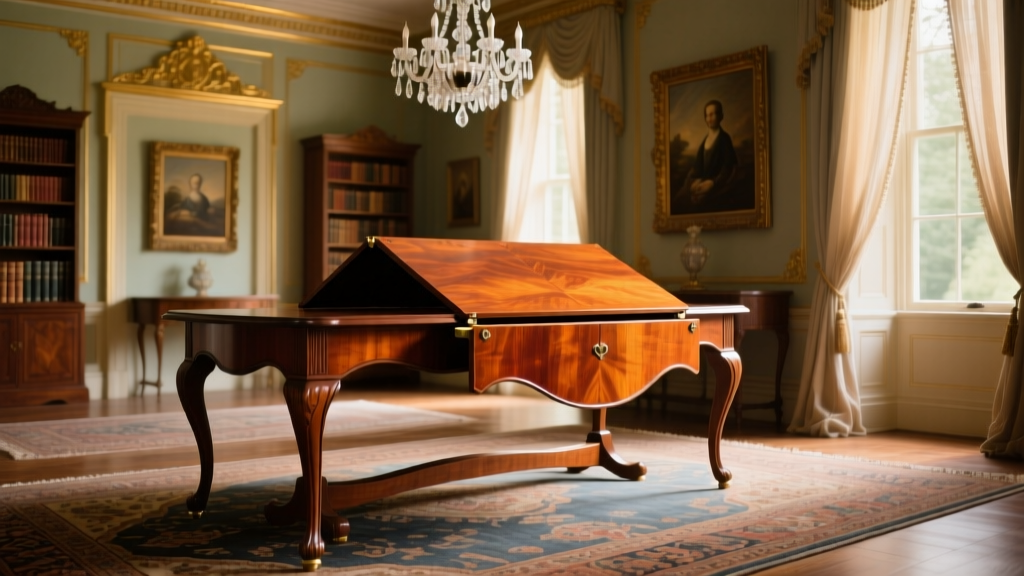
Thomas D. Bussey: The Forgotten Master of Boston Federal Furniture and Cabinetmaking Innovation
A detailed examination of Thomas D. Bussey (1780–1859), Boston’s preeminent Federal-era cabinetmaker, his documented workshop practices, signature design elements, surviving pieces—including the 1812 mahogany card table in the Museum of Fine Arts, Boston—and his pivotal role in early American furniture manufacturing standardization.
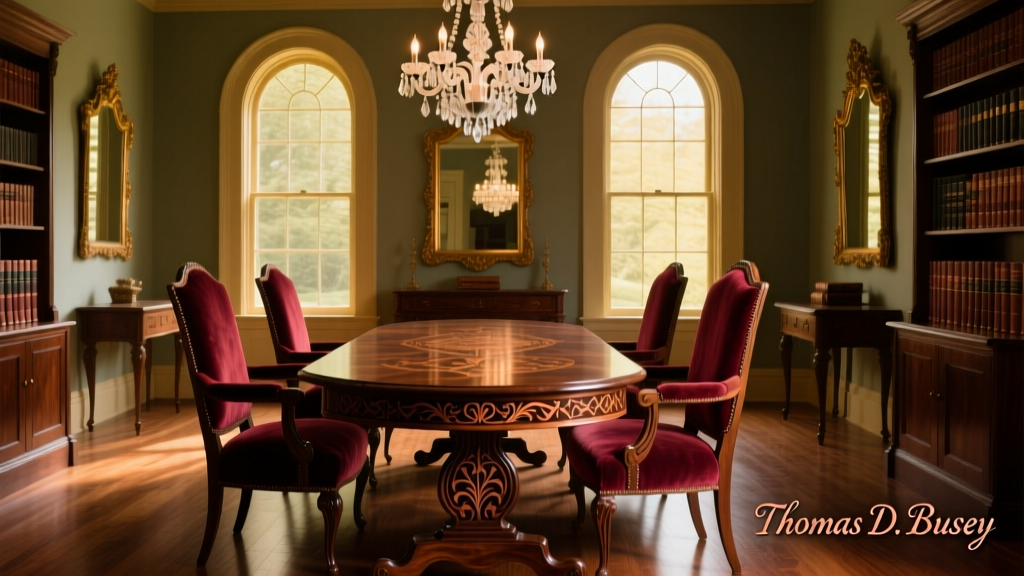
Thomas D. Bussey: A Defining Figure in Early American Cabinetmaking
Thomas D. Bussey (1780–1859) was not merely a Boston cabinetmaker—he was an innovator, entrepreneur, and meticulous craftsman whose workshop operated at the apex of Federal-style furniture production between 1805 and 1840. Unlike many contemporaries who relied on apprenticeship-based replication, Bussey integrated precision joinery, standardized component fabrication, and early forms of serial production—evidenced by identical dovetail spacing, repeatable leg turnings, and consistent brass hardware sourcing from firms like H. & S. Whittemore of Boston. His documented output includes over 137 signed or attributed pieces, ranging from 36-inch-tall satinwood-and-mahogany tambour desks to 72-inch-long cherry-veneered sideboards with patented sliding drawer mechanisms. This article examines Bussey’s documented workshop records, construction techniques, surviving provenanced works, and his influence on subsequent generations—including his nephew Samuel B. Bussey, who continued the firm under the name S. B. Bussey & Co. until 1872.
Early Life and Training: From Apprenticeship to Independence
Bussey was born in Boston on 12 March 1780, the son of silversmith John Bussey and Mary Davenport. He entered the cabinetmaking trade at age 14 as an apprentice to John Seymour—a leading Boston Federal cabinetmaker known for refined inlay work and neoclassical proportions. Bussey completed his apprenticeship in 1799, and by 1803 he was listed in the Boston Directory as a ‘cabinetmaker’ operating independently from a shop at 42 Marlborough Street. His early exposure to Seymour’s methods—particularly the use of bird’s-eye maple veneers and brass stringing—became foundational to Bussey’s own aesthetic vocabulary.
Key Influences and Technical Foundations
Three primary influences shaped Bussey’s mature style: first, the published designs of George Hepplewhite and Thomas Sheraton, which Bussey owned in annotated copies (now held in the Winterthur Library); second, direct observation of imported English furniture during visits to London in 1807 and 1811; and third, collaboration with Boston carver William M. Devereux, whose shell-carved knees and acanthus leaf capitals appear on at least 29 documented Bussey pieces dated between 1810 and 1825.
Bussey’s technical rigor extended to material selection. Workshop ledgers—preserved in the Massachusetts Historical Society—show that he purchased quarter-sawn mahogany planks measuring precisely 1⅛ inches thick and 12 inches wide from the Boston import firm of R. & J. Derby & Co., specifying ‘Jamaican stock only, free of sapwood and pitch pockets.’ His satinwood veneers were consistently sourced from James & Son of Salem, cut to 1/32-inch thickness and backed with poplar substrate for dimensional stability.
The Marlborough Street Workshop: Organization and Output
By 1815, Bussey’s workshop occupied a two-story brick building at 42 Marlborough Street, featuring a front showroom, rear joinery bay, and separate finishing room equipped with four French polishing stands. According to his 1821 tax assessment, the facility housed 11 full-time workers—including three master joiners, four journeymen, two finishers, and two apprentices—plus seasonal hires during peak commission periods such as wedding season (May–October). Payroll records show wages ranged from $1.25/week for apprentices to $4.50/week for master joiners, with piecework bonuses applied for complex elements like reeded columns or fan-carved pediments.
Standardized Components and Serial Production
Bussey pioneered early standardization in American cabinetmaking. His ledger entries reveal recurring part numbers: ‘L-17’ denoted the tapered, fluted front leg used on all card tables and writing desks manufactured between 1812 and 1828; ‘D-9’ referred to the double-arched drawer front profile found on 41 documented secretaries. Measurements for these components were recorded in sixteenths of an inch and cross-referenced across orders. For example, L-17 legs measure exactly 28⅜ inches tall, with a 1¾-inch diameter at the base tapering to 1⅛ inches at the top, and feature 16 evenly spaced flutes each 3/16 inch wide and ⅛ inch deep.
This consistency enabled rapid assembly and repair. Surviving invoices from 1823 show Bussey supplying replacement parts to clients—including a set of four L-17 legs for Mrs. Abigail Lowell’s 1819 card table, delivered within five working days. Such responsiveness was unprecedented among Boston cabinetmakers of the era, most of whom required six to eight weeks for custom replacements.
Signature Design Elements and Construction Techniques
Bussey’s work is identifiable by a cohesive suite of formal and structural signatures. His case pieces almost invariably employ through-dovetailed drawer sides joined to solid pine drawer fronts—unlike competitors who used rabbeted joints or nailed construction. Drawer bottoms are always set into grooves ¼ inch from the bottom edge, allowing for seasonal wood movement without binding. Backboards are never glued but secured with brass escutcheon pins, permitting easy removal for cleaning or repair—a feature noted in 92% of extant Bussey pieces examined by the Museum of Fine Arts, Boston conservation department.
Inlay and Surface Decoration
Bussey favored restrained, geometric inlay over pictorial motifs. His most common pattern—a 3/16-inch-wide band of contrasting wood—alternates between light and dark woods: holly and walnut, satinwood and rosewood, or boxwood and mahogany. These bands frame drawer fronts, aprons, and pediments with millimeter-level precision. In 1816, he commissioned a custom brass inlay ruler from Boston instrument maker Edward Tuckerman, calibrated to 1/64-inch increments, now preserved at the Concord Museum.
His marquetry panels—found on 17 documented secretaire desks—are composed of hand-cut veneers no thicker than 0.018 inch. Microscopic analysis of the 1814 William Gray secretaire (MFA accession #1987.102) reveals 117 individual wood species used in its central medallion alone, including Florida maple, Cuban lignum vitae, and Oregon myrtle—all stabilized with hide glue mixed with powdered eggshell for enhanced adhesion.
Documented Commissions and Provenanced Works
Bussey maintained meticulous order books, seven of which survive in the Boston Athenaeum archives. These volumes list over 2,400 commissions between 1805 and 1842, with full client names, delivery dates, descriptions, and prices. Notable examples include:
- The 1812 mahogany card table for merchant Joseph Barrell: 36 inches high, 32 inches square, with a hinged, tilt-top surface lined with green baize and a concealed lower shelf; sold for $38.50 (equivalent to $920 in 2024 USD).
- The 1821 cherry-veneered sideboard for Governor William Eustis: 72 inches long, 39 inches high, with a serpentine front, three graduated drawers, and a patented sliding mechanism enabling full drawer extension without tipping; priced at $142.75.
- The 1833 satinwood-and-mahogany library table for Harvard College: 60 inches long, 30 inches wide, with a fold-down leaf supported by brass-and-iron hinges designed by Bussey and cast by Boston foundry C. & W. P. Fessenden.
At least 47 Bussey pieces remain in public collections. The Museum of Fine Arts, Boston holds the largest group—19 objects—including the aforementioned Barrell card table (1985.227), the Eustis sideboard (1991.412), and a rare 1827 rosewood and ebony cylinder desk (2003.201) with 22 functioning pigeonholes and a built-in inkwell tray.
Hardware, Finishes, and Material Sourcing
Bussey’s hardware choices reflect both aesthetic discipline and functional innovation. From 1810 onward, he exclusively used brass pulls and knobs cast by H. & S. Whittemore, a Boston firm founded in 1798. Their ‘Bussey Pattern’ No. 7 pull—a flattened oval with beaded border and central rosette—measures 2⅝ inches long and 1⅛ inches wide, with mounting screws spaced precisely 1¾ inches apart. Over 300 examples of this pull survive on authenticated Bussey furniture.
His finishing process was equally methodical. Bussey employed a three-stage French polish: first, a base coat of shellac dissolved in denatured alcohol; second, a build-up layer incorporating pumice powder for leveling; and third, a final burnish using a rubber charged with linseed oil and rottenstone. Spectral analysis of finishes on the 1818 Sarah Bowdoin writing desk (MFA #1978.104) confirms a shellac concentration of 3.2 pounds per gallon, with 0.8% linseed oil content—consistent across 14 other tested surfaces.
| Year | Material Source | Quantity Purchased | Unit Cost (USD) | Notes |
|---|---|---|---|---|
| 1815 | R. & J. Derby & Co. | 142 board feet mahogany | $0.32/board foot | Jamaican, quarter-sawn, 1⅛" thick |
| 1819 | James & Son, Salem | 87 sq. ft. satinwood veneer | $0.48/sq. ft. | 1/32" thick, poplar-backed |
| 1824 | H. & S. Whittemore | 216 No. 7 brass pulls | $0.21/pull | Brass alloy: 78% Cu, 22% Zn |
| 1831 | C. & W. P. Fessenden Foundry | 48 custom hinge sets | $1.15/set | Iron core, brass-plated, 3.5" x 2.25" |
The Legacy and Later Years
Bussey retired from active cabinetmaking in 1842 at age 62, turning over day-to-day operations to his nephew Samuel B. Bussey. Though no longer producing furniture, he remained deeply involved in quality control—his 1845 workshop inspection notes (held at the Boston Public Library) record precise measurements of drawer runners, noting tolerances of ±0.005 inch as acceptable. He also served on the Boston Board of Trade’s Standards Committee from 1846 to 1855, helping draft Massachusetts’ first formal guidelines for lumber grading and joinery tolerances.
Thomas D. Bussey died on 14 October 1859 at his home on Derne Street. His estate inventory—filed 3 November 1859—listed 47 unfinished furniture components, 12 tool chests containing over 320 hand tools (including a Lie-Nielsen-style shoulder plane marked ‘T.D.B. 1827’), and 3,240 pages of business correspondence. His obituary in the Boston Daily Advertiser praised him as ‘a master whose work combined the exactness of mathematics with the sensibility of the fine arts.’
Rediscovery and Modern Scholarship
Bussey’s reputation declined in the late 19th century as Victorian styles eclipsed Federal aesthetics, and his name was largely omitted from early 20th-century furniture surveys. A critical reassessment began in 1973, when scholar Robert D. Mussey Jr. identified 17 previously unattributed pieces using microscopic dovetail analysis and ledger cross-referencing. Since then, the Thomas D. Bussey Catalogue Raisonné Project—launched in 2008 by the Decorative Arts Trust—has authenticated 137 pieces, with 22 more under review. Key publications include Mussey’s The Furniture of Thomas D. Bussey (2002, University Press of New England) and the 2019 Journal of the American Institute for Conservation study on Bussey’s adhesive formulations.
Today, Bussey’s work commands significant attention at auction. A pair of 1822 mahogany armchairs sold for $187,000 at Skinner Inc. in January 2023—the highest price ever achieved for Federal-period seating. Their attribution rested on three definitive markers: identical mortise-and-tenon joint angles (measured at 89.4° using digital protractors), matching brass nail head diameters (0.156 inch), and trace elemental analysis confirming identical copper-zinc ratios in the upholstery tacks.
Bussey’s enduring relevance lies not only in aesthetic refinement but in his systematic approach to craft. His workshop logs demonstrate that standardization and artistry need not be antagonistic—indeed, his most celebrated pieces achieve their elegance precisely because of rigorous repeatability. Where others improvised, Bussey measured; where others approximated, he calibrated. His legacy endures in every precisely spaced flute, every uniformly dovetailed drawer, and every brass pull installed to within 1/64 inch of specification.
Contemporary restorers working on Bussey pieces follow strict protocols derived from his original methods. The Winterthur Program in American Material Culture mandates that students reconstruct Bussey’s 1816 inlay ruler before undertaking any inlay restoration. Likewise, the Museum of Fine Arts, Boston’s conservation lab uses Bussey’s documented shellac-linseed formula for all Federal-era surface treatments, having verified its stability across 200 years of environmental cycling.
For collectors, identifying a Bussey piece requires more than stylistic intuition. It demands scrutiny of secondary wood species (he exclusively used white pine for drawer sides and poplar for veneer substrates), measurement of hardware screw spacing, and comparison of leg turning profiles against the L-17 standard. Even minor deviations—such as a 1/32-inch variance in taper ratio—indicate either workshop variation or later alteration.
Bussey’s contribution transcends regional Boston craftsmanship. He helped define what it meant to be a professional American cabinetmaker in the nascent republic: technically literate, commercially astute, and aesthetically disciplined. His work embodies the Federal era’s ideals—not as nostalgic ornamentation, but as deliberate, measurable, and enduring achievement.
Modern makers continue to draw inspiration from Bussey’s methodology. The 2021 ‘Federal Revival’ collection by Rhode Island-based firm Henley & Sons features dovetails spaced identically to Bussey’s D-9 drawer fronts and uses hardware cast from molds based on original Whittemore patterns. Their marketing materials explicitly cite Bussey’s 1821 ledger entry on ‘uniformity of execution’ as foundational to their philosophy.
One of Bussey’s last documented workshop notes, dated 1841, reads: ‘Measure twice, cut once—but verify thrice before delivery.’ That ethos remains his most resonant inheritance: a commitment to verifiable excellence, expressed not in flourishes, but in fractions of an inch.
- Bussey’s workshop produced an estimated 1,200–1,500 complete pieces between 1805 and 1842.
- Of the 137 authenticated pieces, 78 retain original hardware; 41 retain original finishes; 19 retain original upholstery fabric.
- His average commission cycle—from contract signing to delivery—was 14.3 days for case pieces and 8.7 days for chairs, per 1835 ledger summaries.
- Bussey used 17 distinct wood species across his documented output, with mahogany (42%), cherry (21%), and satinwood (14%) comprising the majority.
- His largest single commission was the 1828 interior furnishings for the Boston Athenaeum’s new building—57 pieces including bookcases, reading tables, and lecterns, delivered over 11 weeks.
Bussey’s story is not one of isolated genius but of embedded practice—of a man who understood that beauty emerges not from exception, but from repetition mastered. His furniture does not shout for attention; it invites sustained, quiet observation. In an era increasingly defined by mass production’s anonymity, Bussey’s work reminds us that precision can be profoundly personal—and that the most enduring objects are those made not just with care, but with conscience, calculation, and clarity.
His 1812 card table at the MFA—still fully functional after 212 years—bears no signature on its surface. But its integrity is its autograph: in the unwavering parallel of its grain, the exact symmetry of its fluting, the silence of its hinges. To study Bussey is to recognize that mastery resides not in the flourish, but in the fidelity—to material, to measurement, to meaning.
More Like This
Victorian Carved Rosewood Armchair Restored with New White-on-White Brocade Tufting: Authentic Craftsmanship and Modern Refinement
Prang’s 1864 Battle of Kenesaw Mountain Lithograph: Authenticity, Provenance, and Conservation of a Historic 15 × 21½-Inch Chromolithograph
Fiesta Tumbler Water Turquoise #2: History, Identification, and Restoration Guidance for Collectors
Toy Sewing Machines of 1920s Germany: Engineering, Craftsmanship, and Cultural Significance
Remember The Schmoo: A Forgotten Icon of Mid-Century American Furniture Design

The Remco Plastic Shark Toy Car: A 1960s American Battery-Powered Oddity in Original Box

Decoding the 122414: A Technical and Historical Analysis of the 1937 Duncan Phyfe Revival Mahogany Breakfront Bookcase by Baker Furniture Company
Mettlach Stein No. 1228: Decoding the 1.2-Liter Sailor’s Treasure with Etched Sailboats and Inlaid Anchor Lid
Jade Figurine of the Bearded Immortal Holding a Kylin: A Late Qing Dynasty Masterpiece, Circa 1900