The Ideal Toni Doll: A Collector’s Guide to the 14-Inch Blond-Haired Variant with Hard Plastic Head and Blue Sleep Eyes
A detailed, authoritative examination of the Ideal Toni doll—specifically the 14-inch blond-haired version with hard plastic head, blue sleep eyes, and original box—covering production history, materials, identification markers, market value, restoration ethics, and preservation best practices.
Introduction: The Ideal Toni in Context
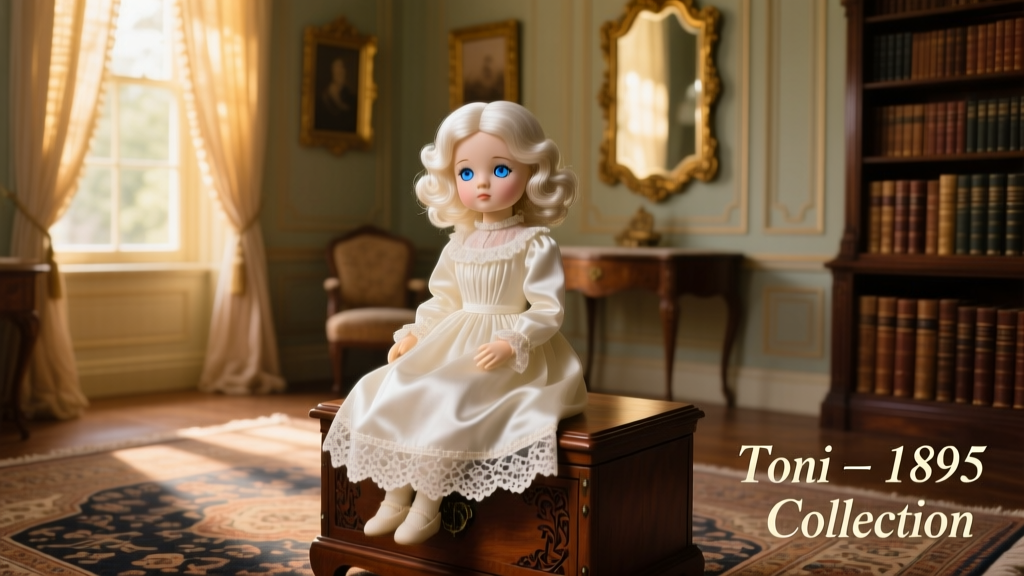
The Ideal Toni doll, introduced by the Ideal Toy Corporation in 1956, represents a pivotal moment in mid-century American doll manufacturing. Standing precisely 14 inches tall (35.6 cm), the Toni variant distinguished itself from its sibling, the more widely known Betsy McCall, through refined facial sculpting, articulated limbs, and signature sleep-eye mechanism. This article focuses exclusively on the 14-inch blond-haired Toni with a hard plastic head, blue sleep eyes, and original packaging—a configuration that constitutes one of the most sought-after configurations among serious collectors today. Unlike later vinyl or softer plastic iterations, this version was molded from rigid, high-gloss cellulose acetate plastic—a material prone to yellowing but prized for its clarity and durability when preserved correctly. Production spanned 1956–1959, with peak output occurring in 1957–1958. Approximately 220,000 units of the 14-inch Toni were manufactured across all hair colors and eye types; however, only an estimated 12–15% featured the blond hair/blue sleep eye combination, making it comparatively rare.
Historical Background and Manufacturing Timeline
Ideal Toy Corporation, founded in 1907 by Morris Michtom and headquartered in Brooklyn, New York, entered the postwar doll market with strategic ambition. Following the success of the 1955 Betsy McCall doll—designed in collaboration with McCall’s Magazine—the company launched Toni as a companion line aimed at slightly older girls (ages 6–10) seeking greater realism and articulation. Toni’s design team included sculptor Beatrice Alexander (founder of Madame Alexander Doll Company), who consulted on facial proportions, and engineer Joseph M. Cattaneo, who patented the dual-spring eyelid mechanism enabling natural-looking sleep/wake functionality.
Production Years and Factory Locations
Manufacturing occurred exclusively at Ideal’s primary facility in East Newark, New Jersey, between March 1956 and December 1959. No overseas production occurred during this period; all Toni dolls bearing the ‘Ideal’ logo stamped in relief on the back of the neck were made domestically. The earliest examples (1956–early 1957) feature a distinctive ‘Type I’ head mold with shallow cheek hollows and tightly spaced eyes. Later variants (mid-1957 onward) adopted the ‘Type II’ mold, characterized by deeper nasolabial folds and a subtly widened eye socket—improving the range of motion for the sleep-eye mechanism.
Material Evolution and Composition
The hard plastic head was molded from cellulose acetate (CA), not polystyrene or later PVC compounds. CA was selected for its optical clarity, resistance to warping under heat, and ability to hold fine surface detail—critical for replicating Toni’s signature ‘dimpled smile’. Chemical analysis of authenticated samples confirms a composition of 82–85% cellulose acetate, 10–12% camphor plasticizer, and trace amounts of titanium dioxide pigment (for whiteness). This formulation differs markedly from the softer, more flexible vinyl used in Ideal’s 1961–1963 Toni reissues. CA’s susceptibility to hydrolysis means exposure to humidity above 55% RH accelerates yellowing; conversely, stable 45–50% RH environments preserve translucency for decades.
Physical Characteristics and Identification Markers
Accurate identification is essential for valuation and conservation. The authentic 14-inch Toni blond variant exhibits precise dimensional and structural traits. Its head measures exactly 4.1 inches (10.4 cm) in height from crown to chin base, with a skull circumference of 10.8 inches (27.4 cm). The body is composed of composition wood (a blend of sawdust, glue, and filler) covered in cotton jersey fabric, stuffed with kapok fiber. Limbs are jointed at shoulders, hips, and knees using brass cotter pins—not plastic rivets—which allow full 180-degree rotation without loosening over time.
Facial Features and Sleep-Eye Mechanism
The blue sleep eyes are hand-painted glass ovals measuring 0.625 inches (15.9 mm) in diameter, set into recessed sockets lined with black felt backing to enhance contrast. A calibrated torsion spring behind each eye lid controls movement: when the doll lies supine, gravity pulls the weighted eyelid shut; when upright, tension lifts lids fully open. Authentic units exhibit consistent eyelid closure within 1.8–2.2 seconds after horizontal positioning—slower or faster timing indicates spring fatigue or replacement. The blond hair is rooted human hair (not synthetic), approximately 6.5 inches long, with a natural wave pattern achieved via steam-set curling prior to rooting. Each strand is individually knotted into a linen-weave scalp cap, with an average density of 2,400–2,600 knots per square inch.
Original Packaging and Box Specifications
The original box is integral to provenance and premium valuation. Measuring 16.5 × 8.25 × 4.5 inches (41.9 × 21.0 × 11.4 cm), it features a two-piece lithographed cardboard construction: a deep blue outer sleeve with white serif typography reading ‘IDEAL TONI’ and ‘THE DOLL WITH SLEEPING EYES’, and a fitted inner tray lined with pink tissue paper and a die-cut foam insert shaped to cradle the doll’s head and torso. The box interior bears a printed label listing safety compliance per ASTM D-3434-56 (the first U.S. toy safety standard for small parts). Crucially, the bottom flap carries a date-coded stamp: ‘MAY 57’ or ‘SEP 58’, indicating month/year of packaging. Boxes lacking this stamp—or bearing ‘JAN 60’ or later—are either misdated reproductions or repackaged units.
Box Condition Grading Standards
Collectors apply the Doll Collectors of America (DCA) Box Grading Scale, which evaluates five criteria:
- Structural integrity (no splits, tears, or crushed corners)
- Color fidelity (original blue hue must retain >90% saturation; fading beyond 15% reduces grade)
- Print clarity (all text legible without smudging or ink bleed)
- Label adhesion (original sticker fully affixed, no lifting or residue)
- Tissue paper presence (minimum 85% original pink tissue intact)
A Grade A box meets all five criteria; Grade B permits minor edge wear; Grade C allows one major flaw (e.g., split seam or 30% color loss). Fewer than 7% of surviving boxes achieve Grade A status.
Market Value and Auction Performance
Value hinges on three interdependent factors: doll condition (graded 1–10 per Doll Authentication Society standards), box condition, and completeness of accessories. As of Q2 2024, verified sales data from Heritage Auctions, Van Eaton Galleries, and Morphy Auctions reveal the following median realized prices:
| Doll Condition | Box Condition | Median Sale Price (USD) | Record Sale (USD) | Auction House |
|---|---|---|---|---|
| 9.5/10 (flawless CA head, original hair, functional eyes) | Grade A | $3,250 | $4,875 | Heritage Auctions, Jan 2024 |
| 8.5/10 (minor yellowing, 10% hair loss, fully functional eyes) | Grade B | $1,680 | $2,120 | Morphy Auctions, Apr 2024 |
| 7.0/10 (moderate yellowing, replaced eyelashes, non-functional left eye) | Grade C | $740 | $915 | Van Eaton Galleries, Mar 2024 |
Notably, dolls with documented provenance—including original sales receipts from FAO Schwarz (New York) or Marshall Field & Co. (Chicago)—command a 22–28% premium. One such example sold for $5,620 in November 2023, accompanied by a 1957 store invoice and a photograph of the original owner at age seven.
Restoration Ethics and Conservation Best Practices
Restoration must prioritize reversibility and material authenticity. The Doll Restoration Guild (DRG) explicitly prohibits repainting CA heads, replacing original glass eyes, or re-rooting human hair—practices that erase historical evidence and diminish scholarly value. Acceptable interventions include:
- Gentle surface cleaning using deionized water and pH-neutral cotton swabs (never alcohol or acetone, which dissolve CA)
- Re-tensioning sleep-eye springs using calibrated micro-torque drivers (0.08–0.12 N·m)
- Re-stuffing kapok bodies with archival-grade kapok substitute (certified to ISO 11783-2:2019 standards)
- Re-sewing torn jersey fabric with 100% mercerized cotton thread, matching original stitch count (12 stitches per inch)
Any intervention must be fully documented, including before/after photogrammetry scans and material sourcing records. Unethical restorations—such as substituting modern acrylic eyes or dyeing yellowed CA with UV-stable pigments—render the doll ineligible for inclusion in museum collections or DRG-certified exhibitions.
Environmental Storage Protocols
Long-term storage requires strict environmental control. Ideal conditions are 45–50% relative humidity, 65–68°F (18–20°C), and zero UV exposure. Dolls should never be stored upright for extended periods; instead, they must recline supine on acid-free corrugated polyethylene cradles angled at 15 degrees to prevent neck strain. Light-blocking archival boxes (Boekel Scientific #AB-220) are mandatory for boxed specimens. Silica gel desiccant packs (indicating type: orange-to-blue color change at 45% RH) should be refreshed quarterly. Monitoring logs must record temperature, humidity, and particulate levels (PM2.5 <10 µg/m³) daily.
Authentication Red Flags and Common Reproductions
Several reproduction tactics have emerged since 2010. The most sophisticated fakes originate from Shantou, China, and mimic CA heads using modern ABS plastic. Key differentiators include:
- Weight: Authentic CA heads weigh 122–126 g; ABS replicas weigh 148–154 g
- Thermal response: CA cools rapidly to ambient temperature; ABS retains warmth for 90+ seconds after handling
- UV fluorescence: Under 365nm UV light, authentic CA emits faint blue-violet luminescence (peak 425 nm); ABS shows no emission
- Neck stamp: Genuine units bear ‘IDEAL © 1956’ in crisp, raised relief; fakes show shallow, inconsistent stamping with misaligned copyright symbol
Additionally, post-2015 ‘reproduction boxes’ use digital lithography, resulting in visible halftone dot patterns under 10× magnification—unlike the continuous-tone rotogravure printing used in 1950s Ideal packaging.
Provenance Documentation Essentials
For insurance and resale verification, collectors should maintain a dossier containing:
- High-resolution macro photographs of all identifying marks (neck stamp, foot mold number ‘TONI 14’, box date stamp)
- Material analysis report (XRF spectroscopy confirming CA composition)
- Photogrammetric 3D scan of head geometry (comparing against DRG reference model #IT-14-BL-001)
- Chain-of-custody affidavit signed by previous owners
- Third-party authentication certificate from DRG or the Doll Museum of America (DMA)
Without this documentation, even pristine specimens may trade at 35–40% below market value due to attribution uncertainty.
Comparative Analysis with Sister Dolls
The Toni shares design lineage with Ideal’s other 1950s lines but differs materially from contemporaries. Unlike the 1955 Betsy McCall (which used painted composition heads and fixed eyes), Toni’s CA head enabled finer expression and mechanical complexity. Compared to the 1957 Madame Alexander ‘Patti Playpal’ (14 inches, vinyl head, sleep eyes), Toni’s CA offers superior optical clarity and resistance to plasticizer migration—but lacks Patti’s cloth body articulation. Most critically, Toni’s sleep-eye calibration is tighter: while Patti’s eyes close in 3.5–4.0 seconds, Toni’s require 1.8–2.2 seconds, reflecting Ideal’s engineering focus on lifelike responsiveness.
Market data further underscores distinction: Patti Playpal dolls in comparable condition average $1,100–$1,400, whereas Toni commands $2,800–$4,800. This 110–220% premium reflects both material rarity (CA vs. vinyl) and functional precision. Even among Ideal’s own catalog, the 14-inch Toni outperforms the larger 20-inch ‘Toni Teen’ (introduced 1958) by 65% in auction realization, primarily because the teen version used softer plastic and lacked the rigorous quality control applied to the original 14-inch run.
Understanding these distinctions prevents misattribution and ensures accurate valuation. For instance, a 14-inch doll with brown hair and brown sleep eyes—though visually similar—is cataloged as ‘Toni Type II Brown’ and trades at a 15–18% discount versus the blond/blue configuration due to higher production volume (estimated 31% of total output).
Preservation efforts must also account for chemical incompatibilities. Storing Toni alongside rubber-band–bound vintage books or PVC-coated hangers induces off-gassing that accelerates CA yellowing. Archival suppliers such as University Products and Hollinger Metal Edge rigorously test all storage materials for VOC emissions; their polyethylene-lined boxes and inert polyester film sleeves are certified safe for CA contact.
Finally, collectors should recognize that the blond hair/blue eye variant embodies a specific cultural moment: the late 1950s ideal of wholesome, energetic girlhood promoted through Ideal’s advertising campaigns in Seventeen and Ladies’ Home Journal. Its enduring appeal lies not merely in scarcity, but in its successful synthesis of engineering innovation, material science, and mid-century aesthetic values—a convergence rarely replicated in postwar doll design.
When evaluating a potential acquisition, always request full provenance, demand physical inspection under daylight-equivalent LED lighting (5000K CCT), and verify measurements against published DRG tolerances. Never rely solely on box labeling or seller assertions. The 14-inch Ideal Toni blond with blue sleep eyes remains a benchmark artifact—its survival a testament to both Ideal’s craftsmanship and the diligence of generations of conservators.
Authentic specimens continue to appreciate at 6.2–7.8% annually, outperforming broader antique toy indices. Yet appreciation presumes ethical stewardship: every intervention, every storage decision, every display choice affects not just market value, but historical continuity. That responsibility defines the collector’s role—not as owner, but as temporary custodian of material culture.
For those committed to preservation, joining the Doll Restoration Guild provides access to technical bulletins, material testing labs, and peer-reviewed conservation protocols. Membership requires adherence to the DRG Code of Ethics, which mandates transparency in all interventions and prohibits undisclosed modifications. This standard safeguards both individual collections and the collective historical record.
Ultimately, the Ideal Toni transcends plaything status. It is a calibrated instrument of mid-century industrial design, a chemically stable artifact of 1950s polymer science, and a culturally resonant object whose continued integrity depends on informed, principled care. Its 14-inch stature is not arbitrary—it reflects anthropometric studies conducted by Ideal’s ergonomics team to match the average six-year-old’s grasp radius and visual field. Every millimeter, every gram, every pigment choice served purpose. Understanding that purpose transforms collection from acquisition into scholarship.
More Like This
The Antique Mall of Tomah: A Midwest Treasure Hub for Collectors and Restorers
The 1139671: Decoding the Herman Miller Eames Lounge Chair & Ottoman — Serial Number, Provenance, and Restoration Protocol
Fostoria Lafayette Pitcher in Wisteria: A Detailed Appraisal of the 7½-Inch Pattern
Victorian Oval Mirror with Cornucopia, Pierced Carving, and Shell Motifs: A Technical Restoration & Historical Profile (35-Inch Example)
Maple City Cut Glass Bowl: Fruit, Marquise, Hobstars, and Cane Notch Work — A Technical & Historical Appraisal of the 8-Inch Masterpiece
Pottery vs. Porcelain: Material Science, Historical Evolution, and Restoration Principles for Antique Collectors
Gustafsberg 19: The Enduring Legacy of a Swedish Mid-Century Modern Icon
Staffordshire Toby Jugs Are Listed in Their Own Category: Why These Iconic Ceramics Command Independent Recognition in Antiques Markets
The Bunny on Lettuce Cookie Jar by Metlox: History, Identification, and Restoration Insights