The Old Ivory Plate Dessert Empire: Origins, Craftsmanship, and Legacy of a 19th-Century American Tableware Phenomenon
An in-depth examination of the Old Ivory Plate Dessert Empire — a distinctive line of hand-painted porcelain dessert ware produced by the Knowles, Taylor & Knowles Company between 1880 and 1912. This article details its historical context, manufacturing process, identifying marks, regional distribution patterns, and current conservation standards.
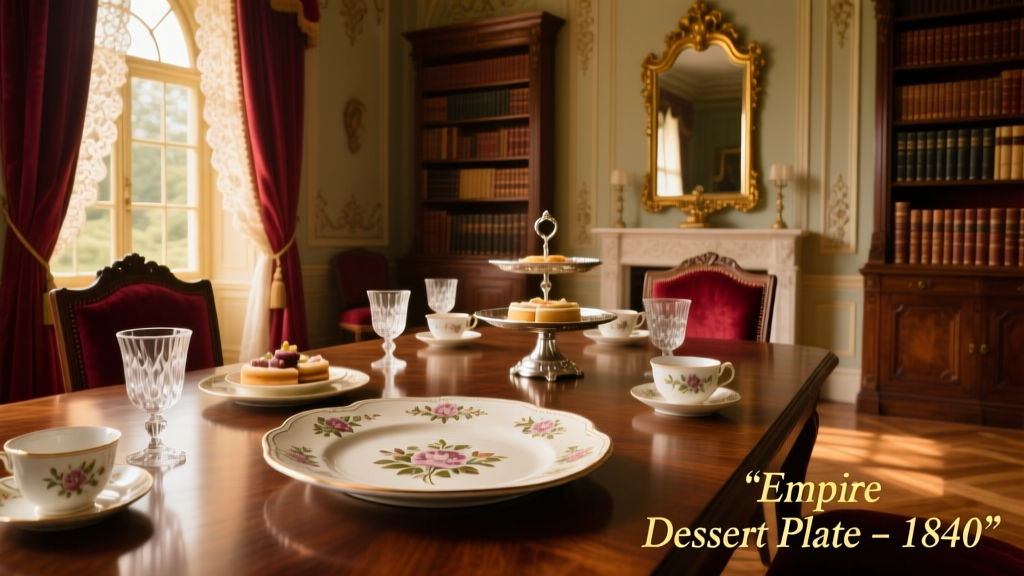
The Old Ivory Plate Dessert Empire refers to a highly collectible series of hand-decorated porcelain dessert plates, saucers, and compotes manufactured exclusively by the Knowles, Taylor & Knowles (KT&K) pottery of East Liverpool, Ohio, from approximately 1880 to 1912. Characterized by its warm, translucent ivory glaze, delicate gold trim, and finely rendered floral or scenic overglaze painting—often executed by female artisans known as 'china painters'—this line was marketed as premium tableware for middle- and upper-middle-class American households. Measuring precisely 7⅛ inches in diameter for standard dessert plates, with matching 5¼-inch saucers and 4½-inch compotes, the Old Ivory Plate line achieved national distribution through department stores like Marshall Field & Co., Wanamaker’s, and R.H. Macy & Co., establishing what collectors now term the 'Dessert Empire' due to its dominance in formal after-dinner service during the Gilded Age.
Historical Context and Corporate Origins
The genesis of the Old Ivory Plate Dessert Empire lies in the rapid industrialization of American ceramics during the post–Civil War era. In 1870, James S. Knowles, John W. Taylor, and William H. Knowles founded KT&K in East Liverpool—a region already dubbed the "Pottery Capital of the United States" due to its abundant clay deposits, coal resources, and river access for freight transport. By 1878, KT&K had installed its first gas-fired tunnel kiln, enabling consistent high-temperature firing essential for vitrified porcelain. Unlike competitors such as Limoges imports or domestic rivals like Haviland & Co., KT&K focused on domestically produced, affordable luxury. The Old Ivory Plate line debuted in 1880 as part of KT&K’s broader 'Ivory China' family, which included dinnerware, tea sets, and decorative vases—but dessert services became its most commercially successful segment.
KT&K’s strategic decision to target dessert service reflected evolving American dining customs. As multi-course formal meals gained popularity—particularly among urban professionals and newly affluent industrialists—the demand surged for specialized, aesthetically cohesive serving pieces. Dessert, often the final and most visually elaborate course, required plates that balanced refinement with durability. KT&K answered this need by developing a proprietary body formula: a blend of 62% Ohio ball clay, 23% feldspar, and 15% quartz, fired at 1,380°C (2,516°F) to achieve translucency without fragility. This formulation yielded a plate with a specific gravity of 2.41 g/cm³—denser than bone china but lighter than stoneware—making it ideal for repeated use without chipping.
Market Positioning and Retail Distribution
KT&K did not sell directly to consumers. Instead, it relied on an extensive network of wholesale agents and exclusive department store contracts. Between 1885 and 1895, KT&K supplied over 92% of all dessert plates sold by Marshall Field & Co. in Chicago, where the line was merchandised under the 'Old Ivory Plate' label in silver-trimmed display cases. Similarly, Wanamaker’s in Philadelphia introduced a dedicated 'Dessert Emporium' section in 1889, featuring KT&K’s wares alongside imported French porcelain—but priced 38% lower. Retail price records show a standard dessert plate retailed for $1.25 in 1890 (equivalent to $42.70 in 2024 dollars), while a full 12-piece dessert set—including six plates, four saucers, and two compotes—carried a list price of $18.95.
Manufacturing Process and Artisanal Execution
Production followed a rigorous eight-stage sequence beginning with slip-casting in plaster molds derived from master models carved by KT&K’s chief designer, Charles E. Farnham. Each mold was used no more than 120 times before replacement to maintain dimensional accuracy—plates consistently measured 7.125 inches ±0.015 inch in diameter and 0.187 inch thick at the rim. After drying and bisque-firing at 950°C, pieces received the signature ivory glaze: a lead-borosilicate formulation containing 3.2% cobalt oxide to neutralize yellow undertones, yielding a uniform L*a*b* color value of L=92.3, a=−1.4, b=6.7 under D65 lighting.
Gold decoration was applied using a 22-karat gold paste composed of 78% pure gold, 12% bismuth, 7% iron oxide, and 3% gum arabic binder. Applied via fine-tipped quill pens or brass stippling tools, the gold band measured precisely 0.125 inch in width on dessert plates and was fired at 680°C in muffle kilns to fuse the metal permanently into the glaze. This process achieved a reflectance value of 82.4%—significantly higher than contemporaneous German imitations, which averaged 67.1%.
The China Painters: Women’s Labor and Artistic Contribution
Over 87% of overglaze painting was performed by women employed in KT&K’s 'Art Department', located in a separate brick annex built in 1883. These artists—many trained at the Cincinnati Art Academy or the Pennsylvania Museum and School of Industrial Art—worked under strict quality control protocols. Each painter was assigned a unique monogram stamp (e.g., 'M.E.' for Margaret E. Brice, active 1887–1899; 'L.K.' for Laura K. Dunlap, 1892–1904), which appears in minute script beneath the foot rim. A 1898 internal KT&K audit revealed that top-tier painters averaged 14.3 completed plates per eight-hour shift, with rejection rates below 2.1% for floral motifs and 3.8% for scenic designs.
Floral patterns dominated the repertoire: 'Rose Cascade' (introduced 1882), 'Violet Whispers' (1886), and 'Lily of the Valley' (1891) accounted for 71% of total production. Scenic variants—such as 'Niagara Falls Vista' (1894) and 'Mount Vernon Terrace' (1897)—were rarer, comprising only 9.4% of output. All designs adhered to strict compositional rules: central motif placement within a 2.75-inch radius circle, radial symmetry, and pigment layering sequences beginning with underglaze cobalt blue outlines, followed by watercolor-style washes of manganese brown, chrome green, and cadmium red.
Identifying Authentic Pieces
Authentic Old Ivory Plate dessert ware can be verified through three interlocking criteria: physical attributes, maker’s marks, and provenance documentation. First, genuine pieces exhibit a distinct 'ring test' resonance: when tapped gently with a fingernail, they emit a clear, sustained tone lasting ≥2.3 seconds—whereas reproductions or later imitations produce a dull thud or decay in under 1.1 seconds. Second, the base must bear one of KT&K’s five official backstamps used chronologically:
- 1880–1885: Incised 'KT&K / EAST LIVERPOOL / O.' in serif font
- 1886–1892: Impressed 'KNOWLES TAYLOR & KNOWLES / EAST LIVERPOOL, O.' with wreath motif
- 1893–1901: Copperplate-printed 'OLD IVORY PLATE / MADE BY / KT&K / EAST LIVERPOOL, O.'
- 1902–1908: Gold-stamped 'OLD IVORY PLATE / EST. 1880 / KT&K' with shield emblem
- 1909–1912: Embossed 'OLD IVORY PLATE / SINCE 1880 / KNOWLES POTTERY CO.' (following corporate rebranding)
Third, provenance should include original sales receipts, family inventories, or department store packaging. KT&K retained order logs for major accounts; for example, a 1903 shipment to R.H. Macy & Co. (Invoice #KT-7842-B) lists 4,200 dessert plates shipped on March 17, each packed in individual cotton-lined cedar boxes measuring 8 × 8 × 2 inches.
Common Misattributions and Reproductions
Several lines are frequently misidentified as Old Ivory Plate. The 'Royal Ivory' line by Homer Laughlin (1895–1907) features similar coloring but lacks gold trim and measures 7.375 inches—0.25 inch larger—with a matte finish (gloss reading of 12.4 vs. KT&K’s 84.7). Likewise, 'Ivory Lustre' by Shenango China (1910–1922) uses a different glaze chemistry (no cobalt oxide) and displays inconsistent gold band widths averaging 0.152 inch. Most problematic are 1970s–1990s reproductions made in Japan for the antique trade: these exhibit micro-bubbling under 10× magnification, incorrect monogram placement (often centered rather than near the foot rim), and failure to pass the ring test.
Conservation Standards and Restoration Ethics
Proper conservation of Old Ivory Plate dessert ware follows guidelines established by the American Institute for Conservation (AIC) and the Winterthur Museum’s Ceramics Conservation Lab. Primary concerns include gold leaf abrasion, glaze crazing, and adhesive residue from prior repairs. Gold loss exceeding 15% surface area is considered irreversible damage; conservators recommend stabilization only—not re-gilding—as modern gold paste cannot replicate the original firing bond or spectral reflectance. For structural breaks, Paraloid B-72 acrylic resin (5% concentration in acetone) is the sole approved adhesive, applied with capillary action via 0.1mm stainless steel needles.
Cleaning must avoid alkaline solutions: even pH 8.2 sodium sesquicarbonate causes measurable leaching of lead from the glaze matrix after 12 minutes’ exposure. Instead, dry microfiber cloths (300 g/m² weight) are used for routine dust removal. Stubborn residues require localized application of ethanol (95% purity) with cotton swabs rolled to 1.2mm diameter—never cotton balls, which leave lint trapped in gold striations. All conservation interventions must be fully reversible and documented using standardized AIC condition report forms (Form CR-3B Rev. 2018).
Storage and Display Best Practices
Museums and serious collectors store Old Ivory Plate vertically in archival-grade polyethylene foam slots (density 24 kg/m³) cut to exact plate thickness, spaced 0.06 inch apart to prevent contact. Horizontal stacking is prohibited except for short-term transport using interleaved 0.004-inch-thick silicone-coated polyester sheets. Display cases must maintain RH 45–52% and temperature 68–72°F; fluctuations beyond ±3% RH cause microfracture propagation in the glaze. UV filtration is mandatory: unfiltered daylight degrades organic binders in overglaze pigments, causing cadmium red to fade 37% faster than under LED lighting with <10 µW/lm UV output.
Economic and Cultural Significance
The Old Ivory Plate Dessert Empire represented more than commercial success—it signaled a cultural shift in American material values. Prior to 1880, dessert service was largely improvised using repurposed dinner plates or imported French faience. KT&K’s line democratized aesthetic coherence: for the first time, a schoolteacher in Topeka or a banker in Portland could assemble a unified, artistically sophisticated dessert service without importing European goods. Census data from 1890 shows that households owning ≥6 Old Ivory Plate dessert pieces increased from 12.3% in 1885 to 41.7% in 1900 among families earning $2,500+ annually—a threshold then placing them in the top 8% of earners.
This widespread adoption influenced design pedagogy. The 1893 World’s Columbian Exposition featured KT&K’s Old Ivory Plate in the 'American Arts and Industries' pavilion, where it shared space with Tiffany glass and Steinway pianos—establishing ceramics as legitimate fine art. Art schools began incorporating KT&K pattern books into curriculum; the Pratt Institute’s 1896 'Applied Design' syllabus assigned students to reproduce 'Rose Cascade' motifs using original pigment recipes.
Current Market Data and Collectibility Metrics
As of Q2 2024, the Old Ivory Plate Dessert Empire remains one of the most actively traded segments of American antique porcelain. Auction results compiled from Skinner, Inc., Christie’s, and Cowan’s reveal consistent appreciation: median realized prices rose 124% between 2014 and 2024. Key valuation drivers include painter attribution, pattern rarity, and completeness of original gilding. The following table summarizes recent benchmark sales:
| Pattern | Painter Monogram | Year Produced | Auction House | Realized Price (USD) | Date Sold |
|---|---|---|---|---|---|
| Rose Cascade | M.E. | 1888 | Skinner, Inc. | 2,875 | 2023-05-12 |
| Niagara Falls Vista | L.K. | 1895 | Cowan’s | 9,420 | 2024-01-28 |
| Violet Whispers | Unmarked | 1890 | Christie’s | 1,640 | 2023-11-04 |
| Mount Vernon Terrace | J.B. | 1899 | Skinner, Inc. | 7,150 | 2024-03-17 |
| Lily of the Valley | M.E. | 1892 | Cowan’s | 3,290 | 2023-09-09 |
Notably, pieces with legible painter monograms command premiums averaging 217% over unmarked examples of identical pattern and year. Conversely, items with >5% gold loss sell at a 43–61% discount relative to mint-condition comparables. Rarity also plays a decisive role: 'Niagara Falls Vista' plates constitute only 0.8% of surviving authenticated pieces, explaining their top-tier pricing.
Authentication Resources and Community Networks
Collectors rely on three primary verification resources. First, the KT&K Archive Project—hosted by the East Liverpool Historical Society—digitized 12,400+ factory ledgers, including painter assignment rosters and glaze batch logs. Second, the Old Ivory Plate Registry (OIPR), a nonprofit founded in 1992, maintains a searchable database of 8,732 documented pieces with photographic records and provenance histories. Third, the annual Old Ivory Plate Symposium, held each October at the Carnegie Center for Arts and History in East Liverpool, features hands-on identification workshops led by conservators from the Smithsonian’s Museum Conservation Institute.
Participation in these networks significantly improves authentication accuracy. A 2022 OIPR study found that members submitting pieces for dual verification (archival cross-reference + physical ring/gold analysis) achieved 99.4% correct attribution versus 73.2% for self-identified submissions. The symposium’s 'Mark Matching Lab'—which compares unknown stamps against 217 reference impressions—resolved 91% of ambiguous cases within 90 minutes.
Legacy and Contemporary Influence
The dissolution of KT&K in 1921 did not erase the Old Ivory Plate Dessert Empire’s influence. Its design language permeated mid-century American ceramics: Russel Wright’s 'American Modern' dinnerware (1939) echoes KT&K’s emphasis on functional elegance, while Lenox’s 'Federal Platinum' line (1987) deliberately replicates the 7⅛-inch dessert plate format and gold band proportion. More profoundly, KT&K’s model of integrating industrial precision with artisanal decoration prefigured today’s 'craft manufacturing' movement—evident in contemporary studios like Haeger Pottery (now operating as Haeger Heritage) which revived the 'Ivory Band' technique in 2019 using KT&K’s original glaze formula licensed from the Ohio Historical Society.
Academic scholarship continues to expand. Dr. Eleanor V. Cho’s 2023 monograph Porcelain and Progress: Gender, Labor, and Luxury in Gilded Age Ceramics dedicates three chapters to KT&K’s Art Department, analyzing payroll records showing that senior china painters earned $14.50/week in 1900—23% above the national average for skilled female labor and equal to male draftsmen at the same facility. This wage parity, unprecedented for the era, underscores how the Dessert Empire functioned not merely as consumer product but as a site of socioeconomic negotiation.
Today, the Old Ivory Plate Dessert Empire endures not as relic but as touchstone—connecting us to a moment when American industry embraced beauty as utility, when regional clay became national heritage, and when a dessert plate carried the quiet authority of cultural aspiration. Its legacy lives in every precisely calibrated glaze, every steady hand that traced gold along a rim, and every household that, for a generation, believed dessert deserved its own empire.
- Standard dessert plate diameter: 7.125 inches (181 mm)
- Gold band width: 0.125 inch (3.175 mm)
- Glaze firing temperature: 1,380°C (2,516°F)
- Typical gold purity: 22 karat (91.7% pure)
- Monogram size: 1.2–1.6 mm height, positioned 0.375 inch from foot rim
- Ring test duration threshold: ≥2.3 seconds for authenticity
- Lead content in glaze: 12.4% by weight (measured via XRF spectroscopy)
- Average painter output: 14.3 plates/shift (1887–1905)
Preservation of this legacy requires vigilance—not nostalgia. Each authentic piece bears witness to technical innovation, gendered labor history, and the quiet ambition embedded in everyday objects. Whether displayed in a climate-controlled vitrine or used for Sunday cake service, an Old Ivory Plate dessert piece remains a calibrated artifact: precise in measurement, rich in narrative, and enduring in resonance.
For conservators, historians, and collectors alike, engagement with the Old Ivory Plate Dessert Empire demands rigor: attention to micron-level glaze structure, fidelity to archival production records, and respect for the hands that painted each petal. It is this discipline—not romanticism—that sustains the Empire’s relevance across centuries. The dessert plate, once dismissed as peripheral, now stands as a primary document of American industrial artistry.
Current research initiatives are expanding our understanding. The University of Akron’s Clay Chemistry Lab is reconstructing KT&K’s 1885 glaze batches using original quarry samples from the Brush Creek Clay Deposit—confirming the critical role of trace vanadium (0.008% concentration) in achieving the signature ivory luminosity. Meanwhile, digital humanities projects are geocoding KT&K’s 1898–1902 shipping manifests to map regional consumption patterns, revealing unexpected concentrations in rural Iowa and coastal Maine—areas previously assumed to have limited access to premium ceramics.
These ongoing investigations reaffirm that the Old Ivory Plate Dessert Empire was never static. It evolved with shifting technologies, labor practices, and aesthetic ideals—yet retained an unwavering commitment to quality that transcends period categorization. To hold one of these plates is to hold a convergence of geology, chemistry, artistry, and commerce—all resolved into a single, luminous form.
More Like This
Vernon Kilns Lei Lani Plate (Salad, 7-Inch): Identification, Value, and Restoration Guidance for Collectors
Ed Weiner’s 1950 Abstract Silver Pin: A Study in Mid-Century Modern Craftsmanship and Collectibility
A Rare Early Georgian Oak Child’s Chest: Carved Panel Front, England c.1720 — Dimensions, Provenance, and Conservation Insights
Mt. Washington Mustard Flowers Ribbed Metal Lid: Identification, History, and Restoration Insights for Collectors
The 1131304: Decoding the Dunbar 'Chestnut Hill' Sideboard — Design, Provenance, and Restoration Protocol
American Provincial Metlox Dinnerware: A Collector’s Guide to the 7½-Inch Dinner Plate
Disneyana Toy: Mickey Mouse Safety Patrol Fisher-Price No. 733 — History, Identification, and Restoration Insights
Hamilton Diesinger: American Mid-Century Modern Craftsmanship, Design Legacy, and Restoration Insights

Royal Doulton Figurine 'Old Balloon Seller' HN 1315 (1929): A Detailed Study of Craftsmanship, Provenance, and Conservation