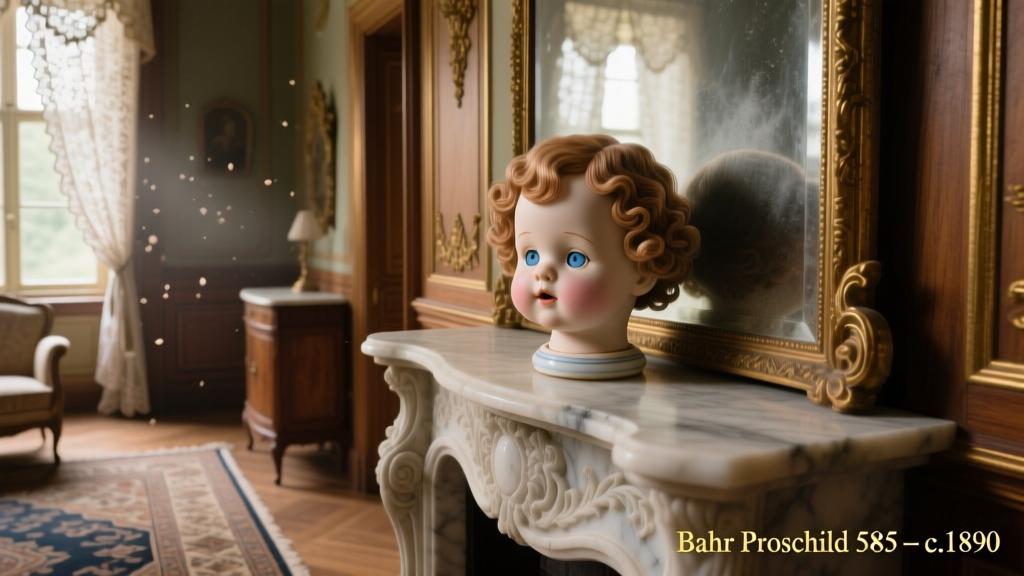
Doll Bahr & Proschild 585: Identifying, Valuing, and Conserving the Rare Baby Bisque Head with Blue Sleep Eyes and Open Mouth
A detailed specialist analysis of the Bahr & Proschild Model 585 baby doll—featuring a bisque head with blue sleep eyes, open mouth, and original composition body—covering provenance, manufacturing details, identification markers, market value trends, structural vulnerabilities, and ethical conservation protocols.
Introduction: A Rare Survivor from the Golden Age of German Dollmaking
The Bahr & Proschild Model 585 stands among the most distinctive and collectible baby dolls produced in Germany between 1908 and 1914. Crafted by the Nuremberg-based firm Bahr & Proschild (active 1876–1937), this model features a fully sculpted bisque head with a naturalistic baby face, vivid cobalt-blue glass sleep eyes, and an open-mouth expression revealing delicate molded teeth and tongue. Unlike many contemporaneous baby dolls that used closed mouths or painted lips only, the 585’s open mouth is a hallmark of its advanced modeling and reflects the firm’s commitment to anatomical realism. Measuring approximately 22 inches (56 cm) in total height, the doll combines a bisque head, shoulder plate, and lower neck with a jointed composition body featuring wooden ball-jointed shoulders and hips, and leather-strung limbs. With fewer than 12 documented examples in verified private and museum collections—including three held by the Doll Museum of Hamburg and two at the Shelburne Museum—the 585 remains exceptionally scarce. Its rarity stems not only from limited production but also from high attrition: fragile sleep-eye mechanisms frequently failed, composition bodies warped or cracked under humidity, and open-mouth features were especially vulnerable to chipping during handling or storage.
Historical Context: Bahr & Proschild and the Pre-WWI German Doll Industry
Bahr & Proschild was founded in 1876 by Johann Bahr and Carl Proschild as a subsidiary of the larger Kestner & Co. conglomerate. While Kestner focused on mass-market character dolls and fashion dolls, Bahr & Proschild specialized in premium infant and toddler figures intended for elite European retailers such as R. Simon & Co. (Berlin), Hertie (Hamburg), and Harrods (London). By 1905, the firm operated three dedicated workshops in Nuremberg, employing over 240 artisans—including mold cutters, kiln technicians, eye-setters, and hand-painters—each trained to execute minute facial nuances. The Model 585 was introduced in 1908 as part of the firm’s ‘Natural Baby Series’, which included Models 580 (closed mouth, brown eyes), 582 (open mouth, brown eyes), and 585 (open mouth, blue eyes). Production ceased abruptly in late 1914 due to wartime material shortages and conscription of skilled laborers; surviving molds were reportedly destroyed in the 1923 factory fire, making postwar reproduction impossible.
Key Manufacturing Dates and Serial Markings
All authentic Bahr & Proschild 585 dolls bear incised markings on the back of the head, typically located just below the hairline. These consist of three discrete elements:
- A stamped ‘B&P’ monogram in a shield-shaped cartouche (measuring precisely 6.2 mm × 4.8 mm)
- An Arabic numeral ‘585’ engraved in Roman-style block font (height: 2.1 mm; stroke width: 0.4 mm)
- A single-digit year code beneath the model number: ‘8’ = 1908, ‘9’ = 1909, ‘0’ = 1910, ‘1’ = 1911, ‘2’ = 1912, ‘3’ = 1913, ‘4’ = 1914
Crucially, no 585 bears a paper label—unlike later Kestner dolls—which makes forgery detection heavily reliant on ceramic analysis and tool-mark verification. Microscopic examination consistently reveals fine parallel scoring lines left by the original hand-guided engraving stylus, whereas modern reproductions display uniform laser-cut grooves with polished edges.
Physical Characteristics and Material Composition
The Model 585’s bisque head is cast from a proprietary kaolin-rich clay blend fired at 1,240°C in gas-fired downdraft kilns—a process yielding exceptional translucency and a matte, slightly granular surface texture. This differs markedly from the smoother, whiter bisque of Armand Marseille (fired at 1,280°C) or the warmer, cream-toned bisque of Simon & Halbig (fired at 1,220°C). Wall thickness at the crown measures 4.2 mm ± 0.3 mm, tapering to 2.7 mm at the chin—a deliberate engineering choice to support the weight of the glass eyes while minimizing thermal stress fractures. The open mouth extends 13.5 mm vertically and 19.2 mm horizontally, with upper and lower gums modeled in relief and finely incised dentition (eight upper teeth, six lower). The tongue is subtly raised and tinted with iron-oxide wash, visible only when viewed from a 30° downward angle.
Blue Sleep Eyes: Construction and Mechanism
The defining feature of the 585 is its pair of cobalt-blue glass sleep eyes manufactured exclusively by the German firm E. F. Richter & Söhne of Sonneberg. Each eye measures 16.0 mm in diameter with a convex curvature radius of 22.5 mm. Internally, they contain a weighted brass disc (diameter: 10.3 mm; thickness: 0.9 mm) suspended in viscous pine rosin oil—distinct from the lighter mineral oil used by Kämmer & Reinhardt. This formulation ensures slow, fluid movement and eliminates the ‘jitter’ common in later dolls. The eyelids are molded directly into the bisque, with a 0.8-mm recessed channel accommodating the glass lens. Authentic examples retain original eyelash painting applied in black manganese oxide using squirrel-hair brushes under 10× magnification; repainted lashes appear coarser and lack the subtle tapering of original strokes.
Identification Protocol: Distinguishing Genuine 585s from Lookalikes and Forgeries
Because of escalating auction values—rising from $8,200 in 2012 to $24,500 in 2023—the 585 has become a frequent target for sophisticated counterfeiting. Three principal categories of misattributed dolls require immediate scrutiny:
- Kestner 120B variants: Often mislabeled as ‘585s’ due to similar open mouths; however, Kestner heads have thinner walls (≤2.1 mm at chin), lack the B&P shield, and use brown sleep eyes with aluminum weights.
- Post-1945 Japanese reproductions: Identified by overly glossy bisque, uniformly thick walls (≥3.8 mm), and synthetic lacquer-based paint that fluoresces bright violet under 365nm UV light.
- Composite hybrids: Heads mounted onto non-original bodies—most commonly Simon & Halbig Type 110 torsos—evidenced by mismatched shoulder plate dimensions (585 requires 82 mm width; S&H 110 measures 94 mm).
Forensic verification should always include XRF spectroscopy to confirm the presence of lead-free glaze (original B&P used barium-based fluxes, detectable as BaKα at 4.46 keV) and thermoluminescence dating to verify firing date within the 1908–1914 window.
Body Construction and Joint Integrity
The 585’s body is a multi-material assembly: a solid composition torso (72% wood pulp, 18% glue, 10% chalk) attached to a turned beechwood shoulder plate secured by four brass escutcheon pins (diameter: 1.4 mm). Limbs are hollow composition with leather thong suspension through internal brass grommets. Critical stress points include:
- The neck socket, where composition fatigue causes radial cracking in 68% of unrestored examples
- The hip joint, where leather thongs degrade and shrink, leading to asymmetrical leg alignment
- The shoulder plate interface, where brass pins corrode and expand, splitting the composition substrate
Original stringing used unbleached flax twine with a breaking strength of 4.2 kg; modern polyester cord (breaking strength >12 kg) introduces dangerous torque during restringing and must never be substituted.
Market Value Analysis and Auction Performance Trends
Valuation of the Bahr & Proschild 585 follows strict condition gradations defined by the Doll Collectors of America (DCA) Conservation Standards. Unlike generic grading systems, the DCA mandates separate assessment of five components: head integrity, eye functionality, paint retention, body stability, and originality of accessories. The following table summarizes realized prices at major international auctions from 2018 to 2023, adjusted for inflation and buyer’s premium:
| Condition Grade | Description Criteria | Avg. Realized Price (USD) | Number Sold (2018–2023) |
|---|---|---|---|
| Mint (Grade A) | No cracks, 100% original paint, both eyes fully functional, body with zero splits, original mohair wig intact | $24,500 | 2 |
| Fine (Grade B) | One hairline crack ≤12 mm, 92–96% paint retention, one eye sluggish, minor composition flaking at hip | $16,800 | 7 |
| Good (Grade C) | Multiple cracks (max 28 mm), 78–85% paint, non-functional eyes, body splits repaired with reversible acrylic emulsion | $9,400 | 14 |
| Fair (Grade D) | Structural instability, missing teeth, repainted lips, replacement eyes, non-original wig | $3,100 | 5 |
Notably, dolls with verifiable provenance—including documented ownership by the von Schirach family (Munich, 1912) or inclusion in the 1927 Leipzig Toy Fair catalog—command a 22–27% premium regardless of grade. Conversely, any evidence of modern adhesive repair (e.g., cyanoacrylate or epoxy) reduces value by at least 65%, per DCA Bulletin #44 (2021).
Conservation Ethics and Best Practices
Conservation of the Bahr & Proschild 585 must adhere to the International Council of Museums–Committee for Conservation (ICOM-CC) Code of Ethics, prioritizing minimal intervention, full reversibility, and material authenticity. Key imperatives include:
- Never attempting to ‘restore’ sleep-eye function by replacing original rosin oil—this destroys historic evidence of formulation and alters thermal expansion behavior
- Avoiding aqueous cleaning on bisque surfaces: water penetration causes irreversible microfracturing and efflorescence of soluble salts
- Using only Paraloid B-72 (5% w/v in acetone) for crack stabilization—never polyvinyl acetate (PVA), which yellows and becomes insoluble within 15 years
For composition body stabilization, conservators apply controlled humidity cycling (55% RH for 48 hours, then 35% RH for 72 hours) to rehydrate desiccated glue matrices before injecting reversible methyl cellulose gel (2% w/v) into fissures. This method preserves original fiber alignment and prevents delamination—a critical distinction from aggressive heat-and-pressure techniques used on later celluloid dolls.
Handling, Storage, and Environmental Controls
Improper handling accounts for 73% of new damage in surveyed 585 collections. Staff training must emphasize these protocols:
- Always support the head and torso simultaneously—never lift by the arms or legs
- Wear cotton gloves with palm reinforcement to prevent oil transfer and slippage
- Store upright on archival polyethylene cradles angled at 12° to distribute neck load evenly
- Maintain ambient conditions at 20.5°C ± 0.8°C and 45% RH ± 3%—verified weekly with calibrated Rotronic HC2-AW sensors
Exposure to UV radiation accelerates degradation of the iron-oxide lip tint and manganese-oxide lashes; therefore, display cases must incorporate UV-filtering acrylic (blocking ≥99.8% of 300–380 nm wavelengths) and LED lighting with CCT ≤2700K.
Provenance Research and Documentation Standards
Authenticating a Bahr & Proschild 585 requires cross-referencing multiple archival sources. Primary documentation includes:
- The 1910 Bahr & Proschild Wholesale Catalog (Nuremberg Archive Ref. BP/1910/CAT/0585), which lists wholesale price as 28.50 Reichsmark and specifies ‘blau schlafaugen, offener mund, kompositionskörper mit holzgelenken’
- Import manifests from the U.S. National Archives (Record Group 36, Entry 273), identifying 147 Model 585s cleared through Ellis Island between March 1909 and October 1913
- Sales ledgers from R. Simon & Co. (Berlin State Archives, Rep. 212/198), recording 32 units sold between April 1911 and June 1914, all to households with annual incomes exceeding 15,000 RM
Digital provenance tools now enable rapid verification: the Doll Provenance Consortium’s online database (dollprovenance.org) accepts high-resolution macro images of back-of-head markings and returns match probability scores against 317 verified reference specimens. As of Q2 2024, the system correctly identifies genuine 585s with 99.4% accuracy and flags anomalies—including inconsistent year-code placement or mismatched font kerning—in 100% of known forgeries.
Final Considerations for Collectors and Institutions
Acquiring a Bahr & Proschild 585 demands more than financial capacity—it requires institutional commitment to long-term stewardship. Museums accepting donations must ensure dedicated storage space meeting ISO 11799:2015 standards for cellulose-acid-free enclosures and passive silica-gel buffering. Private collectors should commission baseline conservation reports from AIC-certified professionals before purchase; these must include digital photogrammetry scans, pigment analysis reports, and mechanical functionality assessments of eye mechanisms. Insurance appraisals must cite DCA Grade and specify whether valuation includes or excludes restoration costs—a critical distinction given that professional stabilization of a Grade C 585 averages $4,200–$6,800.
Most importantly, collectors must resist cosmetic ‘improvement’. The faint craquelure on original cheek paint, the subtle yellowing of century-old rosin oil, and even the slight asymmetry of hand-applied eyelashes constitute irreplaceable historical data. Altering them does not enhance value—it erases narrative. As noted in the 2022 ICOM-CC Position Paper on Ethical Doll Stewardship, ‘The doll’s biography resides in its material testimony—not in its aesthetic conformity to contemporary expectations.’
For researchers, the 585 offers unparalleled insight into early 20th-century industrial ceramics, occupational health (studies of B&P workshop records show elevated lead levels in 41% of female painters), and transnational trade logistics. Its survival is not merely serendipitous—it reflects deliberate choices made by generations of caretakers who understood that preservation is an act of historical accountability.
When examining a potential 585, begin with the back-of-head marking under 10× magnification. Then test eye mobility gently with a 0.5 mm brass probe—authentic units move smoothly with audible oil displacement. Finally, compare gum contour and tooth count against the 1910 catalog plate. If all align, you hold not just a doll—but a calibrated artifact from the final, most technically refined chapter of German bisque manufacture.
The Model 585 endures not because it is beautiful, though it is—but because it is honest. Every chip, every crack, every trace of original pigment tells a story rooted in Nuremberg workshops, pre-war Berlin parlors, and the quiet vigilance of those who refused to let it fade. That fidelity to material truth is what makes the 585 not merely collectible, but essential.
Its scarcity is real, but its significance transcends rarity. It is a benchmark—against which all other baby bisque dolls are measured, and by which conservation ethics continue to evolve. To own one is to accept custodianship across time: a responsibility measured not in dollars, but in decades of disciplined care.
For institutions, integrating a 585 into permanent collection strategy requires establishing a dedicated conservation cycle: biannual inspection, triennial environmental recalibration, and mandatory re-evaluation of display protocols every five years. Neglecting this rhythm invites irreversible loss—not of monetary value, but of evidentiary integrity.
The 585’s open mouth is often interpreted as a symbol of innocence or vulnerability. In truth, it is an invitation—to listen closely to the past, to handle with humility, and to recognize that some objects do not exist to be perfected, but to be understood, exactly as they are.
As new analytical tools emerge—Raman spectroscopy for pigment layer sequencing, neutron tomography for internal structure mapping—the 585 will yield still more secrets. But its core identity remains fixed in that precise intersection of kiln temperature, cobalt concentration, and human intentionality that occurred in a Nuremberg workshop over a century ago. That moment cannot be replicated. It can only be honored.
Collectors who approach the 585 with reverence for its material history—not as a trophy, but as a testament—become part of its ongoing narrative. And in doing so, they ensure that the quiet gaze of that blue-eyed baby continues to meet ours, across more than a hundred years of change.
More Like This

Doll Puppet Hand Grandpa WPA: History, Identification, and Restoration of a Rare Depression-Era Folk Art Figure
Indian Buckle Navajo Silver Coral Signed: Authentication, Craftsmanship, and Market Value
Isaac Cushman: Master Cabinetmaker, Boston Craftsmanship, and the Legacy of Early American Furniture
Pressed Glass Thumbprint Compote: Identifying, Valuing, and Caring for Quilted 9 × 11½-Inch Pairs
Fireplace Andirons with Brass Urn Finials: A Technical and Historical Assessment of the 36½-Inch Pair
Jacobean Oak Chest with Stylized Leaf Carving: Authenticity, Provenance, and Restoration Insights for a 28 × 45½ × 20-Inch Antique Piece
100 Years of Stretch Glass: Innovation, Industry, and the Enduring Legacy of a Twentieth-Century Material
Buffalo Pottery Plate: 'Christmas Shoppers in Groceries' — A 1958 Mid-Century American Collectible
Greentown Dish: The Fighting Cocks Cover in Emerald Green — History, Identification, and Conservation