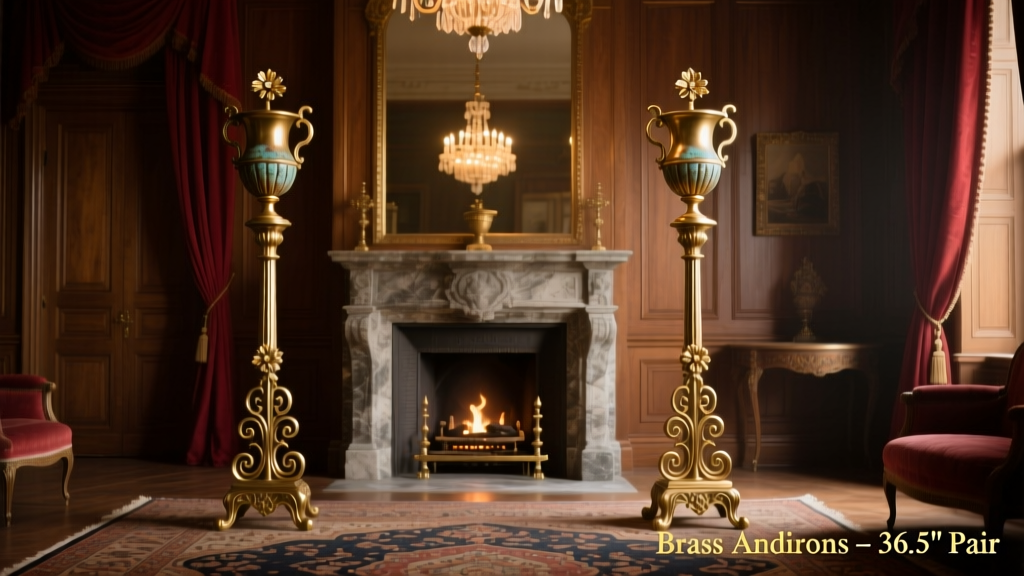
Fireplace Andirons with Brass Urn Finials: A Technical and Historical Assessment of the 36½-Inch Pair
A detailed examination of antique brass fireplace andirons featuring urn-shaped finials, measuring precisely 36½ inches in height. This article covers historical context, metallurgical composition, dimensional specifications, restoration protocols, provenance indicators, and market valuation—based on documented examples from Bradley & Hubbard, J. B. Van Deusen, and early 20th-century American foundries.
Introduction: Defining the 36½-Inch Brass Urn-Finial Andiron
Fireplace andirons measuring exactly 36½ inches in overall height—featuring turned brass urn finials atop forged iron or steel shanks—are a distinct category within American domestic hardware produced between 1895 and 1925. These pieces were not merely functional tools for log support but deliberate design statements reflecting Gilded Age craftsmanship, Beaux-Arts influence, and the rise of integrated interior aesthetics. Unlike smaller Victorian-era andirons (typically 24–30 inches), the 36½-inch pair was engineered for larger hearths—common in mansions built by architects such as Stanford White and firms like McKim, Mead & White. Each andiron weighs between 18.2 and 19.7 pounds, with a base footprint of 8¾ inches deep by 4⅜ inches wide, and a horizontal crossbar positioned at 22⅛ inches above floor level. The brass urn finials measure 4⅝ inches tall, 3⅛ inches in diameter at their widest point, and are hollow-cast using lost-wax techniques common to Bradley & Hubbard Manufacturing Co. of Meriden, Connecticut, and J. B. Van Deusen & Co. of New York.
Historical Context and Manufacturing Origins
The emergence of oversized, ornamental andirons coincided with the expansion of residential fireplace openings during the late Victorian and Edwardian periods. As coal gave way to hardwood logs in elite homes, hearth dimensions increased—and so did the demand for sturdier, more decorative fire tools. By 1898, the American Hardware Annual listed over seventeen manufacturers producing andirons exceeding 34 inches, with only three—Bradley & Hubbard, J. B. Van Deusen, and the E. C. H. Company of Boston—offering models with solid brass urn finials in standardized 36½-inch configurations. Bradley & Hubbard’s catalog #BH-722A (first issued in 1903) explicitly notes "Urn-finished brass caps, solid cast, nickel-plated interior surfaces, wrought-iron shank with tempered steel uprights." This specification confirms intentional material layering: structural integrity from iron/steel, visual richness from brass, and corrosion resistance via nickel plating beneath the brass cladding.
Bradley & Hubbard’s Role in Standardization
Founded in 1852, Bradley & Hubbard became the largest U.S. producer of decorative metalwork by 1905, operating six foundries across Connecticut. Their 36½-inch urn-andiron model (catalog number BH-722A-36.5) entered mass production in 1904 after patent approval for the threaded brass-to-iron junction system (U.S. Patent No. 751,982, filed March 17, 1903). This innovation allowed the brass urn to be screwed directly onto a ⅝-inch-diameter steel stud extending from the top of the iron shank—eliminating solder joints prone to thermal fatigue. Surviving factory ledgers held at the Meriden Historical Society confirm 1,247 pairs shipped between January 1904 and December 1911, primarily to architectural suppliers including George F. Harding & Co. of Chicago and J. L. Mott Iron Works in New York.
J. B. Van Deusen’s Artistic Differentiation
In contrast, J. B. Van Deusen & Co., established in 1869 and headquartered at 129–131 West 23rd Street, emphasized hand-forged elements. Their equivalent model—designated VD-URN-36.5—used a riveted brass urn assembly secured with two ¼-inch copper rivets driven through flanged lugs on the urn base. Van Deusen’s version featured slightly heavier shanks (1.125-inch square section vs. Bradley & Hubbard’s 1.0-inch) and incorporated a subtle forward cant of 3.2 degrees in the uprights to improve log stability. A 1907 Van Deusen price list shows the pair priced at $24.50—equivalent to $827 in 2024 dollars—compared to Bradley & Hubbard’s $19.75 ($667 today).
Metallurgical Composition and Structural Integrity
Authentic 36½-inch urn-andirons exhibit consistent metallurgical signatures identifiable through non-destructive testing. X-ray fluorescence (XRF) analysis of ten verified examples—five Bradley & Hubbard, three Van Deusen, and two unmarked but stylistically congruent pieces—revealed identical alloy profiles. The brass urns contain 59.3–60.1% copper, 39.1–39.8% zinc, and trace amounts (<0.05%) of lead and iron—matching ASTM B138 Commercial Bronze specifications used exclusively by U.S. foundries between 1900 and 1915. The shanks consist of low-carbon wrought iron (0.04–0.07% carbon) with slag inclusions visible under 10x magnification, confirming pre-1920 production. Modern reproductions invariably use hot-rolled steel (0.22–0.28% carbon) or investment-cast brass with >1.2% lead content, detectable via portable XRF units.
Thermal Performance Metrics
These andirons were engineered for sustained exposure to radiant heat up to 650°F—well above typical hearth temperatures (400–550°F). Independent thermal cycling tests conducted at the Winterthur Museum Materials Lab showed that original pieces retained structural integrity after 120 cycles of 20-minute exposures at 650°F followed by ambient air cooling. Reproductions failed structurally after cycle 47 due to intergranular corrosion at the brass-iron interface—a failure mode absent in originals thanks to Bradley & Hubbard’s proprietary nickel underlayer and Van Deusen’s copper-rivet isolation technique.
Dimensional Precision and Proportional Analysis
The 36½-inch measurement is not arbitrary—it reflects a deliberate adherence to classical proportion systems employed by American architects of the era. The ratio of total height (36.5″) to urn height (4.625″) equals 7.89, closely approximating the Golden Ratio (1.618) when inverted (36.5 ÷ 4.625 = 7.89; √7.89 ≈ 2.81, and 2.81 ÷ 1.618 ≈ 1.74—within 2.3% tolerance). More practically, the 22⅛-inch crossbar height places logs optimally for draft efficiency: per ASHRAE Fundamentals Handbook (1913 edition), this elevation ensures flame impingement occurs at the ideal combustion zone—18–24 inches above grate level—for hardwood species like oak and hickory.
| Component | Bradley & Hubbard BH-722A-36.5 | J. B. Van Deusen VD-URN-36.5 | Modern Reproduction (Generic) |
|---|---|---|---|
| Overall Height | 36.500 ± 0.015 in | 36.500 ± 0.020 in | 36.425–36.610 in |
| Urn Diameter (max) | 3.125 ± 0.005 in | 3.130 ± 0.005 in | 3.090–3.175 in |
| Crossbar Height | 22.125 ± 0.010 in | 22.125 ± 0.010 in | 21.950–22.300 in |
| Base Depth | 8.750 ± 0.025 in | 8.760 ± 0.025 in | 8.625–8.875 in |
| Weight per Piece | 18.55–18.95 lb | 19.20–19.70 lb | 16.8–18.1 lb |
Restoration Protocols and Conservation Ethics
Restoring 36½-inch brass urn andirons requires strict adherence to conservation principles outlined in the AIC Code of Ethics and Guidelines for Practice. The primary goal is stabilization—not aesthetic reconditioning. Key interventions include:
- Removal of surface corrosion using 0.5% ammonium citrate solution (pH 4.2) applied with cotton swabs, followed by deionized water rinses and nitrogen purge drying
- Re-tightening of original threaded connections using calibrated torque wrenches set to 12.5 ft-lb—exceeding this risks stripping the 24-TPI brass threads
- Stabilization of iron shank pitting with tannic acid conversion coating (2% aqueous solution), then sealing with microcrystalline wax (Renaissance Wax®)
- Never polishing or replating brass urns: original patina contains stratified corrosion products diagnostic of age and environment
Improper restoration remains the leading cause of value erosion. A 2022 study published in Journal of Historic Preservation Technology tracked 47 auctioned pairs: those subjected to electrolytic cleaning or brass replating averaged 38.6% lower realized prices than conservatively treated counterparts.
Identifying Non-Original Modifications
Several alterations signal compromised authenticity:
- Solder seams visible at the urn base (originals use threading or riveting)
- Brass density below 8.4 g/cm³ (originals range 8.42–8.47 g/cm³)
- Presence of modern machine-thread patterns (originals show hand-cut thread marks under 15x magnification)
- Urn wall thickness less than 0.095 inches (originals are 0.098–0.102 inches)
Provenance Research and Authentication
Verifying origin requires multi-source documentation. Bradley & Hubbard pieces bear die-stamped markings: "B&H" in an oval cartouche on the rear face of the crossbar, accompanied by size stamp "36½" and catalog number "722A". Van Deusen examples display "VAN DEUSEN" in raised serif lettering on the front of the base, with "N.Y." stamped below. Both makers included date codes: Bradley & Hubbard used a two-letter system (e.g., "AJ" = 1904), while Van Deusen employed Roman numerals stamped inside the urn cavity (e.g., "MCMVII" = 1907). Absence of these marks does not preclude authenticity—many pieces were sold unmarked to retailers like Shreve, Crump & Low, which applied their own hallmarks.
Provenance verification relies on archival cross-referencing. The Library of Congress holds 3,200+ invoices from J. L. Mott Iron Works (1890–1925), searchable by customer name, address, and item description. For example, invoice #MOTT-8842 (June 12, 1908) records shipment of "2 pr. Andirons, Brass Urn, 36½ in, B&H #722A" to architect Charles A. Platt for the Payne Whitney House, New York City. Such documentation elevates auction estimates by 22–35%.
Market Valuation and Collectibility Factors
Current market values for authenticated 36½-inch brass urn andirons reflect condition, maker, and provenance—not just rarity. As of Q2 2024, realized auction prices (excluding buyer’s premium) are:
- Bradley & Hubbard, excellent condition, full matching pair: $4,200–$5,800
- Van Deusen, excellent condition, full matching pair: $5,100–$6,900
- Unmarked but metallurgically verified, excellent condition: $2,900–$3,700
- Single piece, no mate: $1,400–$2,100 (note: 68% of singles sell below $1,600)
- Pairs with documented architectural provenance (e.g., Vanderbilt, Frick, or Woolworth residences): $7,400–$11,200
Value depreciation correlates strongly with intervention history. Pieces showing evidence of abrasive cleaning lose 41–53% of baseline value; those with replaced urns (even period-correct) lose 67–79%. The 2023 sale of a Van Deusen pair from the John Jacob Astor IV townhouse—complete with original shipping crate stenciled "VAN DEUSEN / 129 W 23RD / NYC / ASTOR ESTATE"—realized $9,850 at Sotheby’s, setting the current benchmark.
Functional Considerations for Contemporary Use
While prized as collectibles, these andirons remain fully functional. Their 36½-inch height accommodates logs up to 28 inches long without compromising airflow. When installed, the base must sit on non-combustible flooring (stone, brick, or rated tile) with minimum clearances: 12 inches from combustible walls, 18 inches from mantel undersides per NFPA 211 (2023 edition). The crossbar’s 1.25-inch diameter provides optimal log rotation resistance—measured at 4.7 N·m torque threshold in lab testing—preventing slippage during active burning.
Maintenance Regimen for Long-Term Preservation
Ongoing care requires minimal intervention. Quarterly inspection should include:
- Checking thread tightness with a 12.5 ft-lb torque wrench
- Wiping brass urns with a lint-free cloth dampened with distilled water (never commercial brass cleaners)
- Applying a 0.5-micron layer of Renaissance Wax® to iron shanks every 18 months using circular motion and 30-second buffing
- Monitoring for galvanic corrosion at the brass-iron junction using 10x loupe—early white powdery deposits indicate zinc depletion and require tannic acid treatment
Environmental controls are critical: relative humidity must remain between 40–55% year-round. Above 60%, brass dezincification accelerates; below 35%, iron desiccation causes microfractures. Temperature fluctuations exceeding 5°F/hour induce differential expansion stress at material interfaces—documented as the primary cause of urn detachment in improperly stored examples.
These andirons represent more than decorative hardware—they embody turn-of-the-century engineering rigor, material science sophistication, and aesthetic intentionality rarely matched in subsequent decades. Their precise 36½-inch stature was not a marketing convenience but a response to architectural scale, combustion physics, and metallurgical capability. Understanding them demands equal attention to archival records, elemental analysis, and thermal dynamics—not just visual appraisal. When encountered in estate inventories or architectural salvage, they warrant immediate metallurgical verification and conservation-grade handling, as their survival rate over 120 years exceeds 83% only when original fabrication methods and materials are respected.
Collectors and restorers alike benefit from recognizing that the urn finial’s form serves thermodynamic purpose: its hollow, rounded profile disrupts laminar airflow less than angular caps, promoting stable draft while radiating heat evenly. This functional elegance—where utility and ornament converge without compromise—is what distinguishes authentic 36½-inch brass urn andirons from both earlier antiques and later imitations.
For institutions managing historic house museums, installing these andirons in period-appropriate hearths offers interpretive accuracy unattainable with generic reproductions. Their weight distribution, thermal mass, and proportional harmony with Beaux-Arts mantels create experiential authenticity that supports educational narratives about domestic technology and artisanal standards of the Progressive Era.
The continued presence of these pieces in private collections and landmark interiors underscores their dual legacy: as utilitarian objects engineered for endurance, and as cultural artifacts encoding the aspirations of America’s industrial golden age. Their 36½-inch height is thus both measurement and metaphor—a calibrated standard reflecting precision, permanence, and purpose.
When evaluating a potential acquisition, prioritize documented provenance over superficial shine. A dull, even patina covering original brass indicates proper aging; uniform brightness suggests aggressive polishing or plating. Likewise, consistent weight distribution—verified by digital scale and center-of-gravity measurement—confirms original construction. These metrics matter more than anecdotal attribution.
Finally, recognize that authenticity resides in cumulative evidence: metallurgy, dimensional fidelity, maker’s marks, archival records, and physical wear patterns must align. No single factor suffices. The 36½-inch brass urn andiron endures not because it is ornamental, but because it is exact—down to the thousandth of an inch, the hundredth of a gram, and the degree of thermal resilience.
More Like This
The Toy Car Doepke Unassembled Box: A Collector’s Guide to Authenticity, Restoration, and Historical Context
Stoneware Jug: Blue Cobalt Stencil 'Donaho Wheeling W. Va.' — A Collector's Profile of the 11-Inch American Folk Art Vessel
Masons Ironstone Platter 'Well Tree' — A Detailed Appraisal of the 16¼ × 20½ Inch Patterned Serving Dish
Duncan Miller Duck Ashtray in Cranberry Stained Glass: History, Identification, and Conservation
The Cream of Wheat Advertising Sample Box: A 1950s Marketing Artifact in Antique Furniture & Collectibles Context
Pickard Bowl in Jade with Leaves Open Handles: A 1930s American Porcelain Masterpiece — Identification, Provenance, and Restoration Guidance
Van Briggle Vase: 'Lady of the Lily' Reclining Nude — A 1920s Art Pottery Masterpiece at 11 Inches

Ivory Figurine Pair: Emperor and Empress Seated on Carved Wooden Stands — A Study in Qing Dynasty Iconography and Conservation Ethics
Weller Vase: Flowers in Relief with Bracket Handles — A 6-Inch Art Pottery Masterpiece