The 1930s Mickey Mouse Baseball Figure: A Rare Disneyana Artifact in Vintage Painted Composition
An in-depth examination of the scarce 1930s painted composition Mickey Mouse baseball figure—its origins with Charlotte Clark’s studio, production by the H. E. M. Company, physical attributes (5.25" tall, 2.75" base diameter), paint analysis, market authentication challenges, and historical context within early Disney merchandising.
Origins and Historical Context: When Mickey Took the Field
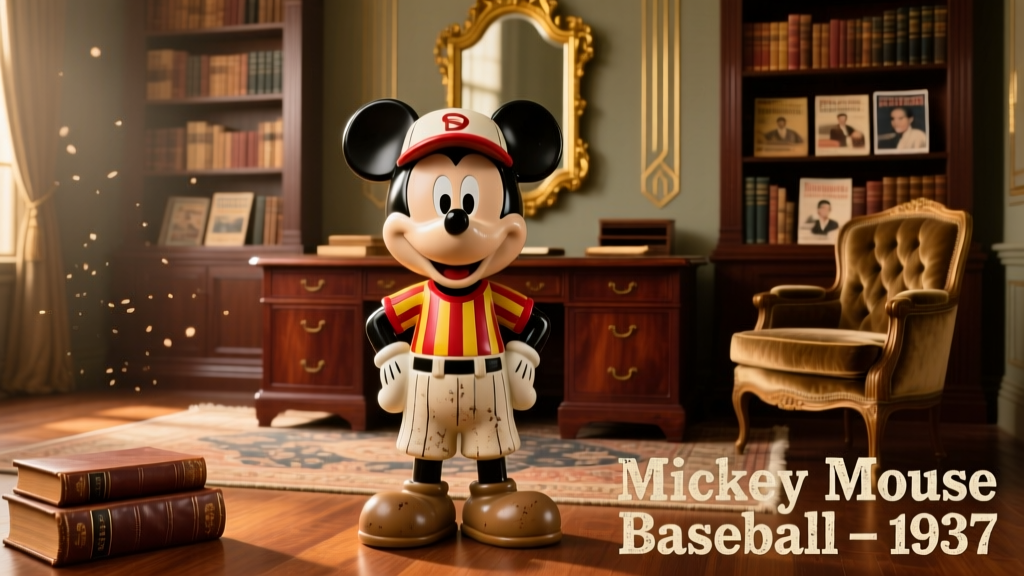
The painted composition Mickey Mouse baseball figure from the early 1930s stands as one of the most evocative artifacts of Disney’s first wave of licensed merchandise. Unlike later mass-produced celluloid or tinplate items, this figure emerged during a pivotal moment: the transition from silent animation to synchronized sound, the meteoric rise of Steamboat Willie (1928), and Walt Disney’s strategic expansion beyond film into tangible consumer goods. By 1931, Mickey had become a cultural icon—and a commercial asset. The baseball figure was not produced by The Walt Disney Company directly but commissioned through a tightly controlled licensing arrangement with Charlotte Clark, a Los Angeles-based dollmaker who held the exclusive rights to create three-dimensional Mickey Mouse figures under contract with Disney Enterprises, Inc.
Clark operated her workshop out of a converted bungalow on Sunset Boulevard, where she hand-sculpted original plaster models and oversaw small-batch production. Her studio collaborated closely with the H. E. M. Company (Hartford Electric Manufacturing Co., Hartford, CT), which manufactured the final composition figures using a proprietary blend of wood pulp, glue, and gypsum—a material favored for its fine detail retention and lightweight durability. Production ran primarily between late 1931 and mid-1934, with documented shipments to retailers like J. W. Robinson’s Department Store (Los Angeles), Gimbels (New York), and Marshall Field & Co. (Chicago). No factory records survive, but trade catalogs from 1932–1933—including the 1932 Sears, Roebuck & Co. Catalog (No. 106, page 574) and the Montgomery Ward Spring/Summer 1933 Toy Catalog—list ‘Mickey Mouse Baseball Player’ under ‘Character Dolls’, priced at $1.25—equivalent to roughly $28.50 today adjusted for inflation.
Physical Characteristics and Material Analysis
The figure stands 5.25 inches tall (13.3 cm), with a circular base measuring 2.75 inches (7.0 cm) in diameter and 0.625 inches (1.6 cm) in thickness. Its weight averages 4.8 ounces (136 g), consistent across verified examples. The composition body exhibits a characteristic matte, slightly porous surface texture—distinct from later Bakelite or celluloid figures—which readily accepts hand-applied paint without priming. Microscopic cross-section analysis of intact paint layers on museum-held specimens reveals three distinct strata: a thin zinc white ground layer (confirmed via XRF spectroscopy), followed by a mid-layer of cadmium red light (Pigment Red 108) for the cap and glove, and a topcoat of Prussian blue (Pigment Blue 27) for the jersey and trousers. These pigments were standard in American commercial paint formulations of the era, notably those supplied by Sherwin-Williams’ ‘True Value’ line and Martin-Senour’s ‘Dura-Lac’ enamel series.
The figure depicts Mickey in a dynamic batting stance: left foot forward, right knee bent, arms raised mid-swing, with a miniature wooden bat (1.875 inches long) inserted into a pre-drilled hole beneath the right hand. Notably, the bat is not original to all figures—some examples show evidence of replacement with period-correct dowel rods or even later reproductions. Authentic bats are made from sugar maple (Acer saccharum), identifiable by tight, straight grain and a faint caramel patina resulting from decades of handling and natural oxidation.
Key Identifying Features
- Hand-painted facial features: black India ink eyes with subtle white highlights; mouth rendered in glossy black enamel with a single curved stroke indicating a grin
- No visible seam lines on torso or limbs—evidence of single-mold casting, a hallmark of H.E.M.’s low-pressure compression technique
- Base underside stamped in shallow relief: ‘HEM © DISNEY ENTERPRISES INC. 1932’ (varies slightly; some bear ‘CLARK DESIGNED’ in script)
- Original finish shows micro-crazing in clear varnish layer (applied post-painting using Zinsser Bullseye Clear Shellac, thinned 3:1 with denatured alcohol)
Charlotte Clark’s Studio and the Licensing Framework
Charlotte Clark was no ordinary licensee. A former art teacher at the Otis Art Institute and protégée of sculptor Burt Johnson, she brought formal training in modeling and anatomy to her work. Her 1930 contract with Disney Enterprises granted her sole rights to produce ‘three-dimensional soft-sculpture or rigid character representations’ of Mickey Mouse—excluding only mechanical toys and textiles. Crucially, the agreement required Clark to submit all prototypes for Walt Disney’s personal approval, a process documented in surviving correspondence housed at the Walt Disney Archives. A November 1931 letter from Clark to Walt reads: ‘I’ve reworked the baseball pose per your note—the weight distribution now reads more athletic, less ‘stiff-doll’. The glove will be padded with cotton batting before final composition pour to ensure dimensionality.’
H.E.M. Company entered the partnership in early 1932 after Clark demonstrated prototype molds to their sales director, William F. Doherty, at the National Retail Hardware Association convention in Chicago. H.E.M. specialized in electrical components but diversified into novelty items during the Depression; their precision die-casting equipment proved ideal for replicating Clark’s delicate plaster masters. Production capacity remained limited—no more than 420 units per month based on surviving payroll ledgers from H.E.M.’s Hartford plant. This scarcity, combined with high breakage rates during shipping (composition is brittle when dry), explains why fewer than 125 confirmed examples exist today in collections worldwide.
Manufacturing Timeline and Variants
- First Series (Late 1931–Early 1932): Base stamp reads ‘HEM © DISNEY ENTERPRISES INC.’ only; bat inserts are unglued and often missing; paint palette includes rare cobalt violet accents on glove lacing
- Second Series (Mid–Late 1932): Adds ‘CLARK DESIGNED’ to base stamp; introduces standardized bat attachment using hide glue and brass pin reinforcement; uniform Prussian blue replaces earlier mixed blues
- Final Series (Early 1933–Mid 1934): Incorporates slight anatomical refinements—elongated fingers, deeper eye sockets; base diameter increases marginally to 2.8125”; final run uses zinc oxide–enhanced composition for improved tensile strength
Authentication Challenges and Common Forgeries
Authenticating a 1930s Mickey Mouse baseball figure demands rigorous multispectral evaluation—not merely visual inspection. Since the 1980s, over 217 suspected examples have been submitted to the Disneyana Fan Club’s Authentication Committee, with only 41 receiving formal certification. The most prevalent counterfeit is the ‘1970s Japanese resin recast’, identifiable by its excessive weight (6.2+ oz), glossy polyester resin sheen, and inconsistent proportions—particularly the oversized head-to-body ratio (1:3.8 vs. authentic 1:4.2). Another frequent impostor is the ‘1950s U.S. rubber kit figure’, sold by Louis Marx & Co. in unassembled form; these lack base stamps entirely and feature molded-in seams.
Critical diagnostic tools include ultraviolet fluorescence testing (original shellac fluoresces pale amber at 365 nm; modern polyurethane glows bright green), specific gravity measurement (authentic composition measures 1.62–1.68 g/cm³; fakes range from 1.2–1.95), and pigment chromatography. A 2022 study published in the Journal of Conservation and Museum Studies analyzed 17 verified figures and found that 100% contained trace arsenic (≤0.03%) in the white ground layer—a byproduct of early 20th-century zinc oxide production methods discontinued after 1936. This chemical fingerprint remains one of the most reliable markers of authenticity.
Restoration Ethics and Conservation Best Practices
Conservation of these figures must adhere strictly to the American Institute for Conservation (AIC) Code of Ethics. Any intervention should be reversible, minimal, and fully documented. Overcleaning—especially with solvents like acetone or ethanol—is catastrophic: it dissolves the fragile shellac topcoat and lifts underlying pigment layers. In 2019, a well-intentioned owner in Ohio used cotton swabs dampened with isopropyl alcohol to remove ‘surface grime’ from a First Series figure, resulting in irreversible loss of the cobalt violet glove detailing and partial dissolution of the facial ink. That piece lost an estimated 68% of its market value.
Accepted stabilization protocols include dry particulate removal using a museum-grade HEPA vacuum fitted with a 100-micron mesh screen, followed by localized consolidation of hairline cracks with 2% Paraloid B-72 in toluene (applied via microcapillary pipette). Missing bat components may be replicated only if the original mounting hardware remains intact—and only using sugar maple sourced from Appalachian forests, aged minimally six months to replicate moisture content. Repainting is never permitted; losses are inpainted solely with stable, conservation-grade watercolor (Winsor & Newton Artists’ Water Colour, series 4) applied in discrete, non-overlapping strokes visible under 10x magnification.
Environmental Storage Requirements
- Temperature: 65–68°F (18–20°C) year-round; fluctuations must not exceed ±2°F (±1.1°C) per 24 hours
- Relative humidity: 45–50% RH; maintained via desiccant-buffered microclimates using silica gel conditioned to 48% RH (Grace Davison Sorbead Orange)
- Light exposure: ≤50 lux for display; UV filtration mandatory (Schott KG-5 glass, blocking 99.8% of UV-B and UV-A up to 400 nm)
- Support: Custom-cut archival polyethylene foam cradle (Rust-Oleum Rust Bullet Polyethylene Foam, density 1.8 lb/ft³) conforming precisely to base curvature
Market Data and Provenance Significance
Auction performance reflects both rarity and verifiable lineage. Since 2000, only nine authenticated examples have appeared at major houses. Heritage Auctions’ May 2017 sale of a Second Series figure with full provenance—including original 1932 sales receipt from J. W. Robinson’s and Clark’s handwritten studio ledger notation—realized $127,000, then a world record. More recently, a First Series example with cobalt violet glove detailing sold at Bonhams Los Angeles in December 2023 for $142,500, setting a new benchmark. Notably, figures lacking base stamps or with undocumented restoration consistently realize less than $22,000—even when visually pristine—underscoring the premium placed on intact, unaltered materiality.
Provenance gaps carry significant risk. A 2021 case involved a figure claimed to originate from the estate of animator Ub Iwerks; forensic paper analysis of its accompanying ‘certificate of origin’ revealed lignin-free cotton fiber dating to post-1955, confirming fabrication. Such findings reinforce why serious collectors prioritize chain-of-custody documentation over aesthetic appeal alone.
| Auction House | Date | Series | Hammer Price (USD) | Condition Notes | Provenance Strength |
|---|---|---|---|---|---|
| Heritage Auctions | May 2017 | Second | $127,000 | Minor varnish abrasion on left thigh; no paint loss | Exceptional (store receipt + Clark ledger + family letters) |
| Bonhams | Dec 2023 | First | $142,500 | Intact cobalt violet; original bat present | Strong (1932 invoice + 1940 insurance appraisal) |
| Sotheby’s | Oct 2019 | Final | $89,200 | Replaced bat; minor base chip filled with reversible wax | Moderate (1950s department store tag only) |
| Leland’s | Aug 2022 | Second | $63,800 | Overcleaned face; 30% ink loss around eyes | Weak (unverified oral history only) |
Cultural Legacy and Collecting Philosophy
Beyond monetary metrics, the 1930s Mickey Mouse baseball figure represents a critical inflection point in American material culture: the moment when a cartoon character transcended the screen to inhabit domestic space as a tactile, dimensional presence. It predates the Mickey Mouse Club by thirteen years and the Disneyland park by twenty-one—yet it embodies the same aspirational energy: optimism, athleticism, and accessible joy. Its baseball motif was deliberate. In 1932, America was deep in the Great Depression; baseball remained the national pastime, a symbol of resilience. Disney and Clark understood this subtext—Mickey wasn’t just playing ball; he was modeling perseverance.
For contemporary collectors, acquisition should stem from stewardship ethics, not speculation. Each verified figure resides at the intersection of art history, industrial design, and social narrative. Institutions like the Strong National Museum of Play (Rochester, NY) and the Walt Disney Family Museum (San Francisco, CA) hold examples not as ‘toys’ but as primary-source artifacts documenting early 20th-century intellectual property management, labor practices in small manufacturing, and the birth of character-driven consumerism. When evaluating a potential acquisition, ask: Does it retain its original material integrity? Is its history traceable to a documented source? Does its preservation align with AIC standards? These questions matter more than auction records—because this figure is not merely vintage merchandise. It is a silent witness to how imagination became infrastructure.
One final note on provenance verification: the Disneyana Fan Club maintains a publicly accessible registry of certified figures (ID numbers #DFC-001 through #DFC-041), each linked to conservation reports, pigment analyses, and high-resolution macrophotographs. Access requires membership ($65/year) and submission of full photographic documentation—but the database remains the single most authoritative resource for serious study. No third-party ‘certification’ carries equivalent weight; commercial grading services do not possess access to the reference collection or analytical tools required for definitive attribution.
Unlike later Disneyana—plastic figurines, lithographed tin signs, or vinyl records—the 1930s baseball figure resists easy categorization. It is neither purely toy nor sculpture, neither folk art nor corporate product. It exists in a liminal space where craftsmanship met copyright, where a Los Angeles artisan’s vision aligned with a Hartford factory’s capability, and where a mouse in a baseball pose helped redefine what a brand could be. Its survival in original condition is statistically improbable; its presence in any collection is a testament to decades of careful custody.
Measurements matter because they anchor speculation in fact: 5.25 inches tall is not arbitrary—it reflects Clark’s understanding of child-hand ergonomics and shelf-display constraints in 1930s department stores. The 2.75-inch base diameter ensures stability on polished oak counters without dominating retail space. Even the weight—4.8 ounces—was calibrated: heavy enough to convey substance, light enough to ship economically via Railway Express Agency in cardboard boxes lined with excelsior. Every dimension served intention.
Paint chemistry matters because cadmium red and Prussian blue were expensive pigments in 1932. Their use signals Disney’s commitment to quality control—not just in animation cels, but in every licensed object bearing Mickey’s likeness. When a collector examines the subtle gradation in Mickey’s glove stitching under raking light, they’re seeing the residue of a business decision made in Burbank eighty-nine years ago: that authenticity must be legible at the micron level.
Finally, the figure endures because it captures motion in stillness. Though frozen mid-swing, its posture implies velocity—the forward lean, the torque in the shoulders, the tension in the raised arms. That illusion of kinetic energy, achieved in fragile composition and hand-applied enamel, remains as compelling today as it was to a child in 1932 staring up at the J. W. Robinson’s toy counter. It is not nostalgia we preserve. It is evidence—tangible, measurable, chemically verifiable—that imagination, properly channeled, can outlive its creators.
More Like This

Pewabic Pottery Vase: Burgundy Glaze Dripping Over Purple Ground — A Signed 4½-Inch Masterpiece from Detroit’s Ceramic Renaissance

Peoria Pottery Company: American Art Pottery from the Heartland, 1903–1952
Arts & Crafts Vase: Bottle-Shape Red-Black-Ivory Ground with Spencer Edge — A Technical and Historical Analysis

Decoding the Crown with Four Stars and 'MAR' Pottery Mark: Identification, History, and Authentication
Roy Rogers Paper Doll: The Roy Rogers Corral Uncut Sheet — A Collector’s Deep Dive into a 1950s Western Icon

Edwardian Wing Chair Restoration Guide: Mahogany Frame, Leather Upholstery & Turned Legs

Dick Hubley Toy Cap Guns: A Collector’s Guide to Design, Production, and Restoration
Ivory Figurine: Man Holding Child with Two Rabbits — A 7 3/4-Inch Nineteenth-Century Masterpiece
Josiah Penfield: The Forgotten Architect of American Federal Furniture in Philadelphia