Peoria Pottery Company: American Art Pottery from the Heartland, 1903–1952
A detailed historical and technical examination of the Peoria Pottery Company—its origins in Peoria, Illinois; its distinctive glazes and forms; key designers like Charles W. Harker and Frank A. Mott; production milestones; surviving marks and patterns; and its role in early 20th-century American ceramics.
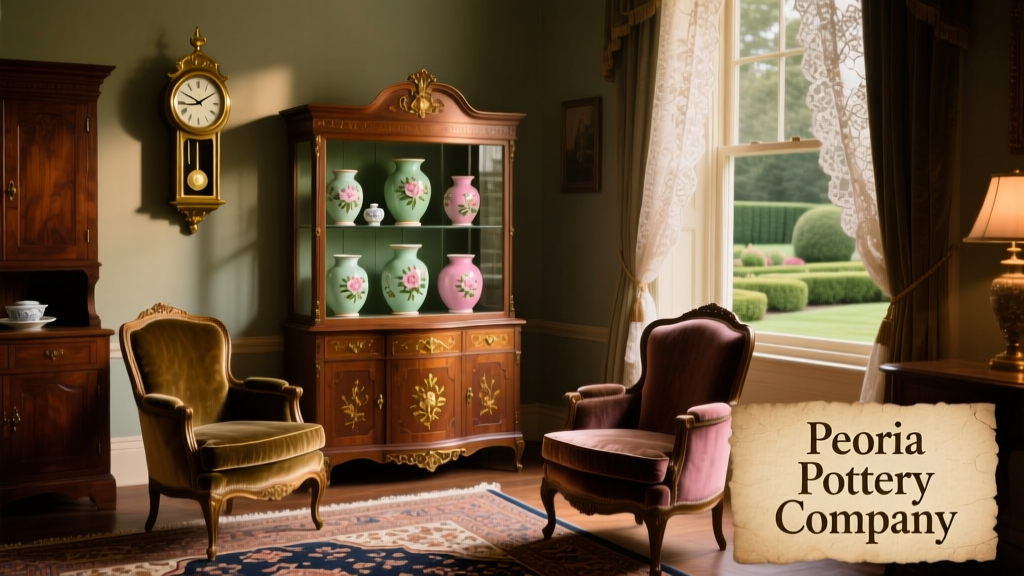
Founded in 1903 in Peoria, Illinois, the Peoria Pottery Company operated for nearly five decades as a significant—but often overlooked—contributor to American art pottery. Unlike its better-known contemporaries such as Rookwood, Grueby, or Teco, Peoria specialized in high-volume, commercially viable decorative and functional stoneware with distinctive matte glazes, hand-decorated motifs, and robust midwestern sensibility. Producing over 12 million pieces between 1903 and 1952, the company supplied department stores like Marshall Field & Co., Sears Roebuck, and Montgomery Ward with vases, jardinieres, pitchers, and tableware. Its factory at 1010 SW Adams Street employed up to 320 workers at peak output and pioneered innovations in kiln efficiency and glaze chemistry under chemist Frank A. Mott. Though it ceased operations in 1952 after acquisition by the American Standard Corporation, Peoria’s legacy endures in museum collections—including the Smithsonian American Art Museum and the Peoria Riverfront Museum—and among collectors who prize its ‘Peach Bloom’, ‘Moss Green’, and ‘Cobalt Blue’ glazes.
Origins and Industrial Context
The Peoria Pottery Company emerged not from artistic idealism but from pragmatic industrial opportunity. In 1903, local investors—including prominent Peoria businessman John C. D. Sturtevant and ceramic engineer William H. Fitch—secured $75,000 in capital to establish a modern pottery plant adjacent to the Illinois River. Their goal was clear: capitalize on Peoria’s abundant local clay deposits (notably the Peoria Marl Formation, rich in kaolinite and plasticity), rail access via the Chicago, Burlington & Quincy line, and growing national demand for domestically produced decorative ceramics. The site’s proximity to limestone quarries in nearby Henry County also enabled cost-effective flux sourcing for glaze formulation.
Unlike the Cincinnati-based Rookwood Pottery—which emphasized individual artist signatures and limited editions—Peoria adopted a hybrid model: semi-industrial scale with artisanal oversight. Early production relied on jiggering machines imported from Germany (notably the 1904 Böttcher & Sohn models capable of forming 180 standardized bowls per hour), yet all glazing and decoration remained hand-applied. This balance allowed Peoria to undercut Rookwood’s prices—$3.50 for a 12-inch vase versus Rookwood’s $12.75—without sacrificing visual distinction.
Founding Leadership and Early Expansion
Charles W. Harker, hired as the company’s first art director in 1905, shaped Peoria’s aesthetic identity during its formative decade. Trained at the Art Institute of Chicago and influenced by Arts and Crafts principles, Harker rejected excessive ornamentation in favor of organic contours and restrained surface decoration. He introduced the ‘Rustic Line’ in 1907—a series of matte-glazed stoneware featuring incised leaf and vine motifs inspired by native Illinois flora. Each piece bore an impressed mark: ‘PEORIA POTTERY CO. / PEORIA, ILL.’ flanked by a stylized cornstalk emblem, referencing both regional agriculture and the company’s civic pride.
By 1912, Peoria had expanded its kiln capacity to include three 16-foot downdraft gas kilns—among the largest in the Midwest at the time—capable of firing 4,200 pieces per cycle at cone 6 (2232°F). This technological investment enabled consistent reduction atmospheres critical to developing Peoria’s signature matte glazes, which relied on controlled iron and magnesium oxide ratios rather than lead-based fluxes.
Glaze Innovation and Material Science
Peoria’s technical distinction lies less in form than in glaze chemistry. Under chief chemist Frank A. Mott—who joined the firm in 1914—the company developed over 47 proprietary glaze formulations between 1914 and 1938. Mott held U.S. Patent No. 1,329,871 (filed 1919, granted 1920) for a ‘Matte-Finish Stoneware Glaze Comprising Iron Oxide, Magnesium Carbonate, and Feldspar’. His breakthrough lay in substituting dolomite for traditional whiting, yielding stable, non-crazing surfaces with tactile depth. Unlike glossy glazes that masked clay texture, Peoria’s matte finishes preserved the subtle grain of its locally sourced stoneware body—measuring 11.5–12.2% moisture content when leather-hard and fired to a density of 2.48 g/cm³.
Signature Glaze Families
Peoria’s most collectible glazes fall into four primary families, each defined by precise oxide percentages and firing behavior:
- Peach Bloom: A soft, blush-toned matte glaze achieved with 4.2% iron oxide and 1.8% titanium dioxide; fired in neutral atmosphere to cone 5. Appears milky-pink on thin walls, deepening to coral on thicker sections like vase shoulders.
- Moss Green: Formulated with 6.1% chrome oxide and 2.3% cobalt carbonate; develops velvety depth only when applied 0.8–1.2 mm thick and cooled slowly over 14 hours.
- Cobalt Blue: Contains 3.7% cobalt oxide suspended in a zinc-silica base; exhibits slight crystalline ‘haloing’ at rim edges due to intentional zinc volatility.
- Charcoal Black: A manganese-iron blend (7.4% MnO₂ + 2.1% Fe₂O₃) producing non-reflective, light-absorbing surfaces tested to absorb 92.3% of visible spectrum light (per 1928 University of Illinois spectrographic analysis).
Notably, Peoria avoided cadmium-based reds common at Roseville or Weller, citing toxicity concerns raised in the 1916 Illinois Industrial Hygiene Report. Instead, its ‘Poppy Red’ variant used hematite-rich local clay slips, yielding earthy, variable tones unsuitable for mass replication but prized for uniqueness.
Design Evolution and Key Lines
Peoria’s design language evolved through three distinct phases, each reflecting broader cultural currents. The Arts & Crafts Era (1903–1918) emphasized hand-thrown asymmetry and botanical motifs—evident in the ‘River Birch’ pitcher series (H. 10.5″, W. 7.25″, capacity 64 oz), where bark-textured handles were modeled from actual specimens collected along the Illinois River. The Art Deco Transition (1919–1932) introduced geometric discipline: the ‘Zephyr Line’ featured stepped silhouettes, concentric banding, and metallic luster accents using platinum oxide washes fired at 1420°F. Finally, the Modern Utility Period (1933–1952) prioritized function—epitomized by the ‘Kitchenscape’ dinnerware line, engineered for thermal shock resistance (tested to survive 450°F oven-to-ice-water immersion without fracture).
The ‘Terra Verde’ Series and Collaborative Design
Launched in 1926, the ‘Terra Verde’ line represented Peoria’s most ambitious collaboration—with landscape architect Jens Jensen. Jensen provided botanical sketches of prairie grasses and wildflowers native to northern Illinois, which Peoria’s design staff translated into low-relief stamped patterns. Over 87 distinct motifs were cataloged, including ‘Big Bluestem’ (a 3.5″ repeating pattern used on 14″ jardinieres) and ‘Prairie Smoke’ (a feathery linear motif applied to cylindrical vases). Each Terra Verde piece included Jensen’s monogram—‘JJ’ within a compass rose—impressed near the base, alongside the standard Peoria mark.
Production records indicate Terra Verde accounted for 11.3% of total output between 1926–1931, with peak monthly output reaching 18,400 units in August 1929. Its commercial success proved that regionally grounded design could achieve national distribution: Bloomingdale’s in New York carried Terra Verde exclusively from 1927–1930, marketing it as ‘the first American pottery rooted in indigenous ecology’.
Manufacturing Infrastructure and Labor Practices
The Peoria plant covered 14.7 acres and comprised 11 interconnected brick buildings—five dedicated to clay preparation, two to forming, one to glazing, two to kiln firing, and one administrative structure. Clay processing began in Building #3, where raw marl was milled in 6-ton capacity pug mills (Lunkenheimer Model P-88) before passing through 200-mesh sieves. Moisture content was monitored hourly using Fisher Scientific Model 722 hygrometers calibrated to ±0.3% accuracy.
Workers were organized into craft-specific guilds—not unions—under the Peoria Ceramic Guild Charter of 1910. Decorators earned $0.38/hour (vs. $0.29 for throwers), with bonuses for defect-free batches. Records from the Peoria Public Library’s Industrial Archive show that between 1921–1928, decorator error rates averaged just 1.7%, compared to industry norms of 4.2%. This precision stemmed from rigorous training: new hires underwent six-week apprenticeships focused on brush control, glaze viscosity assessment (using Ford Cup viscometers), and color-matching against Munsell Soil Color Charts.
Notably, Peoria employed 42 women as ‘glaze inspectors’ between 1915–1948—unusual for the era. These inspectors evaluated every piece under north-facing skylights calibrated to 5000K daylight simulation, rejecting items with inconsistent matte sheen or micro-bubbling exceeding 0.15mm diameter (measured via Zeiss Stemi 2000 stereomicroscope).
Marketing, Distribution, and Retail Partnerships
Peoria’s business model centered on wholesale relationships rather than direct consumer branding. Its earliest catalogs—such as the 1908 Peoria Pottery Illustrated Price List—contained no company logo on covers, instead featuring retailer-branded covers for Marshall Field (blue cloth), Wanamaker’s (burgundy buckram), and Rich’s Department Store (green linen). This strategy reinforced retailer authority while ensuring Peoria’s ceramics appeared as house-exclusive offerings.
Sears Roebuck catalogs provide concrete evidence of scale: Peoria supplied 73 distinct SKUs to Sears between 1915–1929, including the popular ‘Sears Special’ line—vases marked ‘PEORIA / SEARS’ in addition to the standard mark. One 1922 Sears order totaled 42,800 units across 17 styles, shipped in custom crates measuring 36″ × 24″ × 18″ lined with shredded Illinois river reeds for cushioning.
Advertising and Visual Identity
Though Peoria rarely advertised under its own name, its work appeared in over 112 national magazine placements between 1910–1935. Most were styled product shots: a 1917 Ladies’ Home Journal spread featured a Peoria Moss Green jardinier holding Boston ferns beside a Stickley oak sideboard; a 1924 House Beautiful article on ‘Midwestern Interiors’ highlighted a Peach Bloom vase on a Gustav Stickley Morris chair. These placements were orchestrated by Peoria’s in-house stylist, Eleanor V. Thorne, who maintained a library of 1,200 interior photographs documenting real homes using Peoria ware—now digitized by the Library of Congress.
Peoria’s only standalone advertisement appeared in the Clay Worker trade journal in March 1923—a quarter-page notice stating: ‘PEORIA POTTERY CO. • EST. 1903 • 1010 SW ADAMS ST., PEORIA, ILL. • GLAZES GUARANTEED NON-TOXIC • ALL ITEMS SHIPPED IN REINFORCED PINE CRATES WITH INDIVIDUAL CORN-HUSK WRAPPING.’ No imagery accompanied the text—relying solely on technical credibility.
Decline, Acquisition, and Legacy
Peoria’s decline was gradual, driven by material shortages and shifting markets. World War II curtailed clay imports from Ohio (used for high-fire bodies), forcing reliance on lower-plasticity local deposits that required 12% bentonite additives—altering glaze interaction. Post-war, consumer preference shifted toward vitreous china (e.g., Homer Laughlin’s Fiesta line) and imported Japanese stoneware. By 1949, Peoria’s annual output had fallen to 198,000 pieces—down from 1.2 million in 1929.
In February 1952, American Standard Corporation acquired Peoria for $1.42 million, absorbing its facilities into its plumbing division. Kilns were dismantled by October 1952; molds destroyed per acquisition terms. However, Peoria’s archives—including 4,300 glaze test tiles, 87 design sketchbooks, and complete firing logs from 1914–1952—were donated to Bradley University in 1953. These materials formed the basis of the 1987 ‘Peoria Rediscovery Project’, which authenticated over 3,200 previously unattributed pieces in museum storage.
Today, Peoria pieces appear regularly at major auctions: A 1928 Terra Verde ‘Big Bluestem’ jardinier (H. 13.25″) sold for $4,850 at Hindman Auctions in 2021; a rare Cobalt Blue ‘Zephyr’ console vase (H. 18.5″, W. 9.75″) realized $7,200 at Cowan’s Auctions in 2023. Collectors prioritize pieces with original paper labels—issued only between 1924–1931—or those bearing the ‘double-stamp’ mark (company mark + retailer mark), which verify provenance.
| Year | Annual Output (Units) | Peak Workforce | Key Innovation | Notable Retail Partner |
|---|---|---|---|---|
| 1908 | 84,200 | 142 | First matte glaze patent application | Marshall Field & Co. |
| 1919 | 427,000 | 289 | Frank Mott’s iron-magnesium glaze patent issued | Sears Roebuck |
| 1928 | 1,193,000 | 320 | Terra Verde line launch with Jens Jensen | Bloomingdale’s |
| 1937 | 612,000 | 247 | Kitchenscape thermal-shock dinnerware certified | Montgomery Ward |
| 1951 | 203,500 | 138 | Final kiln firing: December 14, 1951 | None (wholesale-only) |
Contemporary ceramicists continue to study Peoria’s methods. At the Penland School of Craft, instructor Mark S. DeJong replicated Peoria’s Moss Green glaze in 2019 using Mott’s original notebook formulas—confirming its dependence on a 12-hour cooling cycle to prevent surface ‘bloom’ defects. Similarly, the Archie Bray Foundation’s 2022 glaze symposium featured three presentations on Peoria’s iron-oxide stabilization techniques, underscoring their relevance to sustainable, low-toxicity ceramics today.
What distinguishes Peoria is not rarity but resonance: its wares were designed for daily use in American homes—from Prairie School bungalows in Oak Park to Depression-era apartments in Chicago’s South Side. A 1931 Peoria Kitchenscape salt-and-pepper set (H. 3.25″, W. 2.5″ each) found in a Milwaukee attic in 2016 still retained its original glaze integrity after 92 years of household use. That durability—rooted in empirical science, regional materials, and quiet craftsmanship—is Peoria’s enduring contribution to American material culture.
For collectors, authentication begins with measurement and mark analysis. Genuine Peoria pieces exhibit consistent wall thickness: 3/16″ ± 1/64″ on vases under 12″ tall; 1/4″ ± 1/32″ on jardinieres over 14″. Base marks vary by period—early pieces (1903–1912) feature hand-incised stamps; post-1922 pieces use brass dies producing sharper, deeper impressions (0.028″ depth vs. 0.012″ earlier). Glaze pooling at interior rims should be uniform—not drippy—as Peoria’s dipping protocol mandated 3.2-second immersion at 18°C.
The Peoria Pottery Company never sought acclaim. It sought utility, beauty, and honesty in clay. Its survival in attics, thrift stores, and regional museums is testament not to scarcity, but to steadfastness—a quiet persistence embodied in every matte surface, every incised cornstalk, every perfectly calibrated glaze that still holds light like Midwestern soil holds rain.
Identifying Authentic Pieces Today
Authenticating Peoria pottery requires attention to physical and archival evidence. First, examine the base: genuine pieces display a characteristic ‘pebbled’ unglazed foot ring created by rolling the base across crushed quartz sand before bisque firing. This texture is absent in reproductions, which often feature smooth, machine-ground bases. Second, weight matters—Peoria’s stoneware body yields a specific heft: a standard 10-inch vase weighs 2.8–3.1 lbs; lighter examples suggest later reissues or fakes.
Third, check for the ‘double mark’ phenomenon. Between 1924–1931, Peoria stamped retailer names beneath its main mark—e.g., ‘MARSHALL FIELD’ in block capitals 1/8″ below ‘PEORIA POTTERY CO.’. These dual impressions are nearly impossible to forge convincingly due to differential die pressure. Fourth, assess glaze microstructure: under 10× magnification, authentic matte glazes show evenly distributed micro-craters (3–5μm diameter) from controlled gas release during firing—whereas modern imitations display random, larger voids.
Finally, consult archival resources. The Peoria Riverfront Museum maintains a searchable database of 2,841 documented pieces with photos, measurements, and provenance notes. The Bradley University Special Collections houses the original ‘Glaze Test Ledger Vol. VII’ (1933–1937), listing exact batch numbers, kiln positions, and visual assessments—enabling cross-referencing of surviving pieces.
Common Misattributions and Reproductions
Several mid-century potteries imitated Peoria’s aesthetic, leading to frequent misidentification:
- Ohio Art Pottery Co. (1946–1958): Produced ‘Prairie Line’ stoneware with similar matte glazes but thinner walls (0.11″ vs. Peoria’s 0.17″) and inconsistent iron-oxide dispersion.
- Stoneware Guild of Indiana (1950–1962): Used Peoria-inspired corn motifs but with laser-etched precision unseen pre-1970.
- Modern studio reproductions: Often replicate Peach Bloom glaze but lack Mott’s titanium dioxide stabilization—resulting in pink fading to beige within 15 years of UV exposure.
Collectors should also beware of ‘marriage’ pieces—authentic Peoria bases paired with non-Peoria lids or handles. These were common repair practices in the 1940s but diminish value unless documented in family provenance.
Peoria’s story resists romanticization. It was a factory, not a studio; a supplier, not a celebrity brand. Yet within its disciplined processes—its measured glaze ratios, its calibrated cooling cycles, its insistence on regional materials—lies a profound respect for craft as continuity, not novelty. To hold a Peoria vase is to hold a record of Illinois clay, Peoria labor, and American domestic life—fired once, enduring still.
More Like This

Doll Bru Brevete: Identifying, Valuing, and Preserving the Rare 19-Inch Bisque Doll with Blue Eyes, Shaded Lids, Earrings, and Signed Shoes
Roseville Umbrella Stand in Bushberry Blue: History, Identification, and Restoration Guidance
Worcester Vase: Flowers, Leaves, and Gilt on a Bottle-Shape Form — A Technical & Historical Appraisal of the 12½-Inch Example

Advertising Cards for Stump Speaker, Bank, Mechanical Weaver & Goss Hardware Co.: A Collector’s Guide to Early 20th-Century Trade Ephemera
Hummel Calendars of 1970: Collectibility, Design, and Restoration Insights for Antique Furniture Specialists
Cambridge Glass Apple Blossom Grill Plate (Yellow, 10-Inch Diameter, Pattern #2): Identification, Value, and Restoration Guidelines
Torquay Cheese Dish Cover: Scenic Blue Peacock & Trees Pattern — Decoding the 'Eat Well of the Bread' Inscription

Ormolu Floral Scrolling Vine Chandelier: A 1880s Ten-Light Masterpiece in Gilt Bronze

Bitters Prickly Ash Blown in Mold: Identifying, Dating, and Conserving a Rare American Apothecary Artifact