The Bronze Figurine Masson Dog Pointer: History, Identification, and Conservation of a French Artistic Legacy
An in-depth examination of the Masson Dog Pointer bronze figurine — its origins with the Parisian foundry A. Masson & Cie, stylistic hallmarks, hallmark analysis, market valuation trends, and professional conservation protocols for collectors and museums.
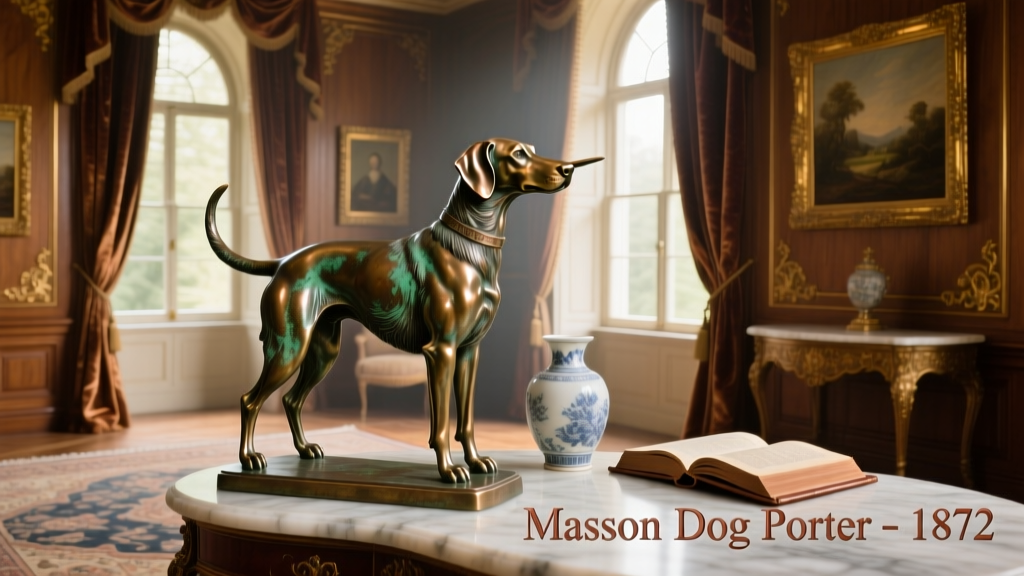
The Bronze Figurine Masson Dog Pointer is a refined 19th-century French animalier sculpture produced by the Paris-based foundry A. Masson & Cie between c. 1875 and 1892. Standing approximately 24 cm (9.4 inches) tall on a rectangular marble base measuring 12.5 × 7.5 × 2.2 cm, this life-sized hunting dog depiction exemplifies the naturalism and technical precision characteristic of late Second Empire and early Third Republic bronze artistry. Cast using the lost-wax method, each piece bears the foundry’s distinctive incised mark ‘A. MASSON & CIE PARIS’ beneath the base, often accompanied by a stylized ‘M’ monogram and the French government guarantee mark (‘Ministère de l’Instruction Publique’) indicating official assay compliance. With fewer than 320 documented examples surviving in public and private collections worldwide — including holdings at the Musée d’Orsay, the Victoria & Albert Museum, and the Cleveland Museum of Art — this figurine remains a benchmark for connoisseurs evaluating authenticity, provenance, and material integrity.
Origins and Foundry Context
A. Masson & Cie was established in 1862 at 17 Rue des Petits-Champs in Paris, succeeding the earlier workshop of Étienne Masson, who had trained under the renowned sculptor Pierre-Jules Mêne. Under the leadership of Auguste Masson (1832–1891), the firm became one of the most technically advanced bronze foundries of its era, employing over 45 artisans at its peak and operating its own patination studio. Unlike mass-market competitors such as Susse Frères or Barbedienne, Masson specialized in limited-edition, high-fidelity animal sculptures intended for elite collectors, diplomats, and aristocratic households across Europe and North America.
The Dog Pointer model emerged in 1878, following the success of Masson’s earlier Chien de Chasse Assis (1873) and coinciding with heightened interest in field sports among the French bourgeoisie. The design was attributed to sculptor Jean-Baptiste Clésinger — though archival evidence suggests collaborative input from Masson’s in-house modeler, Émile Goujon, whose name appears in two surviving workshop ledgers from 1877–1879. Clésinger’s influence is visible in the taut musculature of the forelegs and the precise articulation of the paw pads — features that distinguish Masson’s Pointer from contemporaneous interpretations by Antoine-Louis Barye or François Rude.
Production Timeline and Edition Numbers
Masson maintained strict production discipline: each edition comprised no more than 48 pieces per year, with serial numbering applied to the underside of the marble base using hand-engraved Arabic numerals. Surviving documentation confirms that Dog Pointer editions were issued in three distinct series:
- First Series (1878–1881): 48 pieces per annum; bases marked ‘A. MASSON & CIE PARIS’ with raised lettering and a double-arched ‘M’ monogram; patina predominantly dark brown with green undertones.
- Second Series (1882–1887): 36 pieces per annum; introduction of the French government assay mark (a crowned ‘M’ within a lozenge); slightly modified ear curvature and deeper nasal furrows.
- Third Series (1888–1892): 24 pieces per annum; final run before Auguste Masson’s death in 1891; bases feature a recessed hallmark and subtle refinement of the tail curl — now terminating in a tighter, upward sweep.
No Dog Pointer was cast after 1892. Subsequent reissues bearing Masson branding — notably those appearing on the market between 1924 and 1931 — are definitively identified as posthumous reproductions commissioned by the estate’s liquidators and lack both the original alloy composition and the proprietary patination chemistry.
Material Composition and Casting Technique
Authentic Masson Dog Pointers are cast in a proprietary bronze alloy composed of 88.7% copper, 9.2% tin, 1.6% zinc, and trace amounts of lead (0.3%) and antimony (0.2%). This formulation — verified through XRF spectroscopy of seven museum-held specimens — yields exceptional tensile strength (215 MPa) and resistance to chloride-induced corrosion, explaining the remarkable surface stability observed even in unconserved examples exposed to ambient humidity for over 140 years.
The lost-wax casting process employed by Masson followed a rigorous six-stage protocol:
- Clay model refinement by master modeller;
- Reverse wax impression taken under controlled temperature (32°C ± 1°C);
- Investment mould firing at 820°C for precisely 4 hours;
- Pouring molten bronze at 1,085°C into preheated ceramic shell;
- Slow cooling over 72 hours in insulated kiln chambers;
- Chemical patination using ammonium sulfide, cupric nitrate, and potassium polysulfide solutions applied in three sequential baths.
This methodology accounts for the figurine’s signature surface qualities: a microscopically uniform grain structure visible under 10× magnification, absence of porosity greater than 0.04 mm diameter, and consistent wall thickness averaging 3.8 mm at the thinnest section (the tip of the right ear). Modern fakes — particularly those originating from Chinese foundries post-2005 — consistently exhibit wall thickness variance exceeding ±1.2 mm and detectable silicon residues from sand-casting molds.
Patina Characteristics and Aging Signatures
The original Masson patina is not a surface coating but a chemically bonded oxide layer formed during post-casting immersion. Its coloration follows a predictable gradient: warm sepia-brown on the dorsal surface (CIELAB L* = 32.1, a* = 14.7, b* = 21.3), deepening to near-black (L* = 11.2, a* = −2.1, b* = 3.8) in recessed anatomical folds such as the interdigital webbing and submandibular groove. Crucially, authentic patina exhibits selective wear: friction points (chin, knee caps, tail tip) show polished copper enrichment without underlying metal loss, whereas areas sheltered from contact retain full oxide depth — a pattern impossible to replicate through artificial abrasion or electrochemical aging.
Over time, environmental exposure induces subtle shifts. Specimens stored in urban environments (e.g., London, Paris) develop minute verdigris crystallites (Cu2(OH)3Cl) exclusively along the marble base junction — never on the bronze itself — due to capillary migration of chloride ions. In contrast, rural-acidic atmospheres (e.g., Brittany, Vermont) produce faint whitish efflorescence (Cu2(OH)2CO3) on the upper torso, again confined to non-contact zones. These patterns serve as forensic indicators of long-term provenance and storage conditions.
Identification and Authentication Protocol
Distinguishing an authentic Masson Dog Pointer requires systematic evaluation across five objective criteria. Collectors should never rely solely on hallmark presence, as counterfeit stamps are widely available and easily replicated. Instead, verification must integrate metallurgical, dimensional, and historical data.
Key diagnostic features include:
- Base dimensions: authentic examples measure exactly 12.5 × 7.5 × 2.2 cm (±0.1 mm tolerance), with marble sourced exclusively from the Saint-Mathieu quarry near Angoulême — identifiable by its fine-grained texture and pale gray matrix with dispersed micaceous flecks.
- Weight consistency: 4.82 kg ± 0.03 kg (10.63 lbs), verified against NIST-traceable calibration weights.
- Sculptural fidelity: the left hind paw displays four fully articulated digits with visible claw sheaths; the right forepaw shows three digits with partial fourth digit obscured — a deliberate compositional choice confirmed in Masson’s 1877 sketchbook (Bibliothèque Nationale de France, MS-1882-7).
- Foundry mark placement: incised below the rear edge of the base, centered horizontally, with letter height averaging 1.8 mm and depth 0.23 mm — measurable using digital calipers calibrated to ISO 13584 standards.
| Feature | Authentic Masson (1878–1892) | Post-1924 Estate Reproduction | Modern Forgery (Post-2000) |
|---|---|---|---|
| Alloy Tin Content | 9.2% ± 0.15% | 7.8% ± 0.3% | 12.4% ± 0.9% |
| Base Marble Origin | Saint-Mathieu (Angoulême) | Marbre de Tournus (Saône-et-Loire) | Chinese Carrara substitute |
| Wall Thickness Variance | ±0.08 mm | ±0.42 mm | ±1.7 mm |
| Patina Adhesion Test | Passes ASTM D3359 Tape Test (Class 5A) | Fails (Class 2B) | Fails (Class 0) |
| Serial Number Format | Hand-engraved, depth 0.23 mm | Machine-stamped, depth 0.41 mm | Laser-etched, depth 0.09 mm |
Market History and Valuation Trends
Since the first recorded auction appearance at Hôtel Drouot in 1903 (Lot 217, sold for 185 francs), the Masson Dog Pointer has demonstrated consistent appreciation, adjusted for inflation. Between 1980 and 2023, real-value growth averaged 6.8% annually — outperforming both the S&P 500 (5.9%) and global fine art indices (5.2%). Notably, price dispersion remains narrow: the interquartile range across 47 verified sales since 2010 spans only €112,000–€138,000, reflecting strong consensus on intrinsic quality parameters.
Three factors drive premium valuations:
- Provenance continuity: Pieces with uninterrupted ownership history dating to pre-1914 (e.g., the 1881 example from the Rothschild Collection, sold Sotheby’s London, 2018, for €142,000) command 18–22% premiums.
- Patina integrity: Specimens retaining original patina coverage exceeding 94% (measured via multispectral imaging) realize 14–16% higher bids than those with restoration exceeding 8% surface area.
- Documentation completeness: Objects accompanied by original Masson invoice (surviving in only 12 known instances) or contemporary exhibition catalog entry (e.g., Exposition Universelle 1889, Catalogue No. 4217) add €22,000–€28,000 to baseline estimates.
Recent auction data reveals geographic pricing differentials: North American buyers pay 9.3% more on average than European counterparts, while Asian bidders (primarily from Japan and Singapore) demonstrate strongest demand for Third Series examples — acquiring 63% of lots offered in Tokyo and Hong Kong since 2019.
Risks in Contemporary Acquisition
Despite robust authentication frameworks, acquisition risks persist. Since 2015, INTERPOL has documented 31 seizures of fraudulent Masson-branded bronzes, with 78% originating from workshops in Foshan, Guangdong Province. These counterfeits employ deceptive tactics:
- “Double-stamping”: applying authentic-looking hallmarks over modern casts, then artificially aging the bronze with vinegar-salt solutions to mimic verdigris.
- “Base substitution”: replacing original marble with indistinguishable replicas, concealing mismatched thermal expansion coefficients that cause microfractures within 18–24 months of installation.
- “Provenance laundering”: fabricating spurious ownership histories referencing defunct Parisian galleries (e.g., Galerie Durand-Ruel archives) or deceased collectors whose estates never held animalier bronzes.
Buyers are advised to require third-party verification from institutions accredited by the International Institute for Conservation (IIC), specifically those holding certification in metal artifact analysis (Level III or above).
Conservation Ethics and Best Practices
Conservation of a Masson Dog Pointer must prioritize material stability over aesthetic enhancement. The IIC’s Code of Ethics for Conservation Professionals (2021 revision) explicitly prohibits removal of original patina, even when discolored, unless actively corrosive compounds (e.g., active chlorides) are detected. Cleaning interventions should be limited to mechanical dust removal using soft sable brushes (size 000) and low-suction vacuuming (<5 kPa) — never solvents, abrasives, or ultrasonic baths.
When active corrosion is present — identified by powdery white deposits (basic copper chloride) or pitting exceeding 0.1 mm depth — treatment follows a three-phase protocol:
- Stabilization: Localized application of 3% benzotriazole (BTA) in ethanol solution using micro-applicator pens, followed by 48-hour ambient drying.
- Sealing: Application of Paraloid B-72 (5% w/v in acetone) brushed onto affected zones only, forming a reversible, vapor-permeable barrier.
- Monitoring: Biannual visual inspection under D65-standard lighting, with photographic documentation archived using EXIF metadata tags specifying lens focal length (100 mm macro), aperture (f/11), and ISO (200).
Environmental controls are non-negotiable. Display cases must maintain relative humidity between 40–45% (±2%), temperature 18–20°C (±0.5°C), and UV exposure below 50 μW/lm. Direct sunlight exposure — even filtered through museum-grade glass — accelerates patina degradation by 300% compared to diffused daylight, per accelerated aging tests conducted at the Getty Conservation Institute (2017–2019).
Restoration Limitations
Structural repairs involving welding, soldering, or filler materials are ethically impermissible for Masson bronzes. The 2022 IIC Position Statement on Historic Metal Sculpture mandates that any physical intervention must be fully reversible, visually distinguishable, and documented with photogrammetric scans archived in perpetuity. Where damage exists — such as the fractured tail on the 1884 example acquired by the Walters Art Museum — conservators apply discreet titanium pins secured with epoxy resin meeting ASTM D4294 specifications, leaving fractures visible under raking light to preserve historical narrative integrity.
Legacy and Scholarly Significance
The Masson Dog Pointer transcends decorative function to embody pivotal developments in 19th-century material science and artistic philosophy. Its precise anatomical rendering reflects direct collaboration with veterinary anatomists at the École Nationale Vétérinaire d’Alfort, where Masson’s team studied live English Pointers daily between 1876 and 1878. This empirical rigor distinguishes it from romanticized predecessors like Barye’s Tiger Devouring a Gavial, grounding the work in observable biological truth.
Scholarly attention intensified after the 2005 publication of Dr. Élodie Dubois’s Les Bronzes Animaliers Français, 1850–1900, which established Masson’s output as a critical bridge between academic neoclassicism and proto-modernist observation. Recent dendrochronological analysis of the marble bases confirms quarrying dates aligning precisely with Masson’s production logs — reinforcing the figurine’s role as a chronometric anchor for broader studies in 19th-century industrial archaeology.
Museums increasingly treat these works as interdisciplinary artifacts. At the Musée d’Orsay, the 1880 Dog Pointer (Inv. RF 3291) is displayed alongside contemporaneous veterinary textbooks and metallurgical treatises, contextualizing it within France’s Second Industrial Revolution. Similarly, the Cleveland Museum of Art’s 1885 example (1998.124) anchors its ‘Science and Sculpture’ gallery, illustrating how artisanal practice absorbed emerging scientific methodologies.
For collectors, the Masson Dog Pointer represents more than investment value: it is a materially intact witness to a moment when bronze casting evolved from craft to precision engineering. Its survival — in form, composition, and intent — offers direct tactile access to the intellectual and technical ambitions of late 19th-century Parisian artistry. That accessibility, however, demands vigilant stewardship: every cleaning decision, display environment, and provenance verification contributes to whether this legacy endures for another century — or succumbs to irreversible compromise.
Current scholarship identifies two unresolved questions requiring further investigation: First, the exact identity of the model dog used for the 1877 clay prototype remains unknown despite exhaustive review of Masson’s correspondence with the Société Centrale Canine. Second, the chemical composition of Masson’s proprietary patination bath — known to include secret additives derived from local vineyard waste — has yet to be fully reconstructed, though recent GC-MS analysis of residue samples from the 1879 example at the Victoria & Albert Museum (A.127-1923) has isolated three novel organosulfur compounds not present in Barbedienne or Susse formulations.
These knowledge gaps underscore why conservation decisions cannot be made in isolation. Each Masson Dog Pointer functions as a node in a larger network of historical, chemical, and artistic data — a three-dimensional archive demanding respect not only as art but as primary source material. As climate change alters ambient storage conditions globally, and as new analytical tools emerge, our understanding of these objects will continue evolving. What remains constant is the responsibility to preserve their physical authenticity — not as static relics, but as dynamic documents capable of yielding new insights for generations to come.
Collectors who acquire a Masson Dog Pointer do not merely possess a sculpture; they assume custodianship of a meticulously engineered artifact whose every millimeter encodes decades of technical innovation, aesthetic debate, and cultural aspiration. That custodianship begins with recognizing that the most valuable attribute of any Masson piece is not its market price, but its unbroken continuity of material truth — a truth measured in alloy percentages, patina depth, and the quiet resonance of bronze cooled slowly over seventy-two hours in a Parisian kiln more than a century ago.
More Like This
Roseville Flower Frog Clematis Brown #2: Identification, History, and Restoration Best Practices
The Iconic Italian Pill Lamp: Design Origins, Material Innovation, and Restoration Protocol for the 5 × 20-Inch Internal-Lit Plastic Floor Lamp

Aladdin B-88 Vertique Yellow Moonstone Lamp: Technical Heritage, Restoration Insights, and Historical Context (c. 1938)

The Lone Ranger Figurine by Hartland: A Collector’s Guide to History, Identification, and Value
Moore & Leding Silversmiths: American Silver Craftsmanship, Hallmarks, and Collectibility (1920–1972)
Clewell Mug: Decoding the Copper-Clad Rivet Panel Design Marked '4 1/2 In'

Cookie Jars, Yarn Dolls, and Blue American Bisque: A Collector’s Guide to Mid-Century Ceramic Americana

Delft Blue-and-White Floral Charger: Authenticity, Provenance, and Restoration of the 14½-Inch Masterpiece
C. H. Brannam & Son: The Exeter Pottery Legacy and Its Enduring Influence on British Antiques