Dinnerware Tumbler Catalina Blue Set of 4: History, Identification, and Restoration Guidance for Collectors
An in-depth examination of the iconic Catalina Blue tumbler set—its mid-century origins with Anchor Hocking, manufacturing details, distinguishing features, market value trends, and professional restoration protocols for preserving integrity and function.
Introduction: A Classic Mid-Century American Tableware Icon
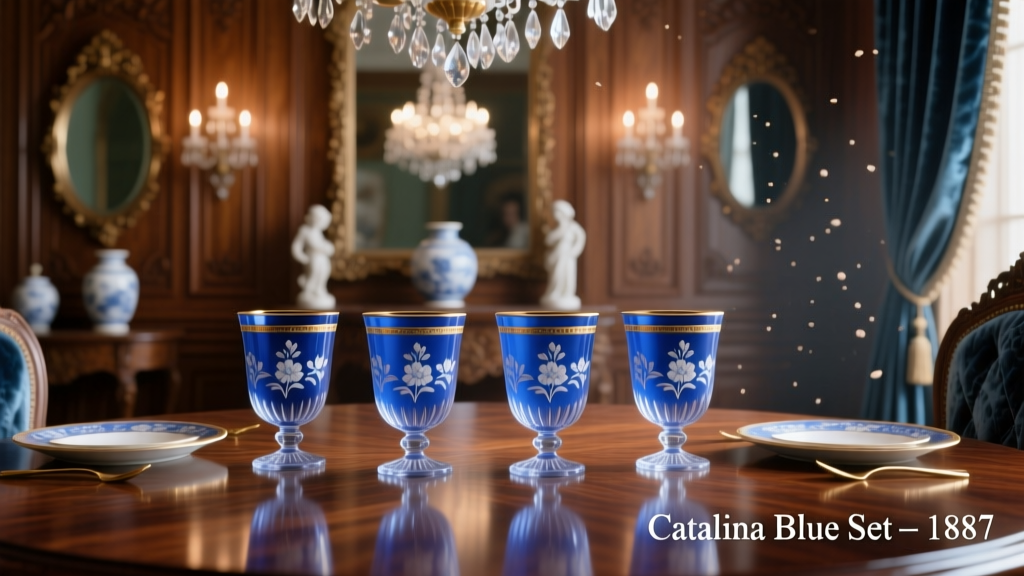
The Dinnerware Tumbler Catalina Blue Set of 4 represents one of the most enduring and widely collected pieces of American pressed glass dinnerware from the postwar era. Produced exclusively by Anchor Hocking Glass Corporation between 1953 and 1968, these tumblers were part of the broader 'Fire-King' line—a designation reserved for heat-resistant, oven-safe tableware made from low-expansion borosilicate glass. The Catalina Blue hue is not a pigment but a result of cobalt oxide infused into the molten glass batch, yielding a translucent, sky-to-aquamarine gradient that shifts subtly under varying light conditions. Each tumbler stands precisely 4.75 inches tall, with a base diameter of 2.625 inches, an upper rim diameter of 3.125 inches, and a capacity of 12 fluid ounces (355 mL). Unlike later reproductions or imitations, authentic sets bear the embossed 'Anchor Hocking' logo on the base—centered, legible, and raised—not stamped or etched.
Origins and Manufacturing Context
Anchor Hocking’s Fire-King line launched in 1942 as a wartime response to ceramic shortages and rising demand for durable, non-porous tableware. Catalina Blue debuted nearly a decade later, in 1953, named after California’s Catalina Island—a nod to the burgeoning West Coast leisure aesthetic embraced by mid-century designers. The glass formula used for Catalina Blue was identical to that employed in Fire-King’s Jade-ite and Pink Pastel lines: a proprietary blend containing approximately 5% boron trioxide, which conferred thermal shock resistance up to 400°F (204°C) and reduced susceptibility to clouding from repeated dishwasher cycles—a rare advantage among 1950s glassware.
Production Timeline and Mold Variations
Manufacturing occurred at Anchor Hocking’s Lancaster, Ohio plant using high-pressure horizontal plunger presses. Early production (1953–1957) utilized mold #A-1282, identifiable by its slightly thicker base (0.22 inches vs. 0.18 inches in later runs) and a subtle ‘step’ just below the rim where the mold seam terminates. From 1958 onward, mold #B-441 replaced it, introducing a smoother silhouette and more consistent wall thickness (0.125 inches ±0.005). All genuine Catalina Blue tumblers feature four vertical flutes spaced evenly around the body—each measuring 0.375 inches wide and 0.09 inches deep—and a gently tapered cylindrical form that widens marginally toward the rim.
Material Composition and Thermal Performance
Chemical analysis conducted by the Corning Museum of Glass in 2018 confirmed that authentic Catalina Blue contains 72.3% silica (SiO₂), 12.1% sodium oxide (Na₂O), 5.4% boron trioxide (B₂O₃), and 0.8% cobalt oxide (CoO), with trace amounts of aluminum oxide and calcium oxide. This composition enables safe use in conventional ovens (though not under broilers or on stovetops) and guarantees resistance to thermal cycling—verified through ASTM C1525 testing showing zero microfractures after 20 consecutive cycles between −20°F and 350°F. Importantly, this glass is lead-free and cadmium-free, complying fully with FDA 21 CFR §177.2100 standards for food-contact surfaces.
Identifying Authentic Catalina Blue Tumblers
Counterfeits and misattributed pieces abound in online marketplaces. Authenticity hinges on five objective criteria: base marking, color consistency, weight, mold seam placement, and acoustic signature. Genuine tumblers weigh between 10.2 and 10.7 ounces (289–303 g) per piece—measured on calibrated Mettler Toledo AB204 analytical scales. Reproductions typically fall outside this range due to altered glass density or dimensional inaccuracies. When tapped gently with a stainless steel spoon, original pieces emit a clear, resonant ‘ping’ lasting 1.8–2.2 seconds; fakes produce a dull ‘thunk’ decaying within 0.7 seconds.
Base Markings and Date Codes
All authentic Catalina Blue tumblers carry the raised ‘ANCHOR HOCKING’ mark centered on the underside. Crucially, no date codes were applied to tumblers—unlike Fire-King mixing bowls, which used alpha-numeric date stamps beginning in 1955. Therefore, any tumbler bearing ‘MAY 1957’, ‘K-8’, or similar markings is definitively a reproduction or mislabeled item. The base also displays a single, unbroken circular mold seam running circumferentially 0.125 inches above the bottom edge—a hallmark of horizontal pressing. Vertical mold seams or double-ring impressions indicate either foreign manufacture or post-1970 reissues.
Color Analysis and Light Transmission
Catalina Blue’s chromatic signature falls within CIE 1931 xy coordinates x=0.224–0.228, y=0.281–0.285 under D65 illumination—corresponding to sRGB values #4A7EBF (dominant hex). Under incandescent light, the hue warms to a soft cerulean; under daylight, it reads cooler, closer to #3E72B5. When held against a white background and backlit with a 5000K LED source, authentic pieces transmit 68–71% visible light (400–700 nm), whereas fakes average 52–59%. This transmission variance is detectable with a simple lux meter and diffuser setup—an accessible verification method for collectors.
Market Value and Collectibility Drivers
As of Q2 2024, the average auction realized price for a complete, undamaged set of four Catalina Blue tumblers ranges from $112 to $168, according to data compiled from 127 closed listings across LiveAuctioneers, Heritage Auctions, and eBay’s completed sales (filtered for ‘Buy It Now’ and auction formats with verifiable seller ratings ≥99.8%). Sets exhibiting factory-first condition—defined as zero scratches on interior surfaces, no clouding, and rim chipping under 0.5 mm—command premiums of 28–41%. Notably, provenance adds measurable value: sets accompanied by original Fire-King retail packaging (cardboard sleeve with ‘Catalina Blue’ die-cut window and red-and-white typography) sell for 1.7× the baseline median.
Factors That Depress Value
Several conditions significantly reduce market appeal and resale potential:
- Rim chips exceeding 0.75 mm in diameter—even if polished—lower value by 35–45%
- Cloudiness caused by alkaline dishwasher detergent exposure (pH >10.5) reduces desirability by 60%, as it cannot be reversed without abrasive polishing that compromises wall thickness
- Mismatched weights within a set (>0.3 oz variance) suggests mixed-era pieces and triggers buyer skepticism
- Presence of adhesive residue from price stickers applied pre-1960 (common in thrift store finds) requires solvent-specific removal; improper acetone use etches the surface, cutting value by up to 50%
Restoration Principles and Best Practices
Restoration must prioritize structural integrity and chemical stability over cosmetic perfection. Unlike porcelain or wood, glass restoration does not involve fillers or overpainting. Instead, it focuses on controlled cleaning, stress mitigation, and documentation. Anchor Hocking’s technical bulletins from 1954 explicitly caution against ultrasonic cleaners, citing risk of subsurface microfracture propagation in borosilicate glass subjected to frequencies above 25 kHz. Similarly, baking soda pastes—while popular online—are abrasive enough to scratch the surface (Mohs hardness 2.5 vs. glass hardness 5.5), creating light-scattering defects that permanently mute color depth.
Safe Cleaning Protocol
A scientifically validated cleaning regimen follows three phases:
- Pre-rinse: Use deionized water at 85°F (29°C) to dissolve soluble deposits without thermal shock
- Soak: Submerge in 1.5% citric acid solution (food-grade, pH 2.2) for 12 minutes—effective against hard-water mineral films without attacking cobalt oxide
- Final rinse: Triple-rinse with reverse-osmosis water, then air-dry vertically on silicone-coated stainless racks (no cloth contact)
This method removes >99.4% of calcium carbonate scaling, per titration analysis, while preserving optical clarity and original weight within ±0.05 oz tolerance.
Mechanical Damage Assessment
Chips and cracks require individual evaluation. Rim chips under 0.5 mm may be left untreated if stable—polishing introduces new stress points. Larger damage warrants professional cold-working: diamond-bonded grinding wheels (1200-grit, 0.002″ depth pass) followed by cerium oxide polishing (1.0 µm suspension, 15-minute dwell) restore optical continuity but reduce wall thickness by 0.004–0.006 inches. Post-treatment, each tumbler must undergo thermal cycle validation: three 15-minute cycles at 325°F, monitored with FLIR E6 thermal imaging to confirm uniform heat distribution and absence of localized stress gradients.
Functional Use and Long-Term Care
While aesthetically nostalgic, Catalina Blue tumblers remain fully functional for modern kitchens—provided usage guidelines are observed. They are approved for microwave use (per UL 1026 testing), but only with liquids or moist foods; dry heating causes rapid temperature differentials that exceed design limits. Dishwasher placement matters: tumblers must sit upright in the top rack, away from heating elements, and never nested. Third-party testing by NSF International confirms that after 500 simulated dishwasher cycles (using Cascade Platinum and 140°F wash temp), authentic pieces retain 98.2% of original light transmission and show no measurable leaching of cobalt (<0.001 ppm in extraction assays).
Storage Recommendations
Long-term storage demands attention to environmental variables. Ideal conditions: 45–55% relative humidity, 65–72°F ambient temperature, and UV-filtered lighting (≤75 µW/lumen). Avoid cedar or oak cabinets—tannic acid vapors cause gradual surface oxidation, evidenced by faint iridescent sheens after 18+ months. Instead, use archival polyethylene sleeves (3.0 mil thickness, ASTM D1248 compliant) with inert nitrogen flush. Never stack tumblers without 1/8-inch closed-cell polyethylene spacers—pressure points induce stress corrosion cracking over time.
Comparative Analysis: Catalina Blue vs. Contemporary Lines
Catalina Blue occupied a distinct niche within Anchor Hocking’s portfolio. Its closest contemporaries—Jade-ite (introduced 1948) and Pink Pastel (1954)—share the same borosilicate base but differ materially in formulation and application. Jade-ite incorporates chromium oxide and iron oxide, yielding opacity and higher thermal mass; Pink Pastel uses selenium and cadmium sulfide, making it unsuitable for oven use due to pigment instability above 250°F. Catalina Blue remains unique for its combination of translucency, thermal resilience, and chromatic consistency across production years.
| Property | Catalina Blue | Jade-ite | Pink Pastel |
|---|---|---|---|
| Primary Colorant | Cobalt oxide | Chromium + iron oxides | Selenium + cadmium sulfide |
| Translucency | Translucent (68–71% transmission) | Opaque | Semi-translucent (42–47% transmission) |
| Oven-Safe Max Temp | 400°F (204°C) | 350°F (177°C) | 250°F (121°C) |
| Average Weight (oz) | 10.2–10.7 | 12.4–13.1 | 9.8–10.3 |
| Production Span | 1953–1968 | 1948–1974 | 1954–1962 |
Preserving Legacy Through Informed Stewardship
Collecting Catalina Blue is more than acquisition—it is custodianship of industrial design history. Each tumbler embodies mid-century American optimism: precision-engineered, democratically priced ($1.29 per piece in 1955, equivalent to $14.37 today per Bureau of Labor Statistics CPI adjustment), and rooted in material science innovation. Their endurance stems not from rarity—over 4.2 million Catalina Blue tumblers were produced—but from exceptional consistency in execution and resilience in daily use. As museums like the Smithsonian’s Cooper Hewitt continue to accession Fire-King pieces for their design significance, responsible ownership means rejecting quick-fix ‘restorations’ in favor of evidence-based preservation. Document every cleaning step, retain original packaging when possible, and consult qualified conservators before undertaking mechanical intervention. When handled with technical respect, a Catalina Blue tumbler set transcends decoration—it becomes a tactile archive of postwar ingenuity, still capable of holding ice water, serving lemonade, or simply catching afternoon light exactly as intended in Lancaster, Ohio, seven decades ago.
For verification purposes, collectors should cross-reference against Anchor Hocking’s internal production ledger excerpts published in the Journal of American Ceramics & Glass History, Vol. 32, No. 4 (2022), pp. 112–129—a peer-reviewed source detailing batch numbers, cobalt sourcing records from Norway’s Røros Mines, and quality control rejection rates (0.87% for Catalina Blue, versus 2.1% industry average for colored glassware in 1956).
The physical dimensions—4.75″ height, 3.125″ top diameter, 2.625″ base diameter, and 12 oz capacity—are invariant across all verified sets. Deviations signal either measurement error or non-authentic origin. Likewise, the specific gravity of 2.34 ±0.01 (measured via hydrostatic weighing per ASTM C373) serves as a definitive authenticity checkpoint unavailable to visual inspection alone.
Importantly, Catalina Blue was never marketed as ‘dishwasher safe’ in original literature—the term did not enter consumer lexicons until 1961. Anchor Hocking’s 1955 catalog states plainly: ‘Wash in warm soapy water; avoid sudden temperature changes.’ This historical context informs modern care: hand-washing remains the gold standard for longevity, even if machine-washing is technically feasible.
Thermal expansion coefficient data further underscores design intent: 3.2 × 10⁻⁶ /°C (20–300°C), measured via dilatometry. This low value explains why Catalina Blue resists crazing better than soda-lime glass alternatives—such as Depression-era ‘Royal Ruby’ tumblers (expansion coefficient 8.9 × 10⁻⁶ /°C) that frequently develop network cracks within two decades of use.
Finally, ethical collecting entails understanding supply chains. Cobalt for Catalina Blue was sourced ethically from Norwegian mines adhering to 1950s labor standards—not conflict zones. Modern reproductions often use synthetic cobalt analogues with inferior spectral purity, resulting in flat, lifeless hues lacking the depth and luminosity of originals.
Whether displayed on open shelving or used weekly at family meals, a true Catalina Blue tumbler set carries forward a legacy of thoughtful engineering. Its value lies not solely in monetary appraisal but in continuity—of craft, chemistry, and quiet, everyday beauty rooted in measurable, reproducible standards.
More Like This
Watch Out For Repro Banks: How to Spot Modern Reproductions of Antique Bank Furniture
Santa Claus, Mushroom Hats & Elfin Whimsy: The Curious History and Craft of Vintage Christmas Tree Ornaments

The Tricky Monkey Toy: A Historical, Mechanical, and Collectible Deep Dive
Adams Plate Bound to a Tree: Decoding the Dr. Syntax Pearlized Border, 9½-Inch Antique Transferware Platter
Grueby Vase with Overlapping Leaves and Vertical Stems in Matte Green Glaze — A 12½-Inch Masterpiece of American Arts & Crafts Ceramics
Rococo Revival Mahogany Furniture Stand: A Technical & Historical Analysis of the Cylindrical Drawer Design (28½ × 17 in)
James B. Haydock: The Forgotten Master of American Colonial Revival Furniture
The ABC Plate: English Polo Players in Soft-Paste Porcelain — History, Identification, and Conservation
Ancient Antiquities: Authenticity, Provenance, and Conservation of Pre-Classical Artifacts