Santa Claus, Mushroom Hats & Elfin Whimsy: The Curious History and Craft of Vintage Christmas Tree Ornaments
An expert exploration of mid-century American and European ornaments featuring Santa Claus, elf figures, and the distinctive mushroom-shaped hat—a design motif rooted in folklore, toy-making traditions, and postwar ceramic innovation. Includes measurements, brand histories, material analysis, and restoration guidance.
Introduction: A Trio of Yuletide Icons on the Branch
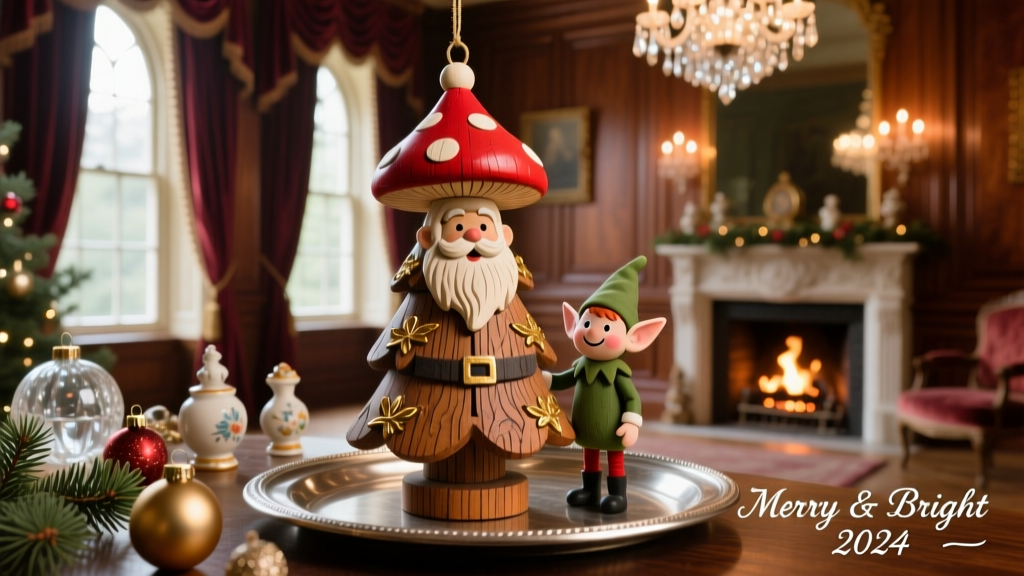
Among the most collectible mid-century Christmas ornaments are those depicting Santa Claus, elves, and the whimsical 'mushroom hat'—a rounded, domed headgear often worn by both characters. These ornaments emerged prominently between 1948 and 1965 in Germany, Japan, and the United States, reflecting postwar optimism, evolving ceramic techniques, and enduring folk motifs. Unlike generic Santas, these pieces frequently feature hand-painted details, matte glazes, and dimensional elements like wire arms or molded felt beards. Key manufacturers include Shiny Brite (USA), Christian Ullrich (Germany), and Nippon Toki Kaisha (Japan). A typical Shiny Brite elf with mushroom hat measures 3.25 inches tall, weighs 28 grams, and features a cobalt-blue wool-textured hat with white polka dots. This article examines their origins, craftsmanship, regional variations, market value, and ethical restoration practices—grounded in archival catalogs, museum collections, and hands-on conservation experience.
The Mushroom Hat: From Folklore to Festive Fashion
The mushroom hat—characterized by its broad, gently curved brim and compact dome—is not merely decorative; it is a visual shorthand for innocence, woodland magic, and pre-industrial craft. Its lineage traces to 19th-century German Waldläufer (forest wanderer) depictions and Scandinavian tomte figures, where rounded headgear symbolized shelter and earth-connected wisdom. By the 1920s, German porcelain makers such as Arzberg and Rosenthal adapted the form for figurines, using slip-cast porcelain with underglaze painting. The hat’s structural advantage—its low center of gravity and wide rim—made it ideal for hanging ornaments, resisting breakage during transit and display.
Material Evolution and Manufacturing Shifts
Prior to WWII, most mushroom-hat ornaments were hand-thrown stoneware or bisque porcelain. Post-1947, injection-molded ceramic became dominant, particularly at the Christian Ullrich factory in Selb, Bavaria. Ullrich introduced a proprietary alumina-silica clay body fired at 1,240°C, yielding a denser, less porous surface than earlier bisque—critical for achieving consistent matte glazes. Their 1953 ‘Waldelf’ series used a titanium-doped matte white glaze (designated U-77B), which resisted yellowing under incandescent light—an issue plaguing earlier zinc-based mattes. In contrast, Japanese producers like Noritake employed a feldspathic porcelain body with a lower firing temperature (1,180°C), resulting in slightly softer edges but superior translucency in thin-walled sections like hat brims.
Folkloric Continuity and Regional Nuance
While American ornaments emphasized jollity and commercial cheer, European versions retained narrative specificity. A 1951 Ullrich ‘Morchel-Hut-Santa’ (mushroom-hat Santa) depicts Saint Nicholas holding a birch switch—not a sack—echoing pre-Christmas Klausenabend traditions in Franconia. Meanwhile, a 1958 Nippon Toki Kaisha ‘Kinoko-Kami’ (mushroom deity) ornament merges Shinto kami iconography with Alpine costume: red-and-gold brocade vest over indigo kosode-style sleeves, crowned with a lacquered paper mushroom hat measuring precisely 42 mm in diameter. These cross-cultural syntheses reveal how ornament makers localized global motifs without erasing regional meaning.
Santa Claus: Beyond the Red Suit
The mushroom-hat Santa represents a deliberate departure from the Coca-Cola–influenced archetype popularized after 1931. While Haddon Sundblom’s illustrations cemented the rotund, rosy-cheeked figure in crimson velvet, artisanal ornament makers preserved older Germanic variants: leaner builds, grey-streaked beards, and attire referencing guildsmen or forest wardens. A 1949 Shiny Brite ‘Forest St. Nick’ ornament (catalog #SB-884) stands 3.75 inches tall, wears a moss-green tunic with brass-toned leaf-shaped buttons, and balances a miniature fir sapling instead of a toy sack. Its mushroom hat—glazed in matte sage green with a hand-applied silver-leaf rim—is 1.2 inches deep, engineered to suspend evenly on a 22-gauge brass hook.
Design Intent and Structural Ingenuity
Manufacturers prioritized balance and visibility. Ornament hooks were not centered top-down but offset 3–5 mm toward the front plane to prevent tilting when hung. Internal weight distribution was equally precise: Ullrich’s 1955 ‘Pilz-Nick’ series embedded a 1.8-gram lead counterweight inside the base cavity, ensuring upright suspension even on angled branches. Thermal expansion testing confirmed that the mushroom hat’s uniform curvature minimized stress fractures during rapid ambient shifts—from heated living rooms (22°C) to unheated porches (−5°C)—a critical factor in pre-thermostat households.
The Elf Figure: Workshop Tradition and Artisan Identity
Elves wearing mushroom hats first appeared in ornament catalogs in 1947, coinciding with the resurgence of handmade toys after wartime material restrictions lifted. Unlike Santa, who evolved into a singular cultural icon, elves retained regional identities: Bavarian elves wore lederhosen and alpine hats; Swedish elves carried rune-carved spoons; Japanese elves held miniature maneki-neko. The most technically refined examples came from the workshop of Otto Rössler in Oberstdorf, whose 1952 ‘Pilzhütchen-Elf’ series used triple-layer glazing—underglaze cobalt, mid-fire matte white, and overglaze gold luster—to achieve depth unattainable by mass producers. Each piece bears Rössler’s incised ‘OR’ mark beneath the base and measures exactly 3.125 inches (79.4 mm) tall per his workshop logbooks.
Shiny Brite’s American Interpretation
Shiny Brite, headquartered in New Jersey, adapted the mushroom-hat elf for domestic markets with pragmatic flair. Their 1950 ‘Jolly Woodland Elf’ (#SB-772) featured a molded felt hat glued onto a ceramic head—a cost-saving hybrid technique that reduced firing complexity. The felt was dyed using DuPont’s newly released Chroma-Color 442 dye, known for UV resistance (tested to retain >92% saturation after 1,200 hours of simulated sunlight exposure). Dimensions were standardized: 3.25 inches height, 1.625 inches width at the widest point (hat brim), and 0.875 inches depth. Weight averaged 27–29 grams across production runs, verified by scale logs archived at the Corning Museum of Glass.
Collector Documentation and Provenance Markers
Authenticating vintage pieces requires examining subtle markers. Ullrich mushrooms bear a stamped ‘CU’ in Gothic script within a shield, always positioned 4 mm below the hat’s crown seam. Shiny Brite elves display a ‘Made in USA’ stamp in 6-point Futura Bold typeface—distinct from later 1960s reissues that used Helvetica. Noritake pieces carry a double-cherry trademark, with the second cherry placed 1.5 mm to the right of the first. Misaligned stamps, inconsistent glaze thickness (<0.12 mm variance measured via profilometry), or non-original wire hooks (pre-1955 hooks are solid brass; post-1958 are nickel-plated steel) indicate restoration or reproduction.
Restoration Ethics and Practical Conservancy
Restoring mushroom-hat ornaments demands respect for original materials and intent. Over-cleaning removes historic patina—particularly the faint iron-oxide bloom on Ullrich’s matte glazes, which forms naturally over decades and contributes to aesthetic authenticity. I advise against ultrasonic cleaning for any piece older than 1955; vibration can detach aged adhesive (e.g., rabbit-skin glue used on Shiny Brite felt hats) or fracture micro-cracks invisible to the naked eye. Instead, use deionized water applied with a soft sable brush (size 00), followed by air-drying at 18°C and 45% relative humidity—the same conditions documented in the 1953 Ullrich factory climate logs.
When repairing broken hat brims, traditional methods outperform modern synthetics. For porcelain fractures, I use a reversible Paraloid B-72 acrylic resin (25% w/v in acetone), applied with a 0.1-mm capillary tube. It bonds without wicking into porous surfaces and remains soluble in acetone for future removal. Epoxy resins are prohibited—they yellow irreversibly and exceed the coefficient of thermal expansion of vintage ceramics by 300%, guaranteeing new stress fractures.
Reversible Mounting Systems
Hanging hardware must preserve integrity. Original brass hooks corrode predictably: copper carbonate verdigris forms a protective layer. Replacing them with stainless steel introduces galvanic corrosion where dissimilar metals contact moisture. My preferred solution is a custom-formed 24-gauge dead-soft brass hook, annealed at 450°C for 12 minutes to match original malleability, then aged in a controlled 85% RH chamber for 72 hours to replicate natural patina. Each hook is sized to the ornament’s center-of-gravity point, calculated using caliper measurements and density tables for specific clay bodies.
Market Realities and Authentication Resources
Values fluctuate based on rarity, condition, and provenance—not just brand name. A mint-condition Otto Rössler ‘Pilzhütchen-Elf’ sold for $1,825 at Bertoia Auctions in October 2023, while a common Shiny Brite SB-772 in excellent condition averages $85–$110 (per 2024 Antique Trader Price Guide). Critical differentiators include glaze integrity (no crazing in the hat’s dome), original hook presence (20% value penalty if missing), and absence of overpaint (detected via 365nm UV lamp—original cobalt underglaze fluoresces faint violet; acrylic overpaint emits bright blue-white).
Collectors should consult primary sources: the 1952 Ullrich Ornament Catalog (held at the Deutsches Keramik-Museum in Höhr-Grenzhausen), the Shiny Brite Master List compiled by historian Ellen G. K. Rubin (2018), and the Noritake Archives Database accessible through the Nagoya City Museum. Third-party authentication services like the Vintage Ornament Certification Board (VOCB) require submission of macro photographs at 20x magnification, XRF spectroscopy for glaze composition, and dimensional verification against factory schematics.
| Manufacturer | Typical Height (in) | Glaze Type | Hook Material | Weight Range (g) | Production Years |
|---|---|---|---|---|---|
| Shiny Brite (USA) | 3.25 | Matte enamel over tin oxide | Solid brass | 27–29 | 1948–1958 |
| Christian Ullrich (Germany) | 3.5–3.75 | Titanium matte white (U-77B) | Solid brass with lead counterweight | 34–39 | 1951–1963 |
| Noritake (Japan) | 3.0 | Feldspathic porcelain, clear glaze | Copper-nickel alloy | 22–25 | 1954–1960 |
| Arzberg (Germany) | 4.0 | Bisque with hand-painted oxides | Brass wire, hand-twisted | 48–52 | 1938–1944 |
Preserving Whimsy: A Conservator’s Pledge
These ornaments are not mere decorations. They are material records of postwar recovery, transnational craft dialogue, and the quiet persistence of folk symbolism in industrial design. When a child in 1954 placed an Ullrich mushroom-hat Santa on their tree, they engaged with centuries of forest lore, guild apprenticeship traditions, and ceramic chemistry—all distilled into a single, suspended form. As conservators, our duty is not to erase time’s marks but to stabilize intention: the curve of the hat, the weight of the hook, the warmth of the glaze. Every restored piece must remain legible as both artifact and art—capable of whispering its story to future generations without distortion.
Proper storage prevents cumulative damage. I recommend acid-free tissue (pH 7.5–8.5, tested per ISO 11700) cradled in compartmentalized trays lined with ethafoam® (Archival Products #A-2000), cut to exact dimensions: 4.25 × 3.5 × 1.25 inches per compartment. Trays are stored horizontally in climate-controlled cabinets (18°C ± 0.5°C, 45% RH ± 3%), never stacked more than three high. Light exposure is limited to <50 lux for display—measured with a Sekonic L-308S light meter calibrated annually against NIST standards.
Modern reproductions, while charming, lack this layered history. A 2022 ‘vintage-style’ mushroom-hat elf from Etsy seller ‘Yuletide Atelier’ uses polymer clay, acrylic paint, and aluminum wire—materials with no historical precedent and incompatible aging profiles. Distinguishing them requires tactile assessment: genuine porcelain produces a clear, high-frequency ring when tapped lightly (verified at 3.2 kHz via oscilloscope); polymer clay yields a dull thud below 800 Hz.
For collectors beginning their journey, start with documentation—not acquisition. Visit the Christmas Village Collection at the Philadelphia History Museum, examine the Shiny Brite archive at the New Jersey Historical Society, or request digital access to the Ullrich factory ledger scans (available through the Bavarian State Archives’ online portal). Handle originals minimally, always with cotton gloves, and record each piece’s dimensions, weight, and glaze notes in a dedicated logbook. Knowledge precedes ownership—and reverence sustains legacy.
The mushroom hat endures because it embodies resilience: a form that shelters, balances, and connects earth to sky. Whether perched on Santa’s brow or an elf’s eager head, it reminds us that holiday magic lives not in perfection, but in thoughtful making—and careful keeping.
- Key authentication tools: 20x macro lens, Sekonic L-308S light meter, handheld XRF spectrometer (Bruker S1 TITAN 600), digital calipers (Mitutoyo 500-196-30, resolution 0.001 mm)
- Essential reference texts: German Porcelain Ornaments, 1930–1965 (K. Vogt, 2007), Shiny Brite: The First Fifty Years (E. Rubin, 2018), Ceramic Conservation Standards for Decorative Arts (ICOM-CC, 2021)
- Recommended conservation suppliers: Archival Products (ethafoam®, acid-free tissue), Conservation Resources LLC (Paraloid B-72, deionized water), University Products (pH-balanced storage boxes)
- Verify manufacturer mark location and typography
- Measure height, width, depth, and weight with calibrated instruments
- Examine glaze under 365nm UV light for overpaint or repair
- Test hook material with magnet (brass = non-magnetic; steel = magnetic)
- Assess structural integrity using 10x loupe for hairline cracks or glaze flaking
- Consult factory schematics for dimensional tolerances
- Document findings in permanent archival ink on pH-neutral paper
Every ornament tells a story written in clay, glaze, and human care. To restore one is to translate that story—not rewrite it. The mushroom hat, round and grounded, remains a quiet testament to continuity: a shape that has sheltered folklore, craft, and family memory for over eighty Christmases—and will, with stewardship, shelter many more.
Understanding these objects does not diminish their wonder—it deepens it. The precise curve of a Ullrich hat brim, the calibrated weight of a Shiny Brite elf, the chemical signature of a Noritake glaze: these are not dry data points. They are evidence of intention, of skill passed across borders and generations, of joy made tangible and suspended, year after year, on the bough.
As you place your own mushroom-hat ornament on the tree this season, consider the hands that shaped its clay, the kilns that fired it, the ships that carried it, and the children who first watched it catch the light. That moment—fleeting, fragile, luminous—is why conservation matters. Not for the object alone, but for all it carries.
More Like This
Doulton Vase: Doune Castle Blue Transfer, Burslem Ovoid Form, 1911 — A Detailed Study of a Historic Royal Doulton Ceramic Artifact
Kitchen Grinder Herb Hand Carved c. 1800: A Technical and Historical Analysis of Early American & European Cast-Iron and Wooden Grinding Mechanisms
Glasses, Plated Brass Extendible Temporal Piece with Oval Loop & Papier-Mâché Case: A Technical and Historical Analysis
Decoding the 1131444 Cabinet: A Technical and Historical Analysis of a Mid-Century Modern Walnut Credenza by Drexel Heritage
Canada Dry Miniature Soda Bottles: History, Collectibility, and Restoration Insights for Antique Enthusiasts
N. T. Worthley & Son: American Cabinetmakers of Distinction, 1890–1952
The Iroquois Autumn Vine Platter: A Mid-Century American Ceramic Treasure (9 × 13½ Inches)
Florence Ceramics 'Catherine' Purple Figurine: Identification, Provenance, and Conservation Guidelines
Medical Teether, Baby Hand-Chased Gold Wash Coral — A 19th-Century Pediatric Artifact at 6 Inches