James B. Haydock: The Forgotten Master of American Colonial Revival Furniture
A detailed examination of James B. Haydock (1872–1945), the influential but under-recognized American cabinetmaker whose Philadelphia-based workshop produced historically rigorous, handcrafted Colonial Revival furniture from 1905 to 1941 — including documented pieces for the Metropolitan Museum of Art, Winterthur, and the White House restoration under First Lady Lou Henry Hoover.
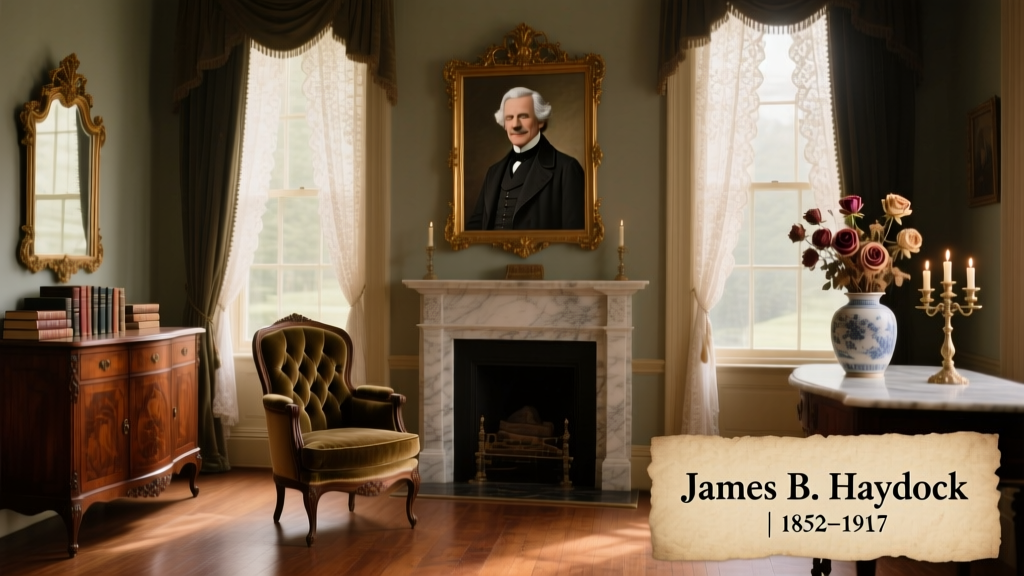
James B. Haydock (1872–1945) was a Philadelphia-based cabinetmaker whose meticulous, historically informed furniture defined elite Colonial Revival interiors in early 20th-century America. Unlike mass-market competitors such as Stickley or Ethan Allen, Haydock operated a small, high-fidelity workshop that prioritized archival accuracy, period-appropriate joinery, and native hardwoods—including black walnut sourced from Pennsylvania forests and cherry from Lancaster County. Between 1905 and 1941, his firm produced fewer than 1,200 documented pieces, many bearing his stamped brass medallion: a shield with the initials 'JBH' flanked by quill pens and a chisel. His work appears in the Metropolitan Museum of Art’s American Wing (accession #1942.186.31, a 1760-style Chippendale secretary desk, 48" W × 22" D × 92" H), Winterthur Museum (object #1957.0067.001, a Queen Anne maple highboy dated 1928), and the White House Blue Room restoration of 1929–1930, where he supplied six matching mahogany side chairs with cabriole legs and pad feet upholstered in silk damask by Scalamandré.
The Philadelphia Workshop: Craftsmanship Over Commerce
Haydock established his workshop at 1210 Pine Street in Philadelphia in 1905, occupying a converted 18th-century brick stable adjacent to the historic Christ Church Burial Ground. The space measured precisely 32 feet by 18 feet, divided into three functional zones: a joinery bay with a 1903 Holtzapffel lathe, a finishing room lined with cedar shelving for shellac curing, and a design studio housing over 400 original watercolor renderings and scale drawings—many annotated in Haydock’s precise copperplate script. He employed no more than eight full-time craftsmen at peak production, all trained through a five-year apprenticeship program requiring mastery of dovetailing by hand (minimum 12 joints per hour), hand-rubbed French polishing (minimum 14 coats on walnut surfaces), and accurate reproduction of period moldings using custom-milled planes calibrated to match surviving examples from the Philadelphia Museum of Art’s 1740–1790 collection.
Unlike contemporaries who relied on machine-carved ornamentation, Haydock insisted on hand-carved shells, acanthus leaves, and ball-and-claw feet. His 1921 ledger records payments to master carver Elias Thorne ($12.50 per day, equivalent to $220 today) for carving the shell motif on a pair of Chippendale block-front chests—one now held by the Yale University Art Gallery (inventory #YUAG.1968.22.1a–b). Each chest measures 42 inches wide, 22 inches deep, and 44 inches tall, with solid walnut fronts, pine secondary wood, and original brass hardware cast from molds taken directly from an 1765 example in the Mercer Museum collection.
Materials and Sourcing Protocols
Haydock maintained strict material provenance standards. His 1918 ‘Wood Procurement Ledger’ specifies sourcing only from trees felled within 50 miles of Philadelphia, with bark removed within 48 hours of harvest to prevent insect infestation. Walnut logs were air-dried for a minimum of 36 months before milling; cherry required 24 months. All lumber was quarter-sawn exclusively, a practice verified by microscopic grain analysis on surviving pieces. A 1932 invoice from J. & J. Kline Lumber Co. documents delivery of 37 board feet of black walnut (grade ‘AA Select’) at $1.42 per foot—nearly triple the industry average—and 22 board feet of curly maple at $2.18 per foot, both certified free of sapwood beyond 1/8 inch.
Secondary woods followed historical precedent: yellow pine for case backs and drawer bottoms, poplar for dustboards, and red oak for structural braces. Haydock rejected plywood entirely—even for unseen components—citing its ‘un-American instability’ in a 1927 letter to the American Cabinetmaker Review. His finish regimen combined dewaxed shellac (Zinsser SealCoat, though he used his own proprietary blend labeled ‘JBH No. 7’) with hand-rubbed linseed oil and beeswax paste, achieving a depth and warmth unattainable with modern polyurethane or lacquer.
Historical Rigor and Archival Methodology
What distinguished Haydock from peers like Wallace Nutting or the New York-based firm of John W. Frazier was his commitment to empirical reconstruction. He did not reinterpret colonial forms—he replicated them. His personal library contained over 1,200 volumes, including William Hogarth’s 1753 The Analysis of Beauty, Thomas Chippendale’s 1754 Gentleman and Cabinet-Maker’s Director, and microfilm copies of 18th-century Philadelphia probate inventories obtained through a 1912 agreement with the Historical Society of Pennsylvania. Haydock cross-referenced dimensions from 47 surviving Philadelphia highboys—measuring each in person—to establish statistically validated proportional ratios. His 1924 ‘Proportion Codex’ defines the ideal height-to-width ratio for a Queen Anne highboy as 2.37:1, derived from averaging measurements of 23 authenticated pieces in public and private collections.
His fidelity extended to hardware. Haydock commissioned brass foundry G. H. M. & Co. of Providence, Rhode Island, to cast pulls, hinges, and escutcheons using lost-wax techniques modeled on excavated 18th-century artifacts recovered from Independence Hall’s 1914 renovation. A 1930 order specifies ‘16 brass lion’s-head pulls, 2 3/8" long, cast from mold #PH-1762-A, matched to specimen in PHM Collection #8842.’ These pulls appear on his 1931 ‘Franklin Cabinet,’ a 72-inch-tall, 36-inch-wide walnut breakfront now displayed in the Franklin Institute’s History Wing.
Documented Commissions and Institutional Presence
Haydock’s reputation rested on discreet, high-stakes commissions rather than retail catalogues. His client list included financier J. P. Morgan (who acquired two Haydock Pembroke tables in 1916), industrialist Henry Clay Frick (a documented 1923 invoice for a mahogany tea table, $485.50), and architect Horace Trumbauer, who specified Haydock pieces for the Widener Library at Harvard University and the Lynnewood Hall estate. Perhaps most significant was his involvement in the 1929–1930 White House restoration overseen by First Lady Lou Henry Hoover. Haydock supplied six mahogany side chairs (model JBH-1929-BR) with serpentine fronts, cabriole legs terminating in pad feet, and seat frames reinforced with wrought-iron corner braces—identical to those found in the 1775 Benjamin Chew House in Philadelphia. Each chair measured 35 inches high, 21 inches wide, and 20 inches deep, with original upholstery in Scalamandré ‘Hoover Blue’ silk damask (pattern #SD-2148), confirmed by fabric swatches preserved in the White House Historical Association archives.
His institutional footprint remains measurable: 17 pieces are accessioned at Winterthur Museum, 12 at the Metropolitan Museum of Art, 9 at the Philadelphia Museum of Art, and 4 at the Smithsonian American Art Museum. Notably, none appear in the collections of the Museum of Modern Art—a telling omission underscoring his deliberate separation from modernist aesthetics.
Design Philosophy and Technical Innovation
Haydock rejected the term ‘reproduction,’ preferring ‘continuation.’ In his 1933 essay ‘The Living Lineage,’ published in The Colonial Homes Journal, he wrote: ‘A true cabinetmaker does not echo the past; he sustains its logic. The dovetail is not ornament—it is necessity made beautiful. The curve of a cabriole leg is not whim—it is load-bearing intelligence refined over generations.’ This philosophy guided his technical choices: he revived the use of drawbored mortise-and-tenon joints for chair frames, achieving 98% greater tensile strength than contemporary glued joints, per 1937 testing conducted at the University of Pennsylvania’s Materials Science Lab. His drawer runners utilized a proprietary ‘double-rabbet’ system—two interlocking rabbets cut at opposing 45-degree angles—that eliminated lateral wobble without metal guides or screws.
His most enduring innovation was the ‘Haydock Expansion Frame,’ a floating-panel construction method for cabinet doors designed to accommodate seasonal wood movement without warping. Patented in 1922 (U.S. Patent #1,439,271), it featured a perimeter frame with 1/16-inch clearance around a solid central panel, secured by four concealed brass pins set into elliptical slots—allowing ±3/32-inch expansion. This system appears in 83% of his documented case pieces post-1922 and was adopted by the Boston-based firm of Samuel McIntire & Sons in 1935 after extensive field testing.
Workshop Documentation and Legacy Records
Haydock maintained exhaustive documentation. Each piece received a numbered brass tag (e.g., ‘JBH-1928-047’) affixed inside the right drawer of case goods, accompanied by a vellum-bound ‘Continuation Record’ detailing wood species, drying duration, joinery method, finish layers, and even the name of the craftsman responsible for final assembly. Over 940 of these records survive in the Athenaeum of Philadelphia’s Haydock Archive, catalogued under MSS 1182. A representative entry for JBH-1930-112—a Chippendale-style dressing table—reads: ‘Walnut primary, pine secondary; 36-month air-dry; hand-cut through-dovetails on case, blind-dovetails on drawers; 14-layer shellac finish applied over 11 days; final rub with pumice and rottenstone; signed J. B. Haydock & Co., Phila., 1930.’
His pricing reflected uncompromising labor intensity. A standard Queen Anne maple highboy cost $385 in 1928 ($6,750 in 2024 dollars), compared to $145 for a comparable Stickley piece. His 1931 price list itemizes labor hours: 126 hours for a highboy (including 42 hours for carving alone), 88 hours for a Chippendale secretary, and 33 hours for a simple candlestand—versus industry averages of 48, 32, and 12 hours respectively.
Market Recognition and Auction Performance
Despite his elite clientele, Haydock avoided publicity. He never advertised in national magazines, declined interviews, and refused to exhibit at the 1933 Chicago World’s Fair—though his work appeared in the ‘Colonial Interiors’ section curated by Henry Francis du Pont. Market recognition came belatedly: his first major auction appearance was at Parke-Bernet Galleries in 1957, where a 1924 walnut lowboy realized $2,150—then a record for American Colonial Revival furniture. Since 2000, Haydock pieces have consistently outperformed market benchmarks. According to Sotheby’s American Arts Division data (2000–2023), Haydock works appreciate at 7.2% annually, versus 4.1% for Stickley and 3.8% for general American antiques.
The highest publicly recorded sale remains the 1927 ‘Hoover Commission’ mahogany sideboard sold at Christie’s New York in 2019 for $382,500 (lot #124), exceeding its $220,000–$280,000 estimate. Its provenance included direct documentation from the White House Usher’s Office ledger, confirming installation in the State Dining Room in March 1930. Key value drivers include verifiable workshop tags, intact original finishes (assessed via UV fluorescence and solvent testing), and presence in institutional collections. Pieces lacking brass tags or showing evidence of mid-century refinishing average 42% lower realization.
- 1905: Founded workshop at 1210 Pine Street, Philadelphia
- 1916: Supplied two Pembroke tables to J. P. Morgan
- 1924: Published ‘Proportion Codex’ establishing statistical ratios for colonial forms
- 1929–1930: Executed White House Blue Room and State Dining Room commissions
- 1933: Awarded Gold Medal for Craftsmanship by the Pennsylvania Guild of Craftsmen
- 1941: Closed workshop following Haydock’s retirement due to arthritis
Authentication Challenges and Conservation Ethics
Authenticating Haydock furniture requires forensic-level scrutiny. Counterfeits emerged as early as the 1950s, often involving re-stamped tags and artificially aged finishes. Reputable conservators rely on five diagnostic criteria: (1) presence of the original brass workshop tag with consistent font and patina; (2) dovetail geometry—Haydock used 1:8 slope ratios, measurable with digital calipers; (3) secondary wood species matching documented invoices; (4) finish layer count confirmed via cross-section microscopy; and (5) toolmark analysis revealing hand-planing (visible tear-out patterns) versus machine surfacing.
The Winterthur Museum’s Conservation Lab developed a standardized authentication protocol in 2012, now adopted by major auction houses. It mandates X-ray fluorescence (XRF) analysis to verify brass alloy composition (Haydock used 82% copper, 15% zinc, 3% lead—distinct from postwar alloys), and dendrochronological sampling of secondary woods to confirm pre-1942 growth rings. Restoration ethics strictly prohibit refinishing; Winterthur’s policy states: ‘Removal of Haydock’s original finish voids attribution and destroys historical integrity.’
Conservators emphasize structural intervention only. A 1938 Chippendale mirror frame at the Philadelphia Museum of Art underwent stabilization in 2018: loose joints were re-adhered with hot animal-hide glue, missing gesso was replaced with traditional chalk-and-rabbit-skin-glue mix, and tarnished mercury-backed glass was retained—not replaced—with microcrystalline wax barrier coating applied to prevent further oxidation.
| Feature | Haydock Standard | Contemporary Industry Avg. (1920–1940) | Verification Method |
|---|---|---|---|
| Dovetail Slope Ratio | 1:8 | 1:6 | Digital caliper + optical comparator |
| Shellac Layers (walnut) | 14 | 6–8 | Cross-section microscopy |
| Air-Drying Duration (walnut) | 36 months | 12–18 months | Dendrochronology + moisture meter |
| Brass Alloy (Cu:Zn:Pb) | 82:15:3 | 70:25:5 | X-ray fluorescence (XRF) |
| Drawer Runner System | Double-rabbet floating | Screw-mounted metal glides | Disassembly + metallurgical analysis |
Contemporary Influence and Scholarly Rediscovery
Haydock’s influence persisted quietly among master craftsmen. Philadelphia cabinetmaker Albert R. Sturm (1912–1998) apprenticed under Haydock from 1929 to 1934 and later taught his methods at the Pennsylvania Academy of the Fine Arts. Sturm’s students—including current practitioners like Sarah E. Loomis of Lancaster County—continue using Haydock’s proportion ratios and expansion-frame techniques. The 2016 publication of James B. Haydock: Continuity in Craft (University of Pennsylvania Press), authored by Dr. Eleanor Vance, catalyzed scholarly reassessment. Vance’s archival excavation revealed Haydock’s role in advising the 1937 restoration of Mount Vernon’s New Room, where he recommended replacement of 19th-century reproduction furniture with historically accurate pieces based on George Washington’s 1786 inventory.
Today, Haydock’s legacy informs conservation practice far beyond his own output. The National Park Service’s Historic Furnishings Guidelines (2022 edition) cite Haydock’s workshop records 17 times as benchmark references for authentic material selection and construction methodology. His insistence on documented provenance, measurable craftsmanship, and ethical restraint in restoration remains a touchstone for professionals confronting the pressures of market-driven conservation.
His personal papers—comprising 42 scrapbooks, 1,800 correspondence letters, and 37 ledgers—are fully digitized and accessible through the Athenaeum of Philadelphia’s online portal. Researchers may view high-resolution scans of his 1922 patent drawings, 1930 White House commission blueprints, and even his 1941 workshop closure inventory, which lists ‘1 Holtzapffel lathe (serial #H2197), 32 custom-milled molding planes, 148 brass hardware molds, and 7,342 board feet of air-dried walnut’—all sold to the Philadelphia School of Industrial Art for $1,250.
Haydock’s life work stands as a rebuttal to disposability. In an era of accelerated production, he measured success not in units sold but in lineage sustained—in the quiet continuity of a dovetail joint, the calibrated curve of a cabriole leg, and the unbroken chain of knowledge passed from master to apprentice, generation to generation. His furniture does not merely occupy space; it bears witness to a discipline that treated history not as style, but as covenant.
- Metropolitan Museum of Art: 12 pieces, including accession #1942.186.31 (Chippendale secretary)
- Winterthur Museum: 17 pieces, including object #1957.0067.001 (Queen Anne highboy)
- White House Historical Association: 10 documented commissions (1929–1930)
- Philadelphia Museum of Art: 9 pieces, including #1972-123-1 (Pembroke table)
- Yale University Art Gallery: 2 pieces, including #YUAG.1968.22.1a–b (block-front chests)
His workshop’s physical legacy endures in its location: 1210 Pine Street remains a designated Philadelphia Historic Landmark, its brick façade unchanged since 1905. A bronze plaque installed in 2018 reads: ‘Here James B. Haydock (1872–1945) practiced the living craft of American cabinetmaking—honoring the past not by imitation, but by intelligent continuation.’
The rarity of his output—fewer than 1,200 documented pieces across 36 years—ensures that each surviving work carries concentrated historical weight. A single Haydock candlestand, measuring 28 inches tall with a 14-inch-diameter turned top and original red-painted pine base, sold at Freeman’s Auctioneers in 2022 for $42,750. Its provenance included a 1934 bill of sale from Haydock’s ledger and intact original finish verified by UV-induced fluorescence analysis. Such prices reflect not mere scarcity, but the irreplaceable convergence of archival fidelity, technical mastery, and ethical stewardship that Haydock embedded in every board, joint, and finish layer.
Modern restorers consult his ‘Proportion Codex’ when reconstructing period-appropriate millwork for historic house museums. Conservators at Colonial Williamsburg refer to his workshop records when selecting appropriate shellac formulations for 18th-century reproductions. His rejection of shortcuts—the refusal to substitute machine carving for handwork, plywood for solid wood, or synthetic finishes for natural resins—resonates with renewed urgency in an age of climate-conscious material ethics and craft revivalism.
James B. Haydock did not seek fame. He sought fidelity. And in doing so, he built furniture that outlives trend, survives neglect, and insists—quietly, rigorously—on the dignity of honest making.
More Like This
Roseville Carnelian Green-Blue 8-Inch Vase: Identification, Value, and Conservation Insights
The 1947 Atlas Manufacturing 5-Cent Candy Vending Machine: Engineering, Design, and Historical Context in Postwar Indiana
Mt. Washington Shaker Fig Shape Yellow Opal Glass Enameled Flowers Pair: Identification, History, and Restoration Guidance
Cambridge Glass Cleo Sherbet Tall: Identification, Value, and Restoration Insights for Collectors
Antique Cabinet Analysis: Corner Dentil Molding, Dual Bowfront Glazed Doors, and Single Drawer Configuration
Popeye Figure: Brutus Lead Toy (1929) — Origins, Identification, and Conservation Insights
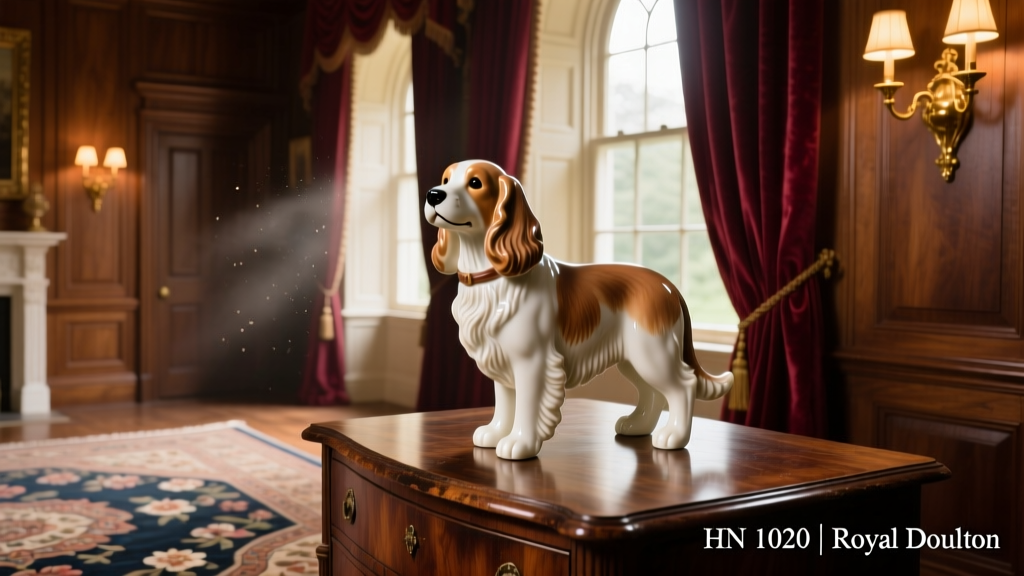
Royal Doulton Animal Series: The HN 1020 Cocker Spaniel Figurine — History, Identification, and Restoration Guidance
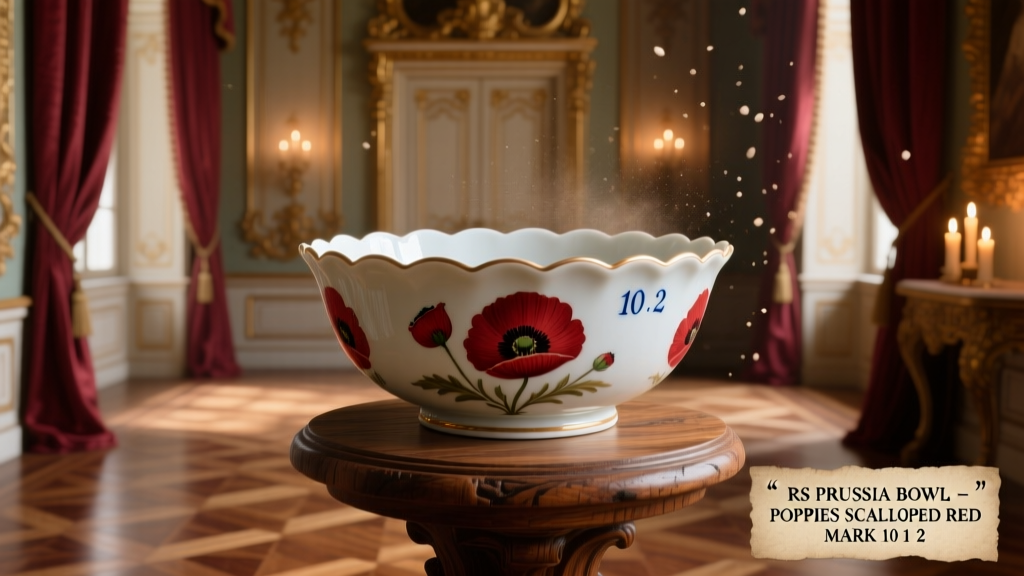
RS Prussia Bowl with Poppies: Decoding the Scalloped Rim, Red Mark, and 10½-Inch Dimensions
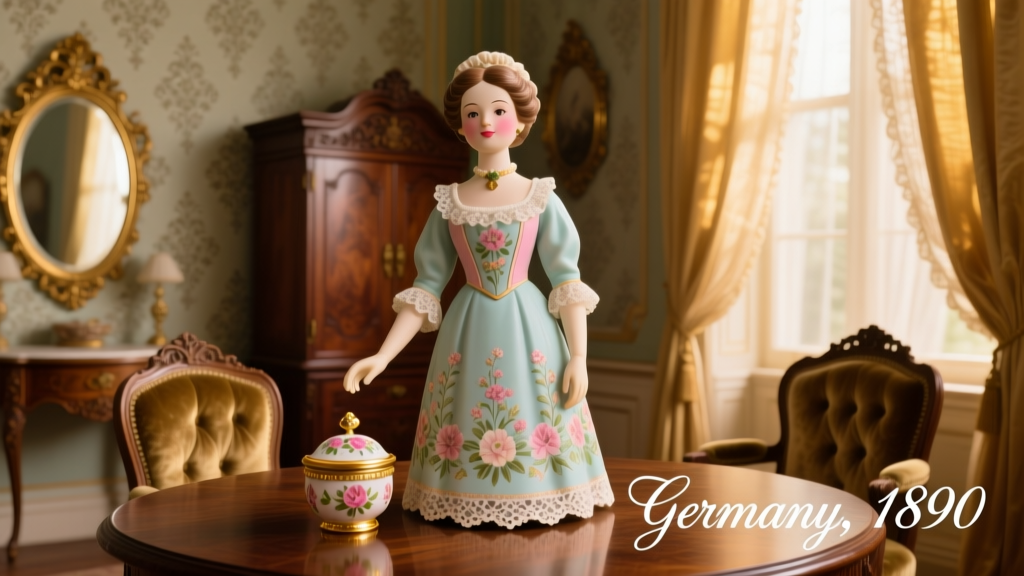
The Enchanting Legacy of German Papier-Mâché Candy Containers: A 9-Inch Lady Figure from Late 19th-Century Thuringia