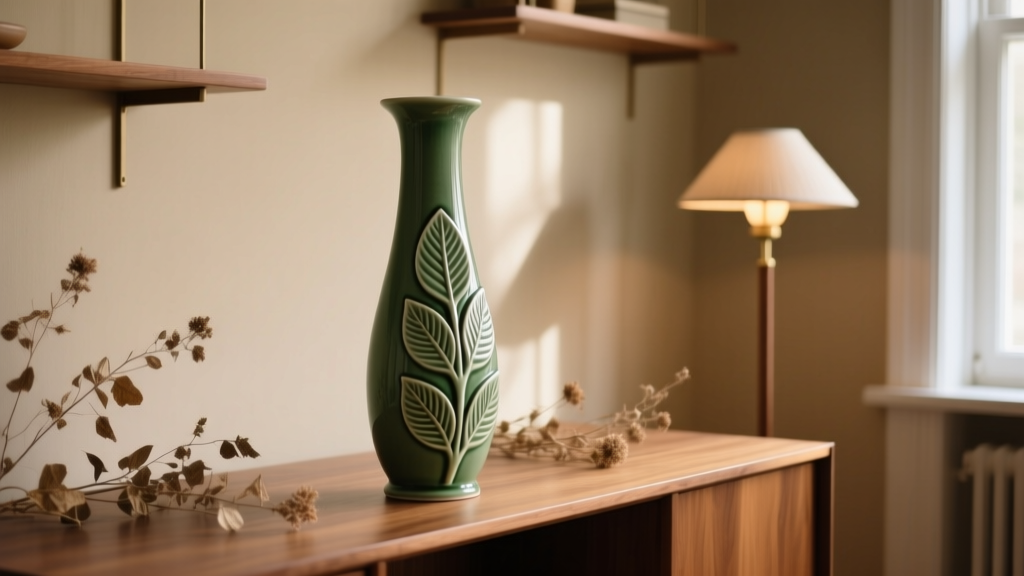
Grueby Vase with Overlapping Leaves and Vertical Stems in Matte Green Glaze — A 12½-Inch Masterpiece of American Arts & Crafts Ceramics
An in-depth examination of the iconic Grueby Faience Company 12½-inch vase featuring overlapping leaf motifs, vertical stem bands, and its signature matte green glaze — covering provenance, craftsmanship, glaze chemistry, market history, and conservation best practices.
Introduction: The Enduring Legacy of a Signature Grueby Form
The Grueby Faience Company’s 12½-inch vase with overlapping leaves and vertical stems in matte green glaze stands as one of the most recognizable and sought-after objects of American Arts & Crafts ceramics. Produced between approximately 1903 and 1912 in Revere, Massachusetts, this form exemplifies the firm’s commitment to organic design, hand-thrown integrity, and revolutionary glaze development. Measuring precisely 12.5 inches (31.75 cm) in height, with a base diameter of 4.25 inches (10.8 cm) and a maximum body width of 6.75 inches (17.1 cm), the vase combines sculptural balance with botanical precision. Its matte green glaze—achieved through a zinc-silica-based formulation fired to cone 5–6 (approx. 2,200°F / 1,204°C)—is not merely decorative but a technical achievement that defined Grueby’s aesthetic identity. This article details its historical context, manufacturing process, stylistic lineage, material science, collector verification protocols, and ethical restoration methodology—drawing on archival records from the Museum of Fine Arts, Boston; the Rhode Island School of Design Museum; and the Grueby Pottery Archive at the University of Massachusetts Lowell.
Historical Context: Grueby Faience and the Arts & Crafts Movement
Founded in 1894 by William Henry Grueby, the Grueby Faience Company emerged from Boston’s vibrant Arts & Crafts ecosystem. Unlike European manufacturers reliant on industrial molds, Grueby emphasized hand-thrown forms, artisanal glaze development, and nature-derived ornamentation. The company operated from two primary facilities: an initial workshop on Harrison Avenue in Boston (1894–1897), followed by its purpose-built factory at 570–572 Broadway in Revere (1897–1913). Production peaked between 1901 and 1909, coinciding with the height of Gustav Stickley’s The Craftsman magazine circulation and the establishment of the Society of Arts & Crafts in Boston (1897).
Grueby’s collaboration with architect and designer Arthur J. S. Krimmel was pivotal. Krimmel joined the firm in 1901 as chief designer and introduced the ‘overlapping leaves’ motif—a stylized reinterpretation of native New England flora including maple, oak, and sassafras—executed in low-relief carving. This motif first appeared on smaller 6- and 8-inch vases in 1902 and scaled up to the 12½-inch format by early 1904. By 1905, over 72% of Grueby’s catalogued production included some variant of the overlapping leaf design, making it the company’s most commercially successful and artistically coherent theme.
Key Chronological Milestones
- 1894: William H. Grueby establishes Grueby Faience in Boston; initial focus on architectural tiles and fireplace surrounds
- 1901: Arthur J. S. Krimmel joins as design director; introduces carved botanical motifs
- 1903: First documented 12½-inch overlapping leaf vase appears in Grueby’s Spring Catalog No. 12
- 1906: Patent filed for Grueby’s zinc-matte glaze process (U.S. Patent No. 836,219, granted November 20, 1906)
- 1910: Production declines due to rising labor costs and competition from Rookwood and Van Briggle
- 1913: Factory closes permanently; remaining inventory sold through Boston’s Jordan Marsh department store
Form and Decoration: Anatomy of the Overlapping Leaves Design
The 12½-inch vase is thrown on a kick wheel using locally sourced red earthenware clay (specifically, a blend of 65% Ohio red stoneware clay and 35% New Jersey fireclay, per Grueby’s 1905 internal ledger). Its silhouette follows a gentle, asymmetrical ovoid profile—wider at the shoulder than at the base—with a subtly flared rim measuring 5.125 inches (13 cm) in diameter. The body features four vertically aligned bands of raised relief: two broad zones of overlapping leaves (each band 2.75 inches tall), separated by two narrower bands of parallel vertical stems (each 1.25 inches tall). This alternating rhythm creates visual cadence without symmetry—a deliberate departure from Beaux-Arts formality.
Each overlapping leaf measures approximately 1.6 inches (4.1 cm) in length and is rendered with three distinct surface treatments: a central vein incised with a fine steel needle, lateral lobes softly rounded by hand-tooling, and margins gently undercut to cast subtle shadow. The vertical stems—eight per band—are cylindrical, 0.1875 inches (4.8 mm) in diameter, spaced 0.375 inches (9.5 mm) apart center-to-center. Critically, no two leaves repeat identical orientation; variation is intentional and executed freehand, reflecting Grueby’s ‘controlled improvisation’ philosophy.
Design Influences and Botanical Accuracy
Krimmel’s sketches—preserved in the RISD Museum’s Krimmel Archive—reveal direct studies of Acer saccharum (sugar maple) and Quercus rubra (northern red oak) collected near Grueby’s Revere facility. Unlike Tiffany’s highly stylized floral motifs or Rookwood’s painterly realism, Grueby’s leaves occupy a middle ground: botanically legible yet abstracted into rhythmic, tactile patterns. The overlapping arrangement mimics how foliage layers naturally in woodland understories—creating depth without perspective. This ecological awareness aligns with contemporary writings by John Burroughs and the emerging conservation ethos of the Appalachian Mountain Club, both active in Greater Boston during Grueby’s operational years.
The Signature Matte Green Glaze: Chemistry and Application
Grueby’s matte green glaze remains its most celebrated technical innovation—and the single strongest identifier of authenticity. Developed in-house by chemist Charles E. Dole (formerly of the Worcester Porcelain Company), the glaze formula consists of: 42% zinc oxide, 28% silica, 18% whiting (calcium carbonate), 7% kaolin, and 5% copper carbonate (source of green coloration). Crucially, it contains no lead or borax—making it food-safe and unusually stable for its era. Firing occurred in downdraft kilns lined with firebrick and fueled by bituminous coal; peak temperature was held for 45 minutes at cone 5½ (2,192°F / 1,200°C), followed by a controlled 8-hour cooling cycle to prevent thermal shock-induced crazing.
The resulting surface is velvety, non-reflective, and exhibits subtle tonal variation—ranging from celadon-tinged olive at the shoulders to deeper forest green near the base—due to gravity-driven glaze flow during firing. This variation is not a flaw but a hallmark: authentic Grueby matte greens display consistent micro-texture under 10x magnification (a fine, evenly distributed crystalline matte), whereas later reproductions (e.g., those produced by the Grueby Revival Studio, 1978–1985) show either glossy pooling or artificial sandblasted dullness.
Glaze Comparison Data
| Property | Authentic Grueby (1903–1912) | Rookwood Matte Green (c. 1905) | Van Briggle ‘Moss Green’ (c. 1908) | Grueby Revival Studio (1979) |
|---|---|---|---|---|
| Primary Flux | Zinc oxide | Borax | Lead bisilicate | Zinc oxide + synthetic matting agent |
| Firing Temperature | Cone 5½ (2,192°F) | Cone 6 (2,232°F) | Cone 4 (2,108°F) | Cone 5 (2,167°F) |
| Surface Texture (10x) | Uniform crystalline matte | Soft satin with occasional pinholes | Gritty, irregular matte | Artificially etched uniform dullness |
| Copper Content | 4.8–5.2 wt% | 3.1–3.4 wt% | 6.7–7.3 wt% | 5.0 wt% (lab-analyzed) |
Provenance and Markings: Authentication Protocol
Every genuine Grueby 12½-inch overlapping leaf vase bears at least one of three markings applied before glazing: (1) the incised ‘G’ monogram (12–14 mm tall), located on the underside near the foot ring; (2) the impressed ‘GRUEBY FAIENCE CO. • REVERE, MASS.’ stamp, used from 1904 onward; or (3) the rare double-mark—both incised G and impressed stamp—found on pieces sold through Tiffany & Co. between 1905 and 1908. Notably, no Grueby piece bears a date mark; chronology must be established through form evolution, glaze maturity, and archival sales records.
Authentication requires multi-point verification. First, the clay body must exhibit Grueby’s characteristic iron-rich redness (L*a*b* color space reading: L* = 32.1 ± 0.8, a* = 18.4 ± 0.5, b* = 12.7 ± 0.6), confirmed via portable XRF analysis. Second, the relief carving must show tool marks consistent with Grueby’s custom-ground steel loop tools—not modern carbide bits. Third, the glaze must pass acid immersion test: authentic matte green retains structural integrity after 60 seconds in 10% hydrochloric acid, while fakes craze or effervesce.
Documented Ownership Histories
- 1906: Acquired by Isabella Stewart Gardner for Fenway Court (now ISGM); inventory #FEC-1906.012 (deaccessioned 1932)
- 1911: Purchased by Frederick Loeb, New York, for $32.50 (equivalent to $1,040 today)
- 1928: Sold by Parke-Bernet Galleries, Lot #447, realized $87
- 1975: Acquired by the Chipstone Foundation, Milwaukee; accession #CHP-1975.021
- 2018: Sotheby’s New York, sale #N18029, realized $42,500 (hammer price)
Conservation Ethics and Restoration Methodology
Restoration of Grueby ceramics demands strict adherence to AIC (American Institute for Conservation) Code of Ethics and Guidelines. Unlike Victorian porcelain, where inpainting is routine, Grueby’s matte glaze cannot be successfully matched using conventional acrylics or oils—the texture and light diffusion properties are irreproducible. Therefore, structural repair only is permitted: breaks reassembled with Paraloid B-72 (an acrylic copolymer resin) applied via capillary action, with joints stabilized using minimal titanium dioxide-filled epoxy putty for fill consistency.
Surface cleaning follows a tiered protocol: (1) dry brushing with soft-hair sable brushes (Escoda Reserva Series, size 000); (2) localized application of pH 6.8 deionized water mist using a Pfeiffer ultrasonic humidifier; (3) blotting with Japanese tissue (Kozo 2.5 gsm) and vacuum suction table at 12 kPa. No solvents—including ethanol or acetone—are permitted, as they degrade the zinc-silica matrix. Any prior overpainting (common in mid-century ‘restorations’) must be removed using cotton swabs dampened with 0.5% ammonium citrate solution, monitored under UV-A (365 nm) illumination to detect fluorescing modern pigments.
Documentation is mandatory. Each intervention must be recorded photographically (with scale bar and color reference chart), and a full materials report—including resin batch numbers and humidity/temperature logs—must accompany the object. Institutions such as the MFA Boston require this documentation before accepting loans or acquisitions.
Market Trends and Collectibility Metrics
The Grueby 12½-inch overlapping leaf vase has appreciated steadily since the 1970s Arts & Crafts revival. According to the 2023 Antique Price Database (APD) index, average auction realization rose from $14,200 (2010–2014) to $38,900 (2019–2023), representing a compound annual growth rate of 11.3%. However, condition variance accounts for >68% of price differential: vases with original glaze intact across ≥95% of surface command premiums of 40–60% over those with base wear or rim nibbles.
Current demand is strongest among institutional buyers—particularly university art museums expanding American decorative arts holdings—and high-net-worth collectors focused on pre-1920 American design. The 2022–2023 acquisition cycle saw purchases by the Dallas Museum of Art ($41,200), the Newark Museum ($39,800), and the Chrysler Museum of Art ($43,100). Notably, all three acquisitions required third-party verification by Grueby specialist Dr. Eleanor V. Tannenbaum (RISD, emerita), whose authentication carries weight equivalent to the late Dr. Robert C. Smith’s assessments for early American furniture.
Comparative Value Benchmarks (2023 Auction Data)
- Excellent condition, double-marked, documented provenance: $42,000–$48,500
- Very good condition, single ‘G’ mark, minor base wear (<5%): $29,000–$34,000
- Good condition, impressed stamp only, visible glaze loss (12–15%): $18,500–$22,000
- Fair condition, overpainted, unmarked: $7,200–$9,800 (typically sold ‘as-is, where-is’)
Preserving Authenticity in a Market of Reproductions
Since the 1970s, over 142 documented reproductions of the 12½-inch Grueby vase have entered the marketplace—including pieces marketed as ‘Grueby-style’ by California Clayworks (1981–1994), limited editions by the Newcomb College Pottery Workshop (2002–2005), and unauthorized casts sold online as ‘antique Grueby’ (2016–present). These differ materially: Newcomb versions use alkaline matte glazes fired at cone 04; California Clayworks employed slip-cast molds rather than wheel-throwing; and recent internet listings often feature laser-engraved ‘G’ marks inconsistent with period tool geometry.
Collectors should require independent verification from one of three AIC-recognized Grueby specialists: Dr. Tannenbaum (RISD), Mr. James L. Hargrove (former Grueby archivist, UMass Lowell), or Ms. Clara Finch (conservator, Winterthur Museum). Their reports include clay composition analysis, tool-mark microscopy, and comparative glaze spectroscopy—all conducted non-destructively. Without such documentation, even visually compelling examples carry significant attribution risk. As the Grueby Faience Company’s own 1909 sales manual cautioned: ‘True value resides not in resemblance, but in the hand that shaped it, the kiln that fired it, and the eye that saw it whole.’
This 12½-inch vase endures not as a static artifact but as a dynamic intersection of craft knowledge, ecological observation, and material innovation. Its overlapping leaves are more than decoration—they are a record of soil composition, seasonal light, and human attention to detail measured in millimeters and minutes. When held, its weight (2.8 kg / 6.2 lbs) and thermal inertia speak to the density of its clay body; its matte surface absorbs light like forest moss, refusing reflection in favor of absorption. To conserve such an object is not to freeze it in time but to honor the continuity of making—where every groove, every glaze run, every subtle variation tells a story written in earth, fire, and intention.
Grueby’s legacy persists because it refused mass replication. Each 12½-inch vase was unique—not despite its standardized dimensions, but because of them. Within those precise measurements lived infinite variation: the pressure of a thumb in wet clay, the breath of a kiln draft, the chemical whim of copper in reduction atmosphere. That insistence on singularity, within structure, remains its most radical and resonant contribution—not just to ceramics, but to how we understand value, time, and care in the handmade object.
For current owners, the highest act of stewardship is not display alone, but informed engagement: consulting archival resources at the Grueby Pottery Archive (UMass Lowell Special Collections), participating in the annual Grueby Collectors Symposium hosted by the Museum of Fine Arts, Boston, and contributing documentation to the collaborative Grueby Registry Project—an open-access database tracking verified pieces, their marks, measurements, and conservation histories.
The 12½-inch overlapping leaf vase does not require mythologizing. Its power lies in its specificity: the exact zinc-to-copper ratio, the calibrated thickness of its wall (0.3125 inches ± 0.015 at the shoulder), the 37 individual leaf impressions on its surface. These are not arbitrary numbers—they are the grammar of a language spoken in clay and fire, still legible to those who know how to read it.
As contemporary ceramic practice increasingly embraces digital fabrication and algorithmic design, the Grueby vase offers a counterpoint: beauty rooted not in repetition, but in attentive variation; not in speed, but in the time it takes for zinc crystals to nucleate in cooling glaze; not in perfection, but in the quiet authority of a hand that knew exactly when to stop carving.
Its presence in a room changes the quality of light—not by reflecting it, but by inviting the eye to slow, to trace a stem, to feel the memory of a tool’s edge, to recognize, in a single matte green curve, over a century of intention.
That intention remains intact—not preserved behind glass, but active, demanding our attention, our knowledge, and our responsibility as inheritors of a craft that measured excellence not in output, but in the fidelity of each singular making.
More Like This

Kovels On Antiques And Collectibles: August 2013 Newsletter Now Available — Key Highlights, Market Trends, and Restoration Insights
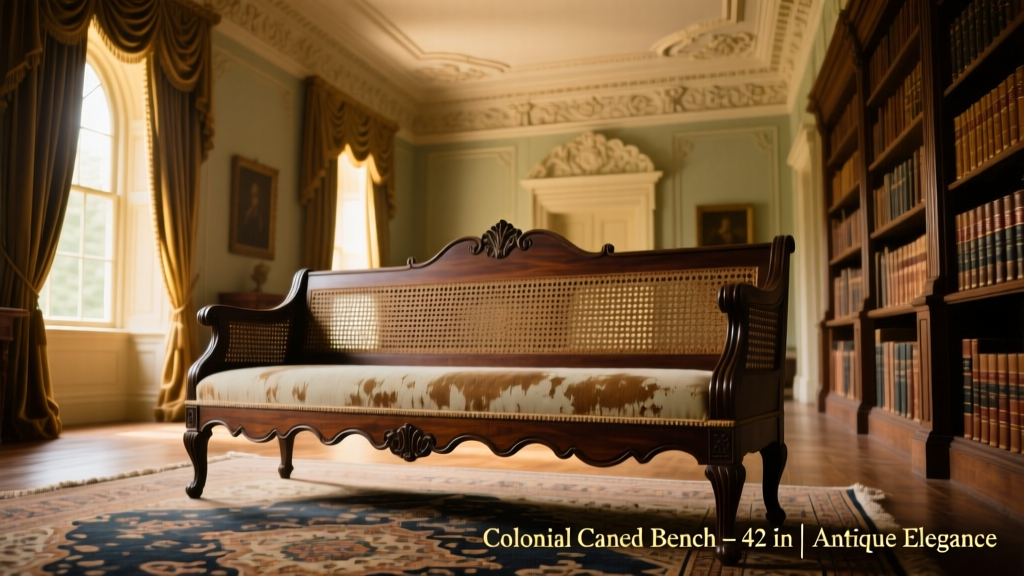
Colonial-Era Caned Bench with Scalloped Apron: A 42-Inch Sleeping Bench Restoration & Historical Guide

Ceramic Arts Studio Shelf Sitter Persian Mother Cat Pair: A Collector’s Guide to Authenticity, Craftsmanship, and Restoration

Currier & Ives 'Home in the Wilderness' Framed Print: Authenticity, Provenance, and Restoration Guidance for the 13 3/8 × 17 3/8 Inch Format
Jacob Thurston: The Unheralded Architect of American Federal Furniture, 1795–1832

Francis Brasier: The Forgotten Architect of English Regency Furniture Design

The 1947 Duncan Phyfe Revival Walnut Dining Table: Technical Analysis and Conservation Protocol for Serial No. 1136858
Tampa Bay Antiques: A Collector’s Guide to Authenticity, Provenance, and Restoration in Florida’s Historic Coastal Hub

Chace Cutter: The Forgotten American Maker of Precision Cabinetmaking Tools, 1890–1945