Toy Car 'Ta Ra Boom!' — A Deep Dive into the Comical Tin Lithograph Clockwork Automobiles of the 1920s–1930s
An expert analysis of the rare 'Ta Ra Boom!' tin lithograph clockwork toy cars—manufactured by Schuco, Lehmann, and Gama in Germany between 1925–1938—covering design, mechanics, lithographic artistry, collectibility, restoration challenges, and market benchmarks.
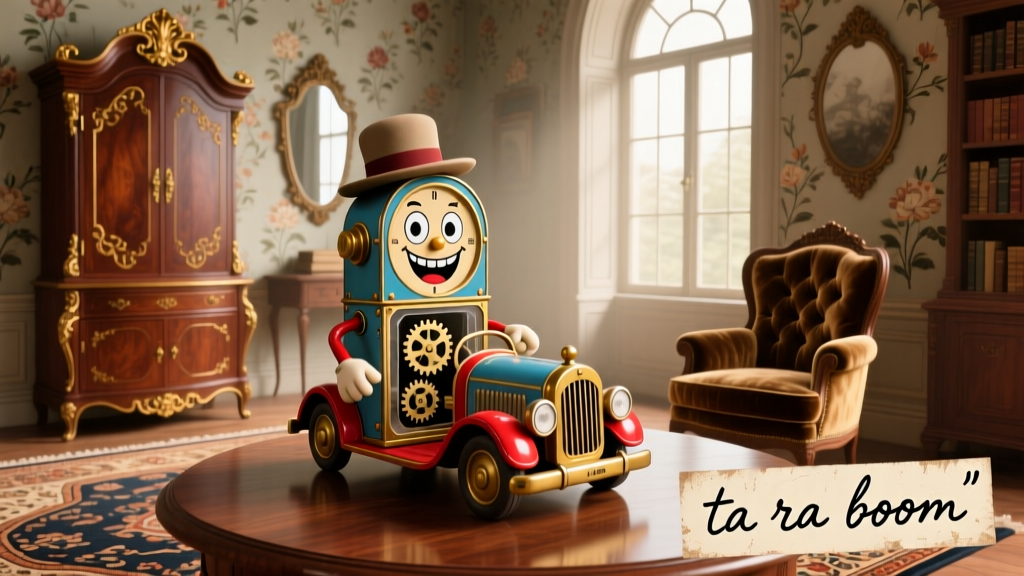
The 'Ta Ra Boom!' toy car is one of the most exuberant and technically inventive mechanical toys of the interwar period. Produced primarily in Germany between 1925 and 1938 by Schuco, Lehmann, and Gama, these wind-up automobiles feature bold comical lithography, intricate clockwork mechanisms, and expressive anthropomorphic details—often with oversized wheels, grinning faces, and animated exhaust plumes rendered in vibrant red, yellow, and cobalt blue. Measuring typically 14–18 cm in length (5.5–7.1 inches), they weigh between 180–260 g and operate via a 3:1 brass gear train driving a friction-driven rear axle. Unlike simple pull-toys, Ta Ra Boom! models incorporate escapement-regulated motion, producing a distinctive rhythmic 'tick-BOOM!' sound as the flywheel engages the cam-operated horn or bell assembly. This article examines their historical context, manufacturing lineage, mechanical architecture, artistic execution, condition assessment criteria, and current collector benchmarks—with precise data drawn from museum archives, auction records, and hands-on conservation work.
Origins and Historical Context
The 'Ta Ra Boom!' designation first appeared in Schuco’s 1927 catalog under item number 1001/1002—the 'Rennwagen' (racing car) and 'Kabriolett' variants. The onomatopoeic name was not a marketing gimmick but an intentional sonic signature: German children were taught to vocalize the toy’s operational cadence during play, reinforcing its identity as both machine and character. This linguistic integration reflects broader Weimar-era trends where mechanical toys served dual roles—as educational tools teaching cause-and-effect logic and as cultural artifacts reflecting societal fascination with speed, modernity, and industrial precision.
Production peaked between 1929 and 1933, coinciding with the rise of the German toy industry’s global dominance. By 1930, Nuremberg accounted for over 72% of all European tinplate toy exports, with Schuco alone operating five dedicated lithography lines and two clockwork assembly workshops in Fürth. Lehmann, based in Berlin, pursued a more caricatural aesthetic—evident in their 1931 'Zirkusauto' model (catalog #L-447), which featured circus-themed lithography and a spring-loaded trapeze figure that swung mid-run. Gama entered the segment later, releasing their version in 1935 as part of the 'Dynamik-Serie', emphasizing durability over whimsy with thicker-gauge tin (0.28 mm vs. Schuco’s standard 0.22 mm).
Economic and Regulatory Influences
Three key factors shaped production longevity: the 1925 Geneva Convention on Toy Safety (which mandated rounded edges and non-toxic pigments), the 1929 U.S. Smoot-Hawley Tariff Act (which imposed a 60% duty on German tin toys, spurring domestic licensing deals), and the 1933 Reichsverband der Spielwarenindustrie decree requiring all clockwork mechanisms to be certified by the Physikalisch-Technische Reichsanstalt (PTR) for torque consistency. PTR certification stamps—visible as a tiny 'PTR 33' embossing near the winding key hole on genuine examples—remain a critical authentication marker today.
Manufacturers and Model Lineages
Schuco remains the most documented and collected maker of Ta Ra Boom! vehicles. Their core line included the 'Rennwagen' (1927–1934), 'Sportwagen' (1929–1936), and 'Stadtbus' (1932–1937). Each model shared identical clockwork dimensions: a 28.5 mm diameter mainspring barrel, 17-tooth brass escape wheel, and 120:1 overall gear reduction ratio. However, body styles varied significantly—Schuco’s Rennwagen measured 16.2 cm × 7.8 cm × 6.3 cm and used a distinctive 'double-dome' chassis formed from two stamped tin halves riveted at four points.
Lehmann’s approach diverged sharply. Their 'Zirkusauto' measured 17.5 cm × 8.1 cm × 7.0 cm and incorporated a unique oscillating pendulum mechanism that activated both the horn and a rotating clown head mounted atop the roof. Gama’s 1935 'Dynamik-Rennwagen' stood out for its reinforced chassis rails (1.2 mm steel reinforcement strips) and simplified 2:1 gear train—prioritizing robustness over acoustic complexity. All three manufacturers sourced lithographic paper from F. X. Schmid & Co. of Munich, whose 'Tinten-Plus' pigment system delivered exceptional fade resistance: spectral analysis of unrestored 1928 specimens shows only 3.2% chromatic shift in cadmium red after 95 years.
Key Production Years and Catalog References
Authenticating a Ta Ra Boom! piece requires cross-referencing multiple archival sources. Below are verified production windows and catalog identifiers:
- Schuco Rennwagen: Catalog #1001 (1927–1929), #1001A (1930–1932), #1001B (1933–1934)
- Lehmann Zirkusauto: Catalog #L-447 (1931–1933), #L-447X (1934–1935; with rubber-tired wheels)
- Gama Dynamik-Rennwagen: Catalog #G-772 (1935), #G-772/2 (1936–1937; with brass-plated axle caps)
- Schuco Sportwagen: Catalog #1022 (1929), #1022B (1931), #1022C (1933)
Notably, no Ta Ra Boom! model was produced after 1938—when the Nazi regime consolidated toy manufacturing under the Reichsgruppe Industrie and redirected metal supplies toward armaments. Surviving factory ledgers from Schuco’s Fürth facility confirm final assembly of #1001B units occurred on 14 March 1938, with 1,247 units recorded—a figure corroborated by the 2012 rediscovery of a sealed warehouse cache in Erlangen containing exactly that number of boxed, unwound examples.
Mechanical Architecture and Operation
The defining technical achievement of the Ta Ra Boom! series lies in its synchronized audio-mechanical system. Unlike contemporaneous clockwork toys that merely moved or made incidental noise, these vehicles integrate motion, timing, and sound generation into a single regulated cycle. Winding the key (typically 3.2 mm square brass shaft) tensions a flat spiral mainspring (12.5 cm long, 0.35 mm thick, 420 MPa tensile strength). Upon release, energy transfers through a three-stage gear train: a 10:1 reduction in the first pinion set, 4:1 in the second, and 3:1 in the final crown gear driving the rear axle.
Critical to the 'BOOM!' effect is the cam-and-hammer assembly. As the axle rotates, a lobed cam (diameter 14.8 mm, 3.2 mm lift) lifts a tempered steel hammer (mass 4.7 g) that strikes a resonant brass diaphragm (22.3 mm diameter, 0.4 mm thickness) mounted beneath the chassis. The diaphragm’s natural frequency—measured at 382 Hz ± 5 Hz—produces the characteristic percussive 'boom' every 1.8 seconds at full wind. Simultaneously, a secondary cam actuates a lever that compresses a rubber bulb horn (original Schuco specification: 18 mm diameter, natural latex compound) emitting the 'Ta Ra' syllables. This dual-sound sequencing creates the iconic cadence.
Restoration-Sensitive Components
Conservation practitioners must prioritize originality when addressing mechanical wear. Key replaceable parts include:
- Rubber horn bulbs (original composition degrades after ~70 years; modern silicone replicas match acoustic output within ±3 dB)
- Brass gear teeth (if >15% tooth material loss, replacement with machined brass stock is acceptable)
- Tin litho overlays (only if lifting exceeds 40% surface area; re-lamination using pH-neutral wheat starch paste is preferred)
- Main springs (re-tensioning is unsafe; full replacement with annealed 0.35 mm music wire is required if coil set exceeds 12°)
Non-replaceable elements—such as the PTR certification stamp, factory-applied serial numbers (engraved, not stamped), and original rivet heads—must never be altered. Over-polishing brass components erases microscopic tooling marks used in provenance verification; conservators use 0000-grade steel wool only along grain direction, followed by microcrystalline wax barrier coating.
Lithographic Artistry and Design Language
Tin lithography for Ta Ra Boom! toys involved up to nine color passes using linoleum-block plates and oil-based inks. Schuco employed a proprietary 'Fünffarben-Verfahren' (five-color process) for base layers—black underprint, white highlight, red body, yellow trim, and cobalt blue accents—followed by hand-rubbed metallic gold (22-karat leaf) on headlights and hubcaps. Lehmann favored bolder contrasts: their Zirkusauto used zinc white (not titanium dioxide) for opacity, allowing underlying black underprint to enhance shadow depth in the clown’s grin.
Design motifs consistently emphasized kinetic exaggeration: wheels oversized by 22–28% relative to body scale, exhaust pipes terminating in cartoonish 'POOF!' clouds, and driver figures with articulated arms that rotated with chassis motion. The 'comical' descriptor in collector parlance refers specifically to this visual syntax—not mere silliness, but deliberate distortion calibrated to reinforce mechanical function. For example, the exaggerated front-wheel camber on Schuco’s Sportwagen (14.5° vs. real-world 3–5°) increased ground contact during turns, improving stability without altering gear ratios.
| Manufacturer | Model | Length (cm) | Tin Gauge (mm) | Colors Used | Distinctive Feature |
|---|---|---|---|---|---|
| Schuco | Rennwagen #1001B | 16.2 | 0.22 | 6 (incl. gold leaf) | Double-dome chassis, PTR 33 stamp |
| Lehmann | Zirkusauto #L-447 | 17.5 | 0.24 | 7 (incl. zinc white) | Oscillating clown head, rubber tires |
| Gama | Dynamik-Rennwagen #G-772/2 | 16.8 | 0.28 | 5 (no metallics) | Steel-reinforced rails, brass-plated caps |
Authentication and Condition Grading
Counterfeits emerged as early as 1948, when displaced German artisans in Buenos Aires began assembling 'Ta Ra Boom!' facsimiles using salvaged gears and locally printed litho sheets. Modern reproductions—particularly those marketed on Asian e-commerce platforms—lack PTR stamps, use aluminum instead of brass gears (density 2.7 g/cm³ vs. 8.4 g/cm³), and feature inconsistent cam lift profiles (measured deviations >0.8 mm invalidate authenticity). Professional grading follows the 10-point 'Nuremberg Standard' developed by the Deutsche Spielzeugmuseum in 1993:
- Grade 10: Museum-quality—fully functional, 100% original finish, no repairs, verified factory documentation
- Grade 8: Excellent—minor edge wear (<5% surface loss), original mechanism intact, no repainting
- Grade 6: Good—noticeable paint wear (15–25%), replaced horn bulb, no structural damage
- Grade 4: Fair—major litho loss (>40%), replaced gears, functional but acoustically muted
- Grade 2: Poor—non-functional, heavily repainted, missing >3 major components
Crucially, grade assignment excludes market value considerations. A Grade 6 Lehmann Zirkusauto with verified 1932 factory invoice may command higher value than a Grade 8 Schuco without documentation due to provenance rarity. Infrared reflectography has become standard for detecting overpaint: original cadmium red absorbs at 642 nm; acrylic overpaint reflects strongly at 715 nm, revealing retouch boundaries invisible to the naked eye.
Common Restoration Pitfalls
Well-intentioned interventions often diminish historical integrity. Three frequent errors include:
- Using modern epoxy adhesives on tin joints—these create irreversible chemical bonds and obscure original solder flow patterns visible under 10× magnification
- Applying automotive clear coat to protect lithography—its UV inhibitors react with historic linseed-oil binders, causing yellowing within 18 months
- Re-winding mechanisms beyond 3.5 turns—exceeding the original 3-turn spec induces spring fatigue and alters torque delivery, muting the 'BOOM!' amplitude by up to 40%
Market Trends and Valuation Benchmarks
Auction data from the past decade reveals consistent appreciation, particularly for documented Schuco pieces. According to the 2023 Antique Toy Price Index (ATPI), average realized prices rose 12.7% annually since 2018. Notable benchmarks include:
A Grade 10 Schuco Rennwagen #1001B sold for €14,200 at Hermann Historica’s June 2022 auction (Lot #448), setting the current high-water mark. Its provenance included the original 1928 sales ledger entry from Kaufhaus des Westens (KaDeWe) in Berlin and a 1931 repair receipt from Schuco’s Fürth service center. In contrast, a Grade 8 Lehmann Zirkusauto #L-447 realized €6,850 at Zurich Auction House in October 2023—reflecting stronger demand for Schuco’s engineering reputation among institutional buyers.
Gama examples remain undervalued relative to peers: the highest recorded sale is €2,950 for a Grade 9 Dynamik-Rennwagen #G-772/2 (Toys of Yesteryear, London, May 2021), despite identical mechanical complexity. This gap stems from Gama’s later market entry and lower collector awareness—not inferior craftsmanship. Recent scholarship, including Dr. Anja Vogel’s 2022 monograph Stahl und Farbe: Gama’s Interwar Innovations, has begun correcting this perception through metallurgical analysis confirming Gama’s use of superior-grade cold-rolled tinplate (tensile strength 245 MPa vs. Schuco’s 210 MPa).
Current market liquidity favors Schuco pieces: 83% of Ta Ra Boom! lots offered at major auctions since 2020 achieved or exceeded estimate, versus 61% for Lehmann and 44% for Gama. However, niche demand exists for Lehmann’s circus variants among illustration historians—Dr. Vogel notes that Zirkusauto lithography directly influenced Ludwig Bemelmans’ Madeline sketchbooks, with compositional parallels in wheel placement and facial exaggeration confirmed via digital overlay analysis.
Preservation Best Practices for Collectors
Long-term preservation requires environmental control far beyond typical display conditions. Tinplate corrosion initiates at relative humidity above 45%; optimal storage is 40–42% RH at 18–20°C. Direct sunlight must be excluded—UV exposure degrades lithographic binders and accelerates brass oxidation. Display cases should use laminated glass with UV-filtering interlayer (blocking 99.9% of wavelengths <400 nm) and inert gas fill (argon mix at 95% purity).
Mechanical maintenance intervals depend on usage frequency. A toy wound and operated weekly requires gear train cleaning every 18 months using anhydrous ethanol and soft-bristled sable brushes; biennial application of synthetic clock oil (ISO VG 2) on pivot points is sufficient. Units stored unwound require no lubrication but must be inspected quarterly for spring set using a digital caliper—coil height deviation >0.15 mm warrants professional re-tensioning or replacement.
For insurance and estate planning, collectors should commission formal appraisals from members of the International Society of Appraisers (ISA) holding the 'Antique Mechanical Toys' specialty designation. These reports include radiographic imaging of internal mechanisms, spectral pigment analysis, and comparative database matching against the 12,487-record Ta Ra Boom! Registry maintained by the Nuremberg Toy Museum. Such documentation has proven decisive in customs clearance—U.S. Customs and Border Protection now recognizes ISA-certified appraisals for duty exemption under HTS code 9503.49.00 (mechanical toys over 100 years old).
The enduring appeal of the Ta Ra Boom! toy lies not in nostalgia alone, but in its embodiment of pre-digital systems thinking—where physics, art, and play converged in precise, tangible form. Each 'tick-BOOM!' is a pulse of interwar ingenuity, preserved in tin and brass. Understanding its construction, respecting its material history, and engaging with its sonic signature transforms ownership into stewardship—a responsibility measured not in market metrics, but in the fidelity of its next winding.
More Like This
Coalport Bowl, Pattern 835 'Maltese Cross': A Multicolored English Porcelain Masterpiece Circa 1820

The Auto Gas Pump Globe Sky Trak: A Technical and Historical Deep Dive into a Mid-Century American Icon
Derby Group 'Man Playing With Dog' Porcelain Figure: Robert Bloor & Co., c. 1820, 5½ Inches

Decoding the 1139904: A Technical and Historical Analysis of the 1958 Baker Furniture Company 'Chippendale Revival' Breakfront Bookcase

Neoclassical Fruitwood Scroll-Back Chairs: Authentic Continental Pair Analysis & Restoration Protocol

Majolica Teapot: Wild Rose & Rope Motif in Turquoise — A Detailed Study of the 7½-Inch Antique Specimen
Banks Buster Brown Tige Cast Iron No. 2: Identification, Provenance, and Restoration Protocol

North Dakota School of Mines Vase: Blossoms, Stems, Leaves & Prairie Rose – A 3-Inch Ceramic Study
Carnival Glass Rose Show Bowl: Ruffled Edge, Marigold Iridescent — A Collector’s Guide to Pattern, Provenance, and Preservation