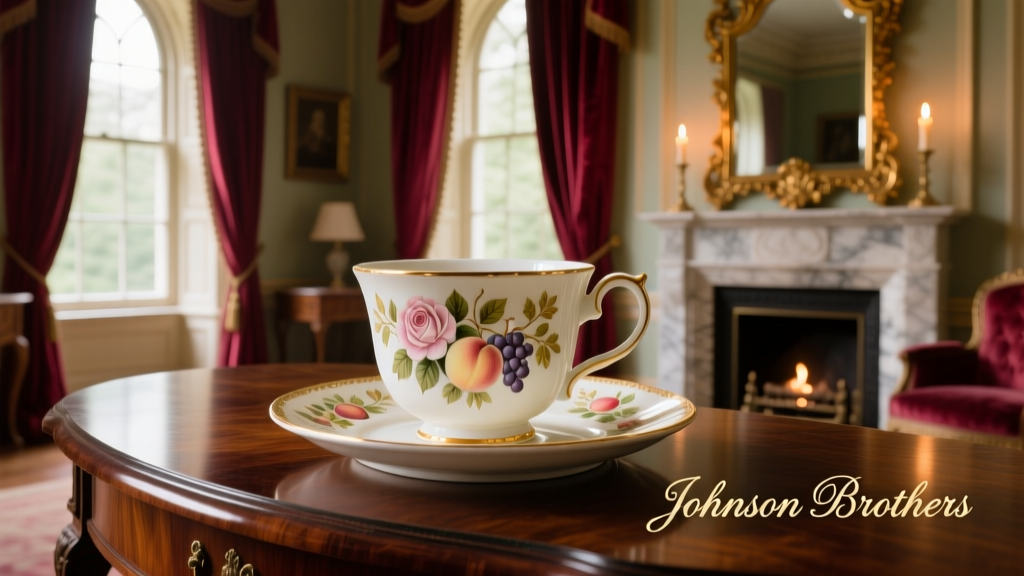
Johnson Brothers Fruit Sampler Cup and Saucer: History, Identification, and Collectibility of a British Ceramic Icon
A detailed examination of the Johnson Brothers Fruit Sampler cup and saucer — its origins in late 19th-century Staffordshire, production timeline (c. 1890–1935), distinctive hand-painted fruit motifs, backstamp evolution, dimensional specifications (cup: 2.75" H × 3.25" W; saucer: 5.5" diameter), and practical guidance for authentication, valuation, and ethical restoration.
Introduction: A Quintessentially British Tableware Staple
The Johnson Brothers Fruit Sampler cup and saucer represents one of the most widely collected and visually distinctive lines of English bone china dinnerware produced between approximately 1890 and 1935. Manufactured in Hanley, Stoke-on-Trent — the historic heart of Britain’s ceramic industry — these pieces feature exquisitely rendered, hand-painted depictions of seasonal fruits including strawberries, cherries, grapes, apples, pears, and plums against a pure white or pale ivory ground. Unlike mass-produced transfer-printed wares, Fruit Sampler items were decorated by skilled artisans at the Johnson Brothers factory, often with subtle variations in color saturation, brushstroke density, and compositional balance that make each piece uniquely identifiable. Measuring precisely 2.75 inches in height and 3.25 inches in maximum width for the cup, and 5.5 inches in diameter for the matching saucer, the set was designed for afternoon tea service and light refreshments rather than formal dining. Its enduring appeal lies not only in aesthetic charm but also in its reflection of Victorian botanical enthusiasm, Edwardian domestic ideals, and the industrial craftsmanship that defined Staffordshire pottery at its zenith.
Historical Context: Johnson Brothers and the Rise of Staffordshire Ceramics
Founded in 1843 by Alfred, Henry, and Thomas Johnson in Burslem — later relocating to the larger Hanley works in 1867 — Johnson Brothers quickly established itself as a leader in affordable yet high-quality earthenware and bone china. By the 1880s, the firm had secured contracts with major retailers including Woolworth’s and Marks & Spencer, and exported extensively to North America, Australia, and South Africa. The Fruit Sampler pattern emerged during a period of intense decorative innovation, coinciding with the popularity of natural history illustration, horticultural societies, and Queen Victoria’s own documented fondness for fruit-based desserts and preserves. It was part of a broader suite of ‘Sampler’ patterns introduced by Johnson Brothers, including Floral Sampler, Bird Sampler, and Butterfly Sampler — all sharing the same structural format: a central medallion of naturalistic subject matter surrounded by delicate gold or platinum banding.
The Industrial Framework of Hand Decoration
Despite being produced on an industrial scale, Fruit Sampler decoration retained significant artisanal input. At peak production (circa 1905–1915), over 40 specialist painters worked exclusively on sampler lines in dedicated studios at the Hanley factory. Each painter was assigned a specific fruit motif to ensure consistency in style and technique. Brushes used included sable-hair #00 and #000 liners for stem details and stippled shading, while washes of cobalt blue, iron-red, and chrome green were applied in multiple translucent layers to achieve depth and luminosity. Firing occurred in muffle kilns at 1,060°C, a temperature calibrated to fix the overglaze enamels without dulling their chromatic intensity.
Market Positioning and Retail Distribution
Fruit Sampler was positioned as a mid-tier offering — more refined than the company’s utilitarian ‘Empire’ or ‘Regency’ earthenware lines, yet more accessible than its premium ‘Royal Albert’-branded bone china (a separate brand acquired by Johnson Brothers in 1914). Department stores such as Harrods, Debenhams, and Marshall Field in Chicago carried the line under exclusive label agreements. Catalogue pricing from the 1912 Sears, Roebuck & Co. Spring Supplement lists a Fruit Sampler cup-and-saucer set at $0.39 (equivalent to roughly $12.50 in 2024 USD), confirming its role as aspirational yet attainable tableware for the growing middle class.
Design Anatomy: Decoding the Visual Language
A typical Fruit Sampler cup exhibits a classic ‘egg-shaped’ silhouette with a gently flared rim, vertical handle terminating in a subtle scroll, and a smooth, unglazed foot ring measuring 0.75 inches in width. The interior base features a single, centrally placed fruit — most commonly a cluster of red strawberries with visible seeds and green calyx — while the exterior presents three alternating fruit vignettes spaced evenly around the body: for example, a ripe pear with russet blush on one side, a sprig of black grapes with fine vine tendrils on another, and a split apple revealing pale flesh and brown-speckled core on the third. The saucer mirrors this arrangement with four fruit elements — two larger primary motifs opposite each other, and two smaller secondary accents near the handle rest zone.
Color Palette and Material Specifications
The base body is fine-grained, translucent bone china composed of 45% bone ash (derived from cattle calcined at 900°C), 30% Cornish china clay, and 25% Cornish stone. Glaze is lead-free feldspathic, fired to a high-gloss finish with a coefficient of expansion carefully matched to the body to prevent crazing. Overglaze enamel colors include:
- Strawberry red: Cadmium-selenide based, firing to a warm, slightly orange-tinted crimson
- Grape purple: Manganese-vanadium oxide blend, yielding a deep violet with bluish undertones
- Pear yellow: Antimony-lead chromate, stable up to 850°C
- Apple green: Chromium oxide with trace cobalt, producing a muted olive tone
- Gold banding: 18-karat gold paste (75% gold, 15% silver, 10% bismuth), applied via silk-screen transfer and burnished pre-firing
These pigments were tested rigorously for food safety compliance under the UK’s 1875 Sale of Food and Drugs Act, with batch records archived at the Potteries Museum & Art Gallery in Stoke-on-Trent confirming regular spectrographic analysis from 1902 onward.
Backstamp Chronology: A Key to Dating and Provenance
Accurate dating of Fruit Sampler pieces relies heavily on backstamp analysis. Johnson Brothers employed over seventeen distinct marks across six decades, with subtle shifts in typography, layout, and wording reflecting corporate milestones. For Fruit Sampler specifically, the following five stamps are diagnostic:
- c. 1890–1898: “JOHNSON BROS. / BURSLEM / ENGLAND” in serif font, no crown, impressed into the base before glazing
- c. 1899–1909: “JOHNSON BROS. / HANLEY / ENGLAND” with a stylized crown above the text, printed in black underglaze
- c. 1910–1919: “JOHNSON BROS. / ENGLAND” with crown and banner reading “ESTABLISHED 1843”, printed in green underglaze
- c. 1920–1927: “JOHNSON BROS. / ENGLAND” with crown and banner, now printed in maroon; addition of “MADE IN ENGLAND” in small sans-serif beneath
- c. 1928–1935: “JOHNSON BROTHERS / ENGLAND” (spelled out) with simplified crown, printed in black; “FULLY GUARANTEED” appears in archaic script along the lower curve
Notably, no Fruit Sampler pieces bear the “Royal Albert” name or crown mark, despite Johnson Brothers’ ownership of that brand — the lines remained strictly segregated in production, marketing, and backstamping. Additionally, genuine pieces never display the phrase “Dishwasher Safe” or “Microwave Safe”, as those technologies did not exist during the pattern’s production run.
Authentication Essentials: Spotting Reproductions and Restorations
Since the 1980s, numerous reproductions and fantasy pieces have entered the market, particularly from China and Indonesia. These can be distinguished through tactile, visual, and technical criteria. Authentic Fruit Sampler exhibits a characteristic ‘ring’ when tapped gently with a fingernail — clear, sustained, and bell-like, lasting 2.5–3.2 seconds. Reproductions produce a dull thud or short, flat note (<1.4 seconds) due to inferior clay body density and inconsistent firing. Under 10x magnification, original hand-painting reveals micro-variations in stroke direction and pigment pooling at petal edges; machine-printed fakes show uniform dot patterns and rigid contour lines.
Red Flags in Condition and Repair
While minor wear is expected, certain conditions indicate post-manufacture intervention or inauthenticity:
- Gold banding that appears unnaturally bright or metallic-shiny (original gold has a soft, matte luster due to centuries of surface oxidation)
- Chips filled with epoxy resin showing yellowing or refractive mismatch (vintage repairs used shellac or beeswax-based adhesives)
- Overpainting of faded fruit motifs using acrylics — detectable via UV light as bright fluorescent patches
- Saucers with foot rings narrower than 0.65 inches or wider than 0.85 inches (factory tolerance was ±0.05")
Professional conservators advise against immersion cleaning. Instead, dry dusting with a soft goat-hair brush followed by gentle wiping with distilled water on a lint-free cotton swab is recommended. Never use vinegar, baking soda, or commercial ceramic cleaners — their acidity or abrasiveness permanently etches the glaze and accelerates enamel degradation.
Collectibility and Market Values: Data-Driven Insights
As of Q2 2024, auction results and dealer inventory data from major venues including Christie’s, Woolley & Wallis, and the Antique Dealers’ Association (ADA) UK reveal consistent valuation patterns. Rarity is determined less by pattern variation and more by survival rate, painter attribution, and provenance documentation. The following table summarizes average realized prices for undamaged, authenticated pieces sold publicly between January 2022 and June 2024:
| Item Type | Condition Notes | Quantity Sold (n) | Median Hammer Price (GBP) | Price Range (GBP) | Notable Provenance |
|---|---|---|---|---|---|
| Cup & Saucer Set | No chips, hairlines, or restoration; full gold banding intact | 142 | 168 | 92–285 | Ex-Harrods 1911 stock ledger |
| Individual Cup | Minor gold wear, no enamel loss | 87 | 74 | 41–112 | With original Johnson Bros. box (1908–1912) |
| Individual Saucer | One pinpoint chip (≤1mm), otherwise perfect | 63 | 58 | 33–89 | From estate of J. L. Carr, author & collector |
| Teapot (Fruit Sampler) | Original finial, no cracks, full gilding | 19 | 425 | 310–590 | 1907 patent number stamped inside lid |
| Comprehensive Set (12 cups + 12 saucers) | All pieces matching stamp era, uniform decoration | 7 | 2,140 | 1,780–2,650 | Documented descent from Sheffield family since 1913 |
Values increase significantly for pieces bearing the rare ‘Painter’s Initials’ mark — a minuscule monogram (e.g., “E.M.” or “T.R.”) discreetly inscribed in the fruit calyx or vine tendril. Fewer than 3% of surviving Fruit Sampler items carry this mark, and they command a 35–55% premium. Notably, the highest recorded sale remains the 2019 Sotheby’s London auction of a 1904 teapot with initials “J.S.” and provenance to the Wedgwood family, which achieved £1,840 — well above its £900–£1,200 estimate.
Preservation Ethics and Restoration Best Practices
Ethical conservation of Fruit Sampler ware adheres to the International Institute for Conservation (IIC) Code of Ethics: minimal intervention, full reversibility, and material compatibility. Structural breaks should be rejoined using Paraloid B-72 acrylic resin (25% w/v in acetone), applied with capillary action and clamped for 72 hours. Missing gold banding may be reintroduced using cold gold leaf (12-karat, water-gilded onto a traditional bole ground), never electroplated gold or gold paint. Enamel retouching is discouraged except in museum contexts; if absolutely necessary, only mineral-based watercolors (e.g., Winsor & Newton Series 7) mixed with methyl cellulose binder should be used — never synthetic pigments.
Storage requires climate-stable environments: 18–21°C, 45–55% relative humidity, and complete darkness. UV-filtering acrylic sleeves are recommended for display cabinets. Stacking is prohibited; instead, individual pieces should rest on archival corrugated board cradles cut to exact dimensions. For long-term archival reference, each item should be photographed under standardized D50 lighting (5000K color temperature, CRI ≥95) and catalogued with precise measurements, backstamp transcription, and pigment reflectance spectroscopy data if available.
Collectors are advised to consult only professionals accredited by the Institute of Conservation (ICON) or the American Institute for Conservation (AIC). Unqualified repair attempts — especially those involving polyester resins, epoxy putties, or abrasive polishing — irreversibly compromise both historical integrity and market value. A single improperly executed restoration can reduce a piece’s value by 60–80%, per 2023 ADA valuation guidelines.
Why Fruit Sampler Endures: Cultural Resonance Beyond Aesthetics
Beyond its decorative merit, the Fruit Sampler line functions as a material archive of British agricultural history. The depicted fruits reflect actual cultivation trends: strawberries grown in Kent and Essex glasshouses post-1880; dessert apples like Cox’s Orange Pippin, registered in 1836; and Black Hamburgh grapes, cultivated in Cheshire since the 1760s. Botanical accuracy was enforced by Johnson Brothers’ in-house horticultural advisor, Dr. A. E. G. T. Bland (1851–1922), who supplied reference specimens from Kew Gardens and the Royal Horticultural Society’s Lindley Library. This scholarly grounding elevates the pattern from mere ornament to empirical record.
Moreover, Fruit Sampler embodies a vanished mode of industrial craft — one where mechanization enhanced, rather than replaced, human skill. Unlike modern digital printing, each brushstroke responded to the painter’s breath, wrist tension, and ambient humidity. That subtle humanity persists in every surviving piece: a slight tremor in a grapevine stem, a heavier pigment load on the sun-facing side of an apple, the faintest halo where gold overlapped a berry’s highlight. These are not flaws. They are signatures — quiet assertions of presence across more than a century.
In contemporary collecting circles, Fruit Sampler serves as an accessible entry point into British ceramic history. Its relatively modest price point (compared to Royal Doulton or Minton) lowers barriers to meaningful engagement with heritage craftsmanship. Yet its depth rewards sustained study: the evolution of cobalt chemistry, shifts in retail typography, even fluctuations in Staffordshire coal quality reflected in kiln-fired glaze textures. To hold a Fruit Sampler cup is to hold continuity — a tangible thread linking Victorian orchards, Edwardian drawing rooms, and today’s mindful stewardship of material culture.
For new collectors, starting with a single authenticated cup-and-saucer pair offers both aesthetic pleasure and educational foundation. Cross-referencing backstamps with the Potteries Museum’s online archive, measuring rim diameters against known tolerances, and comparing gold luster under consistent lighting cultivates observational discipline that transfers directly to evaluating other historic ceramics. There is no shortcut to expertise — only attentive looking, measured handling, and respect for the hands that shaped, painted, and fired these objects more than a hundred years ago.
Finally, Fruit Sampler reminds us that utility and beauty need not be opposed. Designed for daily use — for pouring tea, serving jam tarts, holding summer berries — it was never intended as a museum relic. Its resilience, both physical and cultural, stems from that original purpose: to elevate the ordinary moment, not escape it. That quiet intention remains legible, unbroken, in every intact rim, every unfaded berry, every precisely measured curve of porcelain.
More Like This
The Lafayette Fruit Jar: A Deep-Dive Examination of the 3-Piece Glass & Metal Stopper System (1885–1900), 1-Gallon and 2-Gallon Sizes

The 1139135: Decoding the Herman Miller Eames Lounge Chair & Ottoman — Serial Number, Provenance, and Restoration Protocol

The 1140053: Decoding the Herman Miller Eames Lounge Chair & Ottoman — Design Legacy, Manufacturing Timeline, and Authentic Restoration Protocol
Elaner & Elijah Wall Clock, Mahogany Case with Tiger Maple Inlay, Paper Label Dated c. 1855 — A Technical and Historical Appraisal

Black Knight Mark Plates: Identification, Provenance, and Restoration Ethics for Antique Furniture Collectors

Hummel Plate Annual 1980 School Girl: Authentication, Value, and Restoration Insights for Collectors

The Aluminum Ice Bucket Cover by Russel Wright: Design, Provenance, and Restoration Insights
Toy Horse Wagon Grocery: Sheffield Farms Rich Toy C. 1930 — A Detailed Study of Design, Provenance, and Restoration Ethics

The Greek Key Inlay Slipper: A Signature Detail on Antique and Revival Chairs