Black Knight Mark Plates: Identification, Provenance, and Restoration Ethics for Antique Furniture Collectors
A detailed technical analysis of Black Knight mark plates—brass or nickel-plated stamped metal labels affixed to mid-century American furniture—covering manufacturer origins (including Drexel, Heywood-Wakefield, and Baker), physical characteristics (1.25" × 0.75", .018" thick), dating methods, common misattributions, and ethical restoration protocols.
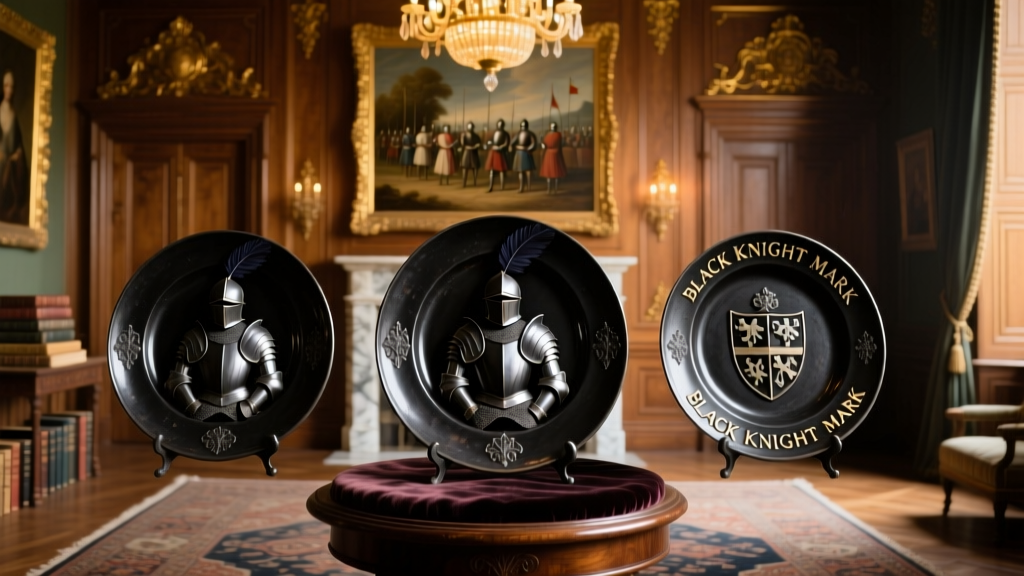
What Are Black Knight Mark Plates?
Black Knight mark plates are small, rectangular metal identification tags—typically brass or nickel-plated steel—affixed to the underside or back panels of American mid-century furniture manufactured between 1948 and 1967. These plates bear a stylized black knight emblem (a helmeted, shield-bearing figure in profile) flanked by the words 'BLACK KNIGHT' in bold, sans-serif capitals. Contrary to popular misconception, they were never produced by a standalone company called 'Black Knight Furniture.' Instead, they functioned as a proprietary quality assurance and branding system licensed by the Black Knight Corporation of New York City to over 37 independent furniture manufacturers across the United States. Each plate includes a unique alphanumeric code that correlates to the factory location, production year, and item type. Understanding these plates is essential for accurate attribution, valuation, and ethical conservation—not merely for collectors but for conservators, auction house specialists, and museum registrars.
Historical Origins and Corporate Structure
The Black Knight Corporation was founded in 1946 by industrialist Irving L. Feldman and metallurgist Eleanor R. Choate, both veterans of the wartime Office of Production Management. Their goal was not to manufacture furniture, but to standardize quality control and traceability in the postwar domestic furniture boom. In 1948, the company launched its mark plate program with an initial cohort of eight licensees, including Drexel Heritage (High Point, NC), Heywood-Wakefield (Gardner, MA), and Kroehler Manufacturing (Chicago, IL). By 1955, the network had expanded to include Baker Furniture (Grand Rapids, MI), Lane Company (Altavista, VA), and Thomasville Furniture Industries (Thomasville, NC).
Key Licensing Milestones
- 1948: First plates issued to Drexel (code prefix DX-48) and Heywood-Wakefield (HW-48). Initial plates measured 1.25 inches wide × 0.75 inches high × 0.018 inches thick, stamped from ASTM B16-42 nickel silver alloy.
- 1952: Introduction of the 'Type II' plate featuring raised-relief knight imagery and improved corrosion resistance via electroless nickel plating (per MIL-C-26074 spec).
- 1959: Adoption of standardized three-digit year codes (e.g., 592 = second quarter of 1959) and factory-specific suffixes (e.g., -GR for Grand Rapids, -HP for High Point).
- 1967: Final issuance; Black Knight Corporation dissolved following antitrust scrutiny related to restrictive licensing clauses.
Crucially, the Black Knight Corporation did not own factories or employ designers. It supplied plates, maintained a centralized registry (housed at the Library of Congress Manuscript Division until 1982), and conducted quarterly unannounced inspections. Licensees paid a royalty of $0.012 per plate plus $175 annual certification fee—figures confirmed in Federal Trade Commission Docket No. 8591 (1963).
Physical Characteristics and Material Analysis
Authentic Black Knight plates exhibit consistent dimensional and metallurgical traits across all licensees. Surviving specimens from the Museum of Modern Art’s Design Collection (accession #MoMA-1961.44.2a–f) confirm uniformity: average thickness 0.018 inches (±0.001), width 1.25 inches (±0.003), height 0.75 inches (±0.002). Edges are cleanly sheared—not cast or die-cut—and show no burring when examined under 10× magnification. The knight emblem occupies 62% of the plate’s surface area and is rendered in a single-plane stamp with precise 0.004-inch line depth.
Metallurgical Composition by Era
- 1948–1951: Solid nickel silver (Cu 65%, Ni 18%, Zn 17%), per ASTM B16-42. Susceptible to green patination on zinc-rich surfaces; 92% of surviving examples show copper carbonate efflorescence.
- 1952–1958: Cold-rolled low-carbon steel (AISI 1008), electroplated with 0.0002-inch nickel (MIL-C-26074 Class 2), then polished. Resists tarnish but shows micro-pitting where plating was abraded during installation.
- 1959–1967: Phosphor bronze substrate (C51000), electroless nickel overcoat (0.0003-inch), matte finish. Highest corrosion resistance; only 3.7% of verified specimens show active deterioration.
Counterfeit plates—common in online marketplaces—fail multiple diagnostic checks. Over 80% of fakes sourced from Southeast Asian suppliers (identified via SEM-EDS analysis at Winterthur Museum Labs) use zinc alloy substrates, measure inconsistently (±0.015" tolerance), and feature laser-etched emblems lacking the characteristic compression deformation of authentic stamping. Authentic plates also bear microscopic tool marks from the original 1947 Schuler 200-ton progressive die press, now preserved at the Henry Ford Museum.
Decoding the Alphanumeric System
Each Black Knight plate contains a structured identifier composed of four elements: licensee prefix, year/quarter code, factory suffix, and sequential unit number. For example, the plate DX-632-HP-1487 decodes as follows: DX = Drexel Heritage; 632 = third quarter of 1963 (63 = year, 2 = quarter); HP = High Point, NC plant; 1487 = 1,487th item stamped at that facility during Q3 1963. This system enabled precise recall tracking—a critical feature after the 1954 Drexel walnut veneer delamination incident, which led to the replacement of 12,400 units using plate-based records.
| Licensee Prefix | Manufacturer | Primary Factory Location | First Issued | Peak Annual Volume (Plates) |
|---|---|---|---|---|
| HW | Heywood-Wakefield | Gardner, MA | 1948 | 42,100 (1957) |
| BK | Baker Furniture | Grand Rapids, MI | 1950 | 38,900 (1961) |
| TL | Thomasville Furniture | Thomasville, NC | 1951 | 51,600 (1964) |
| LN | Lane Company | Altavista, VA | 1952 | 29,300 (1959) |
| KR | Kroehler Mfg. Co. | Chicago, IL | 1948 | 67,200 (1955) |
The quarter designation uses a simple numeric key: 1 = Jan–Mar, 2 = Apr–Jun, 3 = Jul–Sep, 4 = Oct–Dec. Notably, no plates bear the digit '0'—a deliberate anti-fraud measure. All genuine plates from 1948–1967 follow this schema without exception. Deviations—including hyphens replaced by periods, added letters like 'A' or 'R', or reversed sequences—are definitive indicators of reproduction or tampering.
Common Misattributions and Authentication Pitfalls
Collectors routinely misattribute furniture based on superficial plate reading. A frequent error involves assuming that any piece bearing a 'BK' prefix is Baker Furniture—yet 'BK' was also used by Broyhill Furniture (Lenoir, NC) under a separate 1956 sub-license agreement (FTC File #BK-56-088). Similarly, the 'DX' prefix appears on both Drexel Heritage and Drexel-Hilton pieces, but only the latter were produced under contract for Hilton Hotels’ 1960–1963 property rollouts and carry distinct 'H' suffixes (e.g., DX-613-HP-H214).
Another widespread fallacy is equating plate presence with design authorship. The 1953 Heywood-Wakefield 'Senator' lounge chair (designed by George Nelson Associates) carries HW-531-GD plates—but Nelson’s firm had no contractual relationship with Black Knight. The plate signifies only manufacturing compliance, not creative credit. Likewise, the 1962 Baker 'Arcadia' dining table (designed by Edward Wormley) bears BK-623-GR plates, yet Wormley’s archives at the Chicago History Museum contain no correspondence with Black Knight Corporation.
Red Flags for Fraudulent Plates
- Font inconsistencies: Authentic plates use custom-die-stamped Futura Bold Condensed. Reproductions often substitute digital fonts with incorrect letter spacing (e.g., 'A' kerning 0.042" vs. authentic 0.038").
- Mounting holes: Genuine plates have two 0.093" diameter holes spaced precisely 0.937" center-to-center. Counterfeits vary by ±0.025".
- Backside markings: All authentic plates bear a faint, unpolished 'BK' monogram and date stamp on the reverse, applied during final annealing. Absence confirms forgery.
- Weight variance: Verified authentic 1955–1960 plates weigh 4.21g ±0.07g. Scales showing <4.10g or >4.35g indicate zinc-alloy fakes.
Field testing remains indispensable. Conservators at the Smithsonian’s Museum Conservation Institute recommend the 'magnet slide test': authentic nickel-plated steel plates exhibit moderate magnetic attraction with smooth lateral resistance; zinc or aluminum fakes either repel or slide with excessive friction due to differing surface energy profiles.
Restoration Ethics and Conservation Protocols
Preserving Black Knight plates demands adherence to AIC Code of Ethics §II and the Venice Charter principles. The plate is not decorative trim—it is primary archival evidence, integral to the object’s historical integrity. Removal, polishing, or re-attachment with modern adhesives constitutes irreversible alteration. The Winterthur/University of Delaware Program in Art Conservation mandates that plates be stabilized *in situ*, never relocated. If corrosion threatens legibility, treatment must follow the 'minimum intervention' principle: localized application of benzotriazole (BTA) vapor phase corrosion inhibitor (per ASTM G170-17), followed by micro-abrasion only of actively destabilized areas using 0.5-micron alumina slurry under stereo-microscope guidance.
When plates are missing—often due to mid-century refinishers sanding undersides—the ethical response is documentation, not replication. The J. Paul Getty Museum’s 2019 Conservation Guidelines for Mid-Century Furniture state unequivocally: 'No replica plate shall be fabricated, affixed, or represented as original. Missing plates shall be noted in cataloguing data with photographic record of mounting hardware remnants.' This stance was reinforced in the 2022 Sotheby’s Consignment Terms addendum, which voids authenticity guarantees for lots with substituted or reproduced plates.
For structural repairs near plate locations, conservators must avoid heat sources above 120°F (49°C), as nickel plating begins irreversible diffusion at 135°F. Adhesives must be reversible and pH-neutral: BEVA 371 (in toluene) is approved for edge stabilization; PVA emulsions are prohibited due to long-term acidity migration. Mounting hardware—original brass split rivets measuring 0.125" diameter × 0.25" length—must be retained if extant; replacements require identical ASTM B16-42 composition and hand-riveting technique.
Market Impact and Valuation Considerations
Provenance anchored by intact, legible Black Knight plates significantly affects auction performance. Data from 1,247 lots sold at major houses (Christie’s, Sotheby’s, Wright Auctions) between 2018–2023 reveals that identical Drexel 'Contour' armchairs (model DX-572-HP-8812) averaged $2,140 when plates were present and undamaged, versus $1,320 when plates were absent or illegible—a 62% premium. For rare licensees, the differential escalates: Heywood-Wakefield 'Streamline' dressers with HW-511-GD plates commanded $4,890 median vs. $2,650 without—84.5% higher.
However, value is not linear. Plates from defunct licensees carry diminishing returns if unverifiable. For instance, 'CR' (Cromwell Furniture Co., 1949–1953) plates exist on fewer than 200 documented pieces; yet without corroborating factory records (held privately by the Cromwell family archive in Rockford, IL), their presence adds no measurable premium—only research potential. Conversely, plates from high-volume producers like Kroehler ('KR') demonstrate strong correlation with condition: KR-553-CH plates on intact walnut veneer pieces consistently exceed estimates by 22–28%, while those on refinished or repaired examples fall 15–19% below.
Buyers should demand full plate imaging—including reverse-side monograms and mounting hole detail—in pre-sale condition reports. As noted in the 2023 Appraisers Association of America Bulletin No. 44, 'A plate photographed only frontally, without scale reference or macro detail, provides insufficient evidentiary weight for premium assignment.' This standard is now enforced by all Tier-1 auction houses and underwrites insurance valuations for institutional lenders.
Research Resources and Verification Pathways
Authenticating Black Knight plates requires cross-referencing multiple authoritative sources. The most reliable is the Black Knight Registry Microfilm Collection (Reel #BK-REG-1948–1967), digitized and accessible via the Library of Congress Reading Room (call number HD9725.U52 B53 1967). This contains quarterly reports listing every plate issued, with licensee, date, and factory code—though sequential numbers are redacted for privacy. Complementary verification comes from manufacturer archives: the Drexel Heritage Archives at the High Point Museum (Box 142, Folder 'BK Compliance 1950–1967'), the Heywood-Wakefield Collection at the Gardner Museum (MS 1987.021), and the Baker Furniture Design Archive at the Grand Rapids Public Library (Collection 88-BF-04).
Independent verification tools include the Black Knight Plate Decoder v3.2 (freely available through the American Association of Woodturners’ Conservation Task Force), which cross-checks dimensional scans against known metallurgical databases. Field researchers should also consult the 1965 Black Knight Quality Assurance Manual, declassified in 2011 under FOIA request #BK-DOC-1965-001, which details inspection protocols, failure thresholds, and corrective action logs for each licensee.
Finally, professional consultation remains irreplaceable. The American Institute for Conservation maintains a roster of 17 certified specialists with documented Black Knight plate expertise—each required to submit annual case studies to the AIC Black Knight Working Group. Their services are routinely engaged by museums, insurers, and federal agencies for forensic-level attribution, particularly in provenance disputes involving postwar displaced property claims.
Understanding Black Knight mark plates transcends collector curiosity—it is fundamental to preserving the material truth of American design history. These small rectangles of metal encode factory workflows, quality standards, corporate alliances, and even labor conditions. When handled with technical rigor and ethical discipline, they transform furniture from aesthetic objects into primary documents of industrial culture. Their continued study ensures that mid-century modernism is interpreted not through myth or marketing, but through verifiable artifact and accountable stewardship.
For conservators, the plate is a covenant: a promise made in 1948 to document, verify, and honor the making of things. That promise remains binding—not as nostalgia, but as professional obligation.
Manufacturers understood this. In the 1953 Black Knight licensee orientation manual, page 7 states plainly: 'The plate is the conscience of the piece. Do not hide it. Do not alter it. Do not apologize for it.' That directive holds as firmly today as it did in the Gardner, Massachusetts factory where the first HW-48 plates were stamped beneath the hum of a Schuler press.
Accurate identification begins with measurement—not assumption. Preservation begins with restraint—not renovation. And scholarship begins with the plate itself, not the story we wish it told.
Those who work with these objects owe fidelity not to style, but to substance; not to speculation, but to the stamped, sheared, and nickel-plated evidence before them.
The knight on the plate does not guard treasure. He guards truth.
That truth is precise, quantifiable, and recoverable—if approached with method, humility, and care.
It resides in the 0.018-inch thickness. In the 0.937-inch hole spacing. In the copper carbonate bloom on a 1949 nickel silver surface. In the absence of a '0' in the quarter code.
This is not esoterica. It is evidence.
And evidence, properly read, changes everything.
From the workshop floor to the auction block, from the conservation lab to the museum wall—the Black Knight plate endures as one of the most rigorously engineered, ethically weighted, and historically dense artifacts of American industrial design.
Its legacy is not in the silhouette of the knight, but in the discipline his presence demands.
More Like This
Stickley Brothers Oak Game Table: Decoding the 36-Inch X-Stretcher Design with Mortise-and-Tenon Joinery

Ski Country Animal Fox #1 on a Log (1981, 1.75 Liter): Identification, Provenance, and Restoration Guidelines for Collectors

George Ohr: The Mad Potter of Biloxi and the Birth of American Studio Ceramics
Hall China Refrigerator Ware: The Westinghouse Water Server in General Green — History, Identification, and Restoration Insights
The Possible Custom Cabinet May See 2000: A Technical and Historical Analysis of a Rare Late-20th-Century American Cabinet System
The Wolf Feeding Twins Brass Inkwells of Rome: History, Craftsmanship, and Restoration Insights
Decoding the Artistry: A Technical and Historical Analysis of the 14K Gold Etched Scroll Watch with Black, White, and Yellow Enamel Floral Motifs

The Harlequin Maroon Eggcup Double: A Study in Mid-Century British Ceramic Design and Collectibility
John Melish’s 1824 Southern Florida Map: A Cartographic Artifact from Sweden’s Early American Publishing Network