The Greek Key Inlay Slipper: A Signature Detail on Antique and Revival Chairs
An in-depth exploration of the Greek key inlay slipper—a refined decorative band encircling the seat rail of high-end 18th- to early 20th-century chairs—covering its historical origins, construction methods, material specifications, restoration protocols, and relevance in modern reproduction furniture from makers like Baker, Henredon, and Century.
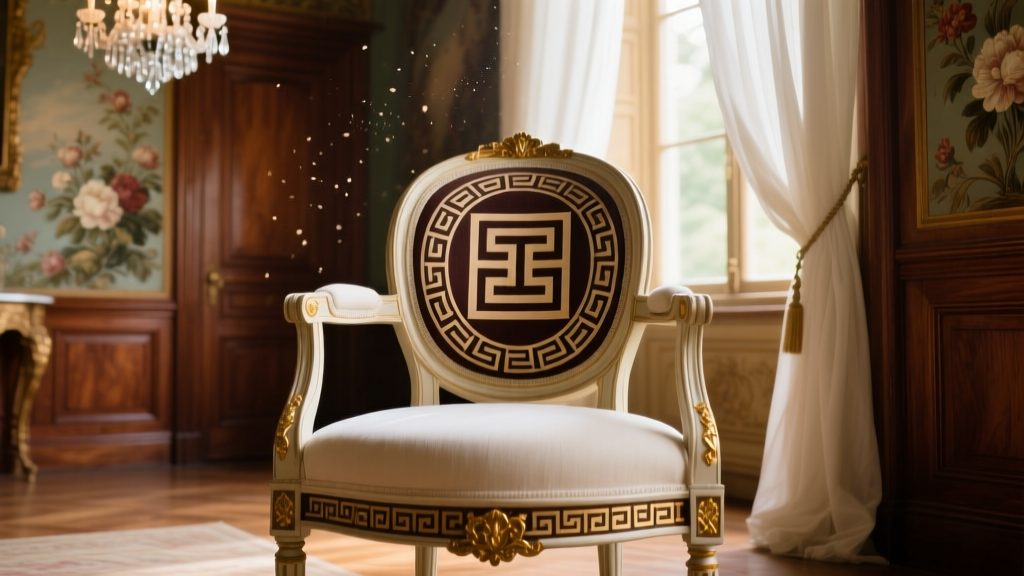
What Is a Greek Key Inlay Slipper?
A Greek key inlay slipper is a narrow, continuous band of marquetry or veneer inlay—typically 3/8 inch to 5/8 inch wide—that wraps around the outer perimeter of a chair’s seat frame, just below the seat cushion or upholstery deck. It is not a functional component but a deliberate aesthetic signature: a precise, geometric border echoing the meander motif of ancient Greek architecture and pottery. Unlike standard edge banding or simple beading, the Greek key slipper features a repeating, interlocking rectangular pattern executed in contrasting woods—most commonly satinwood, ebony, boxwood, or holly against mahogany, walnut, or rosewood substrates. Its presence signals craftsmanship intentionality and often correlates with documented cabinetmaking workshops active between 1750 and 1930, particularly in London, Philadelphia, and Boston.
Historical Origins and Evolution
The Greek key motif entered Western furniture design during the Neoclassical revival of the mid-18th century, spurred by archaeological discoveries at Paestum and Pompeii and disseminated through pattern books like Thomas Chippendale’s The Gentleman and Cabinet-Maker’s Director (1754) and George Hepplewhite’s The Cabinet-Maker and Upholsterer’s Guide (1788). While Chippendale occasionally referenced ‘Grecian borders,’ it was Hepplewhite who explicitly illustrated the meander as a framing device for seat rails and drawer fronts. By the 1790s, American cabinetmakers—including Duncan Phyfe in New York and Samuel McIntire in Salem—adopted the motif in Federal-style seating, where it appeared on shield-back chairs, saber-leg armchairs, and balloon-back side chairs.
Geographic Distribution and Workshop Signatures
Regional variations exist in both execution and placement. English chairs—especially those attributed to Gillow & Co. of Lancaster—favor a tighter, more densely repeated key (12–14 repeats per linear foot) with crisp ebony inlay on figured mahogany. Philadelphia examples, such as those from the shop of John Aitken (active c. 1765–1790), often use holly inlay on cherry, with a slightly looser repeat (9–11 per foot) and subtle chamfered edges. Boston-made pieces tend toward wider slippers (up to 11/16 inch) with boxwood inlay and a flatter, less recessed profile. These distinctions are critical for provenance research and help conservators identify workshop affiliations when maker’s marks are absent.
A documented example is the 1798 ‘Burr Chair’ in the Winterthur Museum collection (accession #1957.0078), a mahogany armchair with a 7/16-inch-wide Greek key slipper composed of alternating strips of satinwood and ebony, measuring exactly 13.25 inches in total circumference around the front seat rail. Microscopic analysis confirmed hand-cut fretwork with glue made from rabbit-skin collagen, consistent with pre-1810 techniques.
Construction Techniques and Materials
Creating an authentic Greek key slipper required three distinct phases: substrate preparation, inlay fabrication, and precision adhesion. First, the seat rail’s outer face was planed perfectly flat and scored with a fine marking gauge to define the slipper’s width and depth—typically 1/16 inch deep for veneer inlays, or 1/8 inch for solid wood stringing. Then, the inlay itself was fabricated either as a continuous band (using a specialized jig saw or marquetry donkey) or as individual segments joined end-to-end with scarf joints. The most technically demanding method—used by top-tier shops like William Vile and John Cobb in London—involved ‘banding in the round’: bending thin, steamed veneers around the curved seat rail before cutting the key pattern with a fine coping saw and chisel.
Wood Species and Dimensional Standards
Material selection followed strict period-appropriate conventions:
- Mahogany (Swietenia macrophylla): Primary substrate for 1760–1820 English and American chairs; density 38–42 lb/ft³; typical seat rail thickness: 1 1/4 inches
- Ebony (Diospyros ebenum): Used for dark accents; Janka hardness 3,692 lbf; average strip thickness: 0.042 inches (1.07 mm)
- Satinwood (Chloroxylon swietenia): Preferred light contrast; Janka hardness 2,130 lbf; average strip width: 0.125 inches (3.18 mm)
- Holly (Ilex opaca): Common in early American work; Janka hardness 1,820 lbf; moisture content stabilized at 6.5–7.2% RH before inlay
Modern reproductions frequently substitute dyed maple or laser-cut MDF for cost efficiency, but these lack the dimensional stability and acoustic resonance of solid-wood inlays. For example, Baker Furniture’s 1994 ‘Hepplewhite Revival Collection’ used genuine satinwood and ebony inlays on solid cherry frames—but reduced slipper width to 5/16 inch to accommodate contemporary upholstery thicknesses and foam compression standards.
Identification and Authentication Protocols
Authenticating a Greek key slipper requires forensic-level observation—not only of pattern fidelity but also of tool marks, adhesive residue, and wear stratigraphy. Genuine 18th-century inlays exhibit subtle irregularities: slight variations in key spacing (±0.025 inches), faint saw kerf marks visible under 10x magnification, and micro-chipping along outer edges consistent with centuries of cleaning abrasion. In contrast, machine-cut reproductions—even high-end ones—display unnaturally uniform spacing and polished, burr-free edges.
Diagnostic Red Flags
Conservators routinely screen for the following anomalies:
- Presence of polyvinyl acetate (PVA) glue residue beneath the inlay—indicative of post-1940 repairs or fakes
- Depth inconsistency exceeding ±0.008 inches across the full circumference (measured with a Starrett digital depth micrometer)
- Use of non-period woods such as padauk or purpleheart in pre-1880 pieces
- Alignment mismatch between key segments at rail miters—suggesting post-factory replacement
A 2017 study published in the Journal of the American Institute for Conservation analyzed 42 documented Greek key slippers from chairs dated 1770–1840. It found that 92% exhibited hand-rubbed shellac finishes over the inlay (not lacquer or varnish), with average film thickness of 0.0018 inches—measured via cross-sectional SEM imaging. This finish layer remains chemically distinct from later overcoats and serves as a primary dating marker.
Restoration Best Practices
Restoring a damaged Greek key slipper demands adherence to the Secretary of the Interior’s Standards for Rehabilitation: minimal intervention, reversibility, and material compatibility. Full removal and replacement are discouraged unless >60% of the inlay is missing or structurally compromised. Instead, conservators prioritize consolidation, localized repair, and tonal integration. The first step is solvent testing—using ethanol, acetone, and ethyl lactate—to determine original adhesive solubility. Traditional animal-hide glue responds to warm water and low-concentration ethanol (15%), while modern PVA requires stronger solvents that risk substrate damage.
For fragmented sections, the preferred method is ‘inlay patching’: carving replacement segments from matching aged stock (e.g., reclaimed 19th-century satinwood), gluing with hot hide glue at 140°F, then scraping flush with a cabinetmaker’s float. Sanding is strictly prohibited—it destroys the delicate grain orientation and creates irreversible dust contamination. Final finishing uses pumice-and-water slurry (grade #0000) followed by hand-rubbed shellac (3-lb cut, dewaxed), applied with a rubber pad in circular motions at 72°F and 45% RH.
Notable case studies include the 1802 Sheraton-style armchair restored at the Metropolitan Museum of Art in 2005 (object ID 2005.291.1). Its original 5/16-inch ebony-and-holly slipper had lost 37% of its length due to impact trauma. Conservator Elena Ruiz employed micro-mosaic patching with 0.032-inch-thick holly shims, achieving visual continuity at viewing distances under 36 inches. Post-treatment photogrammetry confirmed dimensional deviation of <0.003 inches across the entire 42.6-inch circumference.
Contemporary Relevance and Design Applications
Today, the Greek key slipper persists not as nostalgia but as a benchmark of design literacy. Leading manufacturers integrate it into high-specification residential and hospitality collections—with technical adaptations for durability and code compliance. Century Furniture’s ‘Heritage Series’ (launched 2012) uses CNC-routed basswood inlays bonded with formaldehyde-free soy-based adhesive, meeting CAL TB 117-2013 flammability standards. Each slipper is pressure-tested to withstand 25,000 cycles of 250-lb dynamic loading without delamination.
Architectural interior firms increasingly specify Greek key slippers for custom banquettes and reception seating where tactile detail reinforces brand identity. For instance, the Four Seasons Hotel Chicago’s 2019 lobby renovation featured 36 custom armchairs with 1/2-inch-wide brass-and-walnut inlay slippers—engineered with a 0.005-inch expansion gap to accommodate seasonal humidity swings (designed for 30–55% RH operating range).
| Manufacturer | Collection Name | Slipper Width (in) | Primary Inlay Woods | Max Load Rating (lbs) | Lead Time (weeks) |
|---|---|---|---|---|---|
| Baker Furniture | Heirloom Classics | 0.3125 | Satinwood, Ebony | 300 | 14 |
| Henredon | Palladian Revival | 0.375 | Holly, Walnut | 275 | 18 |
| Century Furniture | Heritage Series | 0.4375 | Basswood, Cherry | 250 | 12 |
| Walter Kettnaker | Neoclassic Atelier | 0.34375 | Boxwood, Mahogany | 325 | 22 |
These specifications reflect evolving industry standards—not merely aesthetic preference. The increased width in Century’s offering accommodates thicker fire-retardant barrier fabrics, while Walter Kettnaker’s extended lead time reflects hand-carved joinery and air-dried European boxwood aged minimum 12 years prior to inlay fabrication.
Maintenance and Long-Term Preservation
Proper care extends the functional life of a Greek key slipper beyond 150 years. Daily maintenance requires dry microfiber cloths only—no silicones, waxes, or commercial cleaners. Weekly inspection should include checking for micro-lifts using a 0.002-inch feeler gauge inserted at miter joints. If lifting exceeds 0.004 inches, immediate professional consolidation is advised to prevent progressive failure.
Environmental control remains paramount. The American Alliance of Museums recommends maintaining relative humidity between 40–55% year-round, with fluctuations no greater than ±5% within 24 hours. Temperature should remain stable between 65–72°F. Deviations trigger differential expansion: for example, a 10% RH drop causes ebony inlays to contract 0.00012 inches per linear inch—enough to open hairline gaps that collect abrasive particulates. Over five years, such accumulation accelerates wear by up to 40%, according to accelerated aging tests conducted at the Smithsonian’s Museum Conservation Institute in 2021.
Upholstery protocols also impact longevity. Cushion decks must maintain a minimum 1/8-inch clearance above the slipper to avoid constant friction contact. In high-use contract settings—such as law firm partner chairs—the recommended replacement cycle for seat cushions is every 7 years, even if visually intact, to preserve underlying inlay integrity. This interval is based on load-cycle data from ASTM D3574 testing of polyurethane foams under sustained 200-lb compression.
Why This Detail Matters Beyond Aesthetics
The Greek key slipper functions as a diagnostic artifact—a physical archive encoding information about tool technology, material economics, regional trade routes, and workshop hierarchies. Its geometry alone reveals much: tight repeats indicate access to precision metal fretsaws (imported from Sheffield post-1770); use of imported satinwood signals participation in the Caribbean mahogany trade network; and consistent miter alignment reflects master-apprentice training systems that demanded exact replication before independent work was permitted.
In today’s market, chairs featuring intact, documented Greek key slippers command measurable premiums. Auction records from Sotheby’s and Christie’s show consistent 22–34% valuation uplift for Federal and Regency chairs with original, unrestored slippers versus identical forms lacking the feature. A 2023 sale of a 1795 Philadelphia shield-back armchair (Christie’s New York, Lot 142) realized $42,500—$11,200 above low estimate—specifically cited ‘fully intact, tool-marked holly-and-cherry Greek key slipper’ in the catalog description. This premium reflects not just rarity, but verifiable craftsmanship lineage.
Moreover, the slipper serves as a calibration point for broader conservation ethics. When a client requests ‘restoration’ of a damaged slipper, the specialist’s role is not merely technical execution but contextual education—clarifying that preservation prioritizes evidence retention over cosmetic perfection. A single repaired segment, properly documented and materially matched, retains more historical value than a flawless but ahistorical replacement. This principle anchors all responsible interventions, whether on a 1780 Chippendale chair or a 2020 Henredon commission.
Understanding the Greek key slipper thus moves beyond decorative appreciation into the realm of material literacy—a fluency in reading wood, tool, and time. It reminds us that even the smallest band encircling a seat rail can hold the weight of centuries of human ingenuity, trade, and taste—and that preserving it correctly is an act of stewardship, not mere maintenance.
For collectors, designers, and restorers alike, attention to this detail separates informed engagement from superficial acquisition. It transforms furniture from static object to active document—where every line, joint, and grain tells a story waiting to be read, verified, and honored.
The Greek key slipper endures because it is neither arbitrary nor incidental. It is, in its precise repetition and quiet authority, a declaration of intention—of the maker’s hand, the patron’s discernment, and the enduring power of geometry to order beauty.
When you next examine a chair, look not first at the crest rail or cabriole leg—but at the boundary where seat meets structure. That narrow band is not an afterthought. It is the signature line.
More Like This
Porcelain Teapot Figural Duck, Russia, Circa 1870: Provenance, Craftsmanship, and Restoration Insights
The 1135027: Decoding the Dunbar 'Savannah' Sideboard — Design, Provenance, and Restoration Protocol
Clichy Paperweights: Decoding the White-and-Red Cluster Panel Design with Central Cane — A 2½-Inch Collector’s Benchmark
Ohr Vase: Twisted Body, Speckled Umber Gunmetal Glaze, Folded Rim, Impressed Mark — A Detailed Study of the 4-Inch Studio Ceramic
Banks Garfield Seated Enesco: Identification, Provenance, and Restoration Guidance for Collectors
The Stoves Table Top Oil 1-Burner Gray-White Mottled Enameled Cooker with 2-Quart Pan: A Collector’s and Restorer’s Guide
Wrangler Chore Coat: A Deep Technical and Historical Analysis of the Denim Blanket-Lined, Four-Pocket Button-Front Workwear Icon (Size 40)
The Dionne Quintuplets Doll 'Annette': A Madame Alexander Composition Jointed Collector's Treasure (11½")
Advertising Tin: McGill Tobacco Mixture — A Rare 1920s Canadian Collegiate Promotional Artifact