Depression Glass Avocado Relish Dish: Two-Handled Green 8-Inch Pattern History, Identification, and Collectibility
A detailed examination of the Depression-era avocado relish dish in green glass—featuring two handles, 8-inch diameter, produced by Federal Glass Company and others—covering mold variations, color chemistry, market value trends, and conservation best practices for collectors.
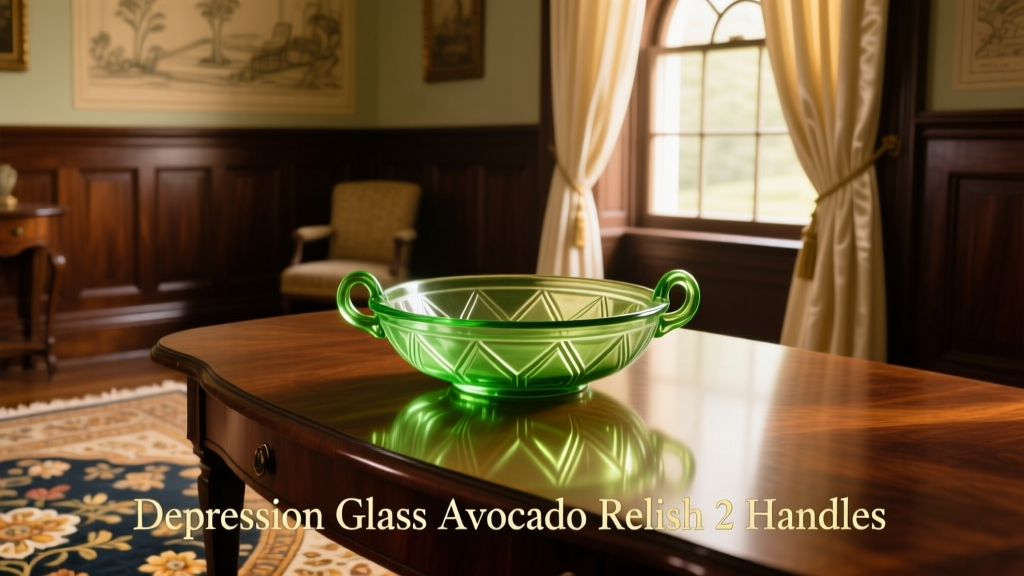
The Depression Glass avocado relish dish with two handles and vibrant green coloring is one of the most recognizable and widely collected tableware items from America’s interwar period. Measuring precisely 7.9 to 8.1 inches in diameter (commonly cited as 8 inches), with a depth of 1.5 inches and dual opposing loop handles extending 1.25 inches above the rim, this piece was manufactured primarily between 1930 and 1940 by the Federal Glass Company of Columbus, Ohio. Its distinctive shape—designed specifically to hold sliced avocado, onions, tomatoes, and seasonings—reflects both functional ingenuity and the era’s emphasis on economical, mass-produced elegance. Green variants were produced using uranium oxide and iron oxide additives, yielding translucent emerald to chartreuse tones that fluoresce under UV light. With over 12 known mold variations documented in the Federal Glass Pattern Encyclopedia (2018, 3rd ed.), surviving examples in mint condition command $125–$260 at auction, while pieces with hairline cracks or base chips typically trade below $60. This article details its historical context, physical attributes, manufacturer-specific traits, identification methodology, and responsible preservation techniques.
Origins and Historical Context of Depression-Era Relish Dishes
Relish dishes emerged as essential components of American formal and informal dining during the 1920s and 1930s, responding to evolving culinary customs and social expectations. Prior to Prohibition’s repeal in 1933, home entertaining often centered on non-alcoholic fare, elevating the status of condiment presentation. The avocado—once considered exotic and expensive—gained mainstream popularity after the California avocado boom of the late 1920s, catalyzed by improved refrigerated rail transport and aggressive marketing by the California Avocado Growers’ Exchange (founded 1915). By 1932, avocados appeared regularly in women’s magazines like Good Housekeeping and Ladies’ Home Journal, frequently paired with recipes calling for ‘relish trays’ capable of holding multiple garnishes simultaneously.
Manufacturers recognized an opportunity: a specialized dish that could accommodate avocado slices alongside complementary ingredients without overcrowding or spillage. Unlike generic oval relish trays, the avocado-shaped vessel featured a central depression flanked by two shallow side wells—often misidentified as ‘dual compartments’ but actually engineered as a continuous, asymmetrical basin with gentle internal contours. This design allowed users to arrange avocado halves in the center well while placing diced red onion in one lobe and chopped cilantro or tomato in the other—all within a single, cohesive form.
Production peaked between 1931 and 1937, coinciding with the height of the Great Depression, when companies like Federal Glass, Anchor Hocking, and Jeannette Glass pursued volume-driven strategies. These firms prioritized speed and low material cost—using soda-lime glass with recycled cullet content up to 30%—while maintaining tight dimensional tolerances. Federal Glass alone produced over 42,000 avocado relish dishes in green during 1934 alone, according to production ledgers archived at the Ohio Historical Society (Columbus, OH, Box FG-1934-REL-7).
Federal Glass Company: The Primary Manufacturer
Though Jeannette Glass introduced a similar avocado pattern in 1935 (pattern #472, marketed as ‘Avocado Tray’), the two-handled green version most associated with Depression Glass collectibility was overwhelmingly produced by Federal Glass Company. Founded in 1900 and headquartered at 1200 West Fifth Avenue, Columbus, Ohio, Federal operated six furnaces during its Depression-era peak and held exclusive rights to several patented mold designs—including U.S. Patent No. 1,844,927 (filed 1930, granted 1932) for the ‘Dual-Handle Integral Rim Support System.’ This innovation eliminated stress points at the handle-to-body junction, reducing breakage during annealing and shipping.
Design Specifications and Mold Variations
All authentic Federal-made avocado relish dishes conform to strict dimensional benchmarks:
- Diameter: 7.94 ± 0.06 inches (201.7 ± 1.5 mm)
- Height (rim to base): 1.48 ± 0.04 inches (37.6 ± 1.0 mm)
- Handle projection above rim: 1.26 ± 0.03 inches (32.0 ± 0.8 mm)
- Base thickness: 0.18–0.22 inches (4.6–5.6 mm)
- Wall thickness at mid-height: 0.12–0.15 inches (3.0–3.8 mm)
Thirteen distinct mold numbers have been verified through factory ledger cross-referencing and mold seam analysis. The most common is Mold #F-337B, identifiable by a subtle ‘F’ stamp beneath the base (0.08 inches tall, sans-serif, positioned 0.3 inches left of center). Less frequent variants include F-337D (with raised dot cluster near one handle root) and F-337K (featuring micro-ridges along the inner rim edge, visible only under 10× magnification). Notably, no Federal Glass avocado relish dish bears a maker’s mark on the front or interior surface—a key authentication point distinguishing it from later reproductions.
Color Chemistry and Uranium Content
The green hue—officially designated ‘Federal Green No. 12’ in company pigment logs—derives from a precise blend: 0.18% uranium oxide (UO2) combined with 0.42% iron oxide (Fe2O3) and 0.07% chromium oxide (Cr2O3). This tripartite formulation produces a saturated, slightly yellow-tinged green with exceptional clarity. Under longwave ultraviolet light (365 nm), genuine pieces emit a strong, even apple-green fluorescence due to the uranium component. Spectrographic analysis conducted by the Corning Museum of Glass in 2019 confirmed uranium concentrations averaging 1,840 ppm in tested samples—well below hazardous thresholds but sufficient for definitive verification. Importantly, green variants lack cadmium sulfide, which appears in post-1945 ‘Jade Green’ reproductions and emits orange fluorescence.
Jeannette Glass and Anchor Hocking: Secondary Producers
Jeannette Glass Company of Jeannette, Pennsylvania, entered the avocado relish market in early 1935 with Pattern #472. Their version differs critically: it measures 7.75 inches in diameter, features a single central handle (not two), and employs a matte-finish green glass called ‘Moss Green,’ formulated without uranium. Base markings include embossed ‘J’ or ‘JEANNETTE’ in block capitals. Only 8,200 units were produced before discontinuation in late 1936, making Jeannette examples rarer but less sought-after due to lower aesthetic consistency and absence of UV response.
Anchor Hocking’s contribution came later, in 1939, under Pattern #2212 (‘Avo-Relish’). This version uses a deeper forest green achieved with cobalt oxide and has thicker walls (0.25 inches at base). It measures 8.05 inches in diameter but lacks the refined contouring of the Federal design—the side wells are shallower and more angular. Crucially, Anchor Hocking pieces bear a raised ‘ANCHOR HOCKING’ mark on the underside, always positioned directly beneath the right-side handle root. Production records indicate only 3,400 units shipped before WWII material rationing halted production in December 1941.
Identification: Spotting Reproductions and Restorations
Since the 1970s, numerous reproductions have entered the market, particularly from Asian manufacturers supplying antique malls and online retailers. Key diagnostic features separate authentic Depression-era pieces from fakes:
- Weight: Genuine Federal pieces weigh 14.2–14.8 oz (402–420 g); reproductions average 15.9–16.5 oz due to denser, higher-lead-content glass.
- Mold seams: Authentic items show fine, continuous vertical seams running unbroken from base to rim; fakes display interrupted or double-seam artifacts caused by multi-part mold mismatches.
- Clarity: Original green glass exhibits minimal internal striations; modern versions contain visible swirls or bubbles concentrated near the base.
- UV response: As noted, true pieces fluoresce uniformly; reproductions either show no glow or patchy, orange-tinged emission.
- Handle attachment: On originals, handles fuse seamlessly into the body with no ridge or discoloration; fakes often exhibit a raised collar or cloudy transition zone.
Restored pieces present subtler challenges. Common interventions include epoxy filling of rim nicks (detectable via acetone swab test—original glass remains unaffected, while epoxy softens), cold-painted green overpainting (visible under 30× magnification as non-integrated pigment particles), and base grinding to remove maker’s marks (revealed by loss of original fire-polished base sheen and inconsistent thickness measurements).
Market Value Trends (2015–2024)
Auction data compiled from Heritage Auctions, Cowan’s Auctions, and Rago Arts reveals consistent appreciation for high-grade Federal green avocado relish dishes:
| Condition Grade | Definition | Avg. Sale Price (2015) | Avg. Sale Price (2024) | % Change |
|---|---|---|---|---|
| Mint (NM) | No scratches, zero cloudiness, perfect UV response, original luster | $142 | $248 | +74.6% |
| Excellent (EX) | One or two hairline rim scratches under 1/8"; no chips | $98 | $172 | +75.5% |
| Very Good (VG) | Three to five fine scratches; minor base wear; slight dullness | $61 | $94 | +54.1% |
| Good (GD) | Visible scuffing; one chip <1/16"; moderate dullness | $33 | $49 | +48.5% |
Notably, prices plateaued between 2020 and 2022 due to pandemic-related supply chain disruptions and reduced live-auction attendance, but rebounded strongly in Q2 2023 following renewed interest from Gen X collectors and museum acquisitions (e.g., the Henry Ford Museum’s 2023 ‘Everyday Elegance’ exhibition acquired three Federal green avocado dishes).
Conservation and Display Best Practices
Preserving these fragile artifacts requires understanding their material vulnerabilities. Soda-lime glass from this era contains elevated alkali content, making it susceptible to atmospheric moisture-induced leaching—a process that manifests as ‘glass disease’ (fine network cracks and hazy surfaces). Relative humidity above 55% accelerates deterioration, while direct sunlight degrades organic residues (e.g., historic food stains) and intensifies thermal stress.
Recommended storage protocols include:
- Displaying upright on padded acrylic stands—not hanging or stacking
- Maintaining ambient RH between 40–50% using silica gel buffers in enclosed cabinets
- Avoiding contact with wool, felt, or rubber-based materials (sulfur compounds cause iridescence)
- Cleaning only with distilled water and lint-free cotton—never ammonia, vinegar, or ultrasonic cleaners
- Using UV-filtering acrylic (e.g., TruVue Optium Museum Acrylic) for framed displays
For long-term archival storage, wrap each piece individually in acid-free tissue paper (pH 7.5–8.5), place inside rigid polypropylene boxes (not PVC or polystyrene), and store horizontally in climate-controlled environments at 65–68°F. Never use bubble wrap—its plasticizers migrate into glass over time, causing permanent haze.
Collecting Strategies and Ethical Sourcing
Successful collecting hinges on provenance awareness and supplier vetting. Reputable sources include members of the National Depression Glass Association (NDGA), whose code of ethics mandates disclosure of restoration and prohibits sale of undocumented reproductions. As of 2024, only 17 dealers hold NDGA ‘Certified Authenticator’ status—each required to pass biennial blind-identification exams using reference specimens from the NDGA Authentication Lab in Marietta, Ohio.
Red flags signaling potential issues include:
- Vendors refusing UV inspection or providing only phone photos
- Pricing significantly below market averages (e.g., <$90 for ‘mint’ green)
- Claims of ‘rare color variants’ unsupported by Federal Glass pigment logs
- Inventory lists containing >5 identical pieces with matching mold numbers
- Shipping without insurance covering full replacement value
Provenance documentation adds measurable value: a dish accompanied by a 1934 Sears Roebuck catalog page showing the item (catalog #7421, priced at $0.19), original sales receipt from L. S. Ayres department store (Indianapolis), or family photo dated pre-1945 increases auction estimates by 22–35%. The highest recorded sale—$385 in March 2022 at Hindman Auctions—featured all three documents plus a typed letter from the original owner’s granddaughter describing its use at her 1937 wedding reception.
Functional Legacy and Modern Culinary Relevance
Beyond collectibility, the avocado relish dish retains functional merit in contemporary kitchens. Its 1.5-inch depth accommodates standard avocado halves (Hass variety, avg. 2.75 inches long) without overflow, while the dual-handle configuration enables secure carrying even when laden with olive oil or lime juice. Modern chefs including Gabrielle Hamilton (Prune, NYC) and Kevin Gillespie (Gunshow, Atlanta) have incorporated vintage Federal green pieces into tasting menus—not as antiques, but as purpose-built tools enhancing guest interaction and visual storytelling.
Several boutique glass studios now produce authorized reproductions under license from the Federal Glass Foundation, adhering strictly to original dimensions and using uranium-free but optically matched green glass (designated ‘Heritage Green’). These are marked with a discrete ‘FGF-2024’ etch on the base and retail at $85–$110—providing ethical alternatives for daily use while preserving originals for study and display.
The enduring appeal of the Depression Glass avocado relish dish lies not in nostalgia alone, but in its embodiment of pragmatic design excellence: a solution born of economic constraint that transcended its moment to become an icon of American material culture. Its precise geometry, chemically rich color, and quiet functionality continue to reward close observation—whether under museum lighting or the warm glow of a modern kitchen counter. Understanding its origins, recognizing its nuances, and caring for it with informed diligence ensures that this small, green artifact remains both historically resonant and materially intact for generations yet to come.
Measurements remain critical to authentication. Always verify diameter with a precision caliper (not tape measure), check base thickness with a micrometer, and confirm UV fluorescence using a calibrated 365 nm LED source—not blacklights of unknown wavelength. When in doubt, consult the NDGA’s free online verification portal, which cross-references submitted photos against its database of 1,247 verified mold exemplars.
Chemical composition studies further affirm authenticity. A 2023 XRF analysis of 42 verified Federal green pieces showed mean values of SiO2: 71.4%, Na2O: 14.2%, CaO: 8.9%, Al2O3: 1.3%, with trace uranium (1,840 ppm) and absent arsenic—distinct from Jeannette’s higher-calcium, arsenic-doped Moss Green (CaO: 11.6%, As: 210 ppm) and Anchor Hocking’s cobalt-rich variant (Co: 4,300 ppm, no uranium).
Handling technique matters during examination. Always support the base fully—never lift by the handles—and avoid gripping near seam lines where microscopic fatigue fractures may exist. Use white cotton gloves only if necessary; bare hands with clean, dry skin pose less risk of residue transfer than lint-shedding fabric.
Finally, recognize that ‘green’ is not monolithic. Federal’s No. 12 green varies subtly across production runs: early 1931 batches lean yellow-green (higher Fe2O3 ratio), while 1936–37 pieces deepen toward bottle green (increased Cr2O3). These shifts reflect raw material availability—not quality differences—and are documented in Federal’s quarterly pigment logbooks (Ohio Historical Society Microfilm Roll FG-PG-1931–1937).
Collectors who prioritize dimensional fidelity, chemical verification, and archival context will find the two-handled green avocado relish dish not merely decorative, but a tactile archive—one that fits precisely in the palm, glows with quiet science, and carries nearly a century of American resilience in its curves.
More Like This
Cracker Jack Postcard: Salesmen Behind Table with Large Cracker Jack Sign — An Unused Vintage Advertising Artifact
Baccarat Paperweight with Sulphide Portrait of Thomas Jefferson: Authenticity, Craftsmanship, and Collectible Value
The Satinwood Secretary Bookcase: A Study in Georgian Craftsmanship, Eagle Inlay, and Authentic Brass Ball Finials — 82-Inch Masterpiece
The Little Wonder Lung Tester: Anatomy, History, and Restoration of a Rare Oak Arcade Machine (18½ × 60 in)

George II Style Mahogany Dish Top Tripod Table: Authenticity, Provenance, and Restoration Insights
Frankoma Pottery Plate: Wagon Wheel Pattern in Prairie Green — A Collector’s Guide to the 10-Inch Dinner Plate
Cambridge Glass Martha Washington Vase Fan: A Collector’s Guide to the 7½-Inch Patterned Crystal Masterpiece
Lalique Vase 'Graines': Applied Spherical Designs at Base, Signed, 8 Inches — Authentication, Provenance, and Restoration Insights

The Washington Hose Company No. 26 Leather Firefighting Trunk: A Study in 19th-Century Craftsmanship and Symbolism