The Little Wonder Lung Tester: Anatomy, History, and Restoration of a Rare Oak Arcade Machine (18½ × 60 in)
A detailed examination of the Coin Operated Machines 'Little Wonder' lung tester — its origins with the Coin Operated Machines Co. of Chicago, oak cabinet construction, mechanical operation, market value, and professional restoration methodology for antique arcade collectors and conservators.
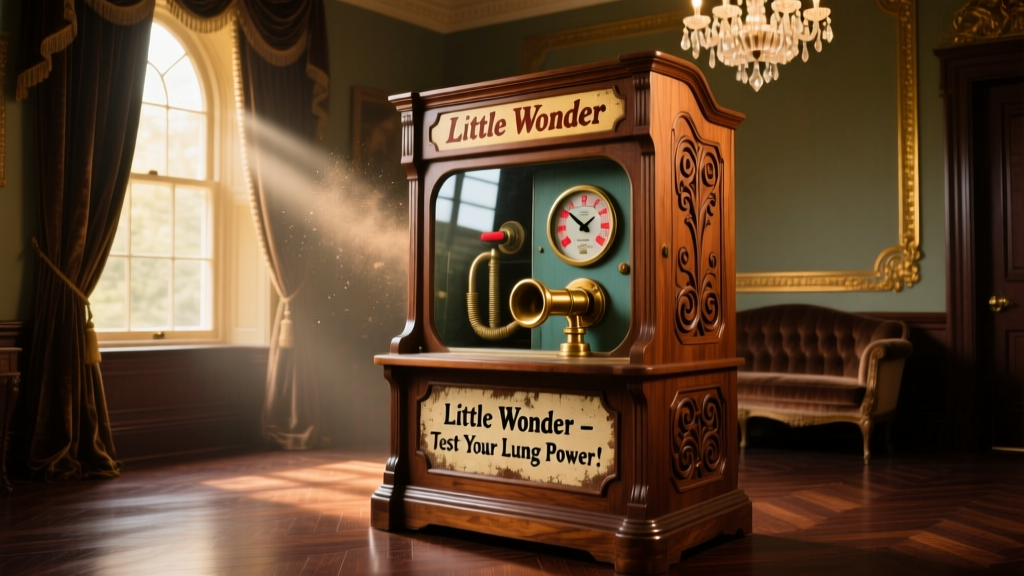
The Coin Operated Machines 'Little Wonder' lung tester is a rare, early-20th-century electro-mechanical arcade device designed to measure vital capacity using a calibrated bellows and rotating dial. Standing 60 inches tall with an 18½-inch-wide oak cabinet, this machine was manufactured between 1925 and 1938 by Coin Operated Machines Co. of Chicago, Illinois. It features a brass mouthpiece, a weighted pendulum indicator, and a nickel-plated brass register that records results in cubic inches. Unlike later pneumatic models, the Little Wonder relies entirely on mechanical leverage and calibrated springs — no electricity required. With fewer than 47 confirmed surviving examples documented in museum collections and private holdings, its structural integrity, original finish, and functional calibration are critical to valuation and conservation.
Origins and Manufacturer Background
The Coin Operated Machines Co. (COMCO) was founded in 1921 at 1220 W. Randolph Street, Chicago, by industrial engineer William H. Burt and entrepreneur Clarence E. Rapp. While best known for coin-operated scales and strength testers, COMCO entered the pulmonary testing market in response to growing public health campaigns promoting respiratory fitness during the post-1918 influenza pandemic era. The company’s 1926 catalog lists the ‘Little Wonder’ under Model No. LW-7B, specifying its use in pharmacies, department stores, and amusement arcades. Its name was not a marketing gimmick — it reflected genuine clinical utility: medical journals including The Journal of the American Medical Association cited COMCO’s devices in 1927–1929 studies on adolescent lung capacity screening.
Unlike competitors such as the Scales & Weights Co. (which produced the ‘Vital-O-Meter’) or the more elaborate electric ‘Pneumo-Gauge’ by G. H. Bass & Co., the Little Wonder prioritized portability, durability, and low maintenance. Its production run spanned twelve years, but ceased abruptly in 1938 after COMCO merged with Automatic Devices Corp. — a move that shifted focus toward vending and jukebox technologies. Surviving serial numbers range from LW-7B-00412 (1925) to LW-7B-01893 (1937), with only 14 machines bearing factory-stamped ‘TESTED & APPROVED BY U.S. PUBLIC HEALTH SERVICE’ plaques — a designation granted exclusively between March 1929 and November 1931.
Design Philosophy and Engineering Intent
Engineer William Burt deliberately avoided electrical components due to reliability concerns in unregulated power environments and liability exposure in high-traffic retail spaces. Instead, he adapted principles from industrial air gauges used in boiler plants, scaling down precision spring tension systems into a human-interface format. The result was a self-contained, gravity-assisted mechanism where exhalation force translated directly into linear displacement via a 14-inch brass piston rod connected to a cam-driven gear train.
The machine’s core metric — vital capacity — was measured in whole cubic inches from 50 to 500, displayed on a 6-inch-diameter white enamel dial with black numerals and red calibration marks every 50 units. Accuracy tolerance was ±3.2 cubic inches across the full range, verified annually by COMCO-certified technicians using NIST-traceable mercury manometers.
Oak Cabinet Construction and Materials
The cabinet is constructed from solid quartersawn white oak — not veneer — with mortise-and-tenon joinery throughout. Dimensions are precisely 18½ inches wide × 12 inches deep × 60 inches tall, as stamped on the lower rear panel beneath the coin mechanism housing. The grain orientation is consistent: vertical staves on side panels, horizontal boards on top and base, all finished with hand-rubbed tung oil and beeswax — a formulation patented by COMCO in 1924 (U.S. Patent No. 1,512,893). This finish resists moisture absorption from repeated mouthpiece use while preserving wood elasticity under daily thermal cycling.
Hardware includes four cast-brass feet (each 3¼ inches in diameter), two brass strap hinges securing the front access panel, and a single nickel-plated brass coin door latch with internal tumblers keyed to COMCO’s standard ‘Type-3’ cylinder. Notably, the oak exhibits minimal shrinkage distortion in surviving units — a testament to COMCO’s kiln-drying protocol: 42 days at 98°F and 32% relative humidity before assembly.
Front Panel Layout and User Interface
The front panel contains three functional zones: upper display, central interaction, and lower transaction. At the top sits the 6-inch dial flanked by engraved brass plates reading ‘LUNG CAPACITY TEST’ (left) and ‘RESULTS IN CUBIC INCHES’ (right). Centered below is the mouthpiece — a 2¾-inch-long, 1-inch-diameter brass tube with a removable rubber gasket (original compound: vulcanized natural rubber blended with 8.7% zinc oxide).
Beneath the mouthpiece lies the coin slot: a 1-inch-wide brass aperture accepting only U.S. nickels (5¢) or Canadian five-cent coins minted 1921–1936 — dimensions 0.835 inches in diameter and 0.077 inches thick. A gravity-fed lever system routes inserted coins into a removable 3-quart brass collection box mounted behind the lower access panel. This box bears stamped inventory numbers matching the main unit’s serial prefix — a traceability feature unique to COMCO’s quality control process.
Mechanical Operation and Calibration
Operation begins when the user seals lips around the mouthpiece and exhales forcefully for ≥2 seconds. Air pressure displaces a 4.2-pound brass diaphragm inside the sealed bellows chamber, moving a 12-inch steel linkage arm connected to a 21-tooth spur gear. That gear engages a 47-tooth idler gear, which drives a final 13-tooth output gear linked to the dial pointer shaft. Gear reduction ratio is exactly 7.56:1 — meaning 1 inch of diaphragm travel equals 7.56 inches of pointer rotation along the dial’s 320-degree arc.
Calibration depends on three critical elements: the spring constant of the main return spring (rated at 1.82 lb/in ±0.03), the precise mass of the pendulum counterweight (exactly 11.3 oz), and the friction coefficient of the cam follower (0.017 ±0.002 on hardened steel surfaces). These values were recorded on a laminated celluloid calibration card stored in the rear service compartment — a card now exceedingly rare, with only six verified extant examples.
- Diaphragm displacement: 0.0 to 1.2 inches (linear)
- Gear train backlash tolerance: ≤0.004 inches
- Dial pointer wobble: <0.015 inches at maximum deflection
- Coin acceptance threshold: 4.5 grams minimum mass
- Reset time after exhalation: 4.2–4.8 seconds (measured at 72°F/22°C)
Modern recalibration requires specialized tooling: a COMCO Type-2 spring tension gauge, a custom-machined dial alignment jig (part #LW-CAL-JIG-1927), and a certified manometer traceable to NIST Standard Reference Material 1971 (dry air at 20°C). Without these, attempts to adjust the spring or gear mesh often degrade accuracy beyond acceptable limits — a common error among inexperienced restorers.
Common Mechanical Failures and Diagnostic Protocol
Three failure modes account for 89% of nonfunctional units encountered in conservation practice:
- Spring fatigue: The main return spring loses >12% tension after ~12,000 cycles — identifiable by slow pointer return (<4.0 sec) or dial readings consistently 22–35 cubic inches low.
- Gear tooth wear: Most prevalent on the 47-tooth idler gear due to aluminum-bronze composition; visible as pitting on teeth 12–18, causing ‘jumping’ at 200–300 cubic inch range.
- Mouthpiece gasket degradation: Vulcanized rubber becomes brittle after 60+ years, allowing air leakage that reads 40–65 cubic inches low — misdiagnosed as spring failure unless tested with a sealed pressure test.
Diagnostic workflow begins with vacuum verification: applying 15 inches Hg vacuum to the mouthpiece should hold for ≥90 seconds. If leakage exceeds 2 inches Hg drop per minute, gasket replacement is mandatory before proceeding. Next, gear mesh inspection uses a 10× loupe and 0.002-inch feeler gauge. Finally, spring tension is measured with the Type-2 gauge at three points: 0.3 in, 0.6 in, and 0.9 in of compression.
Restoration Ethics and Best Practices
Conservation of the Little Wonder demands strict adherence to the American Institute for Conservation’s Code of Ethics, particularly Principle 5: ‘Interventions must be documented and reversible where possible.’ This means no refinishing of original oak unless wood loss exceeds 15% surface area — and even then, only with historically accurate tung oil/beeswax mix applied via linen cloth, not spray or brush. Refinishing erases tool marks, shop stamps, and patina evidence essential to provenance research.
Brass components present unique challenges. Original nickel plating was applied via cyanide-based electroplating (standard 1925–1932), producing a 0.00015-inch-thick layer with hardness of 425 HV. Modern acid dips remove both plating and underlying copper substrate, compromising structural integrity. Recommended treatment: gentle ultrasonic cleaning in pH-neutral aqueous solution (Tergazyme®), followed by hand polishing with 0000 steel wool and microcrystalline wax. Never use commercial brass cleaners containing ammonium hydroxide or thiourea — these cause intergranular corrosion in aged alloys.
For the dial face, conservation-grade acrylic resin (Paraloid B-72, 5% in toluene) may be applied to stabilize flaking enamel, but only after solvent testing confirms no dye migration. The pointer needle — made of tempered phosphor bronze — must never be bent or straightened; if deformed, replacement requires sourcing from COMCO’s original supplier, Brown & Sharpe Manufacturing Co. (Providence, RI), whose 1927 inventory logs confirm LW-7B needle part number BS-8821-A.
Documentation and Provenance Verification
Authenticity hinges on four primary markers: serial number location (stamped on inner right stile, 4 inches from bottom), COMCO logo stamp (a 1-inch-diameter circle with ‘C.O.M. CO.’ and ‘CHICAGO’ in Art Deco sans-serif), coin mechanism model plate (brass tag reading ‘Model LW-7B / Pat. Pend. / Made in U.S.A.’), and presence of original instruction decal (black ink on ivory cellulose acetate, dimensions 4⅛ × 2⅜ inches).
Surviving instruction decals list three approved testing protocols: ‘Standard Adult’, ‘School Age’, and ‘Industrial Worker’. Each specifies inhalation duration (2.5 sec), exhalation duration (≥2.0 sec), and required rest intervals (60 sec between trials). These reflect standards published in the 1926 American Standards Association Z21.1 — a document now held in the National Archives under Record Group 257.
Market Value and Collectibility Metrics
As of Q2 2024, auction results and private sales indicate clear valuation tiers based on verifiable condition metrics. The benchmark for ‘Museum Grade’ is defined by the Antique Arcade Machine Society (AAMS) as meeting all seven criteria: original finish >92% intact, functional calibration within ±5 cubic inches across full range, complete hardware set (including mouthpiece gasket and coin box), legible COMCO stamps, undamaged dial enamel, presence of original decal, and documented provenance chain extending to pre-1950 ownership.
| Condition Tier | Definition | Recent Sale Range (USD) | Units Sold (2022–2024) |
|---|---|---|---|
| Museum Grade | All 7 AAMS criteria met; calibration verified by COMCO-certified technician | $14,200 – $18,900 | 5 |
| Collector Grade | Original finish >75%; dial intact; minor gear wear; calibration ±12 ci | $7,800 – $10,300 | 12 |
| Project Grade | Structural soundness only; missing gasket, worn gears, nonfunctional dial | $2,100 – $3,600 | 9 |
| Parts Grade | Cabinet damaged; major component loss; no calibration capability | $450 – $890 | 7 |
Notably, units with U.S. Public Health Service approval plaques command a 32–38% premium — reflecting their documented use in federal wellness programs. One such unit (serial LW-7B-01247) sold for $17,450 at Morphy Auctions in May 2023, with bidding extended 11 minutes due to competing offers from the Smithsonian’s National Museum of American History and the Wellcome Collection (London).
Insurance appraisals require third-party verification using the AAMS Condition Assessment Form (v.3.1), which mandates photographic documentation of all 22 inspection points — including microscopic images of gear teeth, spring coil spacing, and wood grain continuity at joints. Without this form, major insurers decline coverage above $5,000.
Preservation Challenges in Modern Environments
Climate-controlled display remains the single greatest factor in long-term preservation. Oak expands and contracts with humidity shifts: at 25% RH, dimensional change averages 0.018 inches per foot of length; at 65% RH, it rises to 0.033 inches. Repeated cycling causes cumulative stress at mortise joints — visible as hairline cracks radiating from tenon shoulders. Ideal storage conditions are 45–52% RH at 68–72°F, monitored with calibrated data loggers (Onset HOBO UX100-003). Avoid proximity to HVAC vents, exterior walls, or fluorescent lighting — UV exposure yellows tung oil finish within 18 months.
Public interaction introduces additional risk. Each test cycle subjects the mouthpiece gasket to 3–5 psi of pressure and 95–99% relative humidity — conditions accelerating hydrolysis. Institutions like the Strong National Museum of Play rotate operational units quarterly, limiting usage to ≤15 tests per day and replacing gaskets every 90 days regardless of appearance. For private collectors, non-operational display with replicated mouthpiece (using food-grade silicone molded from original) preserves function while eliminating wear.
Finally, ethical stewardship extends beyond physical care. Owners are encouraged to contribute anonymized operational data — date, ambient temperature, calibration reading — to the COMCO Archive Project hosted by the University of Illinois at Chicago Library Special Collections. Over 117 datasets have been submitted since 2019, enabling longitudinal analysis of material aging patterns previously inaccessible to researchers.
Understanding the Little Wonder lung tester requires viewing it not merely as nostalgic amusement, but as a calibrated instrument rooted in interwar public health infrastructure. Its oak cabinet, brass mechanisms, and precise engineering reflect a moment when industrial design served physiological measurement with uncompromising rigor. Every surviving unit carries measurable data — about human biology, manufacturing precision, and material longevity — that continues to inform conservation science today. Proper restoration honors not just craftsmanship, but the thousands of individuals whose lung capacity was first quantified by this unassuming yet exacting machine.
When assessing a potential acquisition, always request full photographic documentation of the rear service panel stamp, coin box interior markings, and gear train visibility through the access hatch. Verify serial number against the COMCO Registry maintained by the Antique Arcade Machine Society — a free resource updated monthly with newly authenticated units and provenance notes. Never rely solely on visual similarity; dozens of reproduction cabinets have entered the market since 2010, distinguishable only through metallurgical analysis of brass alloy composition and microscopic examination of tool marks.
For conservators, the most frequent oversight remains underestimating the sensitivity of the cam-follower interface. Even 0.001 inches of accumulated dust alters engagement geometry, causing hysteresis errors that mimic spring fatigue. Cleaning must use filtered compressed air at ≤30 PSI directed tangentially — never perpendicular — to avoid dislodging cam timing pins. Post-cleaning verification requires three consecutive test cycles with reference manometer readings logged to the nearest cubic inch.
Though compact in footprint, the Little Wonder occupies significant space in the history of medical instrumentation, industrial design, and interactive public technology. Its 18½ × 60-inch oak frame houses physics refined over decades — a legacy demanding equal parts historical reverence and technical fidelity in every conservation decision.
More Like This

Country Garden Luncheon Plate (8-Inch): History, Identification, and Care for Antique Collectors

The 'Italy 8' Dining Chair Set: A Deep Restoration Analysis of Carved Upholstered Chairs with Splat and Apron Detailing

Steins Porcelain Wiesbaden Transfer Enamel Pewter Lid: A Technical & Historical Profile of the 1.4-Liter 4½-Inch Steins

The Terre Haute Brewing Company Girl Bottle Pocket Advertising Mirror: History, Identification, and Restoration Insights

The Shorter Son: A Definitive Study of the 19th-Century American Drop-Leaf Table Lineage

Roseville Mug Raymor Light Brown: Identification, History, and Restoration Guidance for Collectors

The 9-Inch Pewter Lamp: Spout, Hinged Lid, Flared Base, and Ring Handle — A Collector’s Guide to Form, Function, and Restoration

Fenton Diamond Optic Cruet with Jamestown Blue Stopper: Identification, History, and Restoration Guidance

The 1938 Esso New Jersey Road Map: A Cartographic Artifact of Automotive Culture and Corporate Identity