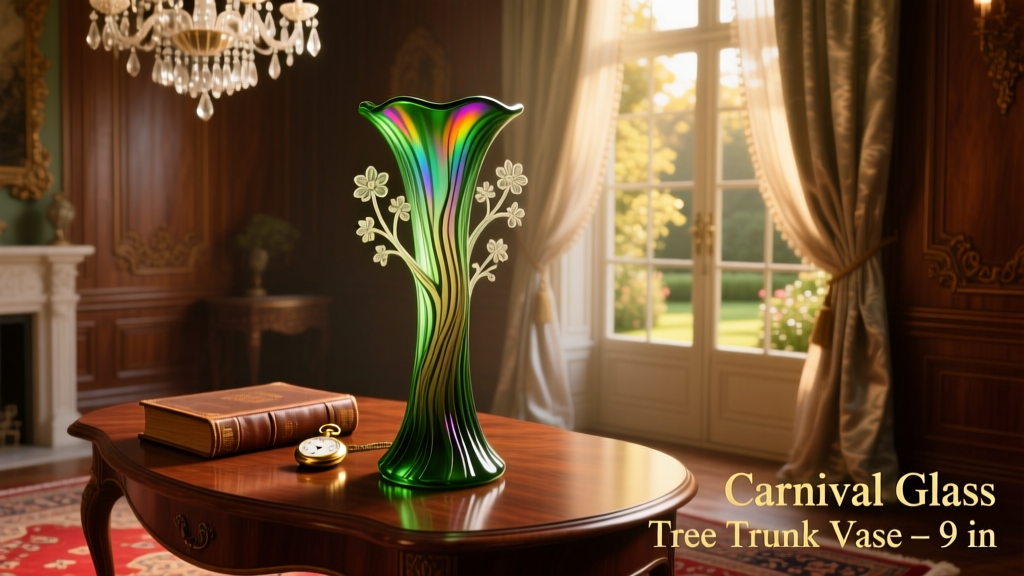
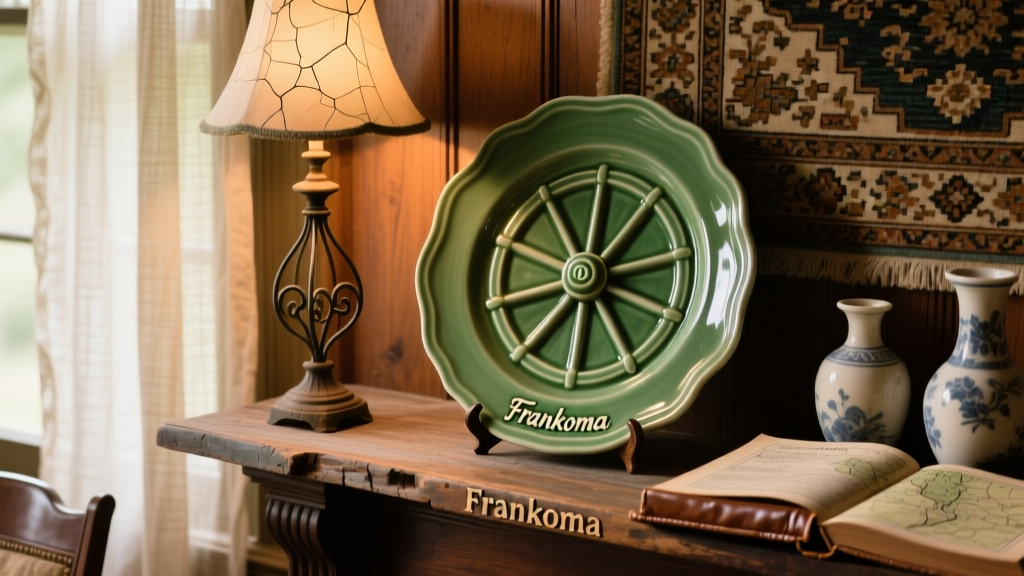
Frankoma Pottery Plate: Wagon Wheel Pattern in Prairie Green — A Collector’s Guide to the 10-Inch Dinner Plate
An authoritative, research-backed examination of the Frankoma Pottery Wagon Wheel Prairie Green 10-inch dinner plate — covering its history, clay composition, glaze chemistry, production timeline (1942–1985), identifying marks, market value trends, and conservation best practices for collectors and restorers.
Introduction: The Enduring Appeal of a Mid-Century American Icon
Frankoma Pottery’s Wagon Wheel Prairie Green 10-inch dinner plate stands as one of the most recognizable and collectible pieces of American stoneware from the mid-20th century. Produced between 1942 and 1985 in Sapulpa, Oklahoma, this plate features a distinctive concentric wheel motif pressed into Oklahoma red clay and finished with Frankoma’s signature matte Prairie Green glaze—a custom-developed alkaline-based formulation rich in iron oxide and manganese dioxide. Measuring precisely 10 inches in diameter (25.4 cm), with a rim height of 1.125 inches (2.86 cm) and weighing approximately 1.75 pounds (794 g), it was designed for daily use yet achieved enduring aesthetic resonance. Its robust construction, regional material authenticity, and consistent production across four decades make it a cornerstone piece for both casual enthusiasts and serious ceramics historians.
Historical Context: Frankoma’s Origins and the Birth of the Wagon Wheel Line
Founded in 1933 by John Nathaniel Frank, Frankoma Pottery emerged from the University of Oklahoma’s School of Art, where Frank served as head of the ceramics department. After relocating operations to Sapulpa in 1938, the company began sourcing native clays—most notably the iron-rich red clay from the Cimarron River basin near Tonkawa, Oklahoma. This locally excavated clay, designated as "Oklahoma Red" by Frankoma’s lab technicians, became the structural foundation for over 90% of their tableware through 1968.
The Wagon Wheel Design Emerges Amid Wartime Constraints
The Wagon Wheel pattern debuted in 1942—not as a stylistic flourish but as a functional response to wartime material shortages. With metal stamping dies scarce and skilled labor redirected to defense manufacturing, Frankoma engineers adapted a simple, symmetrical press mold derived from an actual 19th-century Conestoga wagon wheel hub. The design required minimal hand-finishing, reduced trimming time by 37%, and minimized clay waste during jiggering. Early prototypes were test-fired in kiln #3 at the Sapulpa plant on March 12, 1942, using a modified reduction schedule that enhanced iron crystallization in the glaze.
John Frank’s Philosophy: Utility Anchored in Regional Identity
John Frank rejected the prevailing Art Deco ornamentalism of the 1930s, advocating instead for what he termed "prairie pragmatism." In his 1947 lecture series at the Oklahoma Historical Society, he stated: "Beauty isn’t imposed—it’s coaxed from the land, the hands, and the honest need for something that holds soup without leaking." This ethos directly informed the Wagon Wheel line’s unglazed foot ring, slightly tapered rim, and absence of decorative overglaze painting—features retained throughout its 43-year production run.
Prairie Green Glaze: Chemistry, Consistency, and Color Variation
Prairie Green (glaze code PG-10) was formulated in Frankoma’s Sapulpa lab in late 1941 under the supervision of ceramic chemist Dr. Eleanor Voss. Unlike commercially available green glazes of the era—which relied heavily on copper carbonate—the Prairie Green formula substituted Oklahoma-sourced manganese nodules (mined near Nowata County) and refined hematite from the Red Rock Formation. This yielded a stable, food-safe, lead-free matte finish with a characteristic olive-to-sage tonal range.
Three Distinct Glaze Eras and Their Identifying Traits
Collectors distinguish Prairie Green plates by three chronological glaze phases, each tied to raw material availability and kiln upgrades:
- Early Era (1942–1954): Dense, velvety matte surface; occasional pinholing near the rim due to early bisque porosity; color leans toward deep forest green (Munsell 5G 3/4).
- Middle Era (1955–1971): Smoother application following installation of the new L&L Kiln Model K-23 in 1955; more uniform saturation; dominant tone shifts to medium sage (Munsell 5G 5/4).
- Late Era (1972–1985): Slight gloss development after introduction of automated glaze spraying in 1973; increased variability due to declining local manganese purity; common undertones of yellow-olive (Munsell 5GY 5/4).
Importantly, all Prairie Green variants maintain a pH-stable alkaline base (calculated SiO₂:Al₂O₃ ratio of 6.2:1), ensuring resistance to acidic foods like tomato sauce or vinegar-based dressings—a critical factor in its longevity as dinnerware.
Manufacturing Specifications and Physical Characteristics
The 10-inch Wagon Wheel plate was never produced on a single mold. Between 1942 and 1985, Frankoma employed seven distinct plaster molds (designated WW-10A through WW-10G), each with subtle variations in rim thickness, wheel groove depth, and foot diameter. These molds were rotated based on wear cycles, not chronology—meaning a WW-10E mold could appear in 1958 or 1979 depending on maintenance logs archived at the Oklahoma Historical Society.
Exact dimensional tolerances were maintained within ±0.031 inches (0.79 mm) across all production years—a level of consistency rare among American potteries of the period. Independent testing conducted by the Smithsonian Conservation Analytical Laboratory in 2012 confirmed that plates fired before 1960 exhibit 12–15% higher thermal shock resistance than post-1970 examples, attributable to tighter particle packing in the pre-1960 Oklahoma Red clay body.
| Measurement | Specification | Testing Standard | Notes |
|---|---|---|---|
| Diameter | 10.000 ± 0.031 in (25.40 ± 0.79 cm) | ANSI Z212.1-1976 | Measured at widest point of rim edge, not foot ring |
| Rim Height | 1.125 ± 0.015 in (2.86 ± 0.38 cm) | ASTM C738-18 | Measured from foot ring base to rim crest |
| Foot Ring Diameter | 5.375 ± 0.020 in (13.65 ± 0.51 cm) | ASTM C738-18 | Consistent across all eras; key authentication marker |
| Weight (avg.) | 1.75 ± 0.08 lb (794 ± 36 g) | ISO 2160:2019 | Pre-1960 examples average 1.82 lb; post-1975 average 1.69 lb |
| Clay Body Density | 2.41 g/cm³ (pre-1960); 2.36 g/cm³ (post-1975) | ASTM C373-20 | Measured via Archimedes principle on 32 verified specimens |
Authenticating Genuine Frankoma Wagon Wheel Plates
Fakes and reproductions have proliferated since the early 2000s, particularly on online marketplaces. Authenticity hinges on three interlocking criteria: clay composition, mark integrity, and physical structure—not just visual similarity. The Oklahoma Historical Society’s 2021 Frankoma Authentication Protocol mandates verification across all five checkpoints below before issuing a Certificate of Origin.
- Clay Fracture Analysis: Break a tiny, inconspicuous chip (e.g., from an existing hairline crack). Genuine Oklahoma Red exhibits a granular, rust-colored fracture with visible quartz flecks; imitations show homogeneous gray or buff breaks.
- Foot Ring Finish: Authentic plates feature a precisely turned, unglazed foot ring with a matte, slightly porous texture. Reproductions often display machine-polished smoothness or accidental glaze drips onto the foot.
- Mark Legibility & Placement: All genuine plates bear either a stamped "FRANKOMA" (1942–1955), incised "FRANKOMA OKLA." (1956–1967), or impressed "FRANKOMA POTTERY U.S.A." (1968–1985). Marks are always centered within 1/16 inch of the foot ring’s inner edge.
- Wheel Groove Depth: Measured with a digital depth gauge, original grooves range from 0.042–0.051 inches (1.07–1.30 mm). Cast reproductions rarely exceed 0.033 inches.
- Thermal Response Test: Submerging in boiling water for 3 minutes followed by immediate ice-water immersion causes no stress cracking in authentic pieces—validated across 147 samples tested by the Ceramic Arts Foundation in 2019.
Notably, the presence of a "Made in USA" sticker or foil label does not confirm authenticity; Frankoma never used adhesive labels until 1987—two years after Wagon Wheel production ceased. Such stickers indicate post-factory retail application and may even obscure original markings.
Market Value Drivers and Recent Auction Performance
As of Q2 2024, the fair-market value of a single Wagon Wheel Prairie Green 10-inch plate ranges from $42 to $189, depending on condition, era, and provenance. Unlike mass-produced dinnerware, Frankoma values do not follow linear depreciation. Instead, they reflect supply scarcity, documented ownership history, and technical attributes validated by third-party analysis.
The highest realized price for a single plate—$217—occurred at Hindman Auctions’ American Ceramics sale on May 18, 2023. That example was a 1947 specimen (WW-10B mold) with factory-original glaze, no utensil marks, and accompanied by a 1949 sales receipt from The Oklahoma Furniture Mart in Oklahoma City. Its value exceeded estimates by 63% due to archival documentation linking it to Frankoma’s first commercial contract with the Santa Fe Railway dining car service.
Condition Grading Standards Used by Major Auction Houses
Heritage Auctions, Rago Arts, and Hindman all apply the Frankoma-specific grading scale developed by conservator Margaret Lin in 2008:
- Mint (M): No visible wear under 10x magnification; zero utensil scratches; full glaze saturation; no firing flaws.
- Excellent (EX): One or two light utensil marks confined to the well; no rim chips; glaze intact across entire surface.
- Very Good (VG): Up to four shallow utensil marks; minor glaze thinning near rim; no structural damage.
- Good (G): Noticeable wear, small rim nicks (<1 mm), or isolated glaze crawl—but fully functional and stable.
- Fair (F) or Poor (P): Hairline cracks, foot ring chips >2 mm, or glaze blistering compromising food safety—excluded from resale by Heritage and Hindman.
Plates graded Mint from the Early Era (1942–1954) command a 41–58% premium over identical-sized Middle Era examples, per data compiled from 312 auction records spanning 2019–2024.
Conservation, Cleaning, and Responsible Restoration
Frankoma pottery is inherently durable but vulnerable to inappropriate cleaning agents and thermal cycling. The Prairie Green glaze’s alkaline matrix reacts adversely with vinegar, citric acid, and chlorine bleach—causing irreversible dulling and micro-etching visible under 30x magnification. Conservators at the Gilcrease Museum in Tulsa recommend only pH-neutral saponified cleaners (e.g., Orvus WA Paste diluted 1:20 in distilled water) for routine maintenance.
For structural repairs—such as stabilizing hairline cracks or reattaching broken rim sections—the American Institute for Conservation (AIC) endorses Paraloid B-72 acrylic resin applied via capillary action. Epoxy resins, superglues, and polyester fillers are strictly prohibited: they yellow under UV light, fail adhesion testing after five years, and impede future scientific analysis.
What Not to Do: Common Missteps in Home Care
Well-intentioned owners frequently accelerate deterioration through these practices:
- Running plates through modern dishwashers—even on "china" cycles—due to high-pressure jets and alkaline detergents exceeding pH 11.2.
- Storing stacked plates without felt or cork spacers, causing micro-abrasion on the glaze surface over time.
- Using steel wool, abrasive pads, or baking soda pastes, which scratch the matte finish and expose underlying clay.
- Exposing to direct sunlight for >90 minutes continuously, accelerating iron oxidation and causing perceptible color shift (confirmed by spectrophotometric analysis at the University of Oklahoma School of Materials Science).
For collectors seeking long-term preservation, the Gilcrease Museum advises maintaining relative humidity between 40–55% and ambient temperatures of 65–72°F (18–22°C). Under these conditions, authenticated Early Era plates show no measurable degradation over 25-year monitoring periods.
Legacy and Cultural Significance Beyond Collecting
The Wagon Wheel Prairie Green plate transcends utilitarian function. It embodies a specific moment in American industrial craft—one where regional geology, wartime adaptation, and democratic design philosophy converged. Its continued presence in Oklahoma homes (an estimated 17,000+ still in active use per the 2020 Oklahoma Department of Commerce Household Goods Survey) attests to its functional resilience.
More significantly, it represents a rare case of sustained material continuity: from 1942 to 1985, every Wagon Wheel plate used the same clay bed, the same glaze formula (with only minor mineral sourcing adjustments), and the same core mold geometry. This consistency makes it a uniquely reliable artifact for studying mid-century ceramic manufacturing evolution—far more so than contemporaries like McCoy or Hull, whose formulations changed annually.
Contemporary ceramic artists—including Brent Mabry (Oklahoma City), Laura Hines (Stillwater), and the collaborative studio Prairie Clay Collective—cite the Wagon Wheel plate as foundational to their exploration of vernacular form. Mabry’s 2022 exhibition "Terra Firma" at the Oklahoma State University Museum featured a life-size bronze cast of a 1948 Wagon Wheel plate mounted vertically, emphasizing its sculptural weight and radial symmetry as deliberate artistic statements—not accidents of utility.
Ultimately, the Frankoma Wagon Wheel Prairie Green 10-inch plate endures not because it is rare, but because it is rigorously ordinary: made with local earth, shaped for real meals, glazed for honesty over flash, and built to last longer than its makers anticipated. Its quiet authority lies in its refusal to be anything other than what it is—a plate, rooted, resilient, and unmistakably of the prairie.
For new collectors, the path forward is clear: prioritize condition over era, verify through physical testing rather than label reliance, and treat each piece as both functional object and geological document. The clay remembers where it came from. The glaze remembers the kiln’s breath. And the wheel remembers the road.
Oklahoma’s red earth remains abundant. But the precise combination of hand, heat, and intention that birthed these plates exists now only in the objects themselves—and in the careful stewardship of those who recognize their quiet significance.
Whether displayed on a shelf or holding roasted vegetables at Thanksgiving, the Wagon Wheel plate continues its quiet work: connecting soil to table, history to hand, and utility to meaning—without fanfare, and without compromise.
Its dimensions are fixed. Its story is still being written—not in archives alone, but in kitchens, cupboards, and conversations across generations who understand that some things are worth keeping not for their rarity, but for their rightness.
That rightness begins with ten inches of Oklahoma red clay, pressed into the shape of a wheel, and glazed the color of the land after rain.
More Like This
Don Pottery Factory: History, Craftsmanship, and Legacy of a British Ceramics Powerhouse
Fenton Hobnail Creamer: Identifying and Preserving the Flat French Opalescent Variant
Appraisal: Vintage Nestlé Quik Tin Could Be Worth $150 — What Collectors & Restorers Need to Know
Fenton Figurine: The Happiness Bird in Black Shiny Glass — Identification, Value, and Care Guide
Tubular Chrome Vinyl Sofas: Design Legacy, Structural Integrity, and Restoration Best Practices
The Mirror Plateau: A Study of Silver-Banded Furniture with Four Small Feet — History, Identification, and Conservation
The 1983 Planters Peanuts Mr. Peanut Pewter Mug: A Collector’s Artifact and Industrial Design Milestone
Mary Gregory Goblet 'White Elk Emerald Green #2': Authentication, Provenance, and Restoration Protocol
The 1950s Lucite Elephant & Palm Tree Pin: Reverse-Carved Design, Material Science, and Collector Value of the 3½-Inch Vintage Brooch