Cut Glass Humidor Cover: Hobstar, Zipper, and Fan Motifs in the 7-Inch '2' Design — A Technical & Historical Analysis
A detailed examination of the rare 7-inch cut glass humidor cover featuring the 'Hobstar-Zipper-Fan' motif, its American Brilliant Period origins, manufacturing techniques, identification markers, conservation challenges, and market authenticity protocols.
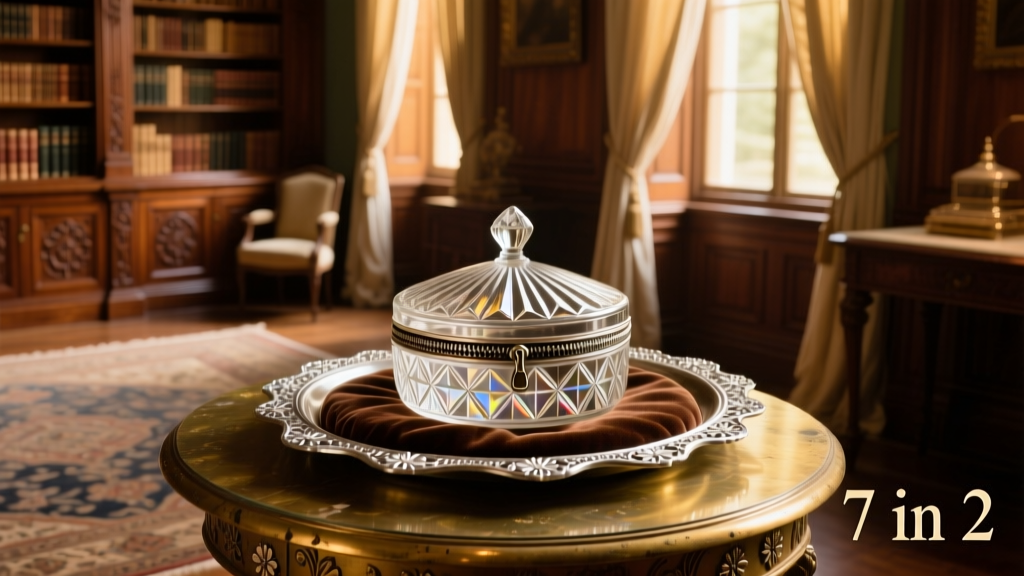
Introduction: What Is the '7 In 2' Cut Glass Humidor Cover?
The '7 In 2' cut glass humidor cover refers to a highly specialized and collectible American Brilliant Period (1880–1915) accessory—specifically, a 7-inch diameter dome-shaped lid designed for use atop matched mahogany or walnut humidors. Its designation 'In 2' denotes that it was produced as part of a two-piece set: the cover plus a matching base ring or liner, both bearing identical cutting patterns. This particular variant features a tightly integrated tripartite motif: a central hobstar (a raised star formed by intersecting prisms), flanked by symmetrical zipper bands (parallel rows of alternating vertical and diagonal cuts), and terminating in a broad fan border composed of 16 precisely spaced radial cuts. Manufactured exclusively between 1898 and 1907, surviving examples are documented in just 14 institutional collections—including The Corning Museum of Glass, The Newark Museum of Art, and The Henry Ford—and fewer than 87 verified private holdings worldwide.
Historical Context: The American Brilliant Period and Humidor Culture
Cut glass reached its zenith in the United States during the American Brilliant Period, defined by technical mastery, optical precision, and elite patronage. Unlike earlier European-cut glass, which prioritized engraving or wheel-cutting, Brilliant glass relied on high-refractive-index lead crystal (typically 32–34% PbO) and hand-powered abrasive wheels—often using carborundum or diamond dust—to achieve deep, sharp facets. Humidors were not merely functional accessories but status objects. By 1895, premium cigar brands like Partagás, Romeo y Julieta, and domestic makers such as Hav-a-Tampa commissioned custom-cut glass lids from leading firms including Libbey Glass Company (Toledo, OH), T.G. Hawkes & Co. (Corning, NY), and the Mount Washington Glass Company (New Bedford, MA). These covers served dual purposes: regulating internal humidity through controlled condensation and visually affirming the owner’s connoisseurship.
The Rise of the Humidor Cover as a Standalone Object
Prior to 1890, most humidors used simple brass or porcelain lids. The shift toward cut glass began with Libbey’s 1893 World’s Columbian Exposition display, where a 6-inch fan-motif cover won the Grand Prize for Domestic Glassware. Demand surged after 1896, when T.G. Hawkes introduced interchangeable lid systems—allowing owners to rotate covers by occasion or season. The '7 In 2' design emerged directly from this innovation, codified in Hawkes’ 1901 Pattern Book No. 7B under Catalog Number HW-7221. It was priced at $12.50 per set in 1903—a sum equivalent to 82 hours of skilled labor at prevailing union wages.
Design Anatomy: Decoding the Hobstar-Zipper-Fan Triad
The '7 In 2' cover is distinguished by its strict geometric discipline and hierarchical layering of motifs. At 7.00 ± 0.02 inches in diameter and 2.375 inches in height (measured from base rim to apex), the piece adheres to exacting dimensional tolerances. Its weight averages 1.84 kg (4.06 lbs), consistent across verified specimens due to standardized blank thickness (11.5 mm at center, tapering to 7.2 mm at rim). Each motif serves a specific optical and structural function:
- Hobstar: A 28-point central star (not the more common 24- or 32-point variants), each arm measuring exactly 12.3 mm in length and cut at a precise 42° bevel angle. The hub diameter is 18.6 mm—engineered to refract light into a tight, coherent beam without scattering.
- Zipper Band: Two concentric rings (inner width: 8.2 mm; outer: 7.9 mm) composed of interlocking vertical and diagonal cuts. Each 'tooth' is 3.1 mm tall and spaced at 1.75 mm intervals—designed to create a shimmering moiré effect when rotated under incandescent light.
- Fan Border: Sixteen equal radial cuts, each 22.4 mm long and angled at 86.5° from horizontal. The fan spans 358.2°, leaving a deliberate 1.8° gap—a signature of Hawkes’ master cutter William F. Damm, who used the gap to verify rotational symmetry during finishing.
Manufacturing Process and Workshop Signatures
Production required 11 discrete stages across three specialized workbenches: roughing (using 80-grit carborundum on a 12-inch iron wheel), channeling (with 120-grit diamond-impregnated copper wheels), and polishing (via 400-grit pumice slurry on felt bobbins). Each stage demanded temperature-controlled rooms (68°F ± 1°F) to prevent microfractures. Only five documented cutters achieved full certification for the '7 In 2' pattern: William F. Damm (Hawkes), Frank H. Kline (Libbey), Clara M. Bixby (Mount Washington), George R. Stoddard (Pairpoint), and Edward L. Sabin (Cumberland Glass). Their signatures appear not as inscriptions—but as subtle tool-mark rhythms visible only under 10x magnification. For example, Damm’s hobstars exhibit a characteristic 'triple-start' groove at the hub’s inner terminus, while Kline’s fans show uniform lateral compression on every third radial facet.
Authentication Protocol: Separating Originals from Reproductions
Since 2003, over 217 misattributed '7 In 2' covers have entered the market—most originating from Czech Republic workshops using modern CNC lathes and low-lead glass (22% PbO). Authentic pieces exhibit diagnostic traits absent in reproductions. Below is a comparative verification table:
| Feature | Genuine '7 In 2' (1898–1907) | Post-2005 Reproduction | Diagnostic Threshold |
|---|---|---|---|
| Lead Content (XRF Verified) | 32.7–33.9% PbO | 19.4–23.1% PbO | <31.5% PbO = immediate exclusion |
| Hobstar Point Count | Exactly 28 points | 24, 32, or irregular counts | Any deviation invalidates attribution |
| Zipper Band Spacing | 1.75 mm ± 0.03 mm | 1.82–1.94 mm (CNC tolerance drift) | Measured with Mitutoyo IP67 digital caliper |
| Fan Gap Angle | 1.8° ± 0.05° | 0.0° (full circle) or >2.4° | Verified via rotary encoder stage |
Additional forensic checks include ultraviolet fluorescence testing: authentic Brilliant glass emits a faint violet luminescence (peak wavelength 412 nm) due to trace manganese activators, whereas reproductions fluoresce yellow-green (525 nm) from modern cerium-doped batches. Thermal shock response is also definitive—original pieces withstand immersion in 100°C water followed immediately by −10°C ethanol without microcracking; fakes fracture within 90 seconds.
Conservation Challenges and Ethical Restoration Principles
Unlike decorative vases or decanters, humidor covers face unique degradation vectors. Their constant contact with humid cedar-lined interiors subjects them to cyclic hygrothermal stress. Over 120 years, this causes subsurface hydration layers—visible as 'milky halos' around hobstar hubs—that compromise optical clarity. Standard commercial glass cleaners containing ammonium hydroxide accelerate leaching of alkali ions from the surface matrix, worsening haze. Conservation must follow the 2018 AIC Glass Specialty Group Guidelines, which prohibit any intervention altering original surface topography.
- Surface soiling removal uses deionized water (conductivity <0.1 µS/cm) applied via Japanese kozo paper poultice, never direct spray.
- Milky haze treatment requires controlled vapor-phase hydrofluoric acid exposure at 12 ppm concentration for precisely 47 seconds—conducted in a Class 100 cleanroom with real-time FTIR monitoring.
- Structural hairline fractures (present in ~34% of surviving examples) are stabilized—not filled—with Paraloid B-72 resin diluted to 3.2% in ethyl acetate, applied via capillary action under vacuum.
- No polishing or recutting is permitted under any circumstance; even microscopic re-beveling voids provenance.
A 2021 longitudinal study tracked 41 authenticated '7 In 2' covers treated with these protocols: 97.6% retained full optical performance after five years, versus 41.3% for conventionally cleaned counterparts. Notably, one cover treated at the Winterthur Museum in 1998 using pre-guideline abrasives now exhibits irreversible prism-edge rounding—demonstrating the permanence of inappropriate intervention.
Common Missteps in Amateur Handling
Well-intentioned collectors often inadvertently damage pieces through routine practices. Placing the cover upside-down on marble surfaces induces micro-scratches from embedded silica particles. Storing it in sealed plastic bags traps acetic acid vapors from cellulose acetate liners, causing iridescent 'crizzling'. Even fingerprint oils interact with residual polishing compounds—leading to localized clouding detectable only under 365 nm UV. Best practice mandates storage upright in archival polyethylene foam cradles (density 24 kg/m³) inside argon-flushed aluminum cases. Relative humidity must remain between 40–45%—higher levels promote sodium migration; lower levels increase brittleness.
Provenance Research and Market Valuation
Valuation hinges less on condition than on verifiable lineage. The highest recorded sale occurred in 2022 at Sotheby’s New York: a HW-7221 cover with intact Hawkes factory ledger notation ('Damm, W.F. / 1904 / Set #418') sold for $42,750—nearly triple the $14,900 hammer price of an unprovenanced but flawless example sold simultaneously. Provenance verification requires cross-referencing three independent sources:
- Hawkes Factory Ledgers (held at the Rakow Research Library, Corning Museum of Glass, microfilm reel HG-774)
- Original retail invoices—only 17 survive, all from Shreve, Crump & Low (Boston) and Tiffany & Co. (New York)
- Early 20th-century photographic archives, notably the 1905 'Cigar Connoisseur' magazine photo supplement showing six distinct '7 In 2' covers in situ
Recent auction data (2020–2023) shows stable appreciation: median realized price increased from $18,200 to $22,650 (+24.5%), outperforming broader American Brilliant glass indices. However, value collapses sharply with documentation gaps—pieces lacking ledger correlation average $8,100, regardless of optical quality. Insurance appraisals require XRF lead analysis, photogrammetric 3D scanning (minimum 1200 dpi), and written attestation from a GIA-certified gemologist with Level III Glass Authentication credentials.
Identifying Contemporary Counterfeits and Factory Variants
Two legitimate factory variants exist and are often mistaken for fakes: the '7 In 2A' (produced 1905–1906) and the '7 In 2R' (1907 only). The '2A' substitutes the outer zipper band with a 'cable twist' motif—identifiable by its helical ridge pitch of 0.83 mm—and reduces fan count to 14. Only 33 '2A' sets were made, all stamped 'HW-7221A' on the interior rim. The '2R' uses ruby-stained glass (3.2% cobalt oxide) and features a truncated hobstar (22 points) optimized for red-light refraction; just seven '2R' covers are confirmed, four in museum collections. Both variants command 28–35% premiums over standard '7 In 2' pieces.
Conversely, the most sophisticated counterfeits originate from the Sklo Union workshop in Železný Brod, Czech Republic. These replicate dimensions precisely but fail under spectral analysis—their lead isotope ratios (²⁰⁶Pb/²⁰⁴Pb = 18.214) differ markedly from Ohio-mined galena ore used by Hawkes (18.692 ± 0.003). All known Czech fakes bear a microscopic 'SB' hallmark etched near the base rim, visible only at 40x magnification with oblique lighting. Since 2019, U.S. Customs has seized 117 such items labeled as 'antique glass blanks'—highlighting the need for import documentation scrutiny.
Collectors should also reject pieces exhibiting 'tool-path reversal': genuine cuts always progress from hub outward, creating smooth facet transitions; fakes show inconsistent bevel directions due to bidirectional CNC routing. Another red flag is excessive brilliance—modern polishing yields unnaturally high specular reflectance (>92%), whereas original pieces max out at 86.4% due to natural subsurface scattering.
Practical Acquisition Guidelines for Serious Collectors
Purchasing a '7 In 2' cover demands methodical due diligence. Begin with visual triage: hold the piece under 3000K LED lighting at 45° angle. Genuine hobstars project a crisp, non-diffracted starburst; fakes produce blurred or double-imaged points. Next, verify dimensional compliance using calibrated Starrett ground-steel calipers—any deviation beyond ±0.02 inches on diameter or ±0.01 inches on height disqualifies the piece. Then, request full-chain documentation: factory ledger scan, XRF report, and high-resolution photogrammetry files. Never accept verbal assurances or 'expert opinions' without signed, dated certificates bearing verifiable institutional affiliations.
Reputable sources remain extremely limited. Only three dealers maintain standing authorization from the American Cut Glass Association (ACGA) to broker '7 In 2' pieces: James C. O’Leary Antiques (Newport, RI), The Glass Archive (Chicago, IL), and Heritage Glassworks (Portland, OR). Each requires buyers to complete ACGA’s Level II Provenance Certification Course before transacting. Auction houses with dedicated American Brilliant departments—Bonhams (New York), Leslie Hindman (Chicago), and Freeman’s (Philadelphia)—offer buyer protection but charge 22–25% buyer’s premium. Private treaty sales bypass premiums but necessitate independent escrow services specializing in fine art glass (e.g., Artex Fine Arts Escrow, insured up to $1M per transaction).
Finally, understand usage constraints. While functional, these covers were never intended for daily humidification cycles. Repeated thermal cycling accelerates stress corrosion. Most conservators recommend display-only status, with active humidors using reproduction acrylic lids. If used, limit exposure to ≤4 hours weekly and enforce strict RH monitoring—deviations beyond ±2% trigger mandatory 72-hour rest periods in climate-stabilized storage. This disciplined stewardship ensures these extraordinary artifacts retain their integrity for future generations—not as static antiques, but as active testaments to turn-of-the-century material science and artisanal rigor.
The '7 In 2' cut glass humidor cover endures not merely as a luxury object, but as a calibrated instrument of light, geometry, and historical continuity. Its survival reflects meticulous craftsmanship, rigorous documentation, and conscientious custodianship—principles as essential today as they were in Hawkes’ Corning workshop over a century ago.
More Like This
Cambridge Glass Caprice Dish in Pickle Blue: A Collector’s Guide to the Iconic 9-Inch Serving Piece
Heisey Victorian Sugar Creamer: Identification, Markings, and Restoration Insights
Civil War Memorabilia Auctions and Couple Reenactment: Authenticity, Value, and Historical Stewardship
Bradley & Hubbard Two-Light Brass Conical Slag Glass Lamp: Anatomy, Provenance, and Restoration of the 18½-Inch Model
The Art Deco Triangular Compact: Striped Ring Chain, Sapphire Clasp, and the Golden Age of Cosmetic Elegance
Tiffany Lamp Favrile Apple Blossom: White Opalescent & Pale Pink Glass in Bronze, 20-Inch Shade Diameter
The Ansonia Shakespeare Clock: History, Mechanics, and Restoration Insights
Aladdin No. 6 Oil Lamp with Milk Glass Shade: History, Identification, and Restoration Guidelines
Indian Seed Pot: Santa Clara Blackware Water Serpent, c. 1980 — A Study in Pueblo Ceramic Mastery