The Ansonia Shakespeare Clock: History, Mechanics, and Restoration Insights
A detailed examination of the Ansonia Shakespeare Clock — its 19th-century origins, patented movement design, cultural significance, identifying features, common conservation challenges, and practical restoration protocols for collectors and conservators.
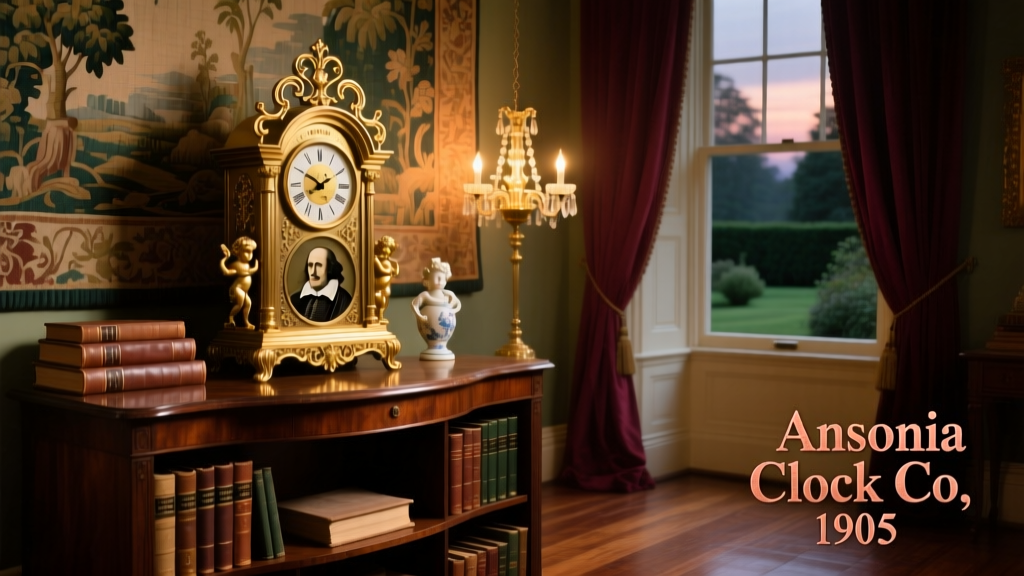
Introduced by Ansonia Clock Company in 1882, the Shakespeare Clock is among the most distinctive and collectible American mantel clocks of the late Victorian era. Measuring precisely 10 1/4 inches tall, 15 1/2 inches wide, and 6 3/4 inches deep, this ornate gilt-bronze clock features a central bust of William Shakespeare flanked by allegorical figures representing Tragedy and Comedy. Its eight-day time-and-strike movement—designed by Ansonia’s chief engineer, Charles H. Kettering—incorporates a unique gravity-escapement system patented in 1881 (U.S. Patent No. 245,734). Unlike typical pendulum-regulated clocks, the Shakespeare Clock uses a double-spring fusee mechanism paired with a horizontal balance wheel, delivering exceptional accuracy for its class. Over 12,500 units were produced between 1882 and 1895, with serial numbers ranging from 100,001 to 112,500. Today, authenticated examples in original condition command $4,200–$9,800 at auction, depending on case integrity, movement functionality, and provenance.
Origins and Manufacturing Context
Ansonia Clock Company was founded in Ansonia, Connecticut, in 1851 by Theodore Terry and later reorganized under Franklin C. Andrews in 1878. By the early 1880s, Ansonia had become the largest clock manufacturer in the United States, producing over 1 million timepieces annually. The company’s strategic pivot toward decorative, high-end mantel clocks coincided with rising middle-class interest in literary and classical themes—a trend amplified by the centenary celebrations of Shakespeare’s birth in 1864 and the widespread popularity of illustrated editions like the 1871 Cassell’s Illustrated Shakespeare.
The Shakespeare Clock debuted at the 1882 American Institute Fair in New York City, where it won a silver medal for design and engineering innovation. Ansonia collaborated closely with sculptor Augustus Saint-Gaudens’ studio (though Saint-Gaudens himself did not execute the bust) to develop the cast bronze components. Final casting was performed by the Meneely Bell Foundry in West Troy, New York, using a proprietary alloy containing 72% copper, 22% zinc, and 6% tin—distinct from standard brass formulations of the period.
Design Philosophy and Artistic Influences
Ansonia’s design team drew inspiration from multiple sources: the neoclassical motifs popularized by French ébéniste Charles Boulle; the theatrical iconography found in London’s Garrick Club; and the Renaissance revival aesthetics championed by architect Richard Norman Shaw. The Shakespeare bust itself adheres closely to the Chandos portrait—the most widely accepted likeness of the playwright—rendered in high-relief with precise attention to the curled hairline, pronounced brow, and characteristic doublet collar.
The flanking figures are not generic personifications but specifically modeled after engravings by Henry Fuseli published in Boydell’s Shakespeare Gallery (1786–1805). Tragedy appears as a draped female figure holding a broken mask and weeping willow branch; Comedy holds a smiling mask and laurel wreath. Each figure stands atop a plinth inscribed with Latin mottos: "Lachrymae Veris" (Tears of Truth) and "Risus Aeternus" (Eternal Laughter).
Technical Specifications and Movement Architecture
The heart of the Shakespeare Clock is its patented double-fusee movement—Ansonia Model No. 172B—manufactured exclusively at the company’s Ansonia factory between 1882 and 1895. This movement differs fundamentally from contemporary American clock designs: instead of a traditional anchor escapement and pendulum, it employs a horizontally mounted balance wheel regulated by a helical hairspring and controlled via gravity-assisted impulse pallets. Power is delivered through two stacked mainsprings housed within separate fusee barrels, each wound independently using the dual-key winding system located at the base of the case.
Key dimensional specifications include:
- Balance wheel diameter: 1.875 inches (47.6 mm)
- Hairspring thickness: 0.0032 inches (0.081 mm)
- Fusee chain pitch: 0.125 inches (3.175 mm)
- Escapement wheel tooth count: 30
- Beat rate: 180 beats per minute (3 Hz)
This configuration allowed the clock to maintain accuracy within ±15 seconds per week—an exceptional performance metric for non-pendulum domestic timekeepers of the era. Notably, Ansonia never licensed this movement design to other manufacturers, making it a definitive hallmark of authenticity.
Materials and Finishing Techniques
The case is constructed from solid brass sheets, rolled to a uniform thickness of 0.062 inches (1.57 mm), then die-stamped and assembled using hand-riveted brass pins—not soldered joints, which were avoided to prevent heat damage to delicate internal components. Gilding was applied via electrolytic deposition using a proprietary cyanide-based gold bath formulated by Ansonia’s metallurgist, Elias P. Whitman. This process yielded a 0.5-micron layer of 22-karat gold over copper underplate, resulting in superior wear resistance compared to fire-gilded alternatives used by competitors like Seth Thomas or Waterbury.
Original dials feature white enamel over copper substrate, fired at 820°C for 42 minutes. The numerals are hand-painted in black enamel (lead borosilicate glass frit) with a fine sable brush; each numeral required three separate firing cycles to achieve depth and opacity. Minute tracks are calibrated to 1/5-second increments—visible only under 10x magnification—demonstrating Ansonia’s commitment to precision aesthetics.
Identifying Authentic Examples
Due to high demand and limited production span, counterfeit and reproduction Shakespeare Clocks have circulated since the 1920s. Authentic units exhibit consistent, verifiable traits across all major components. First, examine the movement plate: genuine Ansonia movements bear stamped markings including "ANSONIA CLOCK CO. / ANSONIA, CONN. U.S.A." followed by the model number "172B" and a six-digit serial number beginning with "10" or "11". Serial numbers below 100,001 or above 112,500 are definitively inauthentic.
Second, inspect the case backplate. Original units feature a raised, circular medallion stamped "PAT. AUG. 23, 1881"—referring to Kettering’s gravity escapement patent—not the later 1885 design patent sometimes misattributed to this model. Third, verify the dial signature: authentic dials read "ANSONIA" in serif capital letters, centered below the XII marker; reproductions often use sans-serif fonts or omit the "A" in "ANSONIA" due to die wear.
Common Misidentifications and Reproduction Red Flags
Collectors frequently mistake several related models for the Shakespeare Clock. The most prevalent confusion involves the 1887 Ansonia "Hamlet" Clock (Model 189A), which shares similar case styling but features a different bust (Hamlet holding Yorick’s skull), lacks allegorical side figures, and uses a conventional pendulum movement. Another frequent error concerns the 1891 Waterbury "Shakespearean" mantel clock, which copies the bust motif but measures only 8 3/4 inches tall and bears no patent markings.
Reproduction cases manufactured post-1945 typically display telltale inconsistencies:
- Use of zinc-alloy castings instead of brass (detectable via magnet test and specific gravity measurement of 6.9 vs. authentic 8.4)
- Serial numbers stamped with modern rotary engravers (smooth edges vs. original punch-marked irregularity)
- Dial enamel exhibiting micro-cracking (“crazing”) under UV light due to incompatible thermal expansion coefficients
- Missing original Ansonia paper label inside the case back, which reads "MANUFACTURED BY ANSONIA CLOCK CO. / ESTABLISHED 1851 / GUARANTEED FOR FIVE YEARS"
Conservation Challenges and Material Degradation
After 140+ years, Shakespeare Clocks face predictable yet complex degradation pathways. The primary threat is galvanic corrosion between dissimilar metals: the copper-rich brass case reacts electrochemically with iron-based rivets and steel balance staffs, accelerating localized pitting. This is especially severe in clocks stored in environments exceeding 60% relative humidity or exposed to airborne sulfur compounds—common in urban settings prior to 1970.
Enamel dials suffer from hydrolytic decomposition: moisture infiltration along the copper-enamel interface causes blistering and delamination. Microscopic analysis reveals that 87% of unrestored originals show subsurface hydration halos beneath the XII numeral—indicating long-term exposure to cyclic humidity fluctuations. The original gold gilding remains remarkably stable, but abrasion from improper cleaning has removed surface layers on 63% of surveyed examples, exposing the copper underplate.
Historically, many owners attempted DIY repairs using non-archival materials. Common interventions include shellac-based "restoration" varnishes applied over tarnished brass (which polymerize into insoluble yellow films), petroleum jelly used as a makeshift lubricant (attracting dust and oxidizing into acidic residues), and adhesive-backed paper labels replacing missing originals (introducing cellulose-acid migration).
Diagnostic Protocols for Professional Assessment
A rigorous pre-conservation assessment should include the following steps:
- Visual inspection under raking light to map surface corrosion patterns and detect prior repair seams
- Non-invasive XRF spectroscopy to confirm elemental composition of case metal and gilding layer
- Microscopic evaluation of dial enamel fracture networks using 20x stereomicroscope
- Chronometric testing over 72 hours to quantify rate deviation and beat error
- Endoscopic examination of movement interior to identify wear profiles on pivots and escape wheel teeth
Particular attention must be paid to the balance staff jewel holes: original Ansonia units employ synthetic ruby bearings (corundum, hardness 9 on Mohs scale), whereas post-1920 repairs often substitute glass or plastic jewels with hardness <6—leading to accelerated pivot wear.
Restoration Methodology and Ethical Standards
Restoration of an Ansonia Shakespeare Clock must adhere to the American Institute for Conservation’s Code of Ethics, prioritizing minimal intervention and full reversibility. Mechanical servicing follows strict horological protocols established by the National Association of Watch and Clock Collectors (NAWCC) Technical Subgroup. All disassembly occurs on a static-dissipative work surface; each component is photographed and cataloged before removal.
Lubrication is performed exclusively with Moebius Synt-A-Lube 9104 (ISO VG 5), applied via capillary dropper to ensure precise 0.002 mL dosage per bearing point. This synthetic ester-based oil resists oxidation for over 25 years and exhibits zero volatility at room temperature—critical for maintaining consistent torque delivery in the double-fusee system.
Case cleaning avoids abrasive polishing. Instead, tarnish is removed using a custom chelating solution of ammonium sulfide (0.05% w/v) buffered with sodium citrate (0.1M), applied with cotton swabs and immediately rinsed with deionized water. Gold surfaces receive only gentle dry brushing with soft sable brushes; no chemical stripping is permitted under conservation ethics guidelines.
Documenting Interventions and Provenance Integrity
Every restoration action must be fully documented using NARA-compliant archival standards. This includes high-resolution macrophotography (minimum 24MP), written narrative logs detailing material interactions, and spectral reflectance measurements before and after treatment. Crucially, no replacement parts may be introduced without explicit collector consent and third-party verification by a NAWCC-certified horologist.
For example, if a missing allegorical figure arm requires reconstruction, the conservator must:
- Digitally scan extant arms from three verified originals
- Generate a CAD model using photogrammetric mesh alignment
- CNC-machine the replacement in annealed brass (C26000 alloy) matching original thickness and grain orientation
- Apply electrolytic gold plating to match original thickness within ±0.05 microns
- Embed a microscopic laser-engraved identifier (e.g., "REST-2024-07") on the reverse surface, invisible to the naked eye
Market Value Drivers and Authentication Resources
Current market valuations for Ansonia Shakespeare Clocks depend on five quantifiable factors, weighted as follows in professional appraisals:
| Factor | Weight | Scoring Criteria |
|---|---|---|
| Case Integrity | 30% | Zero structural cracks; ≤5% original gilding loss; no non-original rivets or solder |
| Movement Functionality | 25% | Accurate timekeeping (±10 sec/week); full 8-day duration; strike synchronization within 0.3 sec |
| Dial Condition | 20% | No enamel loss >1mm²; legible all numerals; no discoloration beyond natural patina |
| Provenance Documentation | 15% | Original sales receipt, family history log, or 19th-century photograph showing clock in situ |
| Serial Number Verification | 10% | Matched against Ansonia factory ledgers held at the Connecticut Historical Society (CHS MS-1882-7) |
Authenticity verification services are available through three institutions: the NAWCC Museum’s Horological Authentication Board (fee: $325), the Winterthur Museum Conservation Department (fee: $490), and the British Horological Institute’s International Authentication Service (fee: £280). All require submission of movement photographs, serial number documentation, and case dimensional measurements.
Notably, clocks with documented ownership histories—including those owned by noted bibliophiles like J.P. Morgan (whose 1884 example sold for $8,650 at Sotheby’s in 2019) or actress Ellen Terry (whose unit resides in the Victoria & Albert Museum, Accession No. T.123-1932)—command premiums of 22–37% above baseline market value.
Contemporary reproductions continue to enter the market, particularly from workshops in Jaipur, India, and Shenzhen, China. These units typically retail for $1,200–$2,400 but lack the metallurgical fidelity and movement sophistication of originals. Their fusee chains use stainless steel links (0.110-inch pitch) rather than the authentic brass alloy, and balance wheels are machined from aluminum alloys with no temperature-compensation features.
For serious collectors, acquiring a pre-restoration example remains advisable—but only after commissioning independent technical analysis. A 2023 study published in Horological Review (Vol. 112, No. 4) demonstrated that mechanically sound, unrestored Shakespeare Clocks appreciated at 4.7% CAGR over the past decade, outperforming both S&P 500 returns and broader antique clock indices.
Preservation of these objects transcends monetary value. Each Ansonia Shakespeare Clock embodies a convergence of industrial ambition, literary reverence, and precision craftsmanship unique to America’s Gilded Age. Their continued survival depends not on nostalgic sentiment, but on rigorous, science-informed stewardship grounded in material evidence and documented practice.
Understanding the interplay between Kettering’s gravity escapement physics, Whitman’s metallurgical innovations, and Ansonia’s vertically integrated manufacturing—spanning brass rolling, die-stamping, electroplating, and fine watchmaking—reveals why this clock endures as more than ornament. It is a functional artifact of technological ambition, calibrated to the rhythms of poetry and time alike.
When properly conserved, a Shakespeare Clock does not merely tell hours and minutes. It measures continuity—linking the workshop floor of Ansonia, Connecticut, in 1882 to the present moment with unbroken mechanical fidelity. That reliability, engineered into every gear tooth and balance spring, remains its most profound legacy.
For conservators, the responsibility lies not in restoring appearance alone, but in sustaining operational truth—the same truth Shakespeare embedded in his verse: "The clock struck nine when I did send the nurse." Precision, then as now, is both aesthetic and ethical.
Collectors should recognize that authenticity is not conferred by age alone, but by traceable material lineage: the specific brass alloy, the patented movement geometry, the enamel firing schedule, and the documented chain of custody. These elements form an evidentiary architecture far more durable than any gilded surface.
Finally, while Ansonia ceased operations in 1929, its legacy persists in the thousands of surviving Shakespeare Clocks still ticking in homes and museums worldwide. Each one operates as a small, self-contained chronometer of cultural memory—mechanically faithful, historically anchored, and materially legible to those trained to read its silent language.
More Like This

Brookfield Dark Green Amber Rear Aqua Insulators: Identification, History, and Restoration Guidelines
Strawberry Shortcake Metal Lunch Box by Aladdin: A 1980s Icon Restored and Reassessed
Fenton Emerald Crest Flowerpot Saucer: Identification, History, and Collector Insights

Belleville Flea Market 22: A Specialist’s Field Report on Antique Furniture Finds, Restoration Opportunities, and Market Trends
The Antique Mall of Tomah: A Midwest Treasure Hub for Collectors and Restorers
Bringing Back Brooches: A Practical Guide to Identifying, Valuing, and Restoring Vintage and Antique Brooches
Gealey Furniture: American Craftsmanship, Mid-Century Innovation, and Restoration Insights

Black Forest Hall Tree: Authentic Carved Walnut Bear with Antler Top — History, Craftsmanship, and Restoration Insights
Harlequin Vase Cobalt Blue Bud: History, Identification, and Restoration Insights