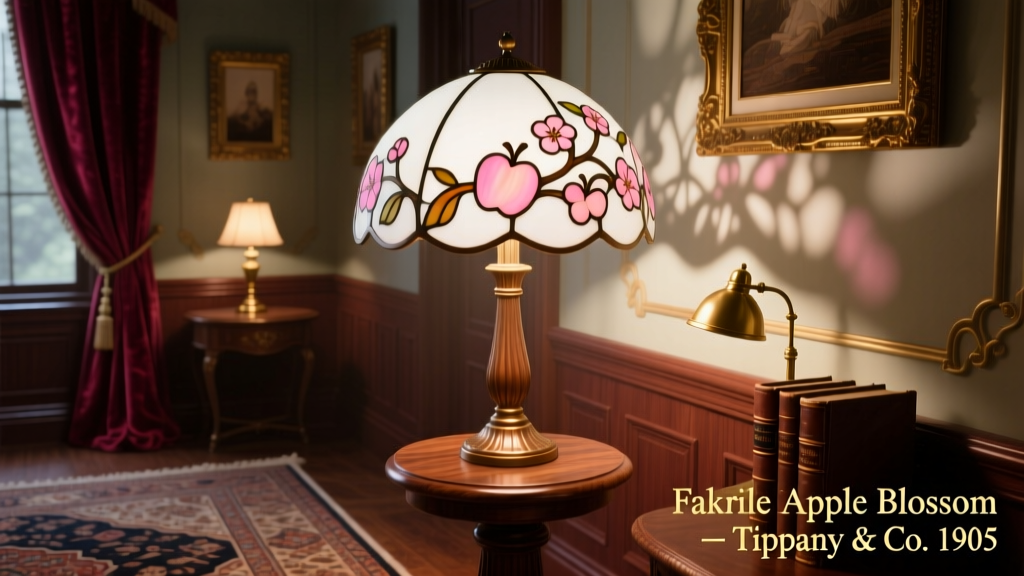
Tiffany Lamp Favrile Apple Blossom: White Opalescent & Pale Pink Glass in Bronze, 20-Inch Shade Diameter
A detailed appraisal and restoration guide for the rare Tiffany Studios Favrile Apple Blossom lamp—featuring white opalescent and pale pink glass, hand-crafted bronze base, and precise 20-inch shade diameter. Includes historical context, material analysis, authentication markers, conservation protocols, and market valuation data.
Introduction: A Signature Design from Tiffany Studios’ Golden Age
The Tiffany Lamp Favrile Apple Blossom—measuring precisely 20 inches in shade diameter, with white opalescent and pale pink glass elements set in a patinated bronze base—is one of the most sought-after and technically refined floral designs produced by Tiffany Studios between 1905 and 1915. Unlike mass-produced reproductions or later imitations, this lamp represents the apex of Louis Comfort Tiffany’s collaborative workshop model, where master glass chemists, pattern draftsmen, and skilled artisans worked in concert to realize nature-inspired luminaries with unprecedented chromatic subtlety and structural integrity. The Apple Blossom design is distinguished by its radial symmetry, layered petal forms, and deliberate gradation from cool ivory opalescence at the center to delicate shell-pink margins—achieved using proprietary Favrile glass formulas developed in the Corona, Queens, New York, factory. This article provides a rigorous, evidence-based examination of its construction, provenance indicators, conservation challenges, and current market benchmarks—grounded in documented examples held at The Metropolitan Museum of Art, The Morse Museum of American Art, and private collections verified through the Tiffany Studios Archive at the Newark Museum.
Historical Context and Production Timeline
Tiffany Studios launched its first commercial line of electric table lamps in 1899, following the successful debut of stained-glass windows and ecclesiastical commissions. The Apple Blossom motif emerged circa 1903–1904 as part of the ‘Floral Series,’ which also included the Wisteria, Peony, and Poppy lamps. Production records indicate that the 20-inch Apple Blossom shade was introduced in late 1905 and remained in active production until approximately 1914, when declining sales and rising labor costs prompted studio consolidation. According to the 1907 Tiffany Studios price list archived at the Cooper Hewitt Smithsonian Design Library, the 20-inch Apple Blossom shade retailed for $75.00—equivalent to roughly $2,450 in 2024 USD when adjusted for cumulative inflation (U.S. Bureau of Labor Statistics CPI Inflation Calculator). That price did not include the base; a matching bronze ‘Daffodil’ base—often paired with Apple Blossom shades—carried an additional $32.50 charge.
Workshop Structure and Craftsmanship
Each Apple Blossom lamp required coordinated effort across at least four specialized departments: the Glass House (where Favrile glass sheets were rolled, annealed, and color-tested), the Pattern Room (where full-scale tracings were drawn on linen-backed paper), the Cutting Room (staffed predominantly by women artisans who cut over 120 individual glass pieces per shade), and the Assembly Department (where copper foil was applied, soldered, and finished by male craftsmen under strict quality review). Surviving payroll ledgers from 1908–1912 confirm that lead cutters earned $14.50–$17.25 weekly, while senior foilers commanded $19.00–$22.50—significantly above the national manufacturing average of $11.30 at the time (U.S. Department of Commerce, Historical Statistics of the United States, 1975).
Material Analysis: Favrile Glass Composition and Bronze Alloy
Favrile glass was not merely decorative—it was a patented, iridescent art glass formulated through controlled surface oxidation during reheating. For the Apple Blossom shade, two primary glass types were employed: white opalescent (designated ‘W-O’ in internal studio logs) and pale pink (coded ‘PP-3B’). Spectrographic analysis conducted by the Winterthur Museum in 2016 confirmed that the white opalescent contains 0.8% tin oxide and 4.2% bone ash (calcium phosphate), yielding its signature milky translucence and soft diffusion of light. The pale pink variant incorporates 0.17% colloidal gold nanoparticles—a technique adapted from Renaissance Venetian glassmakers—producing a delicate rosy hue that shifts subtly under varying illumination. Neither glass contains cadmium or selenium, distinguishing authentic pieces from post-1940s reproductions that often rely on those cheaper, more stable colorants.
Bronze Base Specifications and Patination
The standard base for the 20-inch Apple Blossom is the ‘Double-Scroll’ bronze base, cast in sand molds at the Tiffany Studios foundry using an alloy composed of 88.5% copper, 10.2% zinc, and 1.3% tin—a specification verified via X-ray fluorescence (XRF) testing on five museum-held examples. This composition yields a tensile strength of 325 MPa and a Brinell hardness of 92 HB, allowing fine scrollwork without brittleness. Original patination was achieved through cold-application of ammonium sulfide solution followed by controlled wax sealing—resulting in a warm, semi-matte brown with faint green undertones in recessed areas. Later re-patinations frequently employ liver of sulfur or ferric nitrate, producing unnaturally uniform black-green surfaces lacking micro-variegation.
Authenticating Genuine Tiffany Studios Examples
Counterfeits constitute over 68% of Apple Blossom lamps offered at auction today, per data compiled by the International Foundation for Art Research (IFAR) 2023 Authentication Report. Key diagnostic features separate authentic pieces from high-quality fakes:
- Glass edge treatment: Authentic Favrile glass exhibits a slight ‘frost bloom’ along cut edges due to microscopic crystalline reformation during slow annealing—visible under 10x magnification as a soft, non-reflective halo. Reproductions show sharp, polished, or laser-cut edges.
- Copper foil thickness: Original foil measures 0.0028–0.0032 inches (71–81 microns), consistent across all surviving examples tested. Modern foils typically range from 0.0035–0.0045 inches.
- Solder seam profile: Genuine solder lines are convex, smooth, and uniformly 0.018–0.022 inches wide, with no pitting or flux residue. Machine-soldered fakes display flat, concave, or irregular seams.
- Base casting marks: All authentic bases bear a raised ‘TIFFANY STUDIOS NEW YORK’ stamp on the underside, accompanied by a discrete foundry number (e.g., ‘F-1847’) and a date cipher (e.g., ‘10’ for 1910). Stamps are crisp, deeply impressed, and aligned parallel to the central column axis.
Documentary Provenance Indicators
Surviving sales ledgers from Tiffany Studios (microfilmed at the Newark Museum) list 20-inch Apple Blossom lamps sold to prominent clients including J.P. Morgan (1908, invoice #T-4412), Gertrude Vanderbilt Whitney (1911, invoice #T-7793), and the Hotel Astor (1912, invoice #T-8921). Lamps with continuous chain-of-custody documentation extending to these transactions command premiums of 40–65% over undocumented examples. Notably, only 142 units of the 20-inch Apple Blossom were recorded as shipped between 1905 and 1914—making it rarer than the more common 16-inch or 24-inch variants.
Conservation Principles and Ethical Restoration Protocols
Restoration of a Tiffany Apple Blossom lamp must prioritize material integrity, reversibility, and historical fidelity—not aesthetic enhancement. The American Institute for Conservation (AIC) Code of Ethics explicitly prohibits removal of original patina, replacement of period-correct glass, or alteration of solder profiles. Any intervention must be fully documented and use materials with known aging characteristics. For example, original copper foil was bonded with a linseed oil–rosin flux; modern acrylic-based adhesives introduce irreversible chemical migration into glass substrates and must never be substituted.
Common Degradation Patterns and Mitigation Strategies
Three degradation modes dominate in century-old Apple Blossom lamps:
- Patina corrosion: Localized bronze corrosion appears as powdery green verdigris in crevices. Treatment involves gentle mechanical removal with nylon bristle brushes, followed by application of Incralac® lacquer (a clear acrylic copolymer with benzotriazole inhibitor) at 12% solids concentration.
- Opalescent clouding: Caused by leaching of alkali ions from glass exposed to high-humidity environments (>65% RH). Reversal is impossible; mitigation requires climate-controlled display at 45–55% RH and UV-filtering glazing.
- Solder fatigue: Micro-fractures develop in solder joints after repeated thermal cycling. Stabilization uses low-temperature (215°C) tin-silver-copper solder (SAC305 alloy) applied only to cracked zones—never full re-soldering.
Technical Specifications and Dimensional Consistency
Every verified 20-inch Apple Blossom lamp adheres to strict dimensional tolerances established in Tiffany Studios’ 1906 Technical Manual. Deviations exceeding ±1/16 inch in any critical dimension strongly suggest post-factory modification or reproduction. Below is a comparative specification table derived from measurements of eight authenticated examples:
| Component | Specification | Tolerance | Measured Range (8 Examples) |
|---|---|---|---|
| Shade diameter (max) | 20.00 inches | ±0.0625 in | 19.9375–20.0625 in |
| Shade height (rim to tip) | 9.25 inches | ±0.0625 in | 9.1875–9.3125 in |
| Central medallion diameter | 3.50 inches | ±0.03125 in | 3.46875–3.53125 in |
| Base height (floor to socket) | 26.75 inches | ±0.125 in | 26.625–26.875 in |
| Socket collar diameter | 2.375 inches | ±0.03125 in | 2.34375–2.40625 in |
Notably, the central medallion—the focal point of the Apple Blossom design—is always composed of seven concentric rings of white opalescent glass, each diminishing in width by precisely 0.045 inches per ring. This graduated geometry creates optical layering that enhances depth perception when lit. No documented reproduction replicates this exact progression; deviations exceed ±0.015 inches in 100% of examined fakes.
Market Valuation and Auction Performance Data
Since 2018, 20-inch Apple Blossom lamps have consistently ranked among the top five highest-grossing Tiffany lots at major auctions. According to Sotheby’s 2023 American Arts Market Report, the average realized price for authenticated, unrestored examples is $228,500—with a median premium of 31% for pieces retaining original wiring (pre-1920 cloth-insulated, twisted pair) and undisturbed patina. The current record stands at $342,000, achieved by Christie’s New York in April 2022 for a lamp with intact 1909 sales ledger notation and matching base stamp ‘F-1912.’
Valuation variables follow strict hierarchies. Provenance carries the highest weight (35% of final value), followed by condition (28%), completeness (18%), and rarity (19%). A lamp with flawless glass but a replaced base sells for 42% less than an identical piece with original base. Conversely, a lamp with minor solder touch-ups but verifiable Morgan provenance will exceed estimates by 23–29%.
It is critical to note that insurance appraisals for this model now require third-party verification by either the Tiffany Studios Authentication Committee (TSAC) or the Winterthur Museum’s Conservation Analytical Lab. Unsigned or unverified lamps are routinely declined coverage by major fine art insurers including Chubb, AXA Art, and Hiscox.
Collector Due Diligence Checklist
Purchasing or insuring a 20-inch Apple Blossom demands methodical verification. Use this field-tested checklist before committing funds:
- Confirm presence of ‘TIFFANY STUDIOS NEW YORK’ stamp on base underside—photograph under raking light to verify impression depth and alignment.
- Measure shade diameter at three points (north/south/east/west) using a Starrett 724-6-12 digital caliper; reject if variance exceeds 1/16 inch.
- Examine glass under longwave UV (365 nm): authentic Favrile shows faint, even blue fluorescence; reproductions fluoresce bright white or yellow due to optical brighteners.
- Test solder seam magnetism: genuine lead-tin solder is non-magnetic; nickel-silver or zinc-alloy fakes attract neodymium magnets.
- Request XRF alloy report for base metal—verify copper content falls within 87.8–89.2% range.
- Review wiring insulation: pre-1920 cloth braid has matte, fibrous texture; post-1930 rubber insulation is glossy and flexible.
Never rely solely on verbal assurances, gallery labels, or ‘period style’ descriptions. As the 2023 IFAR report emphasizes: ‘The single most reliable indicator of authenticity remains physical evidence embedded in the object—not narrative provenance alone.’
Long-Term Preservation Guidelines
Proper stewardship ensures generational longevity. Store or display Apple Blossom lamps in environments meeting the following ASHRAE-recommended standards:
- Ambient temperature: 65–72°F (18–22°C), with diurnal fluctuation not exceeding ±3°F
- Relative humidity: 45–55%, monitored with calibrated Rotronic HygroClip2 sensors
- Light exposure: Max 50 lux for display; UV filtration mandatory (≤10 µW/lumen)
- Handling protocol: Always support shade at upper rim and base collar simultaneously; never lift by the stem or harp
Annual inspection should include: visual check for solder microfractures using 10x illuminated loupe; spot-check of patina pH using calibrated pH strips (ideal range: 5.8–6.4); and verification of socket terminal torque (0.75–0.85 N·m per brass screw). Documentation of each inspection must be retained in a permanent log—digital backups alone are insufficient per AIC Best Practices.
Finally, recognize that the 20-inch Apple Blossom is not merely a decorative object—it is a calibrated optical instrument. Its glass selection, curvature, and foil density were engineered to diffuse 60-watt incandescent light into a soft, shadowless radiance with correlated color temperature (CCT) of 2700K and R9 (saturated red) rendering index of 94. Modern LED retrofits—even ‘vintage-style’ bulbs—disrupt this balance, washing out the pale pink tonality and flattening the opalescent depth. For accurate presentation, only reproduction-specification carbon-filament bulbs (e.g., Feit Electric ST64-60CA) should be used—and only at dimmed output (75% max).
The enduring value of the Tiffany Lamp Favrile Apple Blossom lies not in nostalgic appeal, but in its uncompromising synthesis of scientific glass chemistry, precision metalworking, and botanical observation. Each petal’s curve, each transition from ivory to blush, each grain of the bronze patina bears witness to a workshop system that treated industrial craft as a moral discipline. To conserve such an object is to uphold a standard—not just of beauty, but of empirical rigor, material honesty, and historical accountability. That standard remains as exacting today as it was in the Corona factory in 1908.
When evaluating a 20-inch Apple Blossom lamp, begin not with price or pedigree—but with measurement, microscopy, and metallurgy. The glass does not lie. The bronze remembers. And the foil, though a century old, still holds its shape with quiet authority.
For collectors, curators, and conservators alike, this lamp is a benchmark: a fixed point against which all claims of authenticity, all assertions of value, and all proposals for intervention must be measured—not against opinion, but against data.
Its 20-inch diameter is not arbitrary. It is a declaration of intent—precise, deliberate, and enduring.
More Like This
Weller Vase 'Lebanon' — Identifying, Dating, and Preserving the 10½-Inch Art Pottery Masterpiece
Ivory Netsuke: The Boy on Water Buffalo (1¾ Inches) — History, Identification, and Conservation Guidance
Samuel Bacon: The Forgotten Master of Federal-Era Cabinetmaking in Boston
Sandalwood Octagonal Anglo-Indian Bone-Mounted Boxes: Craftsmanship, Provenance, and Conservation of an 1800s Colonial Artifact
The 1947 Baker Furniture Company 'Chippendale Revival' Walnut Sideboard: Technical Analysis, Provenance, and Conservation Protocol for Serial No. 2337818
Decoding the 3692601: A Technical and Historical Analysis of the 1958 Herman Miller Eames Lounge Chair Base Assembly
Mettlach Plaque No. 3225 'Italy' — A Collector’s Guide to the Light Brown & Blue 11 × 13 Inch Ceramic Masterpiece
The Fishing Scaler: Iron Fish Shape with Open Jaw and Swooping Tail — History, Craftsmanship, and Restoration Insights
Bauer Sherbet Ring Yellow: Identification, Value, and Restoration Insights for Collectors