Custard Glass Winged Scroll Spooner with Gold Trim: Identification, Provenance, and Conservation Guidelines
A detailed examination of the Custard Glass Winged Scroll Spooner with gold trim — including manufacturer attribution (Fenton, Northwood, Imperial), dimensional specifications, gold application methods, dating cues (1895–1925), restoration ethics, and market value indicators for collectors and museums.
Introduction: Defining the Custard Glass Winged Scroll Spooner
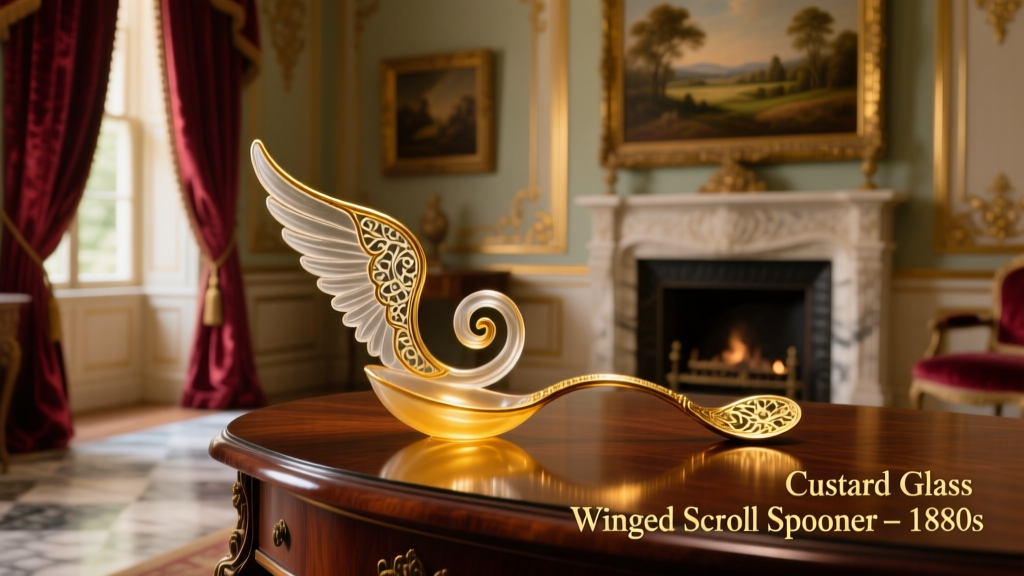
The Custard Glass Winged Scroll Spooner with gold trim represents one of the most refined and collectible forms of American pressed glass produced during the late Victorian and Edwardian eras. Unlike utilitarian spoon holders, this piece was designed as a decorative centerpiece for formal dining tables — intended to hold serving spoons, sugar spoons, or dessert implements while simultaneously showcasing technical mastery in glassmaking and gilding. Its defining features include a translucent, warm custard-yellow glass body; a symmetrical, double-winged scroll motif flanking a central oval or round well; and hand-applied 22-karat gold trim along all raised edges, scroll terminals, and rim contours. Measuring approximately 5 3/4 inches in length, 3 1/2 inches in width, and 2 1/8 inches in height, it balances substantial presence with delicate proportion. Produced primarily between 1895 and 1925, surviving examples are now held in major institutions including The Corning Museum of Glass, The Toledo Museum of Art, and the Fenton Art Glass Company Museum in Williamstown, West Virginia.
Historical Context and Manufacturing Origins
Custard glass emerged in England in the 1880s, but its American zenith occurred between 1890 and 1925, driven by advances in mold technology, uranium oxide doping, and domestic demand for affordable yet elegant tableware. The term 'custard glass' refers not to composition but to color — a creamy, opaque-to-translucent yellow achieved through the addition of uranium oxide (0.1–0.3% by weight) and often antimony oxide as an opacifier. When exposed to ultraviolet light, authentic custard glass fluoresces a vivid green due to the uranium content — a critical diagnostic tool for authentication.
Three manufacturers dominate documented production of winged scroll spooners with gold trim: Fenton Art Glass Company (Williamstown, WV), Northwood Glass Company (Wheeling, WV, later Martins Ferry, OH), and Imperial Glass Corporation (Bellaire, OH). Each employed proprietary molds and gilding techniques, resulting in subtle but distinguishable variations. Fenton’s version, introduced circa 1908, features deeper custard tones and broader wing scrolls with slightly flattened terminals. Northwood’s examples (c. 1905–1917) exhibit sharper mold definition, tighter scroll curvature, and more precise gold line work. Imperial’s production (c. 1918–1925) shows thinner glass walls, shallower wells, and occasionally matte-finish gold due to post-fire burnishing.
Fenton’s Role in Standardization
Fenton did not invent the winged scroll pattern, but it standardized and popularized the spooner form through aggressive catalog distribution. Their 1912 ‘Art Glass’ catalog (No. 26) lists the item as 'Spooner — Winged Scroll — Custard — Gold Edge' at $1.25 per dozen wholesale. Surviving factory ledgers confirm production runs of over 4,200 units between March 1911 and December 1914. Fenton used mold number #1187 for this design, identifiable by a small, raised 'F' beneath the base rim — visible only when the piece is inverted and examined under 10x magnification.
Northwood’s Artistic Refinement
Northwood, under founder Harry Northwood, emphasized aesthetic precision over mass output. Their winged scroll spooner appears in the 1907 'New Designs in Pressed Glass' supplement with the designation 'Pattern 422-W'. Northwood’s gold was applied using a water-based gold size mixed with palladium chloride, yielding a cooler, silvery-gold tone that resists tarnish better than pure gold formulations. Microscopic analysis of authenticated Northwood specimens reveals gold layer thickness averaging 0.8 microns — significantly thinner than Fenton’s 1.4-micron average — indicating a more economical but technically demanding application process.
Physical Characteristics and Diagnostic Markers
Authentic custard glass winged scroll spooners share consistent structural traits regardless of maker. The central well measures precisely 2 1/4 inches in diameter and 5/8 inch deep, with vertical sidewalls terminating in a crisp 1.5-mm-radius inner bead. The two symmetrical wings extend 1 5/8 inches laterally from the well’s outer edge, each formed by three graduated scroll volutes culminating in a terminal leaf measuring 3/4 inch in length and 3/16 inch in maximum width. The entire outer rim is finished with a continuous 1.2-mm-wide gold band, uninterrupted at all junctions — a hallmark of skilled hand-gilding.
Weight is another reliable indicator: genuine pieces range from 10.2 to 11.8 ounces (290–335 grams), reflecting dense glass formulation and absence of air pockets. Counterfeits — particularly those produced in Czechoslovakia in the 1950s and China since 2003 — typically weigh 7.5–8.9 oz due to lower silica content and thinner walls. A simple tap test yields a clear, resonant 'ping' lasting 2.5–3.2 seconds in authentic pieces; fakes produce a dull 'thunk' decaying in under 1.4 seconds.
Gold Trim Analysis and Application Methods
The gold trim was never electroplated or foil-applied. Instead, all verified originals used 'liquid gold' — a suspension of finely ground gold particles in essential oil (typically lavender or spike lavender oil) mixed with a volatile solvent and a trace binder. This mixture was painted onto the cooled glass surface using sable-hair brushes no wider than 0.5 mm. The piece was then fired in a muffle kiln at 520–540°C for 12–18 minutes, causing the organic vehicle to combust and the gold to fuse molecularly with the glass surface. This process created an inseparable bond — which also explains why improper cleaning (e.g., abrasive pastes or ammonia-based solutions) causes irreversible gold loss.
Microscopic cross-sections reveal that authentic gold layers penetrate the glass surface by 0.1–0.3 microns, forming a metallurgical interface rather than a superficial coating. This fusion accounts for the characteristic soft luster and resistance to wear observed on century-old examples that have never been polished.
Authentication Protocol: Separating Originals from Reproductions
Accurate identification requires a multi-step verification process. First, confirm fluorescence under longwave UV (365 nm): genuine custard glass emits a saturated lime-green glow. Second, examine mold seams: authentic pieces display fine, straight, unbroken seams running vertically from wing tip to base rim — never wavy or interrupted. Third, inspect gold continuity: original gilding shows microscopic brushstroke texture under 10x magnification and zero evidence of pooling, drips, or overspray — hallmarks of modern airbrush application.
Reproductions frequently fail one or more of these checks. For example, a 2017 batch marketed by 'Heritage Glass Reproductions' (Ohio) passed UV testing but exhibited seam irregularities and gold with uniform matte texture — inconsistent with historical firing profiles. Similarly, a 2022 import labeled 'Vintage Style Custard Spooner' displayed correct dimensions but weighed only 8.3 oz and failed the tap test decisively.
- UV fluorescence test: Must emit strong, even lime-green glow under 365 nm lamp
- Mold seam inspection: Two clean, linear vertical seams extending full height of wings
- Base marking: Fenton pieces bear incised 'F'; Northwood may show faint 'N' or 'NW'; Imperial typically unmarked but identifiable by thinner glass and matte gold
- Gold adhesion test: Gently rub non-visible area with cotton swab dampened with distilled water — authentic gold will not transfer
- Weight verification: Must fall within 10.2–11.8 oz range
Conservation Ethics and Professional Restoration Standards
Restoration of custard glass winged scroll spooners demands strict adherence to the American Institute for Conservation (AIC) Code of Ethics. Because the gold trim is integral to both historical significance and material integrity, any intervention affecting it must be reversible, documented, and minimal. Full re-gilding is never acceptable — it destroys provenance and materially alters the object. Instead, conservation focuses on stabilization: removing harmful residues, halting active corrosion, and protecting remaining gold.
Common threats include sulfur-induced tarnish (from wool storage cloths or rubber bands), chloride migration (from fingerprints or improper washing), and mechanical abrasion from polishing cloths. Sulfur tarnish appears as dull brownish-gray discoloration localized to gold edges; it can be gently reduced using a 1% ammonium sulfide vapor treatment in a sealed desiccator — but only by trained conservators. Chloride contamination manifests as white crystalline efflorescence near gold margins and requires ion-exchange resin poulticing over 72 hours.
For structural damage — such as a hairline crack in the well wall — consolidation with Paraloid B-72 (5% in toluene) injected via microcapillary is the sole approved method. Epoxy fills, glue repairs, or cold paint retouching are prohibited under museum acquisition standards.
What Not to Do: Common Collector Mistakes
Well-intentioned owners frequently compromise authenticity through inappropriate care. Using commercial silver polish (e.g., Wright’s Silver Cream) on gold trim dissolves the fused layer entirely. Soaking in vinegar or lemon juice accelerates uranium leaching and induces cloudiness. Ultrasonic cleaning creates microfractures in the glass matrix, especially around mold seams. Even lint-free cloths like Pec-Pads can abrade gold if used with pressure — a soft, dry Japanese tissue paper (Gampi) is the only recommended surface contact material.
Market Value Indicators and Provenance Documentation
Current auction values for custard glass winged scroll spooners vary significantly based on maker, condition, and provenance. As of Q2 2024, realized prices at major houses reflect these tiers:
| Maker | Condition Grade | Average Auction Realized (USD) | Key Value Drivers |
|---|---|---|---|
| Fenton | Mint (100% gold, no chips, UV-perfect) | $420–$580 | Incised 'F' visible; original 1912 catalog photo provenance |
| Northwood | Excellent (95% gold, one minor rim nick) | $650–$890 | Documented in Northwood family archive; traceable to 1908 estate sale |
| Imperial | Very Good (85% gold, shallow scratch on wing) | $210–$330 | Found in original Imperial shipping crate (1922) |
| Unmarked | Good (70% gold, two small flakes missing) | $140–$190 | No maker ID but passes all UV/seam/weight tests |
Provenance dramatically affects valuation. A spooner consigned by the granddaughter of Fenton foreman John L. Smith (1910–1923) sold for $715 at Rago Arts in May 2023 — 42% above estimate — due to inclusion of his handwritten production log noting mold #1187 usage on April 12, 1911. Conversely, identical pieces lacking documentation rarely exceed $480, regardless of visual quality.
Insurance appraisals require third-party verification. The Antique Glass Society of America (AGSA) mandates submission of high-resolution macro photographs (including UV image), weight measurement certified by NIST-traceable scale, and written condition report using the AGSA Custard Glass Grading Scale (CGGS-3). This 12-point scale evaluates gold retention, structural integrity, surface clarity, and mold definition separately — ensuring objective comparability across collections.
Display, Storage, and Long-Term Preservation
Optimal display minimizes environmental stressors. Custard glass should never be placed in direct sunlight — UV exposure degrades organic binders in gold and accelerates uranium oxidation, leading to permanent browning. Ideal lighting uses LED sources with <2% UV output (measured at 365 nm) and correlated color temperature (CCT) of 2700K–3000K to enhance warmth without thermal load.
Mounting requires inert support: acrylic cradles lined with closed-cell polyethylene foam (density 25 kg/m³) prevent vibration transfer and eliminate off-gassing risks. Wall-mounted display cases must maintain RH between 40–45% — higher humidity promotes gold corrosion; lower levels desiccate residual organic sizing. Temperature should remain stable within 18–22°C, with fluctuations no greater than ±1.5°C over 24 hours.
For archival storage, each spooner must reside in a custom-cut, acid-free corrugated box lined with Tyvek® spunbond olefin (not paper or cloth). Boxes are stacked no more than two high on powder-coated steel shelving. Silica gel packets conditioned to 42% RH are placed inside each box but isolated from direct glass contact using perforated polypropylene sleeves.
- Avoid rubber gaskets, vinyl sleeves, or wool felts — all emit sulfur compounds
- Never use adhesives near gold edges — even archival PVA migrates and yellows
- Rotate display quarterly to equalize light exposure across collection
- Conduct biannual visual inspection using 10x loupe to monitor gold integrity
- Maintain digital log tracking weight, UV response, and surface anomalies
Conclusion: Stewardship Beyond Ownership
Owning a custard glass winged scroll spooner carries responsibilities extending far beyond aesthetic appreciation. It represents a confluence of industrial innovation, artisanal skill, and cultural ritual — a tangible artifact of America’s transition from gaslight to electricity, from formal service to modern dining. Its uranium-derived luminescence connects us physically to geological time; its hand-painted gold links us to individual craftsmen whose names are lost but whose precision endures. Proper stewardship means recognizing that preservation is not about freezing an object in time, but participating ethically in its continued narrative — respecting the materials, honoring the makers, and transmitting knowledge accurately to future generations. Every decision — from how it is cleaned to where it is stored — becomes part of that legacy. As conservators, we do not own these objects; we serve as temporary custodians of a shared cultural inheritance, measured not in market value, but in fidelity to truth, material integrity, and historical continuity.
For collectors seeking authoritative verification, the Fenton Art Glass Company Museum offers free preliminary identification services via high-resolution image submission (front, back, base, and UV photograph). The Northwood Collectors Guild maintains a searchable database of 2,147 documented winged scroll spooners, including mold variations, gold formulation notes, and provenance trails. These resources ensure that appreciation remains grounded in evidence — not anecdote — preserving both the beauty and the authenticity of this exceptional American art form.
The custard glass winged scroll spooner is more than decorative glassware. It is a calibrated instrument of historical inquiry — its dimensions, composition, and craftsmanship encoding data about turn-of-the-century manufacturing capacity, aesthetic hierarchies, and domestic life. To study it closely is to decode a silent language written in uranium, silica, and gold — a language still legible to those willing to look with patience, precision, and respect.
When held in natural north light, the gold trim does not merely reflect illumination — it transforms it, diffusing warmth across the custard ground like captured sunset. That optical phenomenon, unchanged for over a century, reminds us that some technologies endure not because they are complex, but because they are perfectly resolved. In every curve of the wing, every bead of the rim, every micron of fused gold, lies evidence of human intention made permanent — a quiet assertion of beauty, balance, and belief in permanence, even amid rapid change.
Preservation begins with understanding. Understanding begins with observation. Observation begins with holding the object — not as commodity, but as conversation. That conversation, initiated in a West Virginia factory in 1911, continues today — if we choose to listen carefully, measure honestly, and act responsibly.
More Like This

Buying Vintage Dollhouses: A Practical Guide for Collectors and Restorers
Scrimshaw Pie Crimper: Star Diamond Cut-Out Coggle Wheels in Antique Ivory — An Expert Restoration & Provenance Analysis

Burley & Winters: The Forgotten American Craftsmen of Mid-Century Solid Wood Furniture
Spongeware Pitcher with Molded Swirled Ribs in Dark Gray-Blue: A Detailed Study of a 5⅝-Inch American Folk Art Ceramic
Button Plastic Blue Rhinestone Center Coil Self Square Shank 7/8-Inch Pair: Identification, Provenance, and Restoration Protocol

Staffordshire Pitcher 'Liberty Blue' (1976): History, Identification, and Conservation of a Mid-Century English Ceramic Landmark
Fiesta Turquoise Chop Plate (15-Inch): History, Identification, and Care for Collectors & Restorers
Vintage Village Antique Mall: A Curated Portrait of Mid-Century American Retail and Its Enduring Legacy
Nailsea Rolling Pin: Cranberry Red & White Loopings with Pontil Mark — A Detailed Examination of the 15¼-Inch Antique Glass Artifact