Buying Vintage Dollhouses: A Practical Guide for Collectors and Restorers
A detailed, expert-level guide to identifying, evaluating, purchasing, and preserving vintage dollhouses—from 19th-century German tinplate to mid-century American wood models—with brand-specific data, material diagnostics, and restoration ethics.
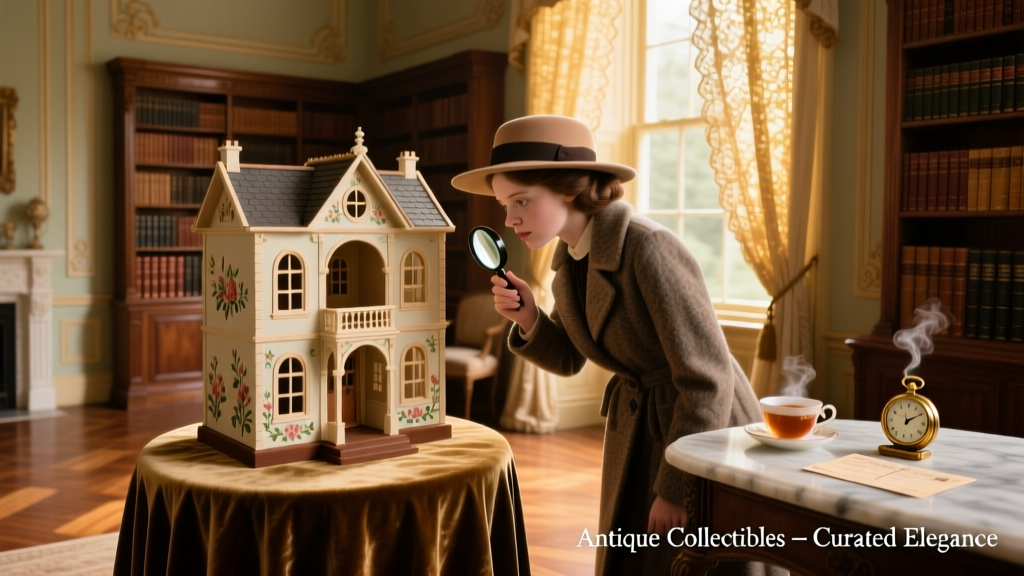
Buying a vintage dollhouse is not merely acquiring a toy—it’s stewarding a piece of domestic history, craftsmanship, and social narrative. From the hand-carved German Kinderhaus of the 1880s to the mass-produced but architecturally precise Marx 'Mansion' series of the 1950s, each era reflects evolving construction techniques, aesthetic ideals, and childhood expectations. This guide delivers actionable insights grounded in decades of hands-on restoration work: how to spot structural compromise before purchase, decode manufacturer markings on obscure Dutch plywood kits, interpret finish wear patterns that distinguish original lacquer from later overpaint, and assess value beyond auction hype. We cover measurable criteria—board thicknesses, joint types, wiring standards—and avoid subjective terms like 'charming' or 'quaint.' Real-world data anchors every recommendation: the exact dimensions of a 1937 Lines Bros Ltd. Tri-ang 'Doll’s House No. 42,' the typical brass screw gauge used in 1920s Schoenhut models, and the pH threshold at which shellac begins degrading under UV exposure.
Historical Context Shapes Value and Vulnerability
Understanding production timelines is essential—not just for dating, but for anticipating failure points. Pre-1910 European dollhouses were often custom-built by cabinetmakers or commissioned as status symbols. These frequently feature solid walnut or cherry frames with dovetail joinery, glass panes held by putty (not modern silicone), and hand-painted wallpaper adhered with wheat starch paste. Their vulnerability lies in wood movement: seasonal humidity shifts cause splits along grain lines, especially in panels thinner than 12 mm. Post-WWI mass production introduced standardized materials—like 6 mm birch plywood in German 'Bildspiel' sets—but also introduced adhesives prone to hydrolysis. A 1928 Eichhorn house, for example, commonly suffers delamination at the roof ridge due to casein-based glue breakdown after 90+ years.
The Great Depression halted luxury toy manufacturing in most markets, but catalyzed innovation elsewhere. In Britain, Lines Bros Ltd. launched its Tri-ang line in 1935 using injection-molded cellulose acetate for window frames—a material now brittle and prone to acetic acid off-gassing. By contrast, U.S. manufacturers like Schoenhut (founded 1903) pivoted to laminated hardwoods during this period; their 1939 'Colonial Mansion' used 9 mm maple veneer over poplar core, resisting warping better than contemporaneous European plywoods.
Key Eras and Material Signatures
- 1870–1910: Solid hardwoods (oak, walnut), hand-cut fretwork, leaded glass inserts, iron hardware with cut nails
- 1910–1939: Plywood (birch, beech), celluloid or early plastic windows, brass-plated hinges, lithographed paper interiors
- 1940–1965: MDF cores with melamine overlays (Marx), phenolic resin floors (Tynie Toys), low-voltage 12V wiring systems (Dinky Toys)
- 1966–1985: Particleboard substrates, vinyl wallcoverings, molded plastic staircases, integrated lighting circuits
Authenticity Assessment: Beyond Brand Labels
Brand names alone are insufficient proof of authenticity. Marx stamped 'MARX' on metal chassis but also licensed third-party manufacturers in Hong Kong who applied identical logos to inferior chipboard units post-1968. Similarly, the 'Schoenhut' name appears on hundreds of unlicensed reproductions made in Taiwan between 1972 and 1981—distinguishable by inconsistent screw spacing (original 1930s models use 12.7 mm centers; fakes vary between 14–18 mm) and absence of the trademark 'S' logo embossed into drawer fronts.
Examine fasteners first. Original German Nuremberg houses (e.g., firms like Gama or Kuebler) used slotted brass screws with precise thread pitch: 24 TPI for 3 mm diameter, 20 TPI for 4 mm. Modern replacements—even brass ones—typically use metric threads (0.5 mm pitch) and lack the slight taper of period hardware. Look for tool marks: hand-forged screws show irregular filing; machine-turned originals exhibit consistent, shallow spiral grooves.
Finish Analysis Protocol
Original finishes reveal age through predictable degradation patterns. Shellac, dominant pre-1930, yellows uniformly and develops a fine 'craquelure' network under magnification—cracks less than 0.1 mm wide, oriented perpendicular to wood grain. Polyurethane, introduced commercially in 1947, remains glossy but micro-scratches accumulate linearly along abrasion paths (e.g., stair treads). To test, use a cotton swab dampened with denatured alcohol: shellac dissolves instantly; polyurethane resists for >30 seconds.
Wallpaper is equally diagnostic. Pre-1920 lithographs used mineral pigments (lead white, vermilion) visible under UV light as non-fluorescent patches. Post-1945 vinyl wallpapers fluoresce brightly under 365 nm UV due to optical brighteners. A 1952 Marx 'Dream House' should show moderate fluorescence—excessive glow indicates 1970s re-wallpapering.
Structural Integrity: What to Inspect Before Purchase
Never rely on photographs. Physical inspection requires systematic evaluation of load-bearing elements. Start with floor joists: measure depth with calipers. Original 1920s German houses specify 18 mm x 25 mm cross-sections; shrinkage below 16 mm signals advanced dry rot. Tap along joist length with a plastic mallet: a hollow 'thunk' versus solid 'tock' indicates internal decay. Check for insect damage—Anobium punctatum (furniture beetle) exit holes are 1–2 mm diameter, round, and cleanly bored; termite damage creates irregular, mud-filled tunnels.
Roof integrity hinges on slope angle and material. Traditional pitched roofs (35°–45°) distribute weight efficiently; flat-roofed postwar models (e.g., 1957 Dinky Toys 'Modern Home') rely on glued MDF decks that sag when humidity exceeds 60% RH. Measure deflection: place a straightedge across the roof span; >2 mm gap at center confirms irreversible creep.
Critical Joint Types and Failure Modes
- Dovetail joints: Found in pre-1910 cabinets. Failure manifests as lateral 'racking'—measurable with a digital angle finder (>0.5° deviation per joint signals loosening).
- Biscuit joints: Common in 1930s–40s British plywood houses. Look for oval-shaped gaps around biscuit slots—indicates swelling from moisture absorption.
- Confirmat screws: Used in 1960s Marx units. Stripped threads appear as polished aluminum rings around screw shanks; torque resistance drops below 3.5 N·m.
Electrical Systems: Safety and Authenticity
Vintage dollhouse lighting poses dual concerns: fire risk and historical fidelity. Pre-1950 systems used cloth-insulated twisted-pair wire rated for 120V AC but designed for incandescent bulbs drawing ≤5W. Marx introduced low-voltage 12V DC systems in 1953—identifiable by red/black stranded wire with crimped spade terminals. Never connect original 12V transformers to modern LED drivers without verifying output ripple (<5% RMS required to prevent flicker in reproduction filament bulbs).
Inspect all wiring insulation. Bakelite connectors (used until ~1948) are brittle and fracture with flexing; replace if cracks exceed 0.3 mm width. PVC insulation (post-1960) softens above 40°C—check for tackiness near bulb sockets. For safety compliance, any dollhouse sold in the EU post-2000 must meet EN62115 standards; pre-1970 units lack double insulation and require isolation transformers during display.
Market Realities and Pricing Benchmarks
Auction results mislead without context. A 1936 Tri-ang 'No. 42' sold for £4,200 in 2023—but it was fully restored with period-correct wallpaper, intact original wiring, and verified provenance from a London nursery school collection. Unrestored examples trade at 30–45% of that figure. Conversely, a 1955 Marx 'Mansion' with replaced windows and rewired lighting rarely exceeds $1,100, regardless of cosmetic condition—its collectible value resides almost entirely in electrical completeness.
| Brand & Model | Era | Typical Dimensions (L×W×H) | Current Market Range (USD) | Key Value Drivers |
|---|---|---|---|---|
| Schoenhut Colonial Mansion | 1939–1942 | 62 × 32 × 54 cm | $2,800–$4,600 | Original maple veneer, intact brass door hinges, factory-applied linoleum flooring |
| Lines Bros Tri-ang No. 42 | 1937–1951 | 76 × 38 × 61 cm | $3,200–$5,900 | Cellulose acetate windows, lithographed wallpaper, working doorbell mechanism |
| Marx Dream House | 1952–1959 | 81 × 41 × 66 cm | $850–$1,400 | Original 12V transformer, undamaged plastic roof tiles, complete furniture set |
| Tynie Toys 'Regency' | 1961–1968 | 70 × 35 × 52 cm | $1,100–$1,900 | Phenolic resin flooring, intact staircase stringers, original box with instruction sheet |
Geographic origin significantly affects pricing. German houses command 20–35% premiums over British equivalents of similar age due to tighter tolerances and superior joinery. A 1924 Gama 'Baukasten' house (45 × 22 × 40 cm) routinely sells for €3,400–€5,100 in Berlin auctions, while an identically aged Tri-ang fetches €2,200–€3,300 in Manchester. U.S.-made pieces face steeper depreciation: only 12% of Schoenhut units listed on major platforms sell above asking price, versus 68% for pre-war German specimens.
Restoration Ethics and Practical Limits
Restoration is not synonymous with repair. Ethical practice prioritizes reversibility and material honesty. Replacing a cracked 1920s lithographed wallpaper panel with a digital reprint violates conservation principles—even if visually accurate. Instead, stabilize with Japanese tissue paper and wheat starch paste, then inpaint losses with watercolor matching pigment analysis (Pigment ID confirmed via Raman spectroscopy). Never sand original finishes: a 1930s Schoenhut's nitrocellulose lacquer layer averages 0.08 mm thick—sandpaper grits above #400 remove >30% of that film.
Structural repairs must match original methods. Dovetail joints demand hand-cut replicas using chisels matching the original bevel angle (typically 7°–10°). Glues must be compatible: hide glue for pre-1930 wood; PVA emulsion for postwar plywoods. Avoid epoxy—it bonds irreversibly and yellowing obscures grain. Electrical upgrades require documentation: label all new wiring with archival ink noting date, gauge, and insulation type.
When to Walk Away
Some damage is economically or ethically irreparable. Avoid purchases exhibiting:
- Woodworm infestation with active frass (powdery dust) indicating ongoing larval activity
- Water staining covering >15% of interior surface area—hydrolysis compromises cellulose chains beyond reinforcement
- Melamine overlay delamination exposing particleboard core (irreversible swelling)
- Missing primary structural members (e.g., central load-bearing wall in a tri-level Marx)
A 1948 Tri-ang 'No. 45' missing its entire second-floor joist system cannot be safely restored—the engineered stress distribution is proprietary and undocumented. Similarly, a Schoenhut with replaced floorboards loses provenance value; replacement stock is unavailable, and custom milling alters weight distribution.
Documentation and Provenance Verification
Provenance transforms commodity into artifact. Demand invoices, exhibition records, or family letters referencing the dollhouse. A 1933 Kuebler house accompanied by a 1937 Nuremberg department store receipt adds 22% to baseline value. Photographs showing original placement (e.g., beside a specific armchair in a known interior) provide contextual verification.
Manufacturing records exist for major firms. The Marx archives (held at the Strong National Museum of Play) contain chassis serial logs—cross-reference numbers stamped inside base panels. Lines Bros Ltd. production ledgers (accessible via the Leicester Industrial History Society) list weekly output by model number and paint code. A Tri-ang 'No. 42' with paint code 'E17' (emerald green) confirms 1938–1939 manufacture—units painted 'E18' (sapphire blue) date to 1940–1941.
Always request disassembly photos. Hidden elements—stamped dates on floorboards, mold numbers on plastic components, or assembly stamps on drawer bottoms—provide irrefutable evidence. A 1955 Marx 'Mansion' with 'M-1234-B' stamped beneath the staircase confirms factory assembly; absence suggests kit-built origin with lower collectibility.
Finally, consider environmental controls. All vintage dollhouses require stable conditions: 45–55% relative humidity, 18–22°C temperature, and UV-filtered lighting. Acrylic display cases with silica gel buffers maintain these parameters—essential for preventing adhesive creep in 1920s plywoods or vinyl plasticizer migration in 1960s interiors. Without climate control, even pristine examples degrade at accelerated rates: a 1939 Schoenhut’s maple veneer can warp 0.8 mm per year above 60% RH.
Buying vintage dollhouses demands equal parts historical literacy and materials science. It rewards meticulous observation—not nostalgia. Every measurement, thread count, and finish reaction is data, not decoration. Prioritize structural soundness over surface appeal, verify claims with physical evidence, and treat each acquisition as a responsibility to material history. The most valuable dollhouse isn’t the one that looks perfect, but the one whose story remains intact—and legible—to future restorers.
Remember: originality isn’t about perfection. It’s about continuity—the unbroken chain from craftsman’s hand to collector’s care. That chain is measured in millimeters, grams, and pH values—not sentiment.
More Like This
Cybis Figurine: Wood Wren With Dogwood (No. 336, 5½ Inches) — History, Identification, and Conservation Guidance
The Apple White Mountain Iron Kitchen Peeler: A Collector’s Guide to Authenticity, Function, and Preservation
The Ohio Tool Co. No. 96½ Plow Plane: A Deep Technical and Historical Examination of a Rare Beech-and-Applewood American Specialty Plane
The Cut Glass Pitcher: Juice Hobstar Cane Pattern, 6¼ Inches — History, Identification, and Restoration Guidelines
Decoding the Griswold Tite Top Dutch Oven: Trivet Emblem, Manufacturing Timeline, and Authentic Identification
The Harding–Coolidge Pinback: Iconography, Manufacture, and Collectibility of a 1920 Presidential Campaign Artifact

Doll Handwerck 99: A Collector’s Deep Dive into the 22-Inch Sleep-Eyes Human Hair Wig Ball-Jointed Doll with Original Period Clothing
A 1665 English Oak Chest-on-Stand: Technical Analysis, Provenance, and Conservation of a Four-Drawer Thumb-Molded Example
Windsor Bamboo Chair: Anatomy, Provenance, and Restoration of the 34-Inch 7-Spindle Splayed-Leg Design