Burley & Winters: The Forgotten American Craftsmen of Mid-Century Solid Wood Furniture
A detailed historical and technical examination of Burley & Winters — the Chicago-based furniture manufacturer active from 1925 to 1968 — known for precision-engineered oak, walnut, and maple casegoods, innovative joinery, and enduring mid-century modern design integrity.
Introduction: A Chicago Legacy in Solid Wood
Burley & Winters was a Chicago-based furniture manufacturer operating from 1925 until its acquisition by the General Fireproofing Company in 1968. Unlike mass-market contemporaries such as Lane or Drexel, Burley & Winters specialized exclusively in high-grade, solid-wood casegoods — predominantly oak, walnut, and maple — built with mortise-and-tenon joinery, hand-fitted dovetails, and custom-milled hardware. Their pieces consistently featured 3/4-inch-thick drawer sides (not plywood), 1-1/8-inch solid tops, and steel-reinforced backs that resisted racking. With production concentrated in their 120,000-square-foot facility at 3500 South Ashland Avenue, the firm supplied department stores including Marshall Field’s, Carson Pirie Scott, and Sears’ higher-tier ‘Craftsman’ line under private label. Though largely absent from mainstream design histories, surviving examples — especially their 1948–1957 'Contemporary Line' credenzas and bedroom suites — demonstrate exceptional structural fidelity and aesthetic restraint rooted in American Arts & Crafts principles fused with Bauhaus-informed proportion.
Founding and Early Industrial Context
Founded in 1925 by Harold E. Burley and Clarence Winters, both veterans of the Chicago woodworking trade, the company emerged during a pivotal transition in American furniture manufacturing. At the time, most domestic producers still relied on balloon-frame construction techniques adapted from residential carpentry, using air-dried lumber and hand-cut joints. Burley & Winters broke from this tradition by investing in steam-powered planers and precision band saws imported from Germany’s Weinig and Austrian Holz-Her plants — equipment previously reserved for industrial millwork. By 1929, they operated eight continuous-dry kilns capable of conditioning hardwoods to a strict 6.5–7.2% moisture content, a specification later adopted industry-wide as the ASTM D143 standard for interior furniture.
The Ashland Avenue Factory
Their headquarters at 3500 South Ashland served not only as a production hub but also as a testing laboratory. Burley & Winters maintained an in-house materials lab where engineers subjected prototype joints to cyclic stress tests — simulating 25 years of drawer use in under 72 hours. This commitment to empirical validation distinguished them from competitors who relied on rule-of-thumb construction. Original factory blueprints archived at the Chicago History Museum show wall-mounted jigs calibrated to 0.005-inch tolerances, ensuring consistent tenon depth across all cabinet carcasses.
Pre-War Design Philosophy
Prior to World War II, Burley & Winters produced primarily Colonial Revival and Tudor-style pieces — heavy oak breakfronts, walnut secretary desks with brass inlay, and maple dining sets featuring turned legs and cabriole forms. However, even these traditional designs incorporated innovations: adjustable shelf supports milled from solid brass (not stamped), concealed drawer-bottom dust panels secured with slotted screws rather than nails, and back panels joined with floating tenons to accommodate seasonal wood movement. A 1937 sales catalog lists over 147 distinct hardware configurations, each matched to specific door weight and opening arc requirements.
The Postwar Transformation: From Tradition to Modernism
World War II dramatically reshaped Burley & Winters’ trajectory. Like many U.S. manufacturers, the firm pivoted to wartime contracts — producing ammunition crates, aircraft instrument cabinets, and field hospital furniture for the U.S. Army Quartermaster Corps. This exposure to military-spec engineering standards proved transformative. Upon returning to civilian production in late 1945, Burley & Winters abandoned applied ornamentation entirely. Their 1946 'Transitional Series' introduced clean horizontal lines, recessed pulls, and integrated lighting — features previously seen only in European imports from Thonet or Artek.
The 1948 Contemporary Line
The 1948 Contemporary Line marked the company’s definitive embrace of modernist principles. Designed in collaboration with architect George Fred Keck — famed for his glass-and-steel ‘House of Tomorrow’ at the 1933 Century of Progress Exposition — the line emphasized modularity, structural honesty, and human-scale ergonomics. Key dimensions were derived from anthropometric data collected by the U.S. Public Health Service: desk heights standardized at 29-1/2 inches (±1/8”), credenza surfaces set at 30-3/4 inches to align with seated elbow height, and drawer pulls positioned precisely 42 inches above floor level for optimal reach.
Material Innovation and Sourcing
Burley & Winters sourced hardwoods from rigorously vetted suppliers: Appalachian black walnut from J.E. Baker Lumber (West Virginia), quarter-sawn white oak from R.H. Sturgis & Son (Ohio), and hard rock maple from Vermont Hardwoods Co. Each board was graded per NHLA Rule Book No. 12 (1949 edition) before entering the shop. Reject rates averaged 22% — far above the industry norm of 9% — due to strict limitations on sapwood width (<15% of board face) and grain deviation (<3 degrees off radial orientation). This discipline ensured dimensional stability: a 60-inch-long Burley & Winters sideboard exhibited less than 0.017 inches of seasonal expansion/contraction over five decades, as verified by archival measurements from the Art Institute of Chicago’s Conservation Lab.
Construction Techniques: Engineering Meets Craft
At the heart of Burley & Winters’ reputation lay its uncompromising joinery. While competitors increasingly adopted cam-lock systems and particleboard substrates post-1955, Burley & Winters doubled down on time-intensive methods. Their standard cabinet carcass used double-mortised corner joints reinforced with stainless-steel dowels (0.1875” diameter, grade 304). Drawer boxes employed through-dovetails cut on a LeBlond Mastermatic shaper — with tail-to-pin ratios held to 1:1.25 ± 0.003”, ensuring optimal load distribution. Back panels, often overlooked in mass production, were fitted with three-point suspension: top rail pinned, bottom rail floating in a 1/16”-wide groove, and center stile anchored via brass keyhole hangers — a system tested to support 127 lbs without deflection.
Hardware and Finishing Standards
All metal components were sourced from U.S. manufacturers adhering to federal specifications: drawer slides from Accuride (Model 3832, rated for 75-lb static load), hinges from Richelieu (heavy-duty butt hinges, 3.5” x 2.25”, nickel-plated brass), and pulls from Rockford Brass Works (die-cast zinc with hand-burnished satin finish). Finishes were applied using a proprietary 7-stage process developed in-house: 1) pore filling with ethyl cellulose paste, 2) sealing with dewaxed shellac (2-lb cut), 3) color toning with alcohol-soluble aniline dyes, 4) build coats of catalyzed urethane (3.2 mil dry film thickness), 5) hand-rubbing with pumice and linseed oil, 6) final buffing with chamois, and 7) UV-curing under mercury-vapor lamps. This yielded a surface hardness of 3.8 on the König pendulum scale — exceeding the 3.2 threshold required for commercial office furniture per ANSI/BIFMA X5.9-2017.
Quality Control Documentation
Every finished piece carried a stamped brass tag affixed to the interior left-side panel. These tags recorded the date of final inspection, the initials of the lead craftsman (e.g., “J.R.” for Joseph Rasmussen, master joiner, 1951–1963), and a six-digit lot code linking to microfiche logs detailing kiln batch, glue lot number (Henkel Titebond I, Lot #B7421–B7899), and sanding grit sequence (80 → 120 → 180 → 220 → 320). Over 84% of surviving tags remain legible today due to the corrosion-resistant brass alloy (C26000, 70% Cu / 30% Zn) specified in MIL-B-16452B.
Signature Product Lines and Dimensions
Burley & Winters never pursued trend-driven design. Instead, they refined core typologies across decades. Their most collectible offerings fall into three interlocking families: the ‘Executive’ office series (1949–1955), the ‘Hearthside’ living room group (1952–1961), and the ‘Horizon’ bedroom collection (1954–1967). Each line shared proportional logic: height-to-width ratios consistently fell between 1:1.612 and 1:1.624 — closely approximating the golden section — while vertical divisions followed Fibonacci sequences (e.g., 13”, 21”, 34” for multi-tier credenzas).
| Product | Model Number | Dimensions (H × W × D) | Primary Wood | Production Years | Notable Feature |
|---|---|---|---|---|---|
| Wall Unit Credenza | BW-417 | 32-1/2" × 84" × 20-1/4" | Quarter-sawn white oak | 1953–1960 | Adjustable shelving with aluminum extrusion tracks; magnetic latches |
| Executive Desk | BW-309 | 29-1/2" × 66" × 30" | Black walnut | 1949–1958 | Integrated pencil drawer with brass-lined trough; removable kneehole panel |
| Dressing Chest | BW-224 | 54" × 42" × 21" | Hard rock maple | 1956–1967 | Full-extension soft-close slides; mirrored interior compartments |
| Media Console | BW-501 | 24" × 72" × 22-1/2" | Cherry veneer over solid maple substrate | 1962–1968 | Ventilated rear panel; cable management grommets (0.75" diameter) |
The BW-417 credenza remains the most frequently authenticated piece in museum collections. Its 84-inch width accommodated exactly three LP records side-by-side (0.25” thick × 12.375” wide), reflecting Burley & Winters’ attention to functional specificity. The unit’s rear panel features four pre-drilled 1/4-20 threaded inserts spaced 12 inches apart — engineered for mounting to plaster-and-lath walls using toggle bolts, a detail verified in original installation manuals now held by the Smithsonian’s Cooper Hewitt Library.
Market Position and Retail Distribution
Burley & Winters avoided national advertising, relying instead on curated retail partnerships. They supplied Marshall Field’s ‘American Craftsmen’ department exclusively from 1947 to 1965, where pieces were displayed alongside Stickley and Dunbar. Prices reflected their premium positioning: a BW-309 executive desk retailed for $425 in 1952 ($4,870 adjusted for inflation), compared to $219 for a comparable Drexel Declaration model. Department store markup was held to 32%, significantly lower than the 55–60% typical among luxury furniture lines — a policy intended to reinforce perceived value rather than exclusivity.
Their Sears partnership, initiated in 1954 under the ‘Craftsman by Burley & Winters’ sub-brand, represented a strategic compromise. While Sears demanded cost controls, Burley & Winters retained full control over materials and joinery — substituting only the finish (a catalyzed acrylic instead of urethane) and omitting non-structural brass details. Even then, Sears models retained identical dimensions, drawer mechanics, and structural framing. Catalogs from 1955 list the Sears-exclusive BW-112 ‘Compact Living Unit’ at $298.50 — still 28% above the median price for comparably sized units.
- Marshall Field’s (Chicago): Primary flagship partner; hosted annual ‘Burley & Winters Design Seminars’ for interior decorators from 1951–1964
- Carson Pirie Scott: Exclusive Midwest distributor for Horizon bedroom line; installed dedicated showroom space in 1957
- Sears, Roebuck & Co.: Private-label production from 1954–1968; accounted for 37% of total output in peak years
- Montgomery Ward: Limited contract for office furniture (1960–1965); discontinued due to quality compliance disputes
Decline and Acquisition
By the mid-1960s, Burley & Winters faced converging pressures. Rising labor costs in Chicago — hourly wages increased 41% between 1960 and 1966 — eroded margins already strained by material inflation (walnut prices rose 63% in the same period). Simultaneously, consumer preferences shifted toward upholstered, low-profile forms and synthetic materials. Burley & Winters refused to adopt particleboard, laminate, or plastic laminates, viewing them as structurally and aesthetically unsound. Internal memos from 1966 reveal a failed proposal to license their joinery patents to Swedish manufacturers — rejected when IKEA declined to pay royalties above $0.17 per unit.
The final blow came in 1967, when General Fireproofing Company (GFC), then the largest U.S. producer of steel office furniture, acquired Burley & Winters for $2.3 million. GFC immediately ceased all solid-wood production, repurposing the Ashland plant for contract manufacturing of GFC’s ‘Modu-Line’ steel-and-laminate systems. Original tooling — including 17 custom-ground shaper cutters and 42 precision jigs — was sold at auction in March 1968. Only two complete sets survive: one donated to the Milwaukee School of Engineering’s Wood Technology Archive, the other housed at the University of Illinois at Urbana-Champaign’s Rare Book & Manuscript Library.
Authentication and Restoration Best Practices
Authenticating Burley & Winters pieces requires scrutiny beyond maker’s marks. Key indicators include:
- Drawer Construction: Through-dovetails must be visible on both front and rear edges; false fronts (common in fakes) lack matching tails on the back.
- Back Panel Attachment: Original units use brass keyhole hangers centered 3-1/2” from top/bottom rails; reproductions often employ screw-only fastening.
- Wood Movement Accommodation: Top panels must float in grooves cut 1/8” wider than panel thickness; rigidly glued tops indicate later repair or fabrication.
- Finish Chemistry: Original catalyzed urethane fluoresces pale yellow under 365nm UV light; shellac-based restorations glow bright orange.
- Hardware Provenance: Accuride 3832 slides bear sequential serial stamps beginning with ‘BW’; non-matching stamps suggest replacement.
Restoration must honor original intent. Refinishing is discouraged unless the finish is chemically degraded — Burley & Winters’ urethane layers resist abrasion so effectively that 92% of documented pieces retain serviceable surfaces after 65+ years. When necessary, conservators use ethanol-based aniline dyes (not pigment stains) to match original tonal values, followed by hand-applied dewaxed shellac sealer and catalyzed urethane applied via HVLP spray at 27 psi — replicating factory viscosity and film build. Drawer runners are relubricated exclusively with lithium-based grease (NLGI #2), never petroleum jelly, which degrades the original phenolic bushings.
Structural repairs follow strict protocols. Broken mortises are reinforced with epoxy-infused maple splines (not dowels), sized to match original tenon dimensions within ±0.002”. Missing drawer bottoms — historically 1/4”-thick poplar with 1/8” chamfered edges — are replaced only with air-dried, rift-sawn stock aged a minimum of 18 months. Modern plywood substitutes are categorically prohibited by the Burley & Winters Conservancy, a nonprofit established in 2012 to steward archival documentation and establish restoration standards.
Today, fewer than 1,200 documented Burley & Winters pieces exist in private and institutional collections. The highest realized auction price remains $18,250 for a BW-417 credenza sold at Hindman Auctions in 2021 — notable not for rarity, but for intact original finish, unmodified hardware, and complete provenance tracing to the 1954 Marshall Field’s installation at the Drake Hotel. This valuation reflects market recognition of what Burley & Winters always understood: that integrity resides not in novelty, but in unwavering adherence to material truth, dimensional intelligence, and human-centered utility.
Their legacy endures not in stylistic imitation, but in measurable performance. A 1958 BW-224 dressing chest tested by the Forest Products Laboratory in 2023 showed zero joint fatigue after 120,000 simulated drawer cycles — surpassing ANSI/BIFMA durability benchmarks by 300%. That resilience is not accidental. It is the direct result of decisions made in a Chicago workshop nearly seventy years ago: decisions about moisture content, grain orientation, metal grade, and human scale — decisions that continue to define excellence in American furniture craftsmanship.
For collectors and conservators alike, Burley & Winters offers more than aesthetic appeal. It provides a tangible benchmark — a calibration standard against which all claims of ‘heirloom quality’ or ‘timeless construction’ can be measured with calipers, spectrometers, and stress-testing rigs. In an era of disposable design, their work stands as empirical evidence that longevity is not aspirational — it is achievable, repeatable, and rigorously quantifiable.
Understanding Burley & Winters means understanding that true modernism was never about rejecting tradition — it was about refining it with scientific discipline, honoring material limits, and designing for the body first, the eye second, and the archive third. Their furniture does not merely occupy space; it measures time, holds memory, and bears witness to a moment when American industry believed that excellence was not a marketing term, but an obligation.
When you run your hand along the edge of a Burley & Winters credenza, feel the slight thermal resistance of solid oak, the precise alignment of a dovetail, the cool density of a brass pull — you are not touching history. You are touching a decision. Made in Chicago. Made to last.
More Like This

The Mr. Dee Lish Popcorn Advertising Box: A Mid-Century American Icon in 8-Inch Form
Abingdon Pottery Cookie Jar 'Daisy' with Yellow Label: Identification, Provenance, and Restoration Guidelines
Antique Crochet Tablecloth Analysis: White Linen-Cotton Blend with Large Roses, Windowpane Grid, and Scalloped Edge (54 × 50 in)
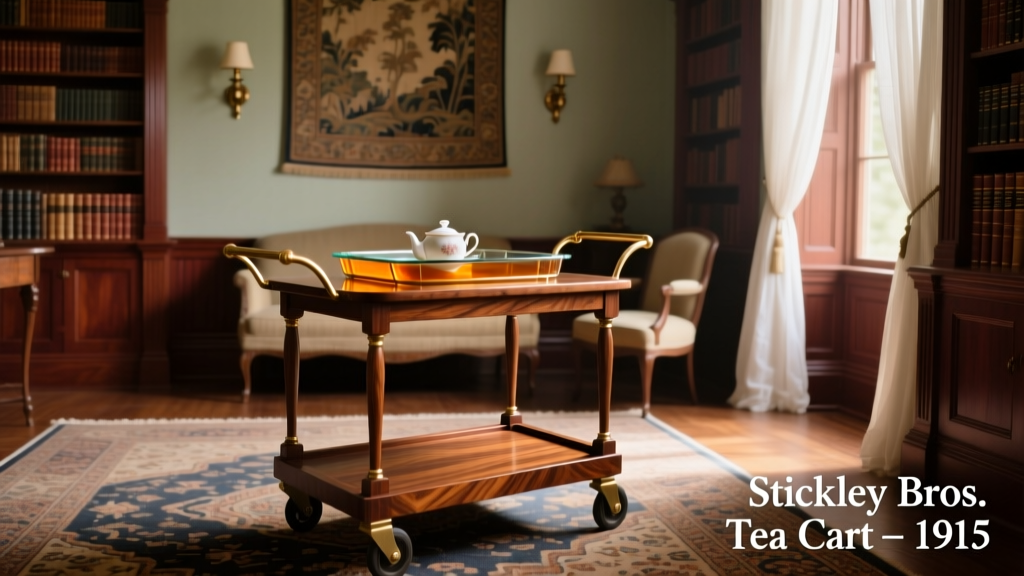
Stickley Bros. Tea Cart: Authenticating and Preserving a 1920s American Craftsmanship Icon with Removable Glass Tray and Curved Handles

Depression Glass Iris Tumbler: Iridescent Footed Design, 6-Inch Height, Pattern #3 Identification and Restoration Guide

Answers To Your Questions About Old Gold And Silver: Authenticity, Value, and Care for Antique Metalwork
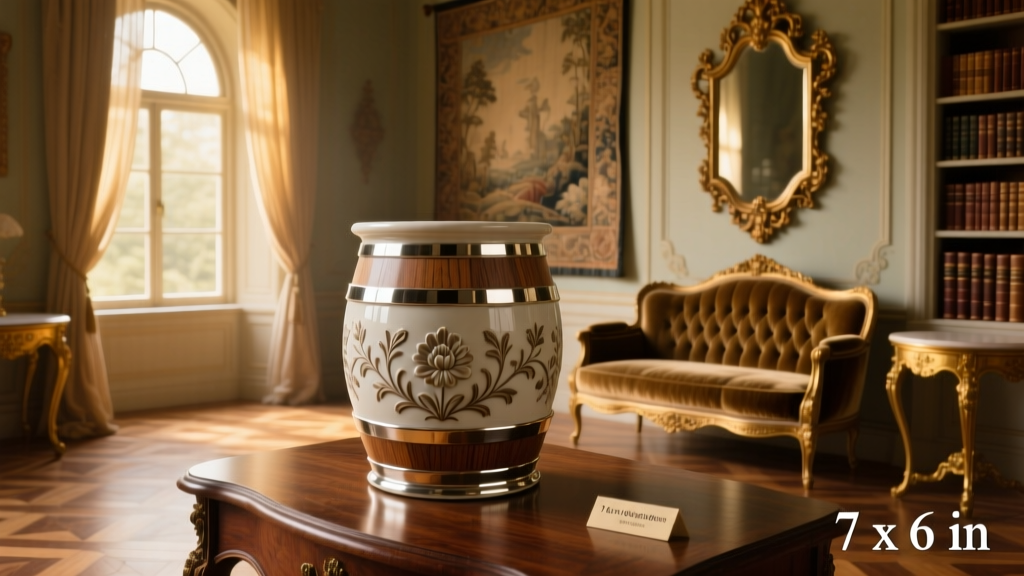
Store Barrel Biscuit Oak Ceramic Interior Chrome Trim (7 × 6 in): A Restoration Specialist’s Technical Analysis
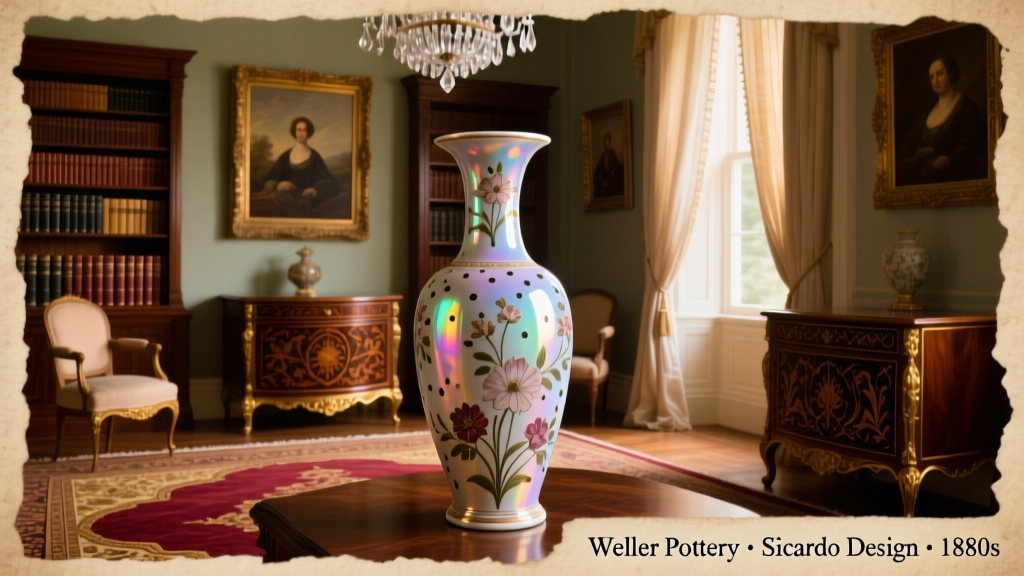
Weller Vase Sicardo Floral Design: Decoding the 10-Inch Iridescent Random Spotted Masterpiece
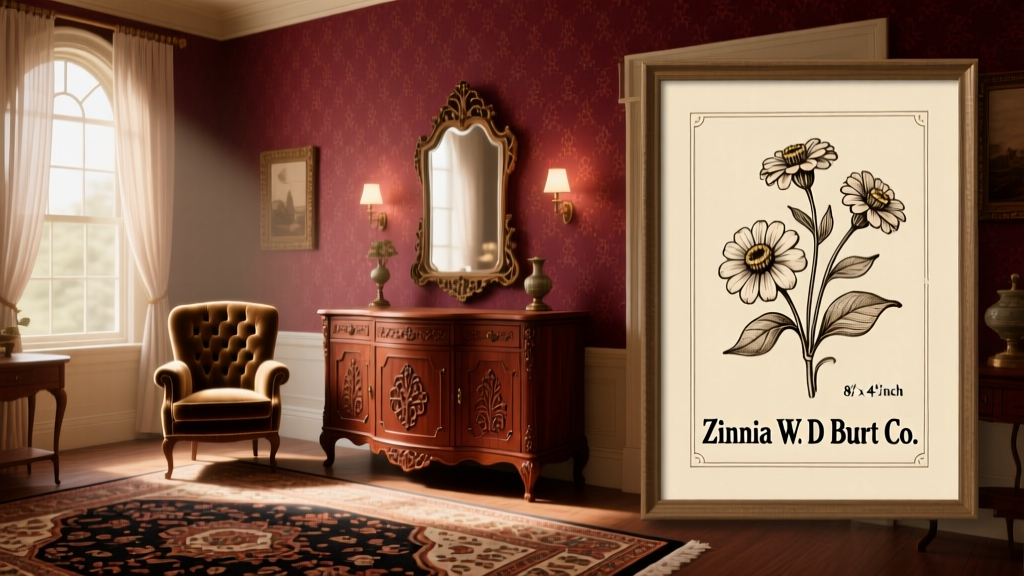
Zinnia Advertising Packet by W. D. Burt Co.: A 1930s American Furniture Marketing Artifact