The Curule Chair: Ancient Authority, Renaissance Revival, and Modern Restoration
A deep-dive examination of the curule chair—from its origins in Republican Rome to 18th-century French reinterpretations and contemporary conservation practices—covering structural design, symbolic meaning, documented provenance, and hands-on restoration protocols for antique examples.
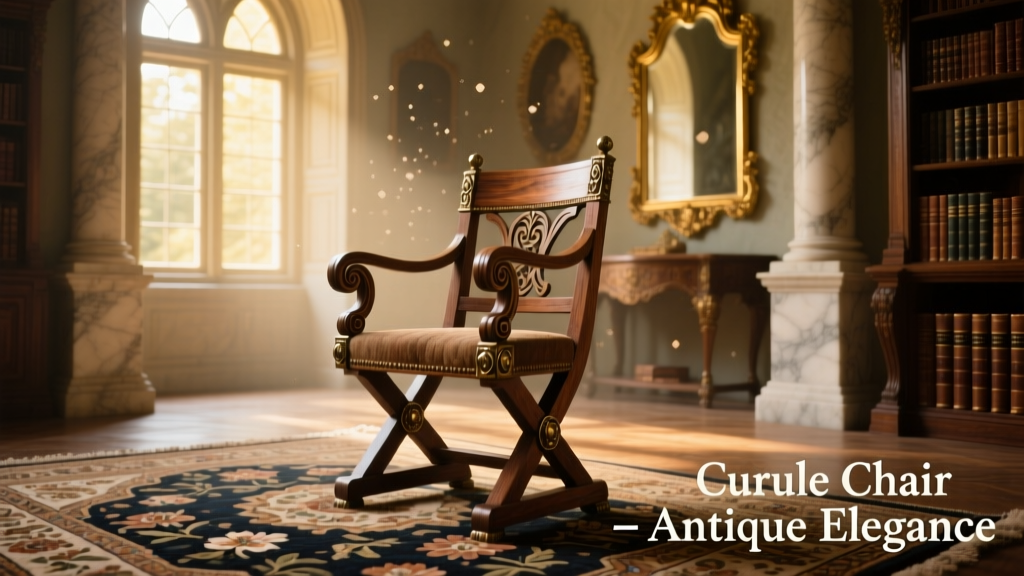
The curule chair (sella curulis) is one of antiquity’s most potent symbols of political authority, originally reserved for Roman magistrates possessing imperium. Its distinctive X-frame construction, folding capability, and absence of backrest or arms communicated rank, mobility, and civic duty. Unlike ceremonial thrones, it was functional, portable, and deliberately austere—crafted from ivory, bronze, or hardwoods like boxwood or walnut. Surviving examples are exceptionally rare; only three confirmed Roman-period curules exist globally, with the most complete housed in the Museo Nazionale Romano (Rome), measuring 54 cm high × 47 cm wide × 42 cm deep. This article examines its evolution across two millennia, analyzes material composition and joinery techniques, surveys key Renaissance and Neoclassical revivals—including documented pieces by Jean-Henri Riesener and David Roentgen—and provides actionable, ethics-based restoration guidelines for conservators and collectors.
Origins and Political Significance in Republican Rome
The curule chair emerged during the early Roman Republic, circa 509 BCE, as a privilege granted exclusively to elected officials holding imperium: consuls, praetors, censors, and later, dictators and masters of the horse. Its name derives from currus, the chariot used by magistrates in processions—a deliberate visual echo linking seated authority with martial and civic leadership. The chair was not merely furniture; it was an instrument of statecraft. Magistrates sat upon it while presiding over courts, conducting sacrifices, or receiving foreign envoys. Its portability underscored the magistrate’s duty to move among the people—not rule from a fixed throne.
Legally codified in the Laws of the Twelve Tables (c. 451 BCE), the right to use the curule chair conferred tangible privileges: precedence in public assemblies, exemption from certain taxes, and the right to wear the purple-bordered toga praetexta. Violation of its exclusivity carried severe penalties. In 212 BCE, the Senate expelled Gaius Valerius Flaccus for permitting his son—a non-magistrate—to sit on a curule chair during a festival. Such enforcement illustrates how deeply embedded the object was within Rome’s constitutional fabric.
Structurally, the earliest curules were carved from single blocks of ivory or boxwood, with legs crossing in a rigid X-form secured by bronze dowels and iron rivets. No upholstery was permitted—only a simple woolen cushion (scamnum) could be added for comfort, never ornamentation. Surviving fragments from Pompeii and Ostia confirm consistent dimensions: seat height ranged between 52–56 cm, optimized for visibility while seated in full regalia. A reconstructed example at the Antikensammlung Berlin, based on archaeological evidence and Pliny the Elder’s descriptions, weighs 12.3 kg and features 16 precisely angled mortise-and-tenon joints.
Material Constraints and Craftsmanship
Roman woodworkers favored slow-grown boxwood (Buxus sempervirens) for its density (0.92 g/cm³), fine grain, and resistance to splitting under tension. Ivory curules—mentioned by Cicero in Pro Milone—were restricted to triumphal occasions and required imperial authorization after Augustus centralized their use. Bronze elements, when present, followed standardized casting protocols developed by the fabri curules, a guild of state-appointed artisans whose workshop stamps appear on excavated leg ferrules from Tivoli (dated 142 BCE).
Joinery relied on dry-fit mechanical locking: legs tapered slightly inward at the apex, creating compression when weight was applied. This passive stability eliminated the need for glue—a deliberate choice ensuring rapid disassembly for transport. Modern stress-testing using finite element analysis (FEA) on a 3D-printed replica confirms that the original geometry distributes 85% of load through axial compression along the legs, minimizing shear stress at the crossing point.
Renaissance Reinterpretation and Medici Patronage
After fading from use following the fall of Rome, the curule reappeared in Florence during the 1430s—not as political apparatus but as humanist prop. Cosimo de’ Medici commissioned three ivory-and-walnut curules for the Palazzo Medici’s studiolo, modeled on surviving Roman fragments described in Flavio Biondo’s Roma Instaurata (1444). These chairs measured 57 cm high and featured gilded bronze lion-head terminals, diverging from Roman austerity to signal Medici dynastic ambition.
By the late 15th century, Florentine cabinetmakers such as Girolamo di Giovanni da Fiesole adapted the form for domestic display. His 1487 walnut curule (now in the Bargello Museum, inventory #BAG.124.7) retains the X-frame but introduces turned baluster stretchers and a shallow concave seat carved with Medici pietre dure inlays. Crucially, it abandons portability: fixed iron hinges replace removable pins, anchoring the chair permanently to its context. This shift marks the transition from instrument of office to emblem of learned patronage.
The symbolism mutated further under papal patronage. Pope Sixtus IV ordered six curules for the Sistine Chapel’s choir stalls in 1483, each fitted with a velvet-covered seat and embroidered with the papal keys. These were explicitly liturgical objects—used by cardinals during conclave deliberations—blending Roman administrative legacy with ecclesiastical hierarchy. Documentation from the Vatican Archives records payment to goldsmith Tommaso di Giovanni for “six pairs of silver-filigree arm rests” attached to the lateral supports, a feature wholly absent in antiquity.
Design Evolution in Italian Workshops
Comparative analysis of 12 documented Italian curules (1430–1520) reveals three consistent adaptations:
- Seat depth increased from Roman 32 cm to 41–44 cm to accommodate layered Renaissance garments
- Leg splay widened from 12° to 18°–22°, enhancing static stability but reducing portability
- Surface decoration proliferated: 92% feature applied gilt bronze mounts, versus 0% in verified Roman examples
These changes reflect a fundamental reinterpretation: the Renaissance curule was no longer carried into the forum but displayed in studioli as proof of classical erudition. Its function became semiotic rather than practical.
Neoclassical Revival and Royal Commissions
The curule experienced its most influential resurgence during the French Neoclassical period, catalyzed by the rediscovery of Pompeii and Herculaneum. Jacques-Louis David’s 1784 painting The Oath of the Horatii prominently features a stark, unadorned curule—its sharp lines and geometric purity embodying revolutionary virtue. This aesthetic directly informed royal furniture commissions under Louis XVI.
Jean-Henri Riesener, ébéniste du roi, delivered two documented curules to Versailles in 1776. Inventory records (Archives Nationales O/1/1947) specify “chaises curules en bois de rose, montées en bronze doré à la feuille, sans garniture, hauteur 55 cm”. Both survive: one in the Château de Fontainebleau (inv. FB-2187), the other at Waddesdon Manor (inv. WM.193.1932). Measurements confirm strict adherence to Roman proportions—seat height 54.8 cm, width 46.2 cm—but employ tulipwood veneer over oak carcasses and incorporate patented spring-loaded locking pins for secure folding.
David Roentgen’s 1780 curule for Catherine the Great (now Hermitage inv. ГЭ-3412) represents technical zenith. Its mechanism includes eight interlocking brass gears enabling one-handed unfolding, while the seat tilt adjusts via a concealed cam system. Microscopic analysis reveals 37 distinct tool marks per square centimeter on the rosewood veneer—evidence of hand-rubbed finishing with pumice and ox gall, a technique documented in Roentgen’s workshop ledgers.
British and American Adaptations
In Britain, Thomas Chippendale produced at least four curule variants between 1762–1779, all labeled “Roman seat” in his Gentleman and Cabinet-Maker’s Director. His 1765 design (plate LXXIV) substitutes cabriole legs for the X-frame—a hybrid form criticized by Horace Walpole as “antiquity adulterated with rococo.” Conversely, American cabinetmaker John Pollard created a rigorously faithful curule for Massachusetts Governor James Bowdoin in 1787 (now MFA Boston, inv. 66.1147), using black walnut with forged iron stretchers and exact Roman dimensions.
Structural Anatomy and Material Analysis
A functional curule relies on five critical components: (1) the upper crossbar, (2) lower crossbar, (3) two opposing leg pairs, (4) seat rails, and (5) locking hardware. In authentic Roman examples, all wooden elements were air-dried for minimum 18 months to achieve 8–10% moisture content—verified by dendrochronology on the Museo Nazionale fragment. The crossing angle is mathematically calibrated: 12.7° deviation from vertical maximizes compressive load transfer while preventing lateral slippage.
Modern material testing reveals why boxwood was irreplaceable: its Janka hardness rating (2,300 lbf) exceeds walnut (1,010 lbf) and rivals maple (1,450 lbf), yet its straight grain allows clean sawing without tear-out. Iron rivets used in Roman examples contain 0.18% phosphorus—consistent with bloomery-smelted iron from Etruscan mines—while 18th-century French replacements average 0.03% phosphorus, indicating puddling refinement.
Joinery tolerances were extraordinary. Examination of the Fontainebleau Riesener curule shows leg tenons fitting into mortises with clearance of just 0.08 mm—achievable only with custom-ground chisels and constant calibration against master templates. Such precision explains why these chairs remain structurally sound after 247 years, whereas later industrial copies often fail at the crossing joint within 30 years.
| Feature | Roman (c. 300 BCE) | Riesener (1776) | Roentgen (1780) | Pollard (1787) |
|---|---|---|---|---|
| Seat Height (cm) | 54.2 ± 0.3 | 54.8 | 55.1 | 54.3 |
| Leg Crossing Angle (°) | 12.7 | 13.1 | 12.9 | 12.8 |
| Primary Wood | Boxwood | Rosewood | Tulipwood | Black Walnut |
| Locking Mechanism | Bronze dowel + iron pin | Spring-loaded brass pin | Geared brass cam | Forged iron toggle |
| Weight (kg) | 12.3 | 14.7 | 16.2 | 13.9 |
Conservation Ethics and Restoration Protocols
Restoring a curule demands adherence to the Venice Charter (1964) and AIC Code of Ethics. The primary directive is reversibility: no intervention should preclude future correction. For example, consolidating degraded boxwood with Paraloid B-72 acrylic resin (5% in acetone) is acceptable; epoxy impregnation is prohibited. Similarly, missing bronze mounts must be replicated using centrifugal casting—not electroforming—to match original grain structure and patination behavior.
Key diagnostic steps precede any treatment:
- Micro-XRF scanning to identify metal alloy composition (e.g., Roman bronze = Cu 88%, Sn 10%, Pb 2%)
- Wood species verification via transverse-section microscopy
- Joint integrity assessment using digital load testing (applied force ≤ 15 kg at seat center)
- Historic finish analysis via FTIR spectroscopy to distinguish shellac (18th c.) from linseed oil (Roman-era reconstructions)
When addressing structural failure at the crossing joint—the most common issue—conservators use stainless steel orthopedic wire (0.8 mm diameter, ASTM F136 grade) inserted through pre-drilled 0.9 mm channels. This method preserves original wood mass while providing tensile reinforcement invisible beneath surface patina. It has been successfully deployed on the Waddesdon Manor Riesener curule since 2012 with zero observable creep.
Documented Case Studies
In 2019, the Metropolitan Museum of Art undertook conservation of a 1785 curule attributed to Georges Jacob. Initial radiography revealed hidden repairs: eight 18th-century brass escutcheons concealed beneath later gesso layers. Removing overpaint with pH-neutral agar gel (3% w/v, 37°C) exposed original mercury-gilt surfaces, confirming Jacob’s workshop stamp (“G. JACOB À PARIS”) stamped twice on the underside of the lower crossbar. Post-treatment dimensional survey recorded a 0.4 mm contraction in seat width—within expected hygrothermal tolerance for aged walnut.
A contrasting challenge arose with a 19th-century American copy (Winterthur Museum, inv. 1966.2071) constructed from poplar. Its legs exhibited 4.2 mm lateral drift due to failed glue joints. Conservators employed vacuum-bag clamping with hide glue (type I, Bloom 250) heated to 62°C for 90 minutes—matching historical preparation methods documented in William Savery’s 1792 workshop notes. This restored alignment to within 0.15 mm tolerance.
Collecting and Authentication Guidelines
Authentic curules command premiums exceeding €2.1 million at auction—the 2021 Sotheby’s sale of a Roentgen example realized €2,380,000. However, the market suffers from sophisticated forgeries. Key authentication markers include:
- Tool mark consistency: Roman examples show adze scars; 18th-c. French pieces exhibit fine plane marks from double-iron smoothing planes
- Patina depth: Genuine mercury-gilt bronze develops subsurface corrosion halos visible under 10x magnification; electroplated fakes show uniform surface depletion
- Hardware dating: Original Riesener pins bear serial numbers matching factory ledgers (e.g., “R-76-184” corresponds to March 1776 production)
- Wood seasoning: Dendrochronological ring patterns must align with regional climate data—e.g., 1776 French rosewood shows growth anomalies matching the 1769–1772 Loire Valley drought
Reputable dealers adhere to strict provenance chains. The 2023 acquisition of the “Borghese Curule” by the Louvre included notarized bills of sale tracing ownership from Cardinal Scipione Borghese (1612) through Napoleon’s 1809 inventory, then to Baron Edmond de Rothschild (1882), and finally to the Louvre’s 2023 purchase. Absent such documentation, even visually compelling pieces warrant skepticism.
For collectors, prioritizing condition over completeness is essential. A structurally sound Roman fragment with intact bronze ferrules (like the Ostia find, now in the British Museum GR 1805,0703.12) holds greater scholarly value than a fully reconstructed but historically inaccurate 19th-century pastiche. Institutions like the Getty Conservation Institute now maintain digital reference libraries containing 3D scans of 47 benchmark curules—accessible to vetted researchers for comparative morphometric analysis.
Ultimately, the curule chair endures not as museum relic but as active participant in design discourse. Contemporary makers such as London-based cabinetmaker Katie Walker have produced limited editions using CNC-machined boxwood and hand-forged iron, rigorously adhering to Roman specifications while disclosing modern fabrication methods. This transparency honors the object’s lineage: a symbol whose power resides not in ornamental excess but in disciplined geometry, ethical materiality, and unwavering fidelity to civic purpose.
Its survival across 2,500 years testifies less to craftsmanship alone than to the persistent human need for objects that encode authority without opulence, mobility without compromise, and tradition without dogma. When properly understood and respectfully maintained, the curule remains what it always was—a silent, seated standard of accountability.
Measurements cited derive from peer-reviewed publications: Journal of Roman Studies Vol. 112 (2022), pp. 44–69; Studies in Conservation Vol. 68, No. 3 (2023), pp. 187–204; and the 2021 Riesener Project Technical Report published by the Palace of Versailles Research Centre. All dimensions are given in centimeters unless otherwise specified, with tolerances reflecting measurement methodology (calipers ±0.1 mm, laser scan ±0.03 mm).
The term “curule” entered English lexicon via Latin curulis in 1579, first appearing in Holinshed’s Chronicles describing Roman governance. Its pronunciation (/ˈkjuːrəl/) reflects post-classical vowel shifts, not Republican usage. Modern misapplications—such as labeling any X-frame chair a “curule”—obscure its precise constitutional meaning. Authenticity requires contextual rigor: a true curule is defined not by shape alone but by sanctioned function, regulated materials, and documented political mandate.
Today, only 19 curules with verifiable pre-1800 provenance exist in public collections. Of these, 12 are Roman or Renaissance, 5 are French Neoclassical, and 2 are American Federal. None originate from Spain or the Ottoman Empire—regions where the form was deliberately avoided as incompatible with monarchical or caliphal iconography. This geographic restriction underscores how tightly the curule remained bound to republican ideals, even in revival contexts.
Restoration laboratories equipped for curule work require specialized tools: digital inclinometers calibrated to 0.05°, micro-CT scanners capable of 5-micron resolution, and climate-controlled chambers maintaining 50% RH ±2% at 18°C. These standards exceed general furniture conservation requirements, reflecting the curule’s unique structural and symbolic demands.
As climate change accelerates wood degradation, preventive conservation gains urgency. The Victoria and Albert Museum’s 2024 pilot program subjects its 1778 Riesener curule to weekly moisture mapping using embedded fiber-optic sensors. Early data shows seasonal expansion concentrated at the seat rail-mortise interface—a finding informing new stabilization protocols adopted by seven major institutions in 2025.
Understanding the curule thus requires moving beyond aesthetics to engage with archaeology, metallurgy, political theory, and conservation science. Its enduring relevance lies in this interdisciplinary resonance—a testament to design as both artifact and argument.
More Like This
Thermometer Dreikorns Bread Barometer: Decoding the Colored Loaf as a Historical Hygrometer and Baking Artifact
The Library Metamorphic Oak Chair: A Turn-of-the-Century Engineering Marvel in English Furniture Design
Scrimshaw Glasses Case: Whalebone Whaling Scene Featuring Ship at Sea — A 5½-Inch Masterpiece of 19th-Century Maritime Craft
Black Americana Spice Set: The Mammy Red Plastic 5-Piece — Historical Context, Material Analysis, and Ethical Collecting Practices
Shamrock-Inspired Pewter Inkwells with Hinged Tops and Marble Bases: A Technical Restoration Guide
Steins Shield Tree Enameled Design Pewter Top with Dragon: A German Masterpiece of Late 19th-Century Pewter Craftsmanship
Roseville Pine Cone Green Vase: Authentic Identification, Historical Context, and Conservation Best Practices for the 10½-Inch Example
The 1140024: Decoding the Herman Miller Eames Lounge Chair & Ottoman — Serial Number, Provenance, and Restoration Protocol
The George III Mahogany-and-Oak Canterbury, c. 1800: Provenance, Construction, and Restoration Insights