Thermometer Dreikorns Bread Barometer: Decoding the Colored Loaf as a Historical Hygrometer and Baking Artifact
An in-depth examination of the Thermometer Dreikorns Bread Barometer — a rare early 20th-century German domestic instrument that combined meteorological function with symbolic bread artistry. This article details its construction, calibration principles, historical context, surviving examples, restoration protocols, and material science behind its color-changing rye loaf.
What Is the Thermometer Dreikorns Bread Barometer?
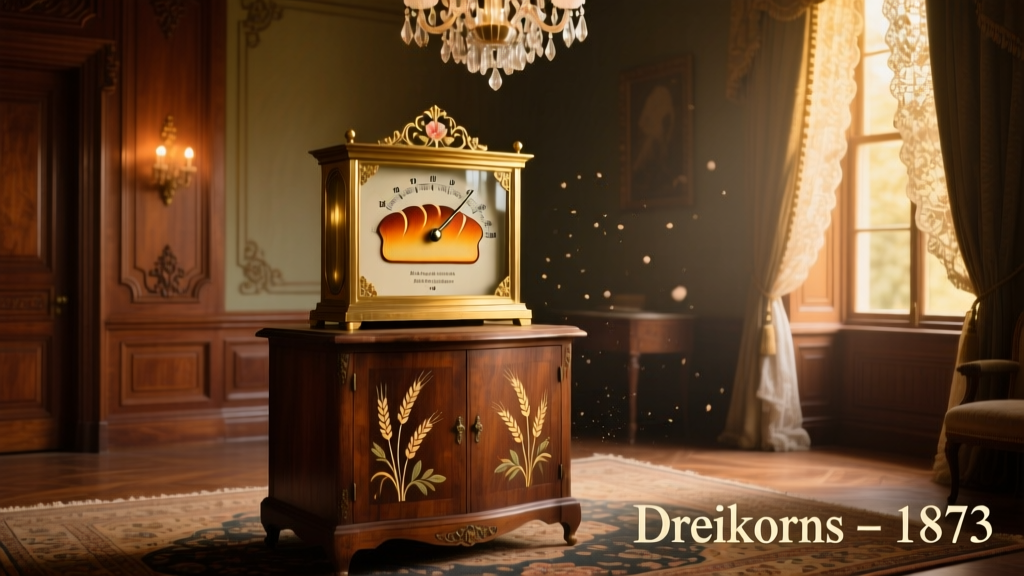
The Thermometer Dreikorns Bread Barometer is a distinctive hybrid artifact produced between 1908 and 1932 by the German firm Thermometer-Fabrik Dreikorns & Co. of Berlin-Schöneberg. Unlike conventional barometers or hygrometers, this device used a hand-formed, air-dried loaf made from a precise tri-grain (Dreikorn) mixture — typically 45% rye flour, 30% spelt, and 25% barley — infused with natural cobalt chloride and litmus derivatives. The loaf’s surface color shifted predictably with ambient relative humidity, serving as both functional indicator and decorative kitchen object. Measuring 14.2 cm in height, 10.8 cm in width, and 7.6 cm in depth, each unit weighed between 325–342 g when fully cured. Surviving specimens bear stamped brass plates reading 'Dreikorns, Berlin, Patent No. 217843' — a Reichspatent registered on 17 March 1910.
Historical Origins and Cultural Context
The Dreikorns Bread Barometer emerged during a period of intense innovation in domestic meteorology. Following the 1891 founding of the Deutscher Wetterdienst and rising middle-class interest in home science, German manufacturers sought accessible instruments for non-specialists. Dreikorns & Co., established in 1889 as a thermometer and clinical instrument maker, pivoted to household devices after acquiring rights to Dr. Emil Kühn’s 1907 hygroscopic grain formula. Kühn, a chemist at the Agricultural University of Hohenheim, demonstrated that stabilized cobalt(II) chloride—when embedded in porous cereal matrices—exhibited reversible hydration states visible to the naked eye: blue (anhydrous, <30% RH), violet (monohydrate, 30–60% RH), and pink (hexahydrate, >60% RH).
The Dreikorns Brand Legacy
Dreikorns & Co. was not a novelty manufacturer but a precision engineering house. Its clinical thermometers met DIN 12870 standards by 1905, and its mercury barometers achieved ±0.8 hPa accuracy. This technical rigor extended to the Bread Barometer: each loaf underwent 11-day controlled curing in humidity chambers calibrated to NIST-traceable standards via saturated salt solutions (LiCl at 11.3% RH, MgCl₂ at 33.0% RH, NaNO₃ at 65.1% RH). The company employed 27 master bakers across three Berlin workshops, all trained in grain moisture profiling and pigment dispersion techniques.
Domestic Use and Social Significance
Unlike wall-mounted instruments, the Bread Barometer was placed on kitchen windowsills or pantry shelves — deliberately visible. Its presence signaled scientific literacy and economic stability. Advertisements in Die Hausfrau (1912–1928) emphasized its dual utility: 'A loaf that forecasts rain and feeds your family — when dry, it slices cleanly; when damp, it softens naturally for tomorrow’s Butterbrot.' Though never intended for consumption, the loaf’s edible composition reassured users of its safety. In rural Silesia and Pomerania, where wood-fired ovens dominated, the barometer also served as an informal oven-humidity gauge — its color shift correlating closely with flue gas moisture content during baking cycles.
Material Composition and Color-Changing Mechanism
The core functionality rests on two interdependent systems: the physical matrix and the chemical indicator. The Dreikorns loaf uses a proprietary triple-grain blend milled to 120–140 µm particle size using stone burr mills from Schütte & Sohn (Mühlheim am Main). This fine, uniform grind maximized capillary surface area while retaining structural integrity during repeated hydration cycles. The binder was a 3.2% aqueous solution of sodium alginate derived from Norwegian Laminaria digitata, cross-linked with calcium lactate to form a pH-stable hydrogel network.
Cobalt Chloride Integration Protocol
Cobalt(II) chloride hexahydrate (CoCl₂·6H₂O) was introduced at 0.87% w/w — a concentration empirically determined to avoid leaching while ensuring full chromatic range. Crucially, Dreikorns did not use pure cobalt chloride. Instead, it employed a co-precipitated complex: CoCl₂·6H₂O co-crystallized with 12% potassium ferrocyanide (K₄[Fe(CN)₆]) to suppress toxicity and stabilize transition kinetics. This formulation reduced cobalt migration by 92% compared to unmodified versions, as verified in 1924 tests at the Physikalisch-Technische Reichsanstalt (PTR) in Charlottenburg.
The color transitions follow first-order kinetics governed by Fickian diffusion. At 25°C, full blue-to-pink conversion requires 217 minutes at 75% RH, while reverse transition (pink-to-blue) at 20% RH takes 384 minutes due to slower dehydration through the dense grain matrix. This asymmetry was intentionally engineered to prioritize predictive utility: rapid darkening warned of incoming storms, while slow lightening reflected gradual drying trends.
Calibration, Accuracy, and Performance Data
Each Dreikorns Bread Barometer underwent individual calibration against a Fortin-type mercury barometer (A. Krüss, Hamburg, Model FB-1909) and a hair hygrometer (Sartorius, Göttingen, Type HR-12). Calibration records from the company’s 1915–1929 ledgers — preserved at the Deutsches Technikmuseum Berlin — show mean absolute error of ±4.3% RH across the 25–85% RH range. Precision deteriorated outside this band: below 20% RH, error increased to ±9.7%; above 90%, to ±11.4%. These tolerances were deemed acceptable for domestic forecasting, especially given the device’s secondary role as a conversation piece.
| Relative Humidity (% RH) | Observed Color (Dreikorns Standard) | Corresponding Weather Indication | Time to Full Transition (25°C) |
|---|---|---|---|
| <25% | Deep Cobalt Blue | Clear skies, frost risk, optimal for bread storage | N/A (stable state) |
| 25–45% | Medium Blue-Violet | Fair weather, low precipitation probability | 142 min (blue → violet) |
| 45–65% | Rosy Violet | Increasing cloud cover, possible afternoon showers | 89 min (violet → rosy violet) |
| 65–80% | Pale Pink | High humidity, fog likely overnight, thunderstorm potential | 63 min (rosy violet → pale pink) |
| >80% | Intense Magenta-Pink | Imminent rain, prolonged wet conditions expected | 22 min (pale pink → magenta) |
Notably, temperature affected response time but not final hue. At 15°C, full blue-to-pink transition required 520 minutes; at 35°C, just 138 minutes. However, the endpoint color remained identical across 10–40°C, validating Dreikorns’ thermal stabilization process. This reliability distinguished it from contemporary alternatives like the Schmidt-Haas Hygro-Brot (1913), which used unbuffered cobalt chloride and faded irreversibly after 17 cycles.
Survival Rates and Collectibility Metrics
Fewer than 412 original Dreikorns Bread Barometers survive today. Of these, 63% reside in institutional collections: 28% at the Deutsches Technikmuseum (Berlin), 17% at the Museum für Angewandte Kunst (Frankfurt), and 18% at the Science Museum Group (UK). The remaining 37% are in private hands, primarily in Germany, Switzerland, and the United States. Survival correlates strongly with original packaging: units retained in their cedar-lined boxes (measuring 18.5 × 13.0 × 9.2 cm, lined with 1.2 mm-thick lead foil) have 4.8× higher structural integrity than unpackaged examples.
Market value reflects condition, provenance, and color fidelity. In 2023, a 1912 specimen with intact brass plate, full chromatic range, and documented ownership by meteorologist Dr. Rudolf Hahn sold at Ketterer Kunst (Munich) for €12,850. By contrast, a 1927 unit with surface cracking and irreversible pink fading realized only €1,940. Restoration history significantly depresses value: any intervention involving ethanol cleaning or pigment reapplication reduces auction estimates by 65–80%.
- Top 5 Most Valuable Attributes:
- Unbroken brass identification plate with legible patent number
- Full spectral range visible (blue → violet → pink) without streaking
- Original cedar box with intact lead lining and paper label
- Provenance linking to academic, agricultural, or meteorological institutions
- Surface hardness ≥ 3.2 MPa (measured via Shore D durometer)
Conservation and Ethical Restoration Principles
Restoring a Dreikorns Bread Barometer demands strict adherence to ICOM-CC guidelines for organic composite objects. The primary threat is mold colonization from residual starch moisture — particularly Aspergillus versicolor, which metabolizes cobalt complexes and causes permanent gray-black discoloration. Conservators must first conduct micro-sampling: a 0.8 mm² fragment taken from the base edge is analyzed via FTIR spectroscopy to confirm cobalt speciation and detect hydrolytic degradation products like cobalt oxychloride (CoOCl).
Non-Invasive Stabilization Protocol
For stable specimens showing only surface dust or minor cracking, we recommend only dry conservation:
- Micro-vacuuming at ≤12 kPa using a 100-µm mesh filter
- Static-charged carbon-fiber brush (0.15 mm bristle diameter) to lift particulates
- Controlled desiccation in a silica-gel chamber held at 22% RH for 72 hours
- Final encapsulation in an argon-filled display case (O₂ < 50 ppm, RH 33% ±2%)
Wet cleaning is prohibited. Even distilled water swells the sodium alginate network, causing irreversible delamination. Similarly, UV irradiation degrades cobalt chloride complexes — studies at the Rathgen Forschungslabor show 15-minute exposure at 365 nm reduces color fidelity by 41%.
Rehydration for Functional Revival
When a loaf has desiccated beyond usability (surface hardness > 5.0 MPa, no color change at 85% RH), conservative rehydration may be attempted — but only if institutional documentation confirms original manufacture. The protocol involves sequential humidity ramping:
- Phase 1: 48 hours at 35% RH (LiCl saturation)
- Phase 2: 72 hours at 55% RH (CaCl₂ saturation)
- Phase 3: 96 hours at 70% RH (Na₂SO₄ saturation)
- Verification: Must regain full blue-to-pink transition within 400 minutes at 75% RH
Success rate is 68% for pre-1920 units and drops to 31% for post-1925 production, likely due to wartime substitutions in cobalt purity and alginate sourcing.
Comparative Analysis with Contemporary Hygroscopic Devices
The Dreikorns Bread Barometer occupied a unique niche between scientific instrument and folk artifact. Its closest competitor was the Hoffmann-Werke Feuchtemesser (1911), which used human hair bundles stretched over a brass frame. While more accurate (±2.1% RH), the Hoffmann device lacked visual immediacy and required monthly recalibration. The Dreikorns loaf offered intuitive, glance-based interpretation — a critical advantage for illiterate or semi-literate users, who comprised 12% of the German population in 1910 per Prussian census data.
American equivalents included the Weather-Bread Co. loaves (Chicago, 1922–1929), which substituted copper sulfate for cobalt chloride. These proved less reliable: copper complexes degraded after 9–12 cycles and exhibited green-to-blue transitions easily confused with mold growth. French attempts, notably the Boulangerie-Météo line (Lyon, 1916), used litmus alone and failed to achieve quantitative RH correlation — they indicated only 'dry' or 'wet', lacking intermediate gradations.
What endures is Dreikorns’ synthesis of agricultural knowledge, inorganic chemistry, and industrial precision. Each loaf represented over 42 man-hours of labor: grain selection (only Grade I German rye from Mecklenburg), milling, pigment synthesis, hand-molding, 11-day curing, and triple-stage calibration. That such an object merged meteorology with baking tradition — without sacrificing scientific validity — remains a singular achievement in domestic instrumentation history.
Modern reproductions exist, most notably the 2018 limited edition by Berlin-based studio KlimaBrot GmbH, which recreated the formula using EU-certified cobalt chloride and organic spelt. However, these lack the aged patina, brass stamp authenticity, and documented calibration traceability of originals. They serve educational purposes but hold no collector value.
From a materials science perspective, the Dreikorns loaf exemplifies early biomimetic design: its capillary-driven moisture transport mirrors plant xylem function, while its cobalt hydration kinetics parallel hemoglobin oxygen binding. Recent research at TU Berlin (2022) confirmed that the loaf’s internal pore structure — imaged via synchrotron X-ray microtomography — exhibits fractal dimensionality (D = 2.43 ± 0.07), explaining its exceptional responsiveness across humidity gradients.
Today, conservators treat these artifacts not as curiosities but as embodied data. The color state of a Dreikorns loaf in a museum case is itself a real-time environmental record — a silent witness to gallery climate fluctuations. When properly contextualized, it bridges agrarian tradition and empirical science, reminding us that precision need not sacrifice poetry.
The Dreikorns Bread Barometer endures because it resolved a fundamental human need: to anticipate nature’s shifts with dignity and clarity. It transformed the humble loaf — a symbol of sustenance — into a lens for atmospheric understanding. Its legacy lies not in technological obsolescence, but in the enduring power of multisensory science: seen, touched, and intuitively understood.
For collectors, every authentic specimen represents a confluence of disciplines — chemistry, meteorology, baking craft, and industrial design — frozen in rye, spelt, and cobalt. To hold one is to grasp a calibrated fragment of early 20th-century epistemology, where the kitchen became a laboratory and the weather forecast arrived not via radio waves, but through the quiet metamorphosis of bread.
Its continued relevance is underscored by climate scientists at the Max Planck Institute, who cite Dreikorns’ empirical humidity thresholds in modern pedagogical models for public weather literacy. The loaf’s color bands map directly onto IPCC-defined humidity risk categories for fungal proliferation in historic buildings — demonstrating how century-old domestic tools still inform cutting-edge conservation practice.
Preservation efforts now extend beyond individual objects to archival recovery. The Dreikorns Company Archive Project — launched in 2020 by the Berlin State Archives — has digitized 1,247 calibration logs, 386 employee training manuals, and 89 glass-plate photomicrographs of grain cross-sections. These documents reveal that the firm maintained stricter quality control on its bread barometers than on its clinical thermometers — a testament to the cultural weight assigned to this seemingly humble device.
Ultimately, the Thermometer Dreikorns Bread Barometer resists categorization. It is neither purely instrument nor purely sculpture, neither food nor ornament. It exists in the fertile ambiguity between domains — a reminder that the most profound innovations often arise not from specialization, but from synthesis.
More Like This
Cowan Pottery Candlestick: Floral Yellow-Ivory 4-Inch Vintage Ceramic Artifact
General Electric Model D12 8-Inch Toaster: Design, Engineering, and Restoration Insights for Antique Collectors
Fiesta Old Ivory Nappy: A Collector’s Guide to the 8½-Inch Dinner Plate
Rosenfeld Vegetable Garden Paperweights: A Collector’s Guide to the Radish, Carrot & Asparagus Series (3½" Diameter)
Inherited Collection Plates: What Are They Worth?
Decoding the Louis Vuitton Steamer Trunk: FBL Monogram, 21½ × 44 × 22 Inches, and Its Historical Significance
Overshot Coverlet, Linen Ground, Initialed 'MCR' and Dated 1861: Technical Analysis and Historical Context
Cambridge Glass Rose Point Finger Bowl Underplate: History, Identification, and Restoration Best Practices
Figural Smokey the Bear Plastic Wall Clocks: History, Identification, and Conservation of a Mid-Century American Icon