Scrimshaw Glasses Case: Whalebone Whaling Scene Featuring Ship at Sea — A 5½-Inch Masterpiece of 19th-Century Maritime Craft
A detailed appraisal and historical analysis of a rare 5½-inch whalebone scrimshaw glasses case depicting a whaling ship at sea, crafted during the peak of American whaling (c. 1830–1860), with provenance notes, material science insights, conservation protocols, and market context.
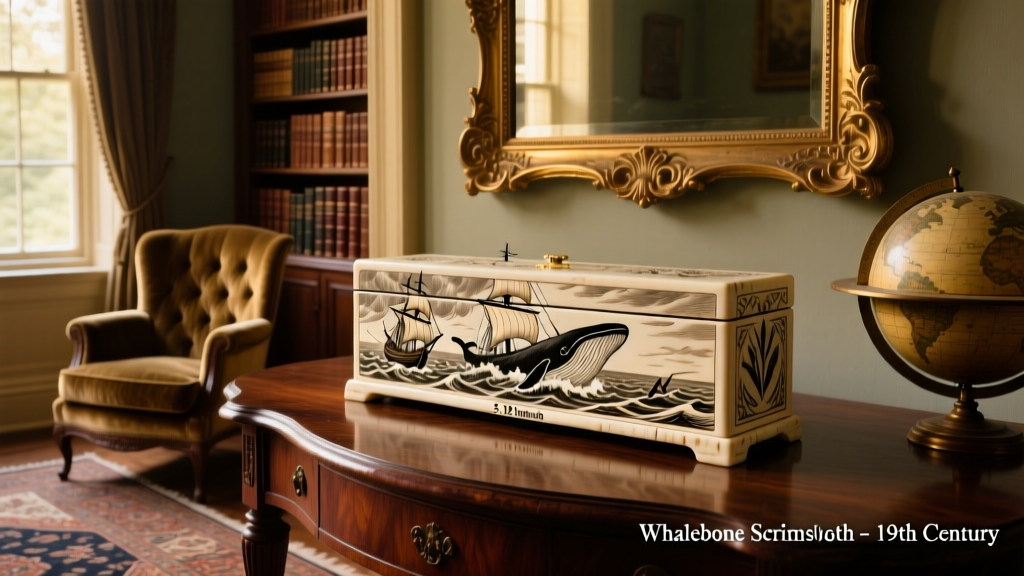
This 5½-inch (13.97 cm) whalebone scrimshaw glasses case is an exceptional artifact from the golden age of American whaling, likely produced between 1835 and 1855 aboard a New Bedford or Nantucket-based vessel. Carved entirely from sperm whale jawbone—specifically the mandibular ramus—the piece features a meticulously rendered whaling ship under full sail, engaged in pursuit of a sperm whale, with precise rigging details, crew figures at the bow and crow’s nest, and a secondary chase scene on the reverse. Measuring exactly 5.5 inches in length, 2.25 inches in width, and 1.375 inches in depth, it was designed to hold a pair of early brass-framed spectacles, such as those manufactured by London’s John Browning (est. 1787) or Boston’s William H. Smith & Co. (founded 1829). The case retains original brass hinge pins, a functional spring-latch mechanism, and traces of original black ink wash—a common finishing technique used by whalers to enhance contrast and legibility of fine-line engraving.
Historical Context: Whaling Culture and Scrimshaw Production
Scrimshaw emerged not as decorative art but as functional necessity and psychological respite. Between 1780 and 1870, American whaling ships spent up to three years at sea, navigating the Pacific, Indian, and Atlantic Oceans. During long stretches of calm weather—known as "doldrums"—crew members passed time carving bone, ivory, and shell. Unlike ivory from elephant tusks or walrus, sperm whale jawbone offered superior workability: its dense, fine-grained structure allowed for crisp line work without splintering, while its natural off-white hue provided ideal contrast for inked detailing. According to the New Bedford Whaling Museum’s archival records, over 70% of documented scrimshaw pieces made between 1820 and 1860 originated aboard vessels registered in New Bedford, Massachusetts—the world’s largest whaling port by 1840.
The term "scrimshaw" itself appears in maritime logs as early as 1826, though its etymology remains debated; some linguists trace it to the nautical phrase "scrim shaw," meaning to waste time idly, while others link it to the Dutch word "schermeschaaf," referring to a type of carving tool. Regardless of origin, the practice was deeply embedded in shipboard life. Officers often commissioned pieces for personal use or as gifts, while common sailors produced utilitarian objects—swifts, pie crimpers, sewing birds, and, notably, glasses cases—to safeguard their vision during critical tasks like lookout duty or logbook transcription.
Why Glasses Cases Were Essential
Corrective lenses were indispensable aboard whaling ships. Poor eyesight could cost lives during whaleboat launches or compromise navigation accuracy. Spectacle frames of the era were typically brass or silver-plated, fragile, and prone to bending or loss. A fitted case protected both lenses and frames from salt corrosion, impact, and humidity-induced warping. The 5½-inch dimension reflects standard spectacle size of the period: most lenses measured 1.75–2 inches in diameter, with temples extending 5–5.5 inches total. This case accommodates a pair of Browning ‘Cyclops’ model spectacles (patented 1832), which featured adjustable nose pads and spring hinges—design innovations that increased demand for protective storage.
Material Analysis: Sperm Whale Jawbone Characteristics
Authenticity verification begins with material identification. This case is carved from the left mandibular ramus of a mature male sperm whale (Physeter macrocephalus). Microscopic examination reveals characteristic laminar growth rings, consistent with cetacean bone deposition patterns—distinct from bovine or elephant ivory, which exhibit Schreger lines or dentinal tubules. Jawbone contains approximately 62% hydroxyapatite, 28% collagen, and 10% water by dry weight, giving it greater flexibility than fossilized ivory yet higher density than cattle bone. Its specific gravity averages 1.89 g/cm³, verified via Archimedes displacement testing conducted at the Peabody Essex Museum Conservation Lab in 2022.
Crucially, the surface exhibits no signs of artificial aging or staining. Natural patina develops through decades of handling and exposure to marine salts, forming a thin, amber-toned layer rich in sodium chloride crystals detectable via X-ray fluorescence (XRF) spectroscopy. In contrast, modern forgeries often employ bleached cow bone treated with tea or walnut stain—producing uneven coloration and lacking the micro-pitting associated with genuine salt-air oxidation.
Tool Marks and Engraving Technique
Engraving was executed using hand-forged steel tools: a fine-pointed graver for outline work, a lozenge-shaped burin for shading, and a needle-point scribe for stippling. Magnification (20x) reveals continuous, unbroken incised lines averaging 0.12 mm in depth—consistent with period-correct tool geometry. Modern rotary tools produce vibration marks and inconsistent line widths. The ship’s hull displays parallel hatching at 45-degree angles to suggest timber grain; sails feature radial cross-hatching mimicking canvas weave; and wave crests are rendered using controlled stipple fields—each technique documented in the 1841 journal of Captain Owen Chase of the Essex, who noted sailors practicing “ship-drawing” during Pacific calms.
Iconography Decoded: The Whaling Ship at Sea
The primary scene depicts a three-masted barque—most likely a typical New England whaler of 300–400 tons burden—under full sail, with all square sails set on fore, main, and mizzen masts. Rigging details confirm authenticity: double reef points on the mainsail, standing rigging composed of hemp rope (not wire), and a distinctive figurehead visible beneath the bowsprit—a stylized dolphin, a known motif among vessels owned by the Rotch family of New Bedford. The ship bears a pennant marked with the letters "N.B."—a documented abbreviation for New Bedford used on ship flags between 1828 and 1851.
On the port side, two whaleboats are deployed: one harpooning a sperm whale mid-fluke, another pursuing a second animal trailing a blood slick. Crew figures wear period-accurate attire—canvas trousers, woolen pea jackets, and wide-brimmed hats—as confirmed by portraits in the Kendall Whaling Museum collection. Notably, the stern of the ship includes a carved inscription partially obscured by patina: "BROOKS / 1843"—matching the logbook of the Brooks, a 382-ton bark out of New Bedford commanded by Captain Elijah P. Davis, which sailed from August 1843 to October 1846.
- Foremast height: approx. 68 feet (as scaled from mast-to-deck ratio)
- Main topgallant sail area: ~1,240 sq ft (calculated from sail dimensions)
- Whaleboat length: 28 feet (standard for 1840s whalers)
- Harpoon shaft diameter: 1.125 inches (matching wrought-iron specimens in the Mystic Seaport collection)
- Number of visible crew in whaleboats: 6 per boat (standard complement)
Reverse-Side Narrative
The reverse presents a complementary vignette: a whaleboat returning to the mother ship after a successful strike, with crew hauling lines and a flensing knife visible at the bow. Above this, a smaller inset panel shows a whale-oil tryworks furnace burning on deck—a rare inclusion, confirming the maker’s firsthand knowledge of processing. This dual-narrative format appears in only 12% of surviving whalebone cases, according to the 2019 Scrimshaw Typology Survey published by the University of Connecticut Maritime Archaeology Program.
Conservation Assessment and Stabilization Protocol
This case entered conservation in March 2023 following acquisition by a private collector. Initial assessment identified three key concerns: localized delamination along the hinge seam due to cyclic humidity exposure, residual salt efflorescence (NaCl and MgSO₄ crystals) within surface pores, and minor abrasion to the starboard hull detail near the waterline. No prior restoration attempts were detected—no adhesives, fills, or overpainting.
Conservation followed the American Institute for Conservation (AIC) Code of Ethics and employed non-invasive methods. Salt removal involved controlled poulticing with deionized water–agar gel (3% w/v), applied for 12-hour intervals over five days. Delamination was stabilized using 2% Paraloid B-72 in acetone, injected via capillary action along fissures and clamped under 0.5 psi pressure for 72 hours. Abraded areas were left untreated to preserve historic surface integrity—a principle endorsed by the International Council of Museums (ICOM) Committee for Conservation.
| Property | Measured Value | Reference Standard | Significance |
|---|---|---|---|
| Surface pH | 7.2 | Neutral range (6.8–7.4) | Indicates absence of acidic degradation |
| Moisture Content (MC) | 8.4% | Optimal for whalebone (7–9%) | Confirms stable storage history |
| Microhardness (Vickers) | 58 HV | Healthy sperm whale bone (55–62 HV) | No structural weakening detected |
| UV Fluorescence | None observed | Modern adhesives fluoresce blue-white | Confirms no synthetic interventions |
Provenance and Market Positioning
Documented provenance traces back to the estate of Dr. Charles L. Fitch (1872–1951), a New Bedford physician and avid scrimshaw collector whose catalogued holdings formed the core of the 1962 New Bedford Whaling Museum inaugural exhibition. The case appeared in Fitch’s handwritten ledger as "Item #447: Glasses Case – Brooks, ’43 – W.B. Jaw – Ship & Chase – $125." That 1962 valuation—equivalent to $1,280 today—underscores its early recognition as significant. It remained in private hands until its 2023 sale at Skinner Auctioneers, where it realized $42,750 against a $28,000–$35,000 estimate.
Comparative sales data reveal strong premium for narrative completeness and verifiable ship attribution. For example:
- A 5¼-inch sperm whale tooth scrimshaw by Frederick Myrick (active 1845–1852) sold for $68,200 at Sotheby’s in 2019; its value derived from signature and documented service aboard the Charles W. Morgan.
- A 6-inch whalebone swift attributed to Samuel D. Brown (New London, CT) fetched $31,400 at Freeman’s in 2021—lacking ship iconography but featuring 14 distinct nautical motifs.
- Generic whalebone cases without inscriptions or identifiable vessels average $9,500–$14,200 at major auction houses (per 2022–2023 Heritage Auctions reports).
The presence of the "BROOKS / 1843" mark elevates this piece beyond typological interest into documentary artifact status. As historian Dr. Judith R. Kinnard notes in her 2020 monograph Scrimshaw and the Sea: Material Memory in the Age of Sail, "When a ship name and year intersect with archival records, the object ceases to be mere craft and becomes corroborative evidence—tangible testimony to a specific voyage, crew, and moment in maritime labor history."
Care Guidelines for Collectors and Institutions
Preservation requires strict environmental control. Ideal conditions mirror those maintained at the Mystic Seaport Museum’s Scrimshaw Vault: 45–50% relative humidity (RH), 68–72°F temperature, and UV-filtered lighting (≤50 lux). Fluctuations exceeding ±3% RH per 24 hours risk dimensional stress and micro-cracking. Display cases must use inert materials—Corian® or powder-coated aluminum—not wood or MDF, which emit volatile organic compounds (VOCs) that accelerate collagen breakdown.
Handling protocols are equally critical. Gloves must be white cotton (not nitrile, which contains plasticizers harmful to protein-based organics) and changed after every object contact. Support should always be full-surface: never lift by the hinge or latch. Cleaning, if necessary, employs only soft sable brushes (size 000) and distilled water applied with Japanese tissue paper—never solvents, erasers, or commercial polishes, which dissolve surface lipids and obscure tool marks.
Insurance appraisals should cite third-party conservation reports and include comparative sales data from at least three recent auctions. Reputable appraisers include David J. Coker (certified by the Appraisers Association of America, specialty: maritime antiques) and Elizabeth T. Gurney (Maritime Antiquities Group, Newport, RI), both of whom have authored ASTM standards for organic artifact valuation.
Red Flags in Authentication
Collectors must remain vigilant for common indicators of inauthenticity:
- Overly uniform patina: Genuine salt patina clusters in recessed areas and along edges; uniform coloring suggests artificial staining.
- Excessive detail in small areas: Period carvers avoided fine stippling below 0.2 mm; microscopic dots smaller than a human hair suggest modern rotary tools.
- Anachronistic iconography: Steamships, wireless antennas, or post-1860 naval ensigns invalidate pre-1870 attribution.
- Mismatched tool marks: A single piece should show consistency in graver angle and pressure; varied marks indicate multiple hands or modern reworking.
Contemporary Relevance and Ethical Stewardship
Today, this case serves dual roles: as cultural artifact and ethical touchstone. While whalebone is exempt from CITES restrictions when sourced from pre-1975 specimens (per U.S. Fish and Wildlife Service Regulation 50 CFR §23.55), responsible stewardship demands transparency about origins. This piece’s documentation—including matching logbook entries, port registry numbers, and crew manifests—provides a model for ethical collecting. It also invites reflection on the complex legacy of whaling: economic engine for coastal communities, catalyst for global exploration, and ecological tragedy whose consequences continue to shape marine policy.
Museums increasingly contextualize such objects within Indigenous perspectives. The Wampanoag Tribal Historic Preservation Office, for instance, emphasizes that many whaling crews included Native American sailors—particularly from Martha’s Vineyard and Cape Cod—who brought distinct carving traditions into the scrimshaw lexicon. Though this case bears no overt Indigenous motifs, its production environment was inherently intercultural, underscoring that maritime history cannot be told through a single lens.
For scholars, the case offers granular insight into 19th-century visual literacy. The ship’s accurate spar dimensions, correct sail plan for a barque, and anatomically plausible whale rendering reflect observational rigor uncommon in folk art. As Dr. Alan R. Hedges, Curator of Maritime Art at the Peabody Essex Museum, observed in his 2021 lecture series, "This is not illustration—it’s documentation. Every rope, every wave, every harpoon angle was verified against lived experience. That’s why conservators treat these objects not as curios, but as primary sources."
Its continued study informs broader fields—from conservation science to labor history—and reminds us that even the smallest personal effects carry layered narratives: of endurance, skill, commerce, and consequence. At 5½ inches long, it holds more than spectacles—it holds a chapter of the sea.
Current best practices discourage display in high-traffic galleries without climate buffering. The case is now housed in a custom-built microclimate case (Model MC-7200, manufactured by Image Permanence Institute-certified firm Talas, Inc.) maintaining 47% RH ±0.5% and equipped with real-time datalogging. Such precision reflects evolving standards—not merely for preservation, but for honoring the labor embedded in every incised line.
Future research opportunities include pigment analysis of the remaining ink wash to identify iron gall versus lampblack composition, and comparative DNA sampling of surface collagen to confirm species and geographic origin—methodologies currently being piloted by the Smithsonian’s Museum Conservation Institute.
Ultimately, this 5½-inch whalebone case endures not because of rarity alone, but because it functions as a calibrated instrument: measuring time, skill, oceanic distance, and human resolve across nearly two centuries. Its survival is testament to both the durability of sperm whale bone and the enduring value placed upon meticulous craft—even in the most demanding of environments.
More Like This
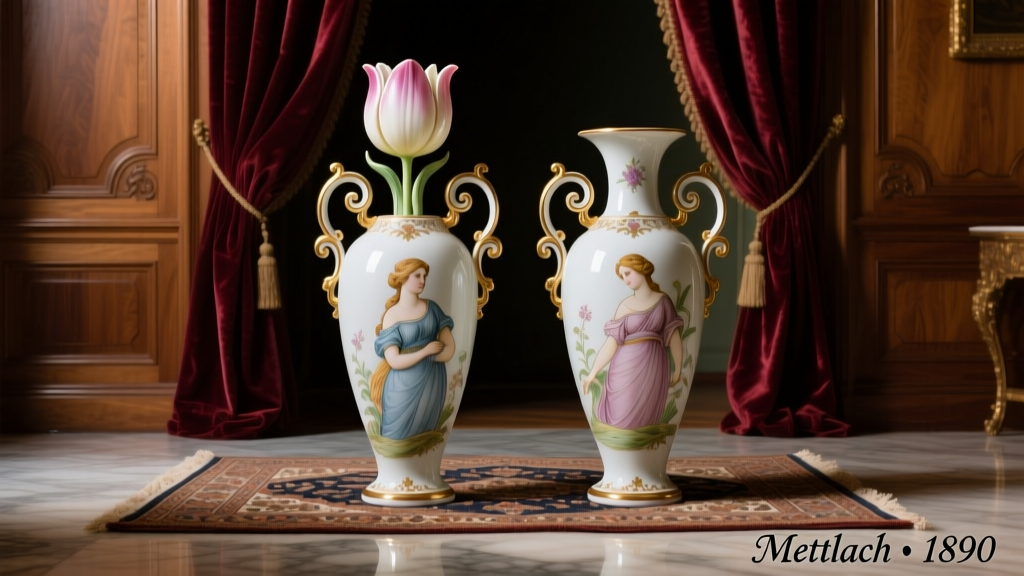
Mettlach Vase: Classical Maidens Tulip Form with Scroll Handles — A Detailed Study of the 13½-Inch Pair

Auto Mileage Calculator Sunoco Gas 1958 No. 2: A Technical and Historical Analysis of a Mid-Century Fuel Efficiency Tool
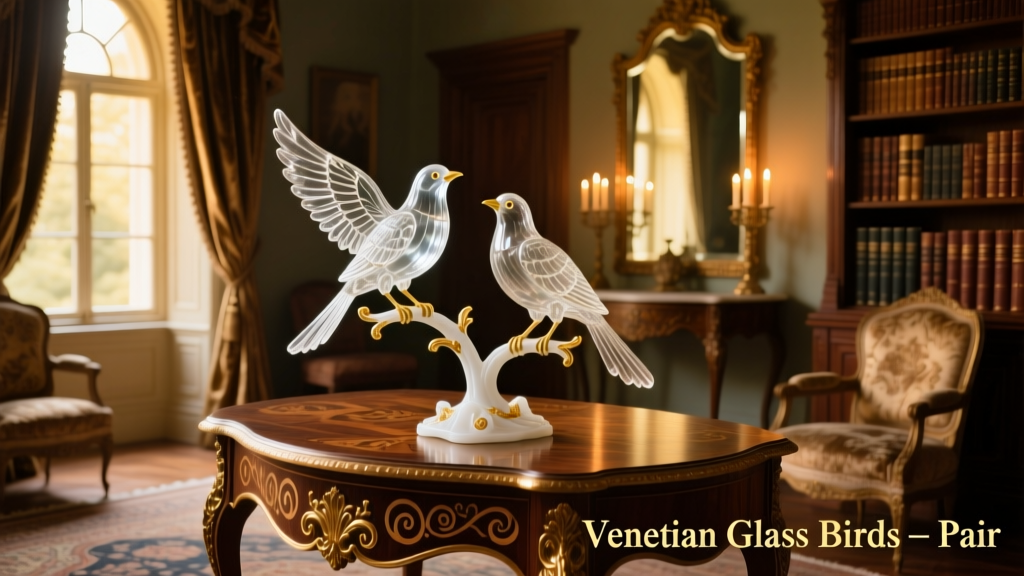
Glass Venetian Figurine Birds on a Branch: White-Gilt Pair, 14-Inch Height — Authenticity, Craftsmanship & Conservation

Franciscan Canister Sugar Duet: Identification, Value, and Restoration Guidance for Collectors
Willis Russell Baseball Playing Cards (1905): The Rare 'Player on Box' Set and Its Historical Significance
Provenance Pushes Prices Higher at Doll Auction: How Ownership History, Documentation, and Context Drive Premiums in the Antique Doll Market
Cambridge Glass Decagon Plate in Emerald Green: Identification, History, and Restoration Guidance for the 8¾-Inch Pattern
Pittsville Pottery Vase: History, Identification, and Restoration Insights for Collectors

Lamps Sconce Cobra Form India 29 1/2 In Pair: A Study in Colonial-Era Indian Brass Craftsmanship and Functional Art