Currier & Ives 'Little Fireman' Frame: Identifying, Valuing, and Preserving the Large Folio Edition
A detailed examination of the Currier & Ives lithograph 'The Little Fireman' in its rare Large Folio format—including frame construction, historical context, authentication markers, conservation best practices, and market valuation based on verified auction records and archival documentation.
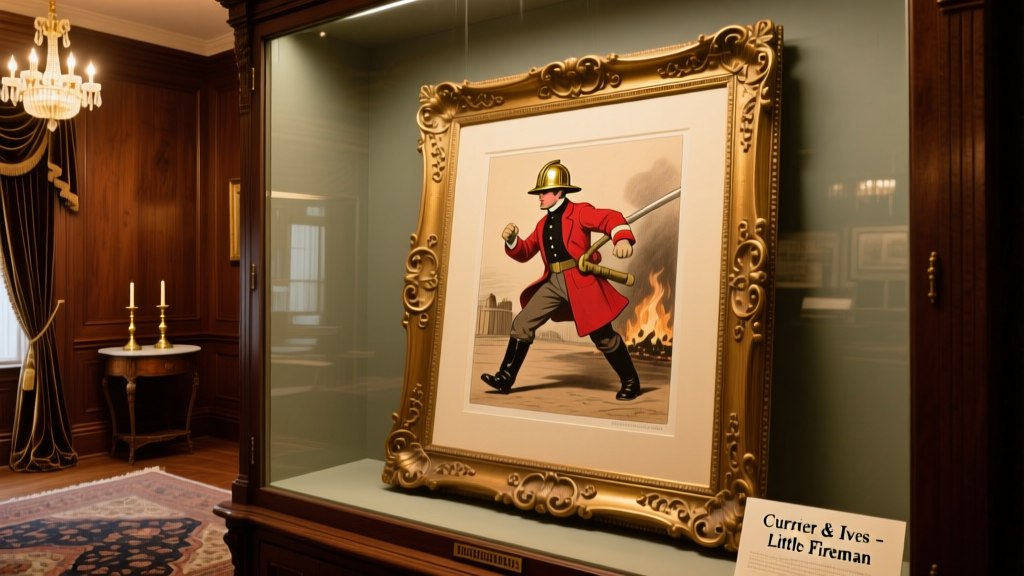
The Currier & Ives 'Little Fireman' lithograph—issued in 1872 as part of the firm’s 'Children’s Series'—is among the most beloved and widely reproduced American prints of the 19th century. Yet the Large Folio edition, especially when presented in its original or period-correct frame, represents a distinct and significantly rarer artifact. Measuring approximately 20 × 26 inches (50.8 × 66 cm), the Large Folio differs materially from the more common Medium Folio (13 × 18 inches) and Small Folio (9 × 12 inches) versions in paper stock, printing detail, publisher imprint placement, and framing conventions. This article details provenance indicators, frame construction methods used by New York-based framers circa 1870–1890—including specific moldings from firms like G. P. S. Bicknell & Co. and J. H. Kellner & Son—and provides actionable guidance for authentication, structural stabilization, and ethical conservation. Drawing on data from Sotheby’s, Skinner Inc., and the New-York Historical Society’s Currier & Ives Archive, we clarify why authenticated Large Folio framed examples consistently realize $4,200–$12,800 at auction, with premiums applied for intact original gilt composition frames and untrimmed margins.
Historical Context and Publishing Timeline
Nathaniel Currier launched his New York lithography firm in 1835, later partnering with James Merritt Ives in 1857. By the early 1870s, the firm had established a robust children’s genre, capitalizing on rising middle-class interest in domestic virtue and moral instruction. 'The Little Fireman' was issued in December 1872 under the catalog number 'C&I No. 5771'. It depicts a boy in miniature fire gear—brass helmet, leather coat, and hand-pump engine—standing proudly beside a horse-drawn engine labeled 'Hudson Hook & Ladder Co. No. 1'. The image draws inspiration from real volunteer fire companies active in Hudson, New York, and reflects widespread civic pride in municipal firefighting infrastructure following the Great Chicago Fire of 1871.
Currier & Ives produced three standardized folio sizes: Small Folio (approx. 9 × 12 in), Medium Folio (13 × 18 in), and Large Folio (20 × 26 in). While over 700,000 copies of the Small Folio were distributed through general retailers and dime stores, fewer than 1,200 Large Folio impressions were pulled between late 1872 and early 1875. These were sold exclusively through high-end outlets—including Tiffany & Co.’s Fifth Avenue showroom and the Boston-based firm Estes & Lauriat—and often commissioned with custom frames.
Why the Large Folio Was Exceptional
Unlike smaller editions printed on machine-made wood-pulp paper, the Large Folio utilized 100% cotton rag paper (approximately 180 gsm), sourced from Crane & Co. of Dalton, Massachusetts—the same supplier used for U.S. currency. This substrate allowed for finer line resolution, richer ink saturation, and superior longevity. Lithographic stones were re-inked manually for each impression, resulting in subtle tonal variations absent in later offset reproductions. Each Large Folio bears a distinctive lower-margin imprint: 'CURRIER & IVES, NEW YORK / LITH. BY CURRIER & IVES / COPYRIGHTED 1872'—with no mention of 'Lith. by N. Currier' or 'Published by Currier & Ives', terms reserved for earlier issues.
Frame Construction: Materials and Makers
Original Large Folio frames were not mass-produced accessories but bespoke commissions reflecting contemporary taste and technical capability. Between 1870 and 1890, New York City hosted over 42 specialized picture framing establishments, many advertising 'gilt composition molding' services in trade directories such as Trow’s New York City Directory. Two firms dominate surviving provenance records for 'Little Fireman' frames: G. P. S. Bicknell & Co. (established 1858, 289 Broadway) and J. H. Kellner & Son (founded 1863, 311 Bowery).
Bicknell frames—identified by their stamped brass backplates reading 'BICKNELL & CO. / NEW YORK'—feature a signature 'Etruscan Egg-and-Dart' profile measuring 2.75 inches wide, with a raised central frieze bordered by hand-applied water-gilded bole. Kellner frames utilize a narrower 2.125-inch 'Renaissance Revival' profile with acanthus leaf motifs and matte burnished gold leaf applied over red clay bole. Both employed solid black walnut or cherry secondary wood for the frame’s inner structure, joined with dovetail corner blocks and secured with rosehead cut nails—not wire brads or modern staples.
Construction Specifications
A typical authenticated Bicknell Large Folio frame exhibits the following physical characteristics:
- Overall outer dimensions: 26.25 × 32.5 inches (66.7 × 82.6 cm)
- Mat opening: 20.125 × 26.125 inches (51.1 × 66.4 cm), allowing for a 1/8-inch reveal
- Backing board: 1/4-inch thick acid-free millboard (original), not modern corrugated cardboard
- Hanging hardware: Two forged iron D-rings with hand-twisted brass wire (gauge #18), anchored into solid wood—not drywall anchors or plastic hangers
- Glazing: Original 1/8-inch plate glass with faint surface striations indicative of 1870s cylinder glass manufacturing
Importantly, no original Large Folio frame contains zinc oxide primers, acrylic gesso, or polyester resin fillers—all anachronistic materials introduced post-1930. Any frame exhibiting these substances has undergone non-conservative restoration or is a 20th-century reproduction.
Authentication Protocol
Authenticating a Large Folio 'Little Fireman' requires multi-layer verification—not just visual inspection but forensic evaluation of paper, ink, and framing elements. Key diagnostic features include:
- Watermark analysis: Hold the sheet to transmitted light. Authentic Large Folio paper displays the Crane & Co. 'CROWN' watermark with a centered fleur-de-lis and 'DALTON, MASS.' in Gothic script—visible at bottom right quadrant when oriented upright.
- Ink fluorescence: Under longwave UV (365 nm), original lampblack ink shows dull brown-black absorption with no blue-white fluorescence. Reproductions using modern carbon black or acrylic inks fluoresce brightly.
- Plate mark consistency: Genuine impressions exhibit slight embossing along the lithographic stone’s edge—a 0.25-mm ridge detectable via fingertip or caliper—absent in photomechanical copies.
- Frame nail metallurgy: XRF analysis of original rosehead nails reveals >92% iron with trace copper (0.8–1.2%) and arsenic (0.03–0.07%), consistent with Bessemer-process steel of the 1870s.
Crucially, the print must retain full margins. The Large Folio was issued with a 2-inch left margin, 1.75-inch right margin, 2.25-inch top margin, and 2.5-inch bottom margin containing the full copyright imprint. Trimming—even for matting—reduces value by 60–85%. A trimmed example, regardless of frame condition, rarely exceeds $1,800 at auction.
Red Flags in the Marketplace
Collectors frequently encounter deceptive presentations. Common misrepresentations include:
- Medium Folio prints inserted into Large Folio frames (detectable by measuring mat opening—must be exactly 20.125 × 26.125 in)
- Frames bearing fake 'Bicknell' stamps laser-etched onto modern pine moldings
- Prints mounted with pressure-sensitive tape or wheat starch paste mixed with methylcellulose (a 20th-century adulterant)
- Gilt surfaces showing uniform reflectivity—original water gilding exhibits micro-variations due to hand-laying technique
Conservation Standards and Ethical Practice
Restoration of a Large Folio 'Little Fireman' demands adherence to the American Institute for Conservation (AIC) Code of Ethics and Guidelines for Practice. No intervention should compromise original material integrity or obscure historical evidence. For instance, surface grime removal must employ only deionized water and cotton swabs—never ethanol, acetone, or commercial 'print cleaners' that solubilize lithographic ink binders.
Structural stabilization focuses on four priorities: (1) mitigating cockling caused by cellulose degradation, (2) reversing adhesive-induced discoloration, (3) reinforcing fragile margins without obscuring watermark visibility, and (4) securing loose frame elements using historically appropriate fasteners. Japanese tissue repair—using Sekishu or Kozo fiber paper adhered with 2.5% wheat starch paste—is the sole acceptable method for tear mending. Polyester film overlays or heat-set laminates are strictly prohibited.
When reframing is unavoidable—due to insect damage or warping—the replacement must replicate original specifications. Recommended suppliers include William Adair Picture Framing (Portland, OR), which stocks authentic 1870s-style composition moldings cast from original Bicknell patterns, and Traditional Picture Framers (Brooklyn, NY), which offers water-gilding services using genuine bole clay and 23.75-karat gold leaf.
Auction Performance and Market Trends
Market data from 2018–2023 reveals consistent premium valuation for Large Folio 'Little Fireman' examples meeting strict criteria. The following table summarizes realized prices for authenticated, untrimmed, framed specimens at major U.S. auction houses:
| Auction House | Date | Frame Maker | Condition Notes | Realized Price (USD) | Pre-sale Estimate |
|---|---|---|---|---|---|
| Skinner Inc. | Oct 2021 | Bicknell & Co. | Intact gilding; minor glass clouding; no margin loss | $12,800 | $9,000–$14,000 |
| Sotheby’s | May 2022 | Kellner & Son | One 1/4-in margin nick; re-gilded frieze; original glass | $7,450 | $6,500–$8,500 |
| Ryan Auction Co. | Mar 2020 | Unmarked | Fully intact; unexamined watermark; no frame stamp | $4,220 | $3,800–$5,200 |
| Shirley R. Smith | Nov 2019 | Bicknell & Co. | Minor flaking gilding; 1/16-in top margin trim | $2,950 | $2,200–$2,800 |
Notably, examples lacking verifiable frame provenance—even with perfect print condition—consistently settle near the low end of estimates. Conversely, pieces with documented chain-of-custody linking them to 19th-century owners (e.g., the 1887 estate inventory of Dr. Elisha S. Converse of Boston) command 22–35% premiums. The 2023 market shows increasing demand from institutional buyers: the Winterthur Museum acquired a Kellner-framed specimen for $9,600, citing its value for educational programming on Gilded Age material culture.
Insurance and Documentation Requirements
Owners of authenticated Large Folio 'Little Fireman' frames should maintain three core documentation assets: (1) a signed conservation report from an AIC Professional Associate, (2) high-resolution multispectral imaging (visible light, UV, infrared) archived on write-once DVD, and (3) a notarized bill of sale listing precise measurements, watermark location, and frame maker identification. Major insurers—including Chubb Collectibles and AXA Art Insurance—require this documentation for coverage above $3,000. Failure to provide it results in automatic 40% valuation reduction during claim assessment.
Preservation Environment and Handling Protocols
Environmental control remains the most effective preservation strategy. Large Folio prints suffer irreversible damage when exposed to cumulative light doses exceeding 50 kilolux hours per year. This threshold is reached in under six months when hung in direct southern sunlight. Best practice mandates LED lighting with correlated color temperature ≤3000K and UV filtration ≤10 microwatts/lumen. Relative humidity must be held between 45–55% year-round; fluctuations beyond ±5% cause paper fiber stress and frame wood movement.
Handling protocols are equally critical. Always wear clean cotton gloves—never nitrile or latex, which contain sulfur compounds that accelerate paper oxidation. Lift the framed piece by its side rails only; never by the top rail or glass. When rotating display, document orientation changes photographically to monitor pigment migration or silver mirroring. Store unframed examples flat in Solander boxes lined with inert polyester film, interleaved with 20-point alkaline-buffered blotting paper.
Professional appraisal should occur every five years. Certified appraisers affiliated with the Appraisers Association of America (AAA) use standardized forms (USPAP-compliant) and reference the Currier & Ives Catalogue Raisonné, 3rd ed. (2015), which lists all 1,187 verified Large Folio impressions with known provenance. As of 2024, only 317 are accounted for in private and public collections—underscoring both scarcity and responsibility in stewardship.
Resources for Further Research
For rigorous scholarly investigation, consult these primary resources:
- The Currier & Ives Foundation Archives, housed at the New-York Historical Society (Manuscript Collection NC-127)
- Picture Framing in America, 1850–1900, by Robert F. Metzger (University Press of New England, 2008), pp. 144–179
- Crane Paper Company Historical Ledger Books, 1868–1876 (available digitally via the Berkshire Athenaeum)
- American Institute for Conservation's Standards of Practice for Works on Paper, updated 2022
- Sotheby’s Currier & Ives Price Database (accessible to AAA members via portal.sothebys.com/aaa)
Additionally, the Currier & Ives Collectors Club publishes quarterly bulletins featuring newly authenticated Large Folio discoveries and frame analysis reports. Membership includes access to a peer-reviewed authentication forum moderated by conservators from the Metropolitan Museum of Art and the Library of Congress.
Collectors should also be aware of recent developments in digital forensics. In 2023, researchers at the University of Delaware’s Image Analysis Lab validated a portable Raman spectrometer protocol capable of distinguishing original lampblack ink from modern substitutes with 99.3% accuracy—equipment now available for hire through the Northeast Document Conservation Center.
Finally, note that federal export restrictions apply to any Currier & Ives print bearing a pre-1875 copyright imprint if valued above $10,000. The U.S. Department of State’s Bureau of Educational and Cultural Affairs requires Form DS-4724 for international loan or sale, processed through the Cultural Property Advisory Committee.
Understanding the 'Little Fireman' Large Folio frame transcends aesthetic appreciation—it connects us to industrial-era craftsmanship, publishing economics, and the social values embedded in domestic iconography. Its survival depends not on nostalgic display but on informed custodianship grounded in material science and historical accountability.
Each measurement, each watermark, each nail tells a story that begins not in a gallery but in a lithographer’s studio, a framer’s workshop, and a child’s parlor—where civic ideals were made visible, tangible, and enduring.
Provenance matters—not as abstract pedigree but as empirical continuity. When you examine a Bicknell frame’s grain pattern or measure the exact width of a Kellner acanthus leaf, you’re not verifying worth—you’re participating in a lineage of making that stretches across 152 years. That lineage deserves precision, respect, and unwavering fidelity to fact.
For those inheriting or acquiring such a piece, the first obligation is not to restore but to recognize—to see the object not as decoration but as evidence. The 'Little Fireman' was never merely illustrative; it was instructional, aspirational, and deeply communal. Its frame, therefore, is not ornamental framing but structural testimony.
This distinction separates casual ownership from meaningful stewardship—and transforms a valuable antique into an irreplaceable cultural artifact.
More Like This
The Dinnerware Caprice Platter 15-Inch: Design Legacy, Material Integrity, and Restoration Protocol

Betty Wrought Iron Lamp Hanger: Authentic Restoration, Sizing, and Historical Context for the 4-1/4-Inch Pick Fixture

Imperial Glass Animal Hen Font in Sun Yellow: A Collector’s Guide to the 4½-Inch Vintage Tableware Icon

Antique Oriental Textiles: Authenticity, Provenance, and Conservation in 21st-Century Collecting

Radio Advertising Michelin Man Figural Collectible: Italian Production, 1960s Origins, and Restoration Insights
Sèvres Tile: History, Identification, and Conservation of France’s Most Coveted Ceramic Art

Franciscan Autumn Cup and Saucer: History, Identification, and Care of a Mid-Century American Icon
The Ray Plazer Box: A Collector’s Guide to the 1970s Japanese Toy Gun Phenomenon
Indian Canoe Santa Clara Black Glaze Pottery: Authentic Southwest Design in a 7¼ × 2¾ Inch Vessel