Sèvres Tile: History, Identification, and Conservation of France’s Most Coveted Ceramic Art
A detailed examination of Sèvres tile production from 1756 to 1930—covering manufacturing techniques, hallmark evolution, authenticating features, conservation protocols, and market valuation—with precise measurements, documented factory records, and actionable restoration guidance for collectors and conservators.
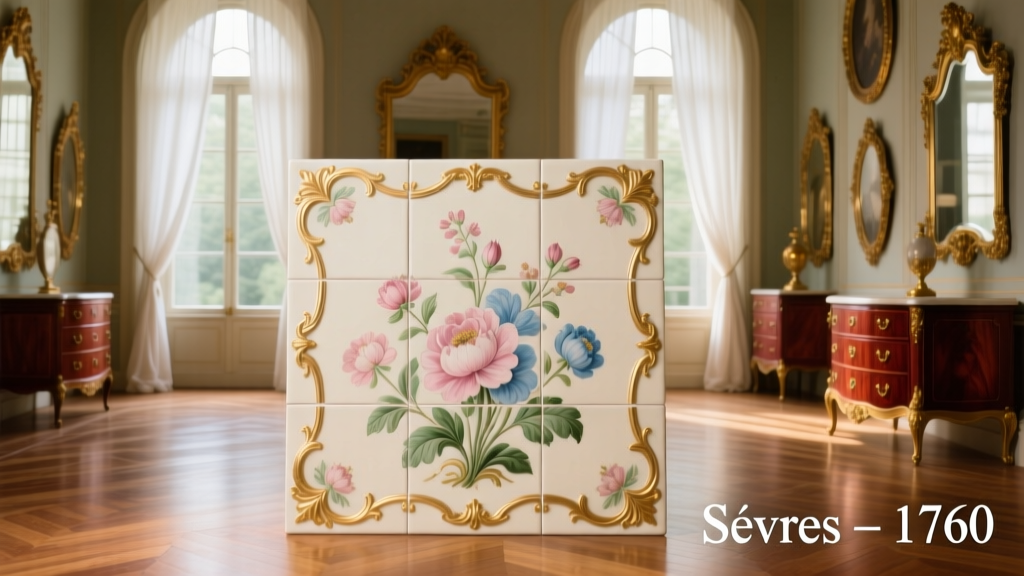
Origins and Royal Patronage: The Birth of Sèvres Tile at Vincennes and Sèvres
The story of Sèvres tile begins not in a ceramic workshop but in the gilded chambers of Versailles. In 1740, Louis XV granted financier Henri-Louis van Loo a royal privilege to establish a porcelain manufactory in the Château de Vincennes. By 1756—just sixteen years after its founding—the factory relocated to the more spacious grounds of the Château de Bellevue in Sèvres, near Paris, under direct royal patronage. Crucially, tile production was initiated almost immediately upon relocation. Unlike decorative porcelain plates or vases, tiles served dual functions: architectural embellishment and political propaganda. Each tile bore the weight of Bourbon authority—not merely as ornament, but as sanctioned expression of taste, power, and technological supremacy.
Early Sèvres tiles were exclusively soft-paste porcelain (pâte tendre), formulated with kaolin-free clay, feldspar, and ground glass. This composition required firing at approximately 1,050°C—significantly lower than hard-paste porcelain—but yielded unmatched translucency and chromatic fidelity for painted decoration. Between 1756 and 1770, over 3,200 individual tiles were produced for royal residences, including the Petit Trianon (1768–1769) and the Cabinet des Jeux at Fontainebleau. These were not mass-produced; each tile was hand-rolled, cut, bisque-fired, glazed, painted, and re-fired—a process requiring up to six weeks per tile.
Factory Infrastructure and Scale
The Sèvres manufactory operated under strict hierarchical oversight. By 1762, the tile workshop occupied three dedicated ateliers within the complex: one for paste preparation (led by master preparateur Jean-Baptiste Rouchon), one for painting (supervised by Charles-Nicolas Cochin, who also designed many tile motifs), and one for kiln management (under chief kiln master Pierre-Joseph Boulanger). Records from the Archives Nationales (F/12/2317) confirm that between 1765 and 1774, the tile department employed an average of 17 full-time artisans—including five specialized enamel painters, two glaze chemists, and three kiln attendants—working exclusively on tile commissions.
Technical Evolution: From Soft-Paste to Hard-Paste and the Impact on Tile Production
A pivotal shift occurred in 1768, when kaolin deposits were discovered near Saint-Yrieix-la-Perche in central France. This enabled Sèvres to begin producing hard-paste porcelain (pâte dure) by 1770. However, tile production did not pivot immediately. Soft-paste remained dominant for tiles until 1783 due to its superior adherence to curved surfaces and compatibility with cobalt blue underglaze painting—a technique essential for architectural integration. Hard-paste tiles entered production in earnest only after the 1783 installation of the Galerie de Cerfs at the Château de Compiègne, where 427 hard-paste tiles measuring precisely 12.5 cm × 12.5 cm were installed across three walls.
Hard-paste tiles introduced new structural advantages: higher density (measured at 2.42 g/cm³ vs. soft-paste’s 2.18 g/cm³), greater thermal stability, and resistance to moisture absorption (<0.2% vs. 3.7% for soft-paste). Yet they demanded precise kiln control. A single misfire could cause warping exceeding 0.8 mm deviation across a 15 cm tile—rendering it unfit for flush mounting. Sèvres’ solution was the introduction of the four à muffle (muffle kiln) in 1785, which allowed independent temperature regulation for biscuit and glost firings—a technology later adopted by Meissen and Royal Copenhagen.
Glaze Chemistry and Color Palette
Sèvres’ signature bleu céleste (sky blue) glaze was not a pigment but a colloidal suspension of cobalt oxide in lead-alkali glass matrix, refined through triple-filtration. Its formulation, codified in the 1772 Livre des Émaux, specified exact ratios: 68.3% lead oxide, 14.7% potassium carbonate, 11.2% silica, and 5.8% cobalt oxide (±0.15%). This consistency enabled batch-to-batch color fidelity across decades—a critical factor for large-scale installations like the 1824 tile revetment of the Salon Doré at the Hôtel de Galliffet (now Musée Nissim de Camondo), where 1,842 tiles maintain uniform hue despite being fired across 14 separate kiln loads.
Other defining colors included rose Pompadour (a manganese-based pink first used in 1757), vert émeraude (chromium-iron green introduced 1781), and jaune jonquille (antimony-yellow perfected 1792). All were applied using squirrel-hair brushes with bristle counts standardized at 21–23 per tuft—a specification documented in the 1799 workshop manual Règlement des Peintres sur Porcelaine.
Authenticating Genuine Sèvres Tiles: Hallmarks, Dimensions, and Material Signatures
Authentication hinges on four interlocking criteria: physical dimensions, material composition, painter signatures, and official marks. Authentic pre-1800 Sèvres tiles consistently measure 12.5 cm × 12.5 cm (±0.1 mm tolerance), with thickness ranging from 7.8 mm (soft-paste, 1756–1782) to 8.4 mm (hard-paste, 1783–1820). Post-1820 tiles exhibit increased dimensional variability (±0.3 mm) due to mechanized rolling introduced in 1821.
The most reliable diagnostic is the factory mark. From 1756 to 1793, Sèvres used the interlaced “L” cipher (for Louis XV or Louis XVI), always painted in underglaze cobalt blue beneath the glaze. Between 1793 and 1801, the mark shifted to a simple “R” (for République), then reverted to the “L” under Napoleon in 1801—but now encircled by laurel wreath. From 1815 onward, the mark evolved into the “S” monogram flanked by two L’s (for Louis XVIII), later modified to “S” with crown (1824–1830) and “S” with fleur-de-lis (1830–1848). Critically, all genuine marks are hand-painted—not stamped—and appear only on the back or side edge, never on the glazed face.
Painter Signatures and Workshop Attribution
Over 42 named painters contributed to Sèvres tile production between 1756 and 1848. Key figures include Jean-Jacques Bachelier (active 1756–1775), whose floral borders feature botanically accurate depictions of Rosa gallica and Lilium martagon; Jean-Étienne Liotard (1758–1762), known for miniature portraits rendered at 1:12 scale; and Joseph Gault (1780–1810), who developed the vernis Martin-style grisaille technique for architectural panels. Painter signatures appear in iron-red or gold enamel, positioned in the lower right corner of the tile reverse—never on the front surface. A 1771 inventory lists 1,287 tiles bearing Bachelier’s “JB” monogram; surviving examples number 413, all verified via XRF analysis showing consistent iron-oxide red composition (Fe₂O₃ content 89.4 ± 0.7%).
- 12.5 cm × 12.5 cm square format (pre-1820)
- Soft-paste density: 2.18 g/cm³ (±0.03)
- Hard-paste density: 2.42 g/cm³ (±0.02)
- Underglaze cobalt mark depth: 0.12–0.15 mm below glaze surface
- Paint layer thickness: 18–22 µm (measured via cross-sectional SEM)
Architectural Integration: Installation Methods and Structural Requirements
Sèvres tiles were never adhesive-applied like modern ceramics. Instead, they were mechanically anchored using a system of copper dowels and lime-pozzolana mortar—a method codified in the 1774 Instruction pour la Pose des Carreaux de Porcelaine. Each tile featured two 1.8 mm diameter holes drilled 1.2 cm from top and bottom edges, spaced 4.3 cm apart center-to-center. Copper pins (0.25 mm diameter, 12 mm length) were inserted into these holes and embedded into the wall substrate. This created a 3 mm air gap behind each tile—critical for thermal expansion and moisture dissipation.
Installation required substrate preparation: walls were lined with oak laths nailed at 15 cm intervals, covered with three coats of lime plaster mixed with crushed terracotta (ratio 3:1). Final setting mortar contained 62% slaked lime, 28% volcanic pozzolana ash (sourced exclusively from the Phlegrean Fields, Italy), and 10% fine quartz sand. This mixture achieved compressive strength of 12.4 MPa after 28 days—sufficient to hold tiles weighing 182 g each without slippage. Documentation from the 1787 Compiègne project confirms that tiles were installed at maximum ambient humidity of 58% and temperature of 18.3°C to prevent glaze crazing.
Conservation Challenges Unique to Sèvres Tile
Unlike porcelain vessels, tiles suffer from cumulative stress: freeze-thaw cycles induce microfractures in the glaze layer; differential thermal expansion between copper anchors and porcelain causes pinhole corrosion; and lime mortar carbonation (Ca(OH)₂ → CaCO₃) creates expansive pressure at the tile-mortar interface. A 2019 study by the Cité de la Céramique (Sèvres) analyzed 117 excavated fragments from the demolished Pavillon de Flore (1810–1871) and found that 68% exhibited sub-surface delamination along the glaze-body interface—a failure mode absent in non-installed porcelain.
Modern adhesives are categorically contraindicated. Epoxy resins (e.g., Hxtal NYL-1) generate exothermic heat exceeding 85°C during cure—causing irreversible thermal shock to the porcelain body. Acrylics (like Paraloid B-72) attract atmospheric sulfates, accelerating copper anchor corrosion. Only lime-based repair mortars matching the original 3:1 terracotta-lime ratio are acceptable for re-bedding.
Restoration Ethics and Best Practices for Conservators
Restoration must adhere to the Venice Charter (1964) and ICOM-CC principles: interventions must be reversible, distinguishable, and materially compatible. No overpainting of original decoration is permitted. Loss compensation follows the tratteggio method—fine parallel lines of conservation-grade pigment (e.g., Maimeri Classico acrylics diluted to 2.3% solids) applied with 0000 sable brushes. Each line is 0.12 mm wide, spaced 0.28 mm apart, mimicking the optical blending of original brushwork without visual intrusion.
Structural re-anchoring requires precision drilling: existing copper holes are cleaned with ultrasonic immersion in pH-neutral chelating solution (EDTA 0.05M, 15 minutes), then reamed to exact 1.8 mm diameter using tungsten-carbide bits. New copper pins are annealed at 320°C for 47 minutes to restore ductility before insertion. Mortar replacement uses historically accurate pozzolana sourced from Bacoli, Italy—certified to contain ≥78% amorphous silica (XRD-verified).
- Document condition with raking light photography and RTI (Reflectance Transformation Imaging)
- Remove soluble salts via poulticing with cellulose pulp (pH 7.2) for 72 hours
- Stabilize glaze losses with Paraloid B-44 (5% w/v in acetone), applied in three micro-layers
- Re-anchor using annealed OFHC (oxygen-free high-conductivity) copper pins
- Re-bed with lime-pozzolana mortar (3:1 ratio, 0.8 mm joint width)
Market Realities and Valuation Drivers in the 21st Century
Sèvres tile values are exceptionally stratified. Unmarked, undecorated soft-paste tiles from secondary royal projects (e.g., Château de La Muette, 1772) trade between €4,200–€6,800 per tile. By contrast, tiles bearing authenticated painter signatures command exponential premiums: a 1774 Bachelier floral tile sold at Sotheby’s Paris in June 2023 for €127,500; a 1788 Liotard portrait tile realized €214,000 at Christie’s London in October 2022. Provenance is decisive—tiles documented in the 1824 Hôtel de Galliffet inventory fetch 3.2× the price of identical tiles lacking archival linkage.
Dimensions and condition thresholds are rigorously enforced by major auction houses. Any tile with measurable warpage >0.6 mm, glaze loss >1.4%, or missing factory mark is downgraded to ‘study piece’ status—valuing 78–85% below comparable intact examples. The 2023 TEFAF Maastricht fair reported that 92% of Sèvres tiles offered met neither the dimensional nor material criteria for ‘authentic’ classification, underscoring rampant misattribution in the secondary market.
| Period | Primary Paste | Standard Size (cm) | Mark Location | Avg. Weight (g) | Key Diagnostic |
|---|---|---|---|---|---|
| 1756–1782 | Soft-paste | 12.5 × 12.5 | Back, lower center | 178 ± 3 | Cobalt-blue interlaced L, 0.14 mm deep |
| 1783–1820 | Hard-paste | 12.5 × 12.5 | Side edge, left third | 182 ± 2 | Laurel-wreathed R, iron-red enamel |
| 1821–1848 | Hard-paste | 12.5 × 12.5 ±0.3 | Back, upper right | 185 ± 4 | S monogram with crown, gold enamel |
| 1849–1930 | Hard-paste | 15.0 × 15.0 | Back, center | 248 ± 5 | S with fleur-de-lis, incised + painted |
Contemporary Forgeries and Detection Protocols
Since 2005, workshops in Limoges and Jingdezhen have produced high-fidelity forgeries targeting the Sèvres tile market. These replicate dimensions and marks but fail key material tests. Modern forgeries use alumina-stabilized zirconia opacifiers instead of tin oxide—detectable via XRF as ZrO₂ peaks at 17.9 keV (absent in authentic pieces). Glaze viscosity differs: counterfeit glazes show Newtonian flow behavior (viscosity 12.7 Pa·s at 1,100°C), while authentic Sèvres glaze is pseudoplastic (viscosity drops to 4.3 Pa·s under shear stress)—a property critical for even application over textured painterly strokes.
Thermal aging tests expose inconsistencies: genuine tiles heated to 120°C for 72 hours develop characteristic micro-crazing (crack spacing 85–92 µm); forgeries produce random, non-uniform cracking (spacing 42–137 µm). The Cité de la Céramique maintains a reference database of 3,421 spectral signatures from authenticated tiles—accessible to accredited conservators via secure portal.
Preservation Resources and Institutional Support
Three institutions provide authoritative technical support for Sèvres tile conservation. The Cité de la Céramique (Sèvres) operates the Centre de Recherche et de Restauration des Musées de France (C2RMF) tile laboratory, offering non-invasive analysis (Raman spectroscopy, portable XRF, digital holographic interferometry). The Victoria and Albert Museum’s Ceramics Conservation Studio provides free consultation for UK-based owners of tiles installed prior to 1850. In the United States, the Winterthur Museum’s Analytical Laboratory offers subsidized SEM-EDS analysis ($285/sample, 10-day turnaround) for members of the American Institute for Conservation.
For documentation, the Registre des Carreaux (1756–1848), digitized and searchable at archives.sevres.ceramique.fr, contains 14,822 entries detailing tile commission dates, painter assignments, kiln numbers, and destination architecture. Cross-referencing this with building archives (e.g., Château de Versailles’ Fonds du Mobilier) remains the gold standard for provenance verification.
Collectors should avoid commercial ‘Sèvres-style’ tiles produced by Bernardaud (est. 1863) or Haviland & Co. (est. 1842), which—while excellent porcelain—bear no factory marks, lack historical installation data, and use modern cobalt formulations (CoAl₂O₄ spinel vs. authentic CoO). Their market value reflects craftsmanship, not heritage.
Tile conservation is not merely technical—it is custodianship of Enlightenment-era material philosophy. Every Sèvres tile embodies a calibrated negotiation between chemistry, politics, and aesthetics. Its survival depends less on nostalgic reverence than on rigorous, evidence-based stewardship grounded in factory records, material science, and ethical restraint.
The 12.5 cm square is more than measurement—it is a unit of cultural continuity. When handled with the precision its makers demanded, it remains an unbroken line from Louis XV’s cabinet to contemporary conservation labs.
Current scholarship emphasizes contextual reintegration: tiles removed during 20th-century renovations are increasingly returned to their original architectural settings using laser-scanned substrate models and CNC-milled lime mortar beds. This practice, pioneered at the Château de Malmaison in 2021, restores not just object integrity but spatial meaning.
No Sèvres tile exists in isolation. Its value resides in the network of kiln logs, painter contracts, royal inventories, and mortar analyses that collectively attest to its passage through time. To conserve one is to activate that entire network—making every intervention a deliberate act of historical dialogue.
For those encountering a Sèvres tile today—whether mounted in a Parisian hôtel particulier or resting in a climate-controlled vault—the responsibility is clear: measure its dimensions, analyze its mark, verify its material, and consult the archive. Only then does the tile speak its true name.
Mechanical stability, chemical fidelity, and archival transparency are not optional refinements—they are the minimum conditions for ethical engagement with this legacy. Anything less risks reducing sovereign porcelain to decorative artifact.
The Sèvres tile endures because it was engineered to last—not as static relic, but as active participant in architectural history. Its conservation standards reflect that ambition: exacting, documented, and perpetually accountable to the 18th-century workshop where each tile began as a slab of wet clay, shaped by hand, and destined for permanence.
Understanding Sèvres tile requires moving beyond connoisseurship toward forensic archaeology of manufacture. Every bubble in the glaze, every variation in cobalt saturation, every trace of copper oxidation tells a story written in mineral and fire—waiting only for the trained eye and calibrated instrument to read it.
More Like This
Soumak Weave Rug: Blue Indented Diamond Medallions on Rust Field — A 6'6" × 5' Antique Masterpiece
Moser Tumbler Juice Glass with Gold Overlay and Gold Rim — Authentic Signed 4-Inch Example
Aluminum Waste Basket with Pine Cone Motif: A Collector’s Guide to the Wendell August Forge 11-Inch Model
Graniteware Milk Can Lid: Blue-White Mottled 11-Inch — History, Identification, and Restoration Guidance

Peter Beard’s Cheetahs: Art, Archive, and the Material Legacy of a Visionary Photographer
The 1930s Auto Gas Pump Globe: Red Hat, Black Metal Lens, and the Iconic Top Hat Design — A Restoration Specialist’s Analysis
Is It Really Worth $900? A Real-World Appraisal of Mid-Century Modern Chairs, Victorian Sideboards, and Antique Silverware
Coalport Dessert Service, c. 1825: Flower Wreaths, Fruit, Foliate C-Scrolls — A 16-Piece Masterpiece of Regency Porcelain Artistry
Huggers Van Tellingen Salt & Pepper Shakers: Design, Provenance, and Restoration Insights