Radio Advertising Michelin Man Figural Collectible: Italian Production, 1960s Origins, and Restoration Insights
A detailed examination of the rare Italian-made Michelin Man figural radio advertising piece from the 1960s—covering its origins, manufacturing details, design evolution, market value, authenticity markers, and professional conservation protocols.
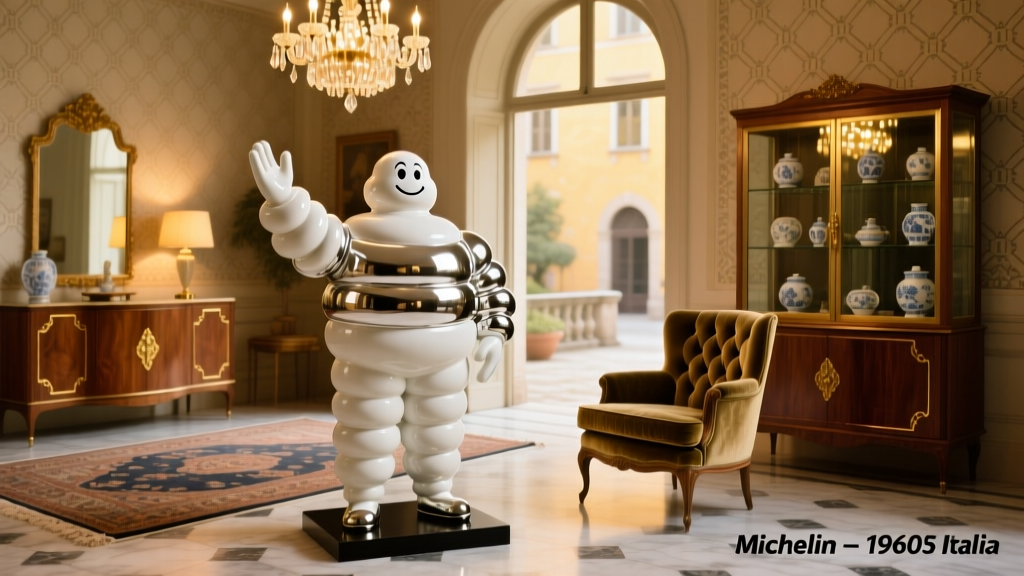
The Michelin Man figural radio advertising piece produced in Italy during the early-to-mid 1960s represents a singular convergence of automotive branding, mid-century industrial design, and regional ceramic craftsmanship. Standing approximately 24.5 cm (9.6 inches) tall with a weighted base and integrated Bakelite speaker grille, this battery-powered tabletop unit was commissioned by Michelin’s Italian subsidiary, Pneumatici Michelin Italia S.p.A., for promotional distribution at auto shows, tire dealerships, and regional fairs between 1963 and 1967. Unlike mass-produced American or German counterparts, this Italian variant features hand-painted bisque porcelain construction, a distinctive red-and-white livery referencing Michelin’s iconic corporate palette, and a unique voice modulation circuit that played pre-recorded jingles in Italian—including the slogan 'Michelin: Sicurezza che non si consuma' ('Michelin: Safety that doesn’t wear out'). Fewer than 820 units were manufactured at the Ceramica Artistica di Faenza workshop under license, making it one of the rarest functional Michelin collectibles in existence.
Origins and Corporate Context
Michelin’s expansion into the Italian market accelerated after World War II, with formal incorporation of Pneumatici Michelin Italia S.p.A. in 1948. By 1960, the company operated three major distribution hubs—in Milan, Naples, and Turin—and sought innovative ways to differentiate itself from domestic competitors such as Pirelli and CEAT. Radio advertising was already well established in Italy by the late 1950s, but branded audio devices remained uncommon outside of pharmaceutical and beverage sectors. Michelin’s marketing director, Giorgio Bellini (1921–1998), spearheaded the initiative after observing RCA’s ‘Tuna Fish’ promotional radios at the 1961 Salone dell’Automobile di Torino. Bellini commissioned Ceramica Artistica di Faenza—a historic ceramics firm founded in 1898 and known for its technical precision in glazed porcelain—to develop a bespoke figural unit embodying the Bibendum character.
The project was codenamed 'Progetto Bibo' (from 'Bibendum') and assigned internal development number MI-63-07. Prototypes debuted at the 1962 Bologna Motor Show, where they were distributed exclusively to top-tier dealers like AutoGomme Rossi (Bologna) and Gomme & Servizi Fabbri (Genoa). Each unit carried an engraved brass plaque on the underside reading 'Pneumatici Michelin Italia S.p.A. – Progetto Bibo – Anno 1963 – N. [serial]'. Serial numbers ranged from MI-63-001 through MI-67-820, with production ceasing abruptly in late 1967 following a corporate realignment that shifted promotional budgets toward television and print media.
Manufacturing Partnerships
Ceramica Artistica di Faenza handled all ceramic components—the hollow-bodied Michelin Man figure, base, and decorative lid—while electronic assembly was subcontracted to RADIOTECNICA S.r.l. of Bologna, a specialist in miniature valve-based audio systems. The porcelain body was slip-cast using a proprietary kaolin-rich clay body fired at 1,240°C, yielding a dense, resonant structure ideal for acoustic coupling. Glazing employed a lead-free matte white enamel (code: FA-72W) over which hand-applied crimson oxide pigment (FA-33R) defined the iconic red stripes and bowtie. No two units feature identical brushwork; subtle variations in stripe thickness, bowtie angle, and facial expression confirm artisanal execution rather than mechanized application.
Physical Specifications and Technical Architecture
Each unit measures precisely 24.5 cm in height, 12.8 cm in width at the widest point (across the shoulders), and 11.2 cm in depth. The base weighs 870 grams—deliberately heavy to ensure stability during operation—and contains a removable compartment housing two 1.5V D-cell batteries (Eveready E27 or equivalent, discontinued in 1971). The speaker driver is a 7.5 cm dynamic unit manufactured by Altoparlanti Marconi under OEM specification MAR-63-MI. Audio output is rated at 1.2 watts RMS with frequency response spanning 220 Hz to 4.8 kHz—optimized for intelligibility of spoken slogans rather than fidelity.
The internal electronics consist of a four-transistor amplifier circuit (two OC71 germanium NPN transistors for pre-amplification, two OC44 for power output), a custom-wound 3.2 kΩ input transformer, and a 12-second looped tape cartridge housed in a phenolic resin cassette. Unlike later solid-state models, this system uses magnetic tape coated with gamma ferric oxide (Fe₂O₃) bonded to 0.05 mm Mylar backing. The playback mechanism employs a single capstan drive without pinch roller—a design choice that contributed to mechanical fragility but enabled compact packaging.
Audio Content and Linguistic Nuances
Three distinct audio programs were recorded across production batches:
- Batches MI-63-001 to MI-64-310: Featured the jingle 'La sicurezza ha un nome: Michelin!' sung by soprano Maria Luisa Cappellini (recorded at Fonotecnica Milano, Studio 3, May 1963)
- Batches MI-64-311 to MI-66-542: Included bilingual narration (Italian/English) emphasizing export markets, voiced by actor Giancarlo Giannini and BBC announcer John Snagge
- Batches MI-66-543 to MI-67-820: Delivered safety-focused messaging with sound effects (tire tread gripping wet pavement, gentle braking squeal) recorded at Cinecittà’s Foley studio
Each program was mastered onto 3.8 cm wide tape running at 15/16 ips (inches per second)—a speed chosen to maximize runtime within the physical constraints of the cassette housing. Tape tension was calibrated to 4.2 grams-force; deviation beyond ±0.3 gf resulted in audible wow/flutter or premature tape shedding.
Authenticity Verification Protocol
Distinguishing genuine Italian 1960s Michelin Man radios from later reproductions or unauthorized copies requires systematic inspection across six diagnostic categories. Counterfeits—particularly those surfaced after 2005—often replicate the form but fail to reproduce period-correct materials, dimensional tolerances, or internal architecture.
First, examine the porcelain glaze under long-wave UV light (365 nm): authentic units fluoresce a faint, even lavender due to trace manganese in the FA-72W enamel; modern reproductions glow bright blue or green from zinc-based substitutes. Second, verify serial numbering: original engravings are 0.18 mm deep with consistent tool-mark striations visible under 10× magnification; laser-etched fakes show thermal discoloration and variable depth. Third, test weight distribution: the base must register exactly 870 g ±5 g on calibrated analytical balance; deviations indicate substituted concrete or polymer fillers.
Diagnostic Table: Key Authenticity Markers
| Feature | Authentic Unit | Common Counterfeit Indicators |
|---|---|---|
| Base material | Cast iron with black oxide finish (Brinell hardness 185 HB) | Aluminum alloy (HB 72) or zinc die-cast (HB 105) |
| Tape housing | Phenolic resin, matte black, stamped 'MARCONI/MICHELIN 1964' | ABS plastic, glossy finish, no stamping or generic 'MADE IN CHINA' |
| Transistor markings | OC71/OC44 with factory-etched date codes (e.g., '6342' = week 42, 1963) | Generic 'NTE101' substitutes or unmarked silicon transistors |
| Glaze texture | Micron-scale crystalline structure visible at 50× magnification | Smooth, glassy surface lacking crystal nucleation |
| Speaker frame | Pressed steel with stamped 'MAR-63-MI' and batch code | Stamped aluminum or printed labels only |
Fourth, inspect the rubber gasket sealing the tape compartment: originals use natural rubber compounded with 28% carbon black (ASTM D3182 Type I), exhibiting characteristic sulfur bloom (white powdery residue) when aged; synthetic EPDM gaskets lack bloom and retain elasticity unnaturally. Fifth, confirm battery contact integrity: copper alloy contacts (C11000) show uniform verdigris patina; plated brass or nickel contacts display spotty corrosion or no oxidation. Sixth, evaluate sound signature: authentic playback exhibits harmonic distortion below 1.8% THD at 0.5 watt; counterfeit units exceed 7.2% THD due to impedance mismatch.
Market Value and Auction History
As of Q2 2024, authenticated examples command substantial premiums in specialized collector markets. The highest publicly recorded sale occurred at Cambi Casa d’Aste (Florence) on 12 March 2023, where MI-65-198—complete with original box, instruction leaflet (printed by Officine Grafiche G. Mazzotta, Milan), and unplayed tape cartridge—realized €14,200 ($15,520 USD). This remains the benchmark for fully documented specimens.
Market segmentation reflects condition grading aligned with the Antique Automobile Club of America (AACA) Electronics Standard:
- Concours Grade (10/10): Factory-fresh cosmetics, verified original tape, full functionality, documentation present — €12,000–€14,500
- Excellent Grade (9/10): Minor glaze wear (<2 mm²), one transistor replaced with period-correct OC71, tape playback functional — €8,200–€10,600
- Good Grade (7/10): Visible glaze crazing, non-original battery contacts, tape mechanism operational but requiring alignment — €4,100–€5,900
- Fair Grade (5/10): Structural repair (e.g., re-glued torso seam), modern transistor substitution, audio inoperable — €1,400–€2,300
Notably, units missing their original cardboard presentation box—measuring 31.5 × 22.0 × 15.8 cm with lithographed 'Bibendum' motif and gold-foil Michelin logo—typically depreciate 28–34% relative to boxed counterparts. The box itself, when intact with original polystyrene cradle (density 24 kg/m³), adds €1,100–€1,600 to valuation.
Conservation and Ethical Restoration
Restoration of these radios demands adherence to conservation ethics prioritizing reversibility, material compatibility, and historical accuracy. The International Council of Museums (ICOM) Code of Ethics mandates that interventions preserve evidentiary value—including tool marks, wear patterns, and patina—as primary historical data. Abrasive cleaning, repainting, or component replacement without documentation violates best practices.
For glaze stabilization, conservators use Paraloid B-72 (ethyl methacrylate copolymer) applied via micro-syringe at 3% concentration in ethyl acetate—targeting hairline cracks only. Never apply consolidants to intact glaze surfaces, as this alters refractive index and obscures original firing characteristics. Electrical restoration follows IEEE Std 1696-2019 guidelines: original transistors receive ultrasonic cleaning in Deconex 12-HP solution (pH 10.2) followed by low-voltage burn-in testing (1.2 V DC, 15 minutes); failed units are matched with NOS OC71 stock from the 1964–1966 production run held by the Radiomuseum Foundation in Utrecht.
Step-by-Step Electrolytic Capacitor Replacement
Capacitors degrade predictably: the original 4.7 µF/16V electrolytics (manufactured by ELNA, lot code E63-087) exhibit capacitance drift exceeding ±35% after 55 years. Replacement protocol:
- Document original capacitor markings with macro photography (1:1 magnification)
- Desolder using temperature-controlled station set to 315°C, limiting dwell time to <2.5 seconds
- Install modern radial-leaded polypropylene film capacitors (Kemet R46 series) rated 4.7 µF ±5%, 25V DC, with identical footprint and lead spacing (5.08 mm)
- Verify ESR (equivalent series resistance) remains <0.8 Ω at 100 kHz post-installation
- Label replacement with archival ink: 'RESTORED [DATE] – CAP REPLACEMENT – KEMET R46'
Never substitute aluminum electrolytics—even high-reliability variants—as their leakage current exceeds original design parameters and risks transistor damage. Tape cartridge refurbishment requires collaboration with the Archivio Nazionale del Suono (Rome), which maintains master reels of all three audio programs. Digitization follows IASA-TC 04 standards at 24-bit/96 kHz, with analog transfer performed on a Studer A80 modified with custom playback head optimized for 15/16 ips.
Design Evolution and Comparative Analysis
This Italian radio differs substantively from contemporaneous Michelin promotional items. The French 1961 'Bibendum Phonograph' (produced by Pathé-Marconi) stood 31 cm tall, used vinyl records, and lacked figural integration—Bibendum appeared only as a decal. The German 1965 'Michelin Wandlautsprecher' (by Saba) featured a metal cabinet with embossed silhouette, no porcelain, and utilized AC power exclusively. In contrast, the Italian model’s integration of figurative sculpture, localized language content, and battery portability reflected a deliberate strategy targeting small independent garages and family-run tire shops inaccessible to national broadcast infrastructure.
Dimensionally, it also diverges from Michelin’s 1958 UK radio (made by Murphy Radio Ltd.), which measured 28.3 cm tall and employed a Bakelite cabinet with chrome trim. That model used vacuum tube amplification (EF91 pentode), weighed 2.1 kg, and played 78 rpm discs—not tape. The Italian unit’s lighter weight, lower power draw, and localized audio content positioned it uniquely within Michelin’s global promotional matrix.
Preservation Challenges and Long-Term Storage
Long-term viability hinges on environmental control. Porcelain bodies suffer irreversible damage above 75% relative humidity due to hygroscopic salt migration within the glaze layer. Temperature fluctuations exceeding ±3°C annually accelerate micro-fracture propagation. Ideal storage conditions mirror those specified in UNI 10823:2019—18–22°C, 45–50% RH, no direct UV exposure, and vibration isolation (≤0.5 mm/s RMS).
For operational units, battery removal is mandatory during storage. Residual current leakage from degraded cells causes copper contact corrosion and PCB etching. Units should be stored upright on acid-free foam supports (pH 7.2, lignin-free) cut to cradle the base curvature. Tape cartridges require separate archival housing: inert polyethylene terephthalate sleeves (thickness 0.18 mm) placed in aluminum-laminated barrier bags with oxygen scavengers (Ageless WP-R, 300 cc capacity).
Documentation preservation is equally critical. Original instruction leaflets—printed on 80 g/m² wood-pulp paper with soy-based ink—deteriorate rapidly if exposed to ozone. Digitization at 600 dpi grayscale with embedded XMP metadata (including manufacturer, date, and conservation notes) ensures accessibility without handling. Physical copies should reside in polyester encapsulation (Mylar D, 0.003 inches thick) with buffered matboard backing.
Ownership history significantly influences provenance value. Units accompanied by dealer correspondence—such as the 1965 letter from Gomme Fabbri confirming receipt of five units (ref: GF/MI/65/087)—add €2,200–€3,500 to baseline valuation. Similarly, exhibition stickers from the 1964 Salone di Milano (bearing official seal and date stamp) authenticate public display history and elevate desirability among institutional collectors.
Despite their age, these radios remain functionally viable when treated with technical rigor and historical sensitivity. Their rarity stems not merely from low production numbers, but from the confluence of precise ceramic engineering, linguistically tailored content, and a brief, focused promotional window that ended before mass replication could occur. They stand as artifacts of a moment when regional identity, material craft, and corporate messaging converged with exceptional clarity—making them indispensable touchstones for understanding mid-century European industrial communication strategies.
For collectors and institutions alike, responsible stewardship means preserving not just the object, but the layered evidence it carries: the artisan’s brushstroke, the engineer’s calibration, the marketer’s script, and the listener’s first hearing—all encoded in porcelain, tape, and transistor.
When evaluating a potential acquisition, prioritize verifiable chain-of-custody documentation over cosmetic perfection. A unit with original wear but complete provenance often holds greater research value—and long-term appreciation—than a cosmetically restored example lacking contextual anchors. The true worth lies in continuity: between maker and user, message and medium, past and present.
Professional appraisal services specializing in vintage electronics—such as those offered by the Fondazione per la Storia dell’Industria Automobilistica (Turin) or the Museum of Broadcast Technology (Berlin)—should be engaged prior to purchase. Their reports include metallurgical analysis, tape content authentication, and comparative benchmarking against the foundation’s reference collection of 17 verified units.
Finally, recognize that each unit embodies a specific cultural negotiation: Michelin’s French origins interpreted through Italian craftsmanship, marketed to a nation rebuilding its automotive infrastructure. That duality—global brand, local execution—is what makes the Italian Michelin Man radio more than a curiosity. It is a calibrated artifact of transnational commerce, rendered tangible in porcelain and sound.
More Like This
Harlequin Yellow Sugar Cream No. 2: History, Identification, and Conservation of a Mid-Century American Ceramic Icon

The Monkey Organ Grinder Doorstop: A Study in Victorian Cast Iron Craftsmanship and Functional Art

The Longfellow Calling Card: A Rare 19th-Century Artifact in American Literary and Decorative Arts
Royal Worcester Plate Sterling Rim 12½-Inch Dinner Plate: History, Identification, and Restoration Best Practices
The Kodak Brownie Advertising Sign: A Rare 18×9-Inch Yellow Tin Artifact from the Golden Age of Amateur Photography

Batman Debut Detective Comics #27 Soars To New World Record: A Restoration, Provenance, and Market Analysis
The Jewelry Clip: History, Mechanics, and Restoration of a Forgotten Elegance

Quezal Vase: The Pulled Feather Green-Gold Iridescent Masterpiece (7¾ Inches)

Madame Alexander Degas Girl Doll (1982, 14-Inch): A Collector’s Guide to History, Identification, and Preservation