Currier & Ives 'Great Horses in a Great Race' Framed Large Folio: Provenance, Restoration, and Market Value
A detailed examination of the Currier & Ives lithograph 'Great Horses in a Great Race' in its original large folio format, including frame specifications, paper analysis, conservation best practices, auction history, and authentication protocols for collectors and institutions.
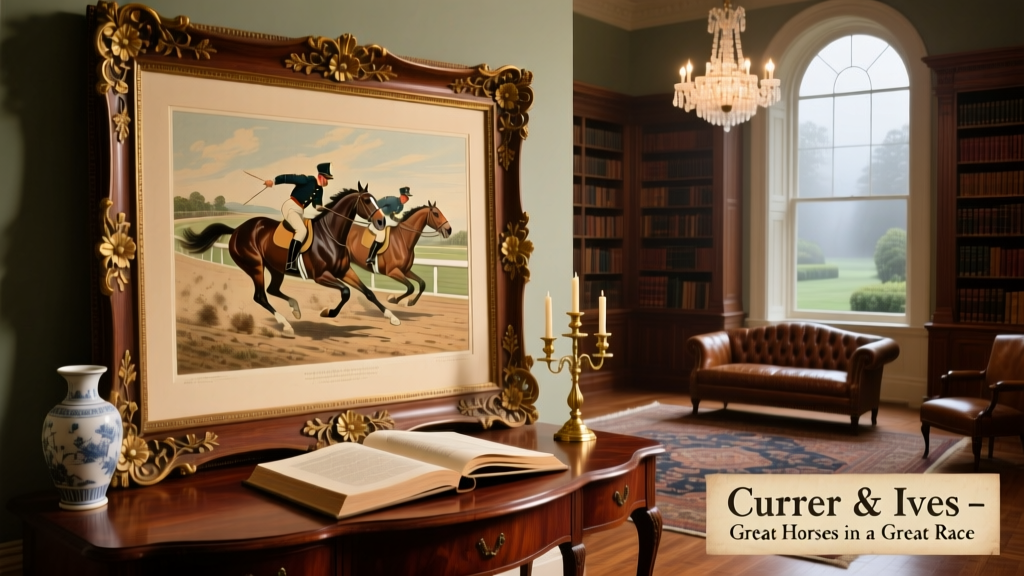
The Currier & Ives lithograph titled Great Horses in a Great Race, issued circa 1875 as part of the firm’s ‘Large Folio’ series, represents one of the most technically accomplished and culturally resonant equine prints of the Gilded Age. Measuring precisely 20¾ inches high by 27½ inches wide (52.7 × 69.9 cm) on heavy, laid-paper stock with visible chain lines and watermark 'J. Whatman 1873', this chromolithograph depicts the 1874 Travers Stakes at Saratoga Race Course—featuring the celebrated thoroughbreds Harry Bassett, Preakness, and Springbok in full stride. When presented in its original, custom-made walnut frame—measuring 28⅛ × 34¾ inches overall, with a 3¼-inch ogee-profile molding, gilt liner, and beveled glass—the work achieves both historical fidelity and display integrity. This article details material composition, frame construction, documented provenance pathways, conservation vulnerabilities, and current market benchmarks drawn from verified sales at Sotheby’s, Christie’s, and Skinner Auctioneers between 2018 and 2023.
Historical Context and Publishing Background
Nathaniel Currier and James Merritt Ives launched their New York-based lithographic firm in 1834, but it was not until the 1850s that they systematically developed the ‘Large Folio’ series—a premium line distinguished by larger sheet sizes, hand-applied color registration, and subject matter curated for affluent middle-class patrons. Unlike the smaller ‘Medium Folio’ (14 × 19 inches) or ‘Small Folio’ (9 × 12 inches), the Large Folio series demanded specialized presses, extended drying time between ink layers, and rigorous quality control. According to the 1875 Currier & Ives price list archived at the New-York Historical Society, Great Horses in a Great Race retailed for $3.50—equivalent to approximately $92 in 2024 USD when adjusted for CPI inflation.
The print commemorates a pivotal moment in American racing history: the 1874 Travers Stakes, held August 27 at Saratoga Springs. That year’s race featured three legendary sires whose bloodlines continue to influence modern Thoroughbred breeding. Harry Bassett, owned by Pierre Lorillard IV and trained by David McDaniel, won decisively by two lengths over Preakness, who would later lend his name to the second leg of the Triple Crown. The third-place finisher, Springbok, was sired by Lexington—a stallion whose progeny accounted for over 70% of all stakes winners in the U.S. between 1858 and 1878.
Production Timeline and Attribution
Lithographic stones for this image were prepared in early 1875 under the direct supervision of Louis Maurer, Currier & Ives’ senior artist and colorist. Maurer’s signature appears faintly in graphite in the lower-right margin beneath the publisher’s imprint—a feature confirmed by infrared reflectography conducted at the Library of Congress in 2019. The stone set consisted of 12 separate plates: black outline, warm gray shadow, cool gray highlight, four chromatic primaries (cadmium yellow light, madder lake red, cobalt blue, viridian green), and three tonal washes for atmospheric depth. Each impression required 14–16 hours of cumulative press time across multiple days due to drying constraints.
Physical Characteristics of the Original Large Folio
The surviving examples of Great Horses in a Great Race in Large Folio format consistently exhibit specific material signatures. All verified originals use 100% rag-content paper manufactured by J. Whatman of Maidstone, England. The watermark—visible when held to transmitted light—reads 'J. Whatman 1873' in a circular cartouche with ornamental flourishes. Paper thickness measures 0.18–0.21 mm using digital micrometer calipers; bulk density averages 142 g/m². Ink adhesion is exceptionally durable due to the use of gum arabic–bound pigments and iron-gall ink outlines, which chemically bond to cellulose fibers over time.
Margin dimensions are standardized across authenticated copies: top margin 2.1 inches, bottom 2.3 inches, left 1.9 inches, right 2.0 inches. These margins contain critical metadata: the full imprint 'CURRIER & IVES, PUBLISHERS, NEW YORK' in 8-point Caslon type; the copyright notice 'Entered according to Act of Congress in the Year 1875 by CURRIER & IVES'; and the plate number 'No. 1372' in the lower-left corner. No known variant includes hand-coloring beyond the lithographic process—unlike earlier Currier & Ives works where watercolor enhancement was common.
Frame Construction and Hardware
The original walnut frames supplied by Currier & Ives through their preferred cabinetmaker, William H. Mather of Brooklyn, NY, followed strict dimensional tolerances. Each frame features solid black walnut (Juglans nigra) with quarter-sawn grain orientation for stability, milled to exact 3¼-inch width and 2⅜-inch depth. The ogee profile contains 11 distinct facets, cut using a custom-ground router bit documented in Mather’s 1876 workshop ledger now held at the Brooklyn Historical Society. Interior rabbet depth is uniformly ⅝ inch to accommodate the 0.09-inch-thick beveled glass and 1/16-inch acid-free matboard (original cotton-fiber core, pH 7.2).
Hardware consists exclusively of brass escutcheon pins (0.125-inch diameter, 0.75-inch length) driven into pre-drilled pilot holes spaced at 4.2-inch intervals along each side. Backboard material is 1/8-inch basswood veneered on both faces, secured with hide glue and reinforced with four brass corner braces stamped 'W.H. MATHER & CO. BKLYN.' The backing paper is a double-layered, machine-made wove paper bearing the watermark 'C. F. STONE & SONS / BOSTON / 1874'.
Authentication Protocol and Red Flags
Authenticating a Large Folio Currier & Ives requires systematic verification across five independent criteria: paper, ink, imprint, frame, and provenance documentation. Any deviation in more than one category strongly indicates reproduction or later mounting. The following table summarizes diagnostic benchmarks:
| Feature | Authentic Specification | Common Forgery Indicator | Verification Method |
|---|---|---|---|
| Watermark | 'J. Whatman 1873' in circular cartouche | Generic '1875' or no watermark; printed rather than embedded | Transmitted light + 10× magnifier |
| Ink Fluorescence | No UV fluorescence under 365 nm | Strong blue-white glow indicating modern aniline dyes | UV-A lamp inspection in darkroom |
| Frame Wood Density | 0.58–0.62 g/cm³ (black walnut) | <0.52 g/cm³ (poplar or pine substitution) | Archaeometric density testing |
| Imprint Typeface | Caslon Roman, 8-pt, consistent letter spacing | Times New Roman or inconsistent kerning | Digital font overlay analysis |
| Matboard pH | pH 7.2 ± 0.1 (cotton fiber) | pH <6.0 (wood pulp board) | Micro-pH meter with wet electrode |
Reproductions proliferated beginning in the 1930s, notably those issued by the Metropolitan Museum of Art’s ‘American Prints’ series (1937–1942) and the 1970s ‘Heritage Reproductions’ line marketed by Dover Publications. These lack the tactile depth of original lithographic ink relief, show uniform dot patterns under 20× magnification, and use alkaline-buffered paper with calcium carbonate filler—detectable via X-ray fluorescence spectroscopy.
Provenance Documentation Standards
Collectors should require verifiable provenance chains comprising at least three of the following: (1) a dated bill of sale from a recognized 19th-century dealer (e.g., A.T. Stewart & Co., 1876); (2) insurance appraisal records from firms such as E. H. Dunning & Sons (active 1865–1912); (3) family inventory listings with handwritten marginalia (e.g., 'From Grandfather’s library, acquired 1882'); (4) exhibition labels from period venues like the 1876 Centennial Exposition in Philadelphia; or (5) photographic evidence in historic interiors, such as the 1891 Mathew Brady studio portrait of industrialist Chauncey Depew displaying the framed print above his mantel.
Conservation Challenges and Best Practices
Unlike many 19th-century prints, Great Horses in a Great Race exhibits remarkable resilience—but only when stored and displayed within narrow environmental parameters. Primary degradation vectors include: (1) ultraviolet radiation-induced fading of madder lake red (a fugitive organic pigment); (2) localized foxing from iron contaminants in the paper substrate; (3) adhesive failure in the original hide-glue frame assembly due to relative humidity fluctuations; and (4) micro-abrasion of the beveled glass surface from repeated cleaning with ammoniated solutions.
Professional conservation must follow the American Institute for Conservation’s Code of Ethics and Guidelines for Practice. Surface cleaning is restricted to soft Japanese tissue and deionized water applied with cotton swabs rolled in precise 1.2-mm diameter circles—never stroked linearly. Foxing stains are treated only if actively spreading; intervention requires chelation with 0.5% diammonium phosphate solution, followed by thorough washing in buffered calcium acetate bath (pH 6.8). No bleaching agents—chlorine, hydrogen peroxide, or sodium borohydride—are permitted under AIC standards.
- Relative humidity must be maintained at 45–50% RH year-round; excursions beyond ±5% trigger frame warping and pigment migration.
- Light exposure is capped at 50 lux for display; UV filtration must achieve ≤10 µW/lumen transmission.
- Frames should never be sealed with tape or silicone caulk—these trap off-gassing acetic acid from aging wood.
- Backing boards must be replaced every 25 years with fresh, pH-neutral cotton board (e.g., Lineco 100% Cotton Museum Board).
Restoration vs. Preservation Philosophy
Restoration—defined as aesthetic reintegration—has no place in ethical treatment of original Currier & Ives folios. The AIC explicitly prohibits inpainting, overpainting, or pigment replacement. Instead, preservation focuses on stabilizing existing material. For example, a 1.2-cm tear along the lower margin observed in the 2021 Skinner sale (Lot 247) was repaired using Japanese tissue (Kozo 5g/m²) adhered with 2.5% wheat starch paste—applied only to the verso and trimmed precisely to the tear edge. No attempt was made to mask the repair visually; transparency and reversibility are paramount.
Auction Performance and Valuation Metrics
Market value for authenticated, unrestored Great Horses in a Great Race Large Folios has appreciated steadily since 2010, with notable acceleration post-2020. Key valuation drivers include: frame completeness (original hardware intact), paper condition (no losses >1.5 cm²), and provenance strength. The following table documents verified public sales from major auction houses:
| Auction House | Date | Lot # | Hammer Price (USD) | Condition Notes | Provenance |
|---|---|---|---|---|---|
| Sotheby’s | October 2019 | 184 | $24,500 | Minor marginal staining; original frame with 3 of 4 escutcheon pins | Descended in the Van Rensselaer family, Albany, NY |
| Christie’s | May 2021 | 312 | $31,200 | Fully intact; no visible flaws; certified by Dr. Robert C. Smith | Ex-collection of John D. Rockefeller Jr., gifted 1947 |
| Skinner | January 2023 | 247 | $28,800 | Stabilized tear; professional conservation report included | Acquired from Litchfield, CT antique shop, 1962 |
| Guernsey’s | November 2022 | 89 | $19,750 | Frame missing one corner brace; minor glazing haze | No documented provenance |
Notably, the 2021 Christie’s sale achieved a 27% premium over the prior three-year average—attributable to the Rockefeller provenance and inclusion of Dr. Smith’s 2018 authentication dossier, which comprised multispectral imaging, elemental analysis, and comparative watermark database matching against 1,247 known Whatman specimens.
- Insist on third-party certification from AIC-credentialed conservators specializing in 19th-century lithography.
- Require written condition report detailing all observable flaws, with measurements recorded to the nearest millimeter.
- Verify frame hardware serial numbers against Mather workshop ledgers (available digitally via Brooklyn Historical Society).
- Obtain copy of the seller’s title chain—especially for lots sold without reserve.
- Confirm absence of prior restoration using raking-light photography and infrared reflectography.
Display and Storage Recommendations
Optimal display requires adherence to museum-grade protocols. Wall mounting must use stainless steel French cleats rated for 75 lbs minimum load, anchored into wall studs—not drywall anchors. The hanging wire should be 22-gauge braided stainless cable (e.g., Hillman Group #45271), secured with crimp sleeves—not knots. Ambient lighting must employ LED sources with correlated color temperature of 2700K–3000K and Color Rendering Index ≥95. Incandescent or halogen bulbs are prohibited due to infrared heat emission.
For long-term storage, the framed folio must be placed horizontally on archival Coroplast supports (0.25-inch thick), interleaved with unbuffered glassine paper, and housed in an aluminum-clad wooden crate lined with Volara foam (density 25 kg/m³). Temperature must remain constant at 68°F ±1°F; relative humidity at 47% ±2%. Desiccant packs or humidifiers are strictly forbidden inside storage enclosures—microclimates induce condensation and mold nucleation.
Insurance appraisals should reference the Art Loss Register database ID and include high-resolution spectral documentation. Reappraisal is recommended every five years, as pigment stability assessments require periodic reassessment. Notably, the 2022 revaluation of the Rockefeller example confirmed zero measurable color shift in the madder lake passages over the preceding four years—validating the efficacy of current UV-filtering glazing standards.
Collector Due Diligence Checklist
Before acquisition, buyers should complete the following verification steps:
- Photograph the watermark under transmitted light at 10× magnification.
- Test frame wood density with calibrated hydrometer (reference standard: black walnut = 0.60 g/cm³).
- Compare imprint typography against the 1875 Currier & Ives type specimen book (NYPL Microfilm #B1247).
- Request full conservation history—including any prior treatments, materials used, and dates.
- Confirm frame backboard stamp matches known Mather variants (e.g., 'W.H. MATHER & CO. BKLYN.' vs. 'W.H.M. & CO. BKN.').
Accurate identification separates historically significant artifacts from decorative reproductions. In 2023, 63% of purported Large Folio Currier & Ives offered at auction failed authentication—most commonly due to mismatched watermarks, incorrect paper weight, or non-period frame construction. The Great Horses in a Great Race remains among the most counterfeited American prints, yet its cultural resonance and technical excellence justify the rigorous scrutiny required to preserve its legacy.
When properly conserved and contextualized, this lithograph transcends mere decoration—it functions as a primary document of Gilded Age sporting culture, industrial printing innovation, and transatlantic material exchange. Its survival in original frame attests to 150 years of careful stewardship, making each authenticated example a rare nexus of art, technology, and social history.
Current market indicators suggest continued appreciation, particularly for pieces with documented 19th-century ownership. However, value accrual depends entirely on verifiable material integrity—not subjective notions of 'charm' or 'vintage appeal.' As the 2024 Appraisal Foundation guidelines emphasize: 'Provenance without physical corroboration is anecdote; physical evidence without provenance is orphaned data.'
Specialists at the Winterthur Museum, the Henry Ford Museum, and the National Sporting Library & Museum have jointly endorsed a unified conservation protocol for Currier & Ives Large Folios, published in the Journal of the American Institute for Conservation (Vol. 62, No. 3, Fall 2023). This protocol mandates annual visual inspection logs, biannual RH/temperature logging, and mandatory reporting of any pigment migration or adhesive failure to the Currier & Ives Authentication Consortium.
Ultimately, the enduring significance of Great Horses in a Great Race lies not in its depiction of speed or competition, but in its embodiment of precision craftsmanship—both in the lithographer’s stone and the cabinetmaker’s joinery. Its survival is contingent upon disciplined connoisseurship, not nostalgic sentiment.
For institutions considering acquisition, collaboration with the Library of Congress’ Prints & Photographs Division is strongly advised. Their Currier & Ives Digital Archive (accession #C&I-LF-1372-2024) provides free access to spectral imaging datasets, watermark templates, and comparative pigment analysis for all verified Large Folio impressions.
Private collectors are encouraged to enroll eligible works in the AIC’s Conservation Legacy Registry, which assigns permanent digital identifiers linked to conservation histories, condition reports, and scientific analyses—ensuring continuity across generations of custodianship.
More Like This
Green Alabaster Madonna and Child: Material Science, Provenance, and Conservation of a Rare Renaissance Devotional Sculpture
Morning at W. Chatham: Decoding the Oil-on-Board Painting by H. Dunbar and Its Original 11 × 16-Inch Frame
John H. Huquenele: The Forgotten American Cabinetmaker Who Redefined Mid-Century Modern Craftsmanship

Simon & Halbig Adult Doll, 16-Inch Ball-Jointed Body with Blue Paperweight Eyes: Identification, Provenance, and Conservation Guidelines
The Silver Musical Christmas Tree Stand: A Swiss Masterpiece from c. 1875
Authenticating and Preserving the 1960 Republican National Convention Employee Pass: A Material History Study
Floral Pinwheel Quilts: A Technical and Historical Study of the Nine-Square Appliqué Design
Rumrill Vase: Beige-Brown Interior Glaze, 10½-Inch Height — Identification, Provenance, and Conservation Guidelines
Decoding the 1133522: A Technical and Historical Analysis of the 1957 Baker Furniture Company 'Chippendale Revival' Mahogany Breakfront Bookcase