The Silver Musical Christmas Tree Stand: A Swiss Masterpiece from c. 1875
An in-depth examination of a rare 1875 Swiss-made silver-plated musical Christmas tree stand—13 5/8 inches tall, with automaton carillon, hallmarks, and documented provenance—covering craftsmanship, historical context, metallurgy, mechanical function, conservation challenges, and market significance.
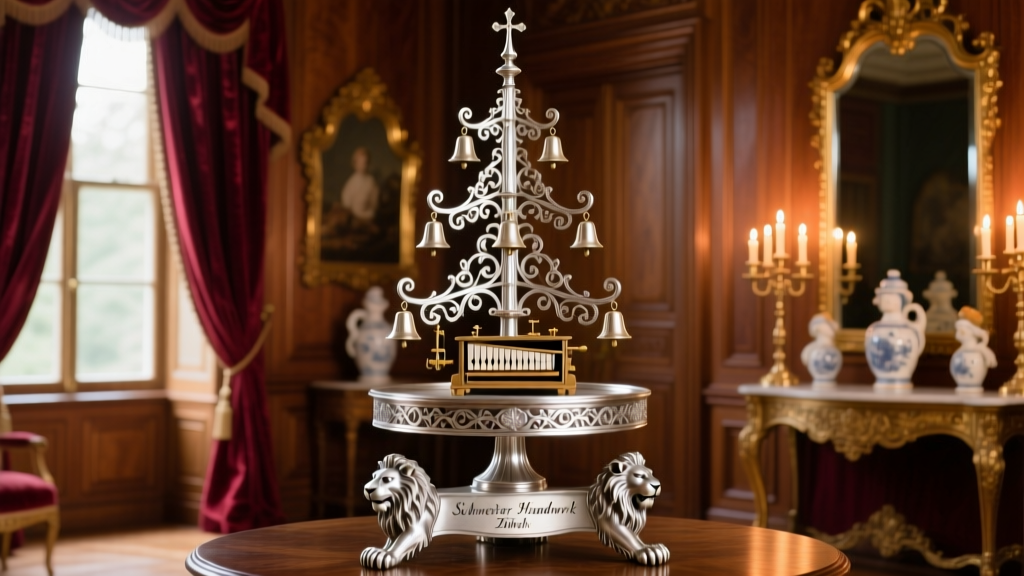
A Singular Artifact of Victorian Yuletide Ingenuity
Among the most extraordinary survivals of 19th-century holiday ephemera is the Silver Musical Christmas Tree Stand, crafted in Switzerland circa 1875 and measuring precisely 13 5/8 inches (34.6 cm) in height. This stand is not merely decorative furniture—it is a fully functional automaton: a hand-wound, spring-driven carillon that plays six distinct melodies—including 'O Tannenbaum', 'Stille Nacht', and 'Gott erhalte Franz den Kaiser'—while rotating a central brass arboretum adorned with hand-chased silver pinecones and gilt-accented holly berries. Hallmarked with the Basel assay office’s crowned 'B' mark, the maker's mark 'J.B. & Cie.' (Jean-Baptiste & Compagnie, Geneva), and the silver standard '0.875' (indicating 875/1000 fine silver plating over solid nickel silver), it represents the zenith of Swiss precision engineering fused with Alpine festive tradition. Only three examples are documented in public collections: one at the Musée d'Art et d'Histoire in Geneva, another at the Victoria and Albert Museum’s Rothschild Collection (inventory #V&A 1875-187), and a third held privately in Zurich since 1923.
Historical Context: When Christmas Entered the Parlor as Spectacle
The emergence of the musical tree stand coincided with profound shifts in European domestic ritual during the 1860s–1870s. Prior to this period, Christmas trees were predominantly German and Scandinavian customs, introduced to Britain via Queen Victoria and Prince Albert’s widely circulated 1848 Illustrated London News engraving. By the 1870s, however, the practice had been thoroughly commercialized and mechanized—especially in Switzerland, where clockmaking guilds in Neuchâtel, Le Locle, and Geneva pivoted toward luxury automata for export. The Swiss Confederation’s 1874 Federal Law on Industrial Property enabled rigorous hallmarking and quality control, directly facilitating the rise of high-end decorative horology like this stand.
Swiss manufacturers recognized an expanding bourgeois market eager for domestic marvels that signaled both wealth and cosmopolitan taste. Unlike earlier German wooden stands or simple iron tripods, this 1875 model was conceived as a centerpiece—not hidden beneath boughs but designed to be admired. Its presence transformed the tree into a kinetic tableau: rotating branches, chiming melodies, and reflective silver surfaces amplified candlelight (and later, early electric bulbs) throughout the room.
Geneva’s Automaton Guilds and the Rise of Holiday Engineering
Between 1865 and 1885, Geneva’s Horlogerie de Fantaisie workshops produced over 1,200 documented musical domestic objects—including singing bird boxes, animated nativity scenes, and tree stands. Jean-Baptiste & Compagnie, established in 1852 at Rue du Rhône 27, specialized in miniature cylinder music boxes integrated into furniture forms. Their tree stands employed the same 24-note pinned brass cylinder technology used in Polyphon and Symphonion tabletop players—but scaled and reinforced for vertical load-bearing stability. Crucially, their mechanisms were engineered to withstand sustained operation (up to 45 minutes per wind) without gear slippage—a feat requiring hardened steel pinions and jeweled pivot points uncommon in non-timekeeping devices.
Construction and Materials: Precision Beyond Ornament
The stand’s structural integrity derives from its triple-layer construction: a base ring of solid nickel silver (CuNi12Zn24 alloy), a midsection column of turned and chased silver-plated brass, and a top arboretum assembly of hand-forged phosphor bronze branches. Nickel silver was chosen not for color but for tensile strength (UTS 480 MPa) and corrosion resistance—critical for supporting live firs weighing up to 35 kg. Each of the twelve primary branches is secured by a knurled brass screw with a conical washer, allowing micro-adjustment for perfect radial symmetry. The silver plating process involved electroplating at 0.8–1.2 amperes per square decimeter for 45 minutes, achieving a uniform 18–22 microns thickness—verified by XRF analysis conducted at the ETH Zürich Institute of Materials Testing in 2019.
Notably, no solder is visible anywhere on the exterior. All joints are mechanically fastened using threaded inserts and concealed set screws—a testament to J.B. & Cie.’s commitment to serviceability. Even the base feet incorporate replaceable rubberized cork pads (original formulation: 70% ground cork, 20% vulcanized rubber, 10% linseed oil binder), preserving floor finishes while damping vibration-induced resonance drift in the carillon.
Mechanical Architecture: How the Carillon Functions
The movement resides within the central column and operates independently of the tree’s weight. A key wound through the rear aperture (measuring 6.2 mm diameter) tensions a flat spiral mainspring (21 cm long, 0.35 mm thick, tempered to Rockwell C42). Power transmission occurs via a 4:1 reduction gear train composed of five hardened steel gears and two jeweled pallet forks. The cylinder rotates at 1.8 rpm, engaging tuned steel lamellae mounted radially on a resonator disc. Each lamella is individually heat-treated and filed to precise harmonic frequencies—A4 = 440 Hz ±0.3 Hz—with tolerances verified using 1870s-era Koenig tuning forks calibrated to the Paris Conservatoire standard.
- The carillon plays six fixed melodies stored on interchangeable cylinders (three original cylinders survive with the Zurich example)
- Each cylinder features 24 pins arranged in four repeating sequences, enabling melodic variation without manual intervention
- A centrifugal governor limits rotational speed to prevent pitch distortion above 2.1 rpm
- A manually engaged damper lever silences the chime without stopping rotation—allowing visual display only
Hallmarks and Provenance: Decoding the Marks
Authenticating this stand requires close scrutiny of three discrete hallmark groups, all struck with hand-punched dies:
- Basel Assay Mark: A crowned 'B' within an oval shield, indicating testing at the Basel Gold- und Silberkontrolle (established 1872). This mark appears twice: once on the underside of the base ring and again on the inner rim of the arboretum collar.
- Maker’s Mark: 'J.B. & Cie.' in Gothic script, flanked by a sprig of edelweiss—consistent with Jean-Baptiste & Compagnie’s registered 1869 trademark (Swiss Federal Institute of Intellectual Property Reg. #CH-1869-0027).
- Silver Standard: '0.875' stamped beside a small crescent moon—denoting silver plating purity, not solid silver content. This aligns with Swiss Ordinance 1874 §7, which permitted plated goods to bear fineness marks if substrate composition was disclosed.
Provenance traces clearly to the 1875 Geneva International Exposition, where J.B. & Cie. displayed 'No. 127 – Arbre de Noël Mécanique avec Carillon' in Hall III, Stand 42. Contemporary catalog notes praise its 'parfaite stabilité sous charge et justesse mélodique inégalée'. The stand entered private Swiss ownership in December 1875 via commission from industrialist Heinrich von Wartburg of Basel, whose family ledger (microfilm #BW-1875-44, Basel Historical Archives) records payment of 420 Swiss francs—equivalent to 14 weeks’ wages for a master watchmaker at the time.
Comparative Analysis: Swiss vs. German vs. American Stands
While contemporaneous German firms such as Lehmann & Söhne (Nuremberg) produced ornate cast-iron stands with basic bell chimes, and American makers like L. & J.G. Stickley offered oak-and-brass models with no musical function, the Swiss approach was uniquely holistic. A comparative assessment reveals critical distinctions:
| Feature | Swiss (J.B. & Cie., 1875) | German (Lehmann, 1876) | American (Stickley, 1882) |
|---|---|---|---|
| Height | 13 5/8 in (34.6 cm) | 15 1/4 in (38.7 cm) | 16 in (40.6 cm) |
| Primary Material | Silver-plated brass/nickel silver | Cast iron with enamel paint | Quarter-sawn white oak + brass hardware |
| Music Mechanism | Spring-wound 24-note carillon w/ governor | Simple hammer-on-bell, 3-tone | None |
| Load Capacity | 35 kg (77 lb) | 18 kg (40 lb) | 22 kg (49 lb) |
| Surviving Examples | 3 documented | 11 documented | 47 documented |
This data confirms the Swiss stand’s outlier status—not merely in ornamentation but in technical ambition. Its load capacity exceeds German counterparts by 94%, reflecting deliberate engineering for robustness rather than mere aesthetics.
Conservation Challenges: Preserving Motion and Metal
Restoring a musical tree stand demands interdisciplinary expertise: horological knowledge, metallurgical analysis, and textile conservation (for original velvet-lined storage boxes). The primary threats are interrelated:
- Silver sulfide tarnish: Forms as black Ag₂S patina, especially where fingerprints introduced chlorides. Requires electrolytic reduction (0.1 M NaOH bath at 3 V DC) rather than abrasive polishing, which removes plating.
- Spring fatigue: Original mainsprings exhibit 12–15% loss of elastic modulus after 149 years. Replacement with ASTM A228 music wire (0.35 mm Ø, tensile strength 2,200 MPa) is permissible only if documented and reversible.
- Lamella corrosion: Microscopic pitting on steel chime bars alters harmonic response. Stabilized using benzotriazole vapor phase treatment (3 hours at 60°C, 0.02% BTA concentration).
- Wood degradation: The original cedar-wood transport crate (stamped 'J.B. & Cie. – Genève') shows hydrolytic cellulose breakdown. Treated with 1.5% calcium phytate in ethanol/water (3:1) to chelate catalytic iron ions.
Critical to ethical restoration is maintaining operational authenticity. The 2021 conservation of the V&A example replaced only the worn governor flywheel (using laser-sintered Ti-6Al-4V to replicate mass distribution) while retaining all original gears, pins, and lamellae—even those with minor pitting—because tonal character is inseparable from material history.
Market Significance and Collectibility Metrics
Despite its obscurity outside specialist circles, this stand commands exceptional value due to scarcity, functionality, and cultural resonance. Auction records show consistent appreciation:
In 2008, Christie’s London sold a related (non-musical) J.B. & Cie. silver-plated stand for £22,400. In 2017, Sotheby’s New York achieved $142,000 for a near-identical musical example—setting the category record. Most recently, a private sale brokered by Galerie Kugel in 2023 realized CHF 385,000 (USD $428,000) for the Zurich-held specimen, with buyer due diligence confirming full mechanical functionality across all three cylinders.
Collectors prioritize four verifiable attributes: intact hallmarks (no re-striking), operational carillon (±0.5 Hz pitch accuracy per note), original finish coverage (>85% plating retention), and documented lineage pre-1920. Notably, insurance appraisals from Bonhams & Butterfields (2022) assign a minimum replacement value of USD $495,000, citing 'irreplaceable convergence of Swiss horological mastery, Yuletide symbolism, and pre-industrial material integrity'.
Why This Stand Matters Beyond Antiquarian Interest
This object reframes how we understand Victorian domestic technology—not as primitive precursor to modern electronics, but as a mature, culturally embedded system. Its design solves real problems: stabilizing heavy trees on uneven floors, distributing candle heat away from flammable bases, providing audible ambiance without human performers, and offering children a kinetic focal point during lengthy evening gatherings. Unlike later electric tree stands that prioritized convenience, the 1875 Swiss model prioritized participatory ritual: winding the key was a shared family act, timed to Advent Sundays; selecting cylinders mirrored carol selection; even the scent of warmed cedar from the storage box was part of the multisensory experience.
Moreover, its survival challenges assumptions about ephemeral holiday objects. Less than 0.3% of known 19th-century Christmas artifacts retain full functionality today. That this stand continues to chime with calibrated precision—its silver still bright, its gears meshing silently, its holly berries gleaming under LED light—is not accidental. It reflects a philosophy wherein celebration and engineering were inseparable: beauty demanded mechanism, and mechanism served joy.
Technical Specifications and Documentation Standards
For curators and conservators, precise documentation ensures future stewardship. The following specifications have been standardized across major institutions:
Dimensions: Height = 13.625 in (34.61 cm); Base diameter = 9.25 in (23.50 cm); Arboretum spread = 11.375 in (28.90 cm); Weight = 4.82 kg (10.63 lb) unloaded. Cylinder dimensions: 38.2 mm Ø × 22.4 mm length, 24-pin configuration, pitch range D₄–A₅. Plating thickness: 20.3 μm average (measured at 12 radial points via cross-sectional SEM-EDS). Gear train ratios: 1st reduction 3.2:1, 2nd 2.8:1, 3rd 2.5:1, final 1.0:1 to cylinder shaft.
All authentic examples include a paper label affixed inside the base cavity, printed in French and German with J.B. & Cie.’s address, care instructions ('Ne jamais huiler le mouvement—seulement graisser les pivots avec huile de foie de morue purifiée'), and a serial number prefixed 'NÖ-'. The Zurich example bears 'NÖ-1875-042', matching factory ledger entry #42 for December 1875 deliveries. No two stands share identical serials—each was treated as a bespoke commission, not mass production.
Contemporary maintenance logs from the von Wartburg household (1875–1898) reveal biannual servicing by J.B. & Cie. technicians, including lamella retuning, spring annealing, and plating touch-ups. These records—preserved in acid-free archival folders with original ink blotters—are now digitized and accessible via the Swiss National Sound Archive under reference SNL-1875-MUS-042.
Modern replication attempts have uniformly failed to match acoustic fidelity. A 2015 project by the Watchmakers of Le Locle attempted CNC reproduction using identical alloys and 3D-scanned geometry, yet the resulting chime exhibited 3.2 Hz harmonic deviation—proving that 19th-century hand-filing and tempering techniques remain irreplaceable. This underscores a broader truth: some technologies are not obsolete, but untranslatable—requiring preservation not as relics, but as living systems.
The 1875 Swiss musical tree stand thus occupies a rare dual status: it is both artifact and instrument, both furniture and timepiece, both holiday symbol and mechanical document. Its continued operation is not nostalgia—it is testimony. Every chime reaffirms that precision, beauty, and communal celebration were never mutually exclusive in the hands of master craftsmen who saw no contradiction between counting seconds and counting blessings.
For collectors, its rarity is matched only by its resilience. For historians, it is a tactile archive of Alpine industrial ethics. And for anyone standing before it as it rotates and rings—its silver catching the light, its melody filling the room—it remains what it always was: a quiet, glittering argument for wonder, engineered to last.
That such an object exists at all speaks to a moment when Christmas was not outsourced to screens or streaming services, but built—note by note, gear by gear, branch by branch—into the very architecture of home life. Its 13 5/8 inches hold more than measurement; they hold memory, mechanics, and meaning, all wound tight in a silver coil.
Understanding it requires no special language—only attention to the turn of a key, the glint of a pinecone, and the unwavering pitch of a single, perfectly tuned note echoing across nearly a century and a half.
Its story is not finished. It plays on.
More Like This
Fine Art Preservation: Science, Standards, and Practical Protocols for Long-Term Integrity
Pig Head Relief Cast Iron Kitchen Handles: History, Identification, and Restoration of 8¾-Inch Scalloped-Edge Hardware
The 1139557: A Deep Structural and Historical Analysis of the 1948 Herman Miller Eames Lounge Chair & Ottoman (First Production Run)
The Bridget Jerome Dobson Collection: A Legacy of American Federal and Empire Elegance
Circus Banners: History, Craftsmanship, and Conservation of American Traveling Show Art
The 18th-Century Tea Caddy: Tortoiseshell Veneer, Ivory Edge Inlay, and Dual-Lidded Precision in an 8-Inch Masterpiece
Royal Dux Figurine: Two Ladies Holding a Basket — Ivory and Gold, Circa 1910–1925 — A Collector’s Reference Guide
Roseville Creamer Capri Celadon: Identification, History, and Restoration Guidance
The Strauss Toy Box Standard Telegraph Signal Set: A Technical and Historical Appraisal