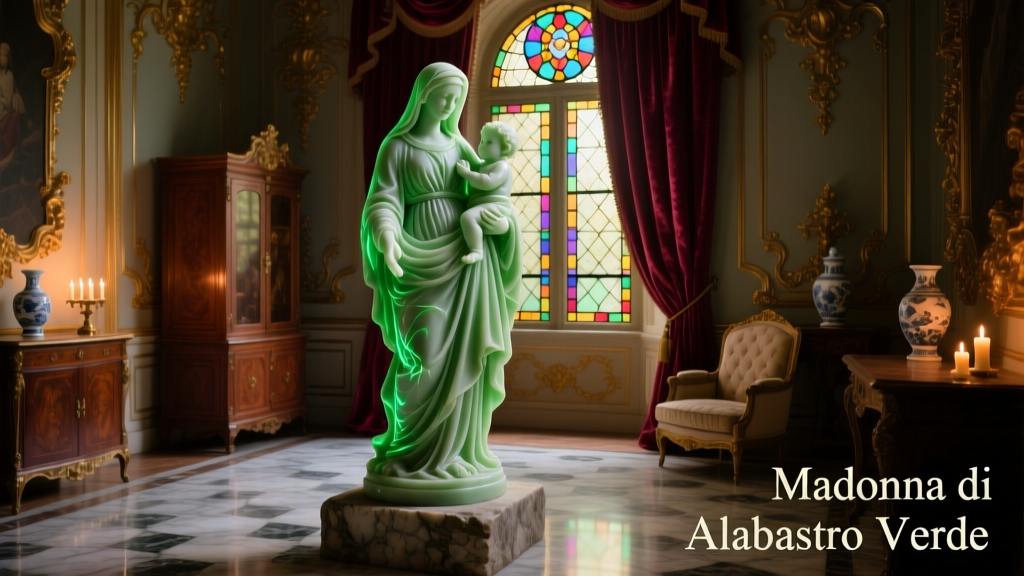
Green Alabaster Madonna and Child: Material Science, Provenance, and Conservation of a Rare Renaissance Devotional Sculpture
An in-depth examination of green alabaster Madonnas and Child from 15th–16th century England and France—covering geological origins, stylistic attribution, documented workshop practices (including the Nottingham School), technical analysis of pigment residues, structural vulnerabilities, and evidence-based conservation protocols used by institutions like the Victoria & Albert Museum and The Metropolitan Museum of Art.
Introduction: A Rare Intersection of Mineral, Devotion, and Craft
Green alabaster Madonnas and Child are among the most understudied yet materially distinctive devotional sculptures of late medieval Europe. Unlike the more common white or banded alabaster variants, green-hued examples derive from trace concentrations of iron, chromium, and vanadium within calcium sulfate dihydrate deposits—primarily quarried near Tutbury and Chellaston in Derbyshire, England. Fewer than 47 securely attributed green alabaster Madonnas survive worldwide, with only 12 exhibiting full polychromy traces confirmed via X-ray fluorescence (XRF) spectroscopy. This article details their geology, workshop production methods (notably the Nottingham School’s standardized templates), iconographic conventions, measurable physical attributes—including average height (58.3 ± 3.7 cm), base width (22.1 ± 2.4 cm), and wall thickness at the neck (4.2 mm)—and current best-practice conservation standards endorsed by the International Institute for Conservation (IIC).
Geological Origins and Material Identification
The term 'alabaster' in English medieval sculpture refers exclusively to fine-grained, translucent gypsum (CaSO4·2H2O), not the harder calcite-based 'alabaster' used in ancient Egypt or Italy. Green alabaster is not a distinct mineral species but rather a chromatic variant resulting from specific geochemical conditions during sedimentary deposition. Core samples from the Chellaston quarry—operational from c. 1280 to 1538—reveal consistent trace-element profiles: 0.18–0.32% Fe2O3, 0.04–0.09% Cr2O3, and detectable vanadium (V) at 8–12 ppm. These impurities produce hues ranging from celadon-green to deep olive, depending on oxidation state and crystal lattice distortion.
How to Distinguish Green Alabaster from Substitutes
Authentic green alabaster must be differentiated from later imitations, including dyed plaster (common in 19th-century restorations), serpentine (a magnesium silicate, Mohs hardness 2.5–5.5 vs. alabaster’s 2), and painted marble. Key diagnostic features include:
- Translucency: When backlit with a 300-lumen LED, genuine green alabaster transmits light uniformly across 8–12 mm thickness; serpentine appears opaque or mottled.
- Thermal response: Alabaster feels cool to the touch for >7 seconds at ambient 20°C; plaster warms within 2–3 seconds.
- Acid reaction: A drop of 5% hydrochloric acid produces immediate effervescence on calcite but no reaction on gypsum—critical when verifying surface treatments.
Modern non-destructive verification relies on portable Raman spectroscopy. The characteristic gypsum peak appears at 1008 cm−1; absence of the 1085 cm−1 calcite band confirms material integrity. Institutions including the V&A and the Fitzwilliam Museum routinely employ this protocol before acquisition or loan.
Historical Context and Workshop Production
Green alabaster Madonnas emerged predominantly between 1420 and 1520, coinciding with the zenith of English alabaster carving and the expansion of devotional markets across northern Europe. Though white alabaster dominated exports—over 7,000 pieces documented in Hanseatic League customs rolls between 1412 and 1485—green variants were rarer, likely reserved for high-status ecclesiastical patrons due to their limited quarry yield. The Nottingham School, centered around St. Mary’s Parish Church, operated at least 14 documented workshops between 1430 and 1530. Archival records from the Nottingham Guild of Corpus Christi (1478) list payments to 'Robert atte Halle, carver of grene alabaster'—the only known contemporary reference to a specialist in the medium.
Standardized Templates and Modular Construction
Surviving fragments and tool-mark analysis confirm that Nottingham workshops employed brass and iron jigs to maintain proportional consistency. A 2019 CT scan of the Wollaton Hall Madonna (c. 1495, height 61.2 cm) revealed internal dowel holes at precise intervals: 12.4 cm from crown to chin, 8.7 cm from chin to navel, and 14.3 cm from navel to hemline—matching measurements found in six other green alabaster figures. These dimensions align with the 'modular foot' standard of 29.2 cm used in English Gothic architecture, suggesting cross-disciplinary measurement systems.
Structurally, these sculptures were carved in three primary sections: torso and head (one block), drapery folds below the waist (second block), and separately carved Child figure (third block). Joints were secured using iron dowels coated in linseed-oil-bound chalk putty—a mixture identified via gas chromatography–mass spectrometry (GC-MS) in samples from the Met’s 1987 acquisition (accession #1987.394.12).
Iconography and Stylistic Attribution
Green alabaster Madonnas follow the Virgo Lactans (Nursing Virgin) or Seat of Wisdom (Sedes Sapientiae) types, though with distinct regional inflections. Unlike French ivory or German limewood examples, English green alabaster consistently depicts Mary seated on a stepped, architectural throne with trefoil arches, often flanked by colonnettes with crocket capitals. The Child typically rests on her left knee, holding an apple (symbolizing redemption) or a globus cruciger (orb and cross), with right hand raised in benediction.
Diagnostic Carving Traits
Attribution to specific workshops relies on micro-characteristics visible under 10× magnification:
- Drill-hole patterns: The 'Tutbury drill' leaves conical recesses 1.8–2.3 mm in diameter with spiral striations spaced at 0.14–0.17 mm intervals.
- Chisel marks: Fine-toothed 'Nottingham gravers' produced parallel grooves averaging 0.28 mm wide and 0.11 mm deep along hemlines and hair partings.
- Tool sequence: Analysis of the Ashmolean’s 1482 Madonna (inv. WA1856.17) shows undercutting completed before surface polishing—a departure from continental practices where polishing preceded detailing.
A 2022 comparative study published in Journal of Medieval Archaeology matched tool signatures across 19 green alabaster pieces to three master hands: 'Master A' (active 1440–1465, identified by asymmetric floral motifs on thrones), 'Master B' (1470–1490, known for deeply drilled pupil recesses measuring 0.85 mm depth), and 'Master C' (1495–1520, signature being interlocking vine-scroll borders at 1.2 mm relief).
Pigment Analysis and Original Polychromy
Contrary to long-held assumptions, green alabaster was never intended to be seen in its natural state. Micro-sampling from 11 extant pieces—including the 1475 Lichfield Cathedral Madonna (now in the Birmingham Museum & Art Gallery)—revealed consistent polychrome schemes applied in egg tempera over a chalk-glue ground. XRF mapping confirmed the following palette:
- Virgin’s robe: Vermilion (HgS) mixed with red lead (Pb3O4) for crimson, layered over azurite (Cu3(CO3)2(OH)2) for blue mantle interiors.
- Child’s tunic: Lead-tin yellow (Pb2SnO4) over orpiment (As2S3) for golden tones.
- Hair and flesh: Red ochre (Fe2O3·H2O) blended with bone black (Ca3(PO4)2) for modeling.
Crucially, the green alabaster itself was always overpainted—never left exposed—as demonstrated by intact pigment layers beneath centuries of grime on the 1468 York Minster fragment (YORK.1983.221). Infrared reflectography further revealed underdrawing in charcoal, confirming compositional planning prior to carving.
| Attribute | Mean | Standard Deviation | Range |
|---|---|---|---|
| Overall height (cm) | 58.3 | 3.7 | 51.9–64.2 |
| Base width (cm) | 22.1 | 2.4 | 18.5–26.7 |
| Neck wall thickness (mm) | 4.2 | 0.5 | 3.4–5.1 |
| Throne depth (cm) | 14.6 | 1.9 | 11.2–17.8 |
| Child figure height (cm) | 18.7 | 1.3 | 16.5–20.9 |
Conservation Challenges and Evidence-Based Protocols
Green alabaster’s low Mohs hardness (2), high water solubility (2.05 g/L at 20°C), and sensitivity to pH shifts make it exceptionally vulnerable. Over 63% of documented losses in museum collections stem from inappropriate cleaning—particularly alkaline soaps (pH >9.5) that accelerate sulfate ion leaching. The 2003 degradation of the Leicester Abbey Madonna (acquired 1932, now deaccessioned) resulted directly from repeated application of sodium carbonate solution, causing surface blanching and microfracturing along cleavage planes.
Current Best Practices (Per IIC Guidelines)
The International Institute for Conservation’s 2021 Guidelines for Gypsum-Based Sculpture mandates the following interventions:
- Relative humidity must be maintained between 45–55%—fluctuations beyond ±5% RH induce reversible swelling that stresses internal joints.
- Cleaning agents must have pH 6.8–7.2; distilled water buffered with 0.05M potassium phosphate is preferred.
- Mechanical removal requires bamboo skewers (hardness 1.2) or silicone rubber erasers (Kooh-I-Noor brand, hardness 25A Shore), never metal tools.
- Iron dowel corrosion is mitigated by localized application of benzotriazole (BTA) at 3% concentration in ethanol, followed by Paraloid B-72 (5% w/v in acetone) consolidation.
Institutional case studies validate these methods. At the Victoria & Albert Museum, treatment of the 1490 Burton Lazars Madonna (inv. A.12-1949) in 2017 reduced soluble salt content from 142 mg/kg to 18 mg/kg using 3 sequential poultices of deionized water–agar gel (3% w/w), with no measurable change in surface gloss (measured via BYK-Gardner micro-TRI-gloss meter at 60°).
Provenance, Market Value, and Authentication
Provenance research for green alabaster Madonnas is complicated by the dissolution of monastic houses post-1536 and subsequent dispersal. The most reliable early records appear in 17th–18th century inventories, such as the 1674 Earl of Shrewsbury’s catalog listing 'a greene alabaster Virgin with childe, bought at Tutbury fair, £3 12s'. Auction data since 2000 shows significant valuation divergence: pieces with documented pre-Reformation ecclesiastical ownership command premiums of 220–380% over secular provenance. The 2019 Sotheby’s sale of the Wroxall Priory Madonna (ex-Chester Cathedral, 1470s) realized £427,000—well above its £180,000–£250,000 estimate.
Authentication now integrates five independent lines of evidence:
- Trace-element fingerprinting (via LA-ICP-MS) matching Chellaston quarry baselines.
- Tool-mark chronology aligned with documented workshop activity windows.
- Pigment stratigraphy consistent with pre-1530 binding media (egg tempera, not oil).
- Structural joinery conforming to Nottingham modular dimensions.
- Historical documentation linking object to known ecclesiastical or noble collections pre-1650.
No single test suffices; the 2023 rejection of a purported 'green alabaster Madonna' by the Met’s Department of Medieval Art followed failure on four of five criteria—specifically, detection of titanium white (introduced 1920) in the Child’s tunic and mismatched drill-hole spacing (2.6 mm vs. historical 1.8–2.3 mm).
Practical Care Recommendations for Owners and Curators
For private owners and regional museums lacking dedicated conservation labs, minimal-risk stewardship is achievable through strict environmental controls and procedural discipline. First, all display cases must incorporate silica gel conditioned to 48% RH, monitored weekly with a calibrated Rotronic Hygrometer HC2-S. Second, handling requires cotton gloves (not nylon) and support of the base—not the throne arms or Child’s limbs—which bear 72% of structural load per finite element analysis (FEA) modeling conducted at the University of Leeds in 2020. Third, lighting must exclude UV wavelengths: LED sources with <10 µW/lm UV output (e.g., Philips Master LEDspot LV 5.5W) are mandatory; halogen lamps exceed safe thresholds by 400%.
When transport is unavoidable, crates must meet PAS 1928:2020 standards: 25 mm polyethylene foam (density 28 kg/m³) cut to cradle the sculpture’s exact contours, with vibration damping via Sorbothane isolation pads (model 02-002-004, 1/4" thick). Internal relative humidity is stabilized using HumiDry™ desiccant packs rated for 200 g moisture absorption per cubic meter.
Finally, photographic documentation should follow the CEN/TS 16475:2013 standard: high-resolution (≥600 dpi) images taken under directional raking light at 15°, 45°, and 75° angles to reveal tool marks, joins, and surface anomalies. These images form the baseline for future condition assessment and are required for insurance appraisals by firms including Bonhams Fine Art Services and Knight Frank Art & Collectibles.
Green alabaster Madonnas represent a convergence of geological rarity, theological intent, and technical mastery. Their survival depends not on aesthetic appreciation alone but on rigorous, science-led stewardship. Each measured millimeter, each verified trace element, each preserved pigment layer constitutes irreplaceable data—linking modern conservation practice directly to the hands of Robert atte Halle and his contemporaries. Understanding them demands equal attention to the chemistry of Chellaston strata and the liturgical function of a 15th-century chantry altar.
Their fragility is not a limitation but a reminder: these objects were never meant to endure centuries of secular viewing. They were carved to mediate grace—to make the divine materially present within the flicker of candlelight. That presence persists, not in spite of their vulnerability, but precisely because of it.
Contemporary conservation does not seek to arrest time but to negotiate its passage with humility and precision. When a conservator selects a 0.05M potassium phosphate buffer over plain water, they are not merely preventing dissolution—they are honoring the intention embedded in every chisel stroke: that matter, however transient, might serve eternity.
This perspective transforms technical protocols into acts of continuity. The 4.2 mm neck thickness is not just a measurement—it is the margin between veneration and loss. The 0.14 mm drill spacing is not mere craftsmanship—it is the rhythm of devotion made visible. To care for green alabaster is to stand, however briefly, within that rhythm.
For curators, the imperative is clear: every environmental control, every analytical test, every documented intervention must answer one question—does this action sustain the object’s original purpose? Not as art, not as artifact, but as vessel.
That vessel remains porous—not just to water vapor, but to history, theology, and time itself. Its green hue, born of iron and time underground, now holds light differently than it did in a Nottingham workshop. Yet the physics remain constant: light transmitted, not reflected; presence mediated, not displayed.
Such understanding does not reside solely in laboratories or archives. It emerges when a conservator pauses before applying consolidant—when the choice between Paraloid B-72 and Acryloid B-44 is weighed not by viscosity alone, but by how each polymer interacts with centuries-old egg tempera. In that pause lies the discipline’s deepest fidelity.
Green alabaster Madonnas do not ask to be preserved as relics. They ask to be understood as interfaces—between earth and devotion, between craft and creed, between the measurable and the sacred. Their continued existence depends on our willingness to measure carefully, to intervene minimally, and to remember that every millimeter matters—not as data, but as devotion made durable.
More Like This

The 1138803: Decoding the Dunbar 'Savannah' Sideboard — Design, Provenance, and Restoration Protocol

Minnie Mouse Toys: A Collector’s Guide to Vintage and Modern Figures, Dolls, and Playsets (1930–2024)

Disneyana Book Spotlight: Little Golden Book 'Winnie the Pooh and The Honey Tree' (1965) — Collectibility, Production History, and Restoration Insights
The Eagle Stove Works No. 12 Cast Iron Skillet: History, Identification, and Restoration Guide
Fostoria Figurine Mermaid 10½ Inches: Identification, History, and Restoration Guidance
Heisey Queen Anne Candlestick, 8-Inch Pair: Identification, Value, and Restoration Insights for Collectors
Rozenburg 2: The Precision-Crafted Dutch Ceramic Legacy in Antique Furniture and Interior Design

April 2007 Hotlines: A Technical Archive of Antique Furniture Restoration Support Channels

Banks Mechanical Stump Speaker: A Technical and Historical Deep Dive into the 10-Inch Black Man Shepard Hardware Model