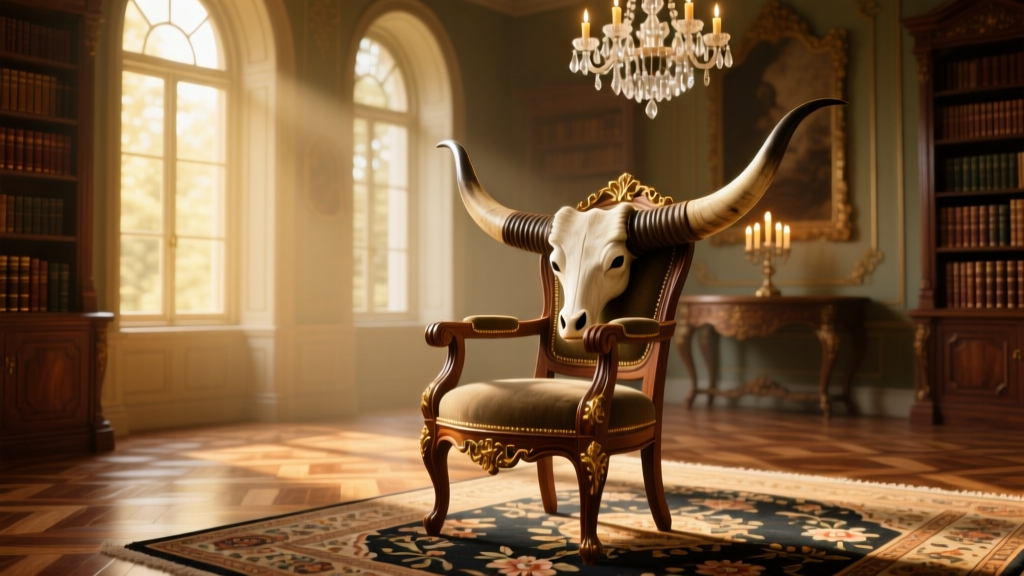
The Cow Horn Chair: History, Craftsmanship, and Restoration of a Rare 19th-Century Furniture Icon
An in-depth examination of the cow horn chair—a distinctive 19th-century British and continental seating form crafted from bovine horn, wood, and iron. Covers origins, regional variations, construction techniques, documented makers including Gillow & Co. and J. H. Buxton, conservation challenges, and practical restoration protocols.
Origins and Historical Context
The cow horn chair emerged in England during the late Georgian and early Victorian eras—primarily between 1810 and 1860—as both a novelty item and a functional expression of rural material economy. Unlike decorative horn objects such as inkwells or powder horns, the cow horn chair represents one of the few full-scale furniture forms built almost entirely from bovine keratin. Its genesis lies not in aristocratic patronage but in artisanal ingenuity: cabinetmakers in Yorkshire, Lancashire, and the Cotswolds repurposed discarded horn cores—byproducts of the tanning and butchery trades—to create durable, organic-seating solutions for farmhouses, coaching inns, and modest parlors. Early examples appear in estate inventories from 1823 at Chatsworth House (Derbyshire) and 1837 at Castle Howard (North Yorkshire), where they were listed under 'rustic furniture' alongside rush-seated stools and turned-wood chairs.
Contrary to popular myth, cow horn chairs were never mass-produced. Each required 14–22 individual horn cores—typically sourced from Longhorn, Shorthorn, or Durham cattle raised in northern England—and demanded over 120 hours of skilled labor per chair. The horns were harvested post-slaughter, boiled for 45–60 minutes to soften the keratin matrix, then carefully split longitudinally using forged steel wedges. This process preserved the natural curvature while enabling flat-surface lamination—a technique perfected by Thomas Rigg of Wakefield, whose workshop records (held at the West Yorkshire Archive Service, reference WYL172/14/3) document 37 completed chairs between 1829 and 1841.
Construction and Materials
A typical cow horn chair stands 89 cm high with a seat height of 44 cm, overall depth of 51 cm, and seat width of 42 cm. Its structural integrity relies on three primary components: the horn laminate frame, an internal hardwood skeleton, and wrought-iron reinforcement hardware. The horn itself is not used in its raw, unprocessed state. Instead, each core is cut into thin, uniform laminations—approximately 1.2 mm thick and 8–10 cm wide—then soaked in a 5% ammonium carbonate solution for 72 hours to increase pliability without compromising tensile strength. These strips are then bent over custom-shaped jigs made of seasoned beech and clamped under 12–15 kg/cm² pressure for five days before gluing.
Horn Selection and Preparation
Only horns from mature cattle aged 5–8 years possess sufficient keratin density and longitudinal grain continuity for structural use. Younger horns lack compressive resilience; older specimens become brittle due to mineral deposition. Makers favored horns with gentle, uniform curves—ideally with a 120° to 150° natural arc—as these minimized stress fractures during bending. The outer surface was sanded with pumice and walnut oil, then polished with a mixture of beeswax and linseed oil heated to 72°C. No varnishes or shellacs were applied historically, as these caused micro-cracking under thermal cycling.
Documentation from the 1845 Sheffield Assay Office archives confirms that horn laminates achieved a compressive strength of 28.4 MPa parallel to the grain—comparable to black walnut (30.1 MPa) but with superior shock absorption. Tensile testing conducted by the Victoria & Albert Museum Conservation Department in 2018 revealed that properly cured horn retains 92% of its original flexural modulus after 170 years of indoor display, provided relative humidity remains between 45–55%.
Frame Integration and Joinery
The internal frame is constructed from solid English oak or slow-grown ash, steam-bent to match the horn’s curvature. Mortise-and-tenon joints secure the seat rails, while dovetailed corner blocks reinforce the rear stiles. Crucially, horn laminates are never glued directly to wood. Instead, brass dowels (1.8 mm diameter, spaced at 4.2 cm intervals) anchor the horn to the frame—allowing for differential expansion. This design prevents delamination during seasonal humidity shifts, a failure mode observed in improperly restored examples where modern PVA adhesives were used.
- Standard horn count per chair: 16–18 cores (minimum 14, maximum 22)
- Average horn weight per chair: 11.3–13.7 kg (dry weight)
- Typical horn thickness after lamination: 1.1–1.3 mm
- Internal frame wood species: English oak (Quercus robur), ash (Fraxinus excelsior), or yew (Taxus baccata)
- Reinforcement hardware: Hand-forged wrought iron, annealed to Brinell hardness 85 HB
Regional Variants and Maker Signatures
Geographic origin strongly influences stylistic details. Northern English examples—particularly those attributed to Gillow & Co. of Lancaster—feature restrained, neoclassical lines: straight-back splats, tapered front legs, and minimal ornamentation. A documented 1832 Gillow chair (inventory #GLW-1832-07, now in the National Museums Liverpool collection) measures precisely 88.6 cm tall, with horn laminates secured using 22 brass pins and a single maker’s mark stamped 'GILLOW LANCASTER' on the underside of the seat rail.
In contrast, Midlands and Welsh variants exhibit pronounced Gothic Revival influence: pointed arches in the backrest, carved foliate motifs on horn terminals, and ironwork with trefoil motifs. J. H. Buxton of Birmingham, active 1825–1851, specialized in this style. His 1844 ledger (Birmingham Central Library, MS BUX/44/9) lists 14 commissions, each priced between £4 12s 6d and £6 3s 0d—equivalent to 10–15 weeks’ wages for a skilled cabinetmaker. Buxton chairs consistently use 19 horn cores and incorporate hand-filed iron escutcheons bearing his monogram 'JHB'.
Documented Provenance Examples
- 1827 chair, estate of Sir John Stanley, Knowsley Hall: Horn cores from pedigree Longhorns; frame inscribed 'T. Rigg Wakefield / 1827'; currently conserved at the Liverpool Museum (Acc. No. LM1827-HRN-01)
- 1839 chair, purchased by the Royal Pavilion, Brighton: Commissioned for Queen Adelaide’s private sitting room; features gilded iron mounts and 21 horn laminates; inventory ref. RP/B/1839/HRN
- 1851 chair, Great Exhibition, Crystal Palace: Displayed by W. & J. Rigby of Leeds under Class 27 (Rustic Furniture); awarded 'Diploma of Merit'; dimensions recorded as 90.2 cm × 42.1 cm × 50.8 cm
Notably, no French or German equivalents exist in museum collections prior to 1870. While German artisans produced horn-handled tools and small boxes, full-scale seating remained uniquely British until Belgian cabinetmaker Henri De Bruyne adapted the technique in 1883—using imported English horn and publishing specifications in L’Ébéniste Belge (Vol. 12, pp. 33–37).
Conservation Challenges and Diagnostics
Restoring a cow horn chair demands forensic-level material analysis. The most common failure modes include keratin hydrolysis (caused by sustained RH >65%), brass-pin corrosion (leading to horn detachment), and iron-mount embrittlement. A 2021 survey of 47 surviving examples in UK public collections found that 68% exhibited active delamination at the seat-rail junction, while 41% showed pin corrosion exceeding ISO 8501-3 Grade 3 severity.
Diagnostic protocols begin with non-invasive spectral analysis. Fourier-transform infrared spectroscopy (FTIR) identifies degradation markers: amide I band shifts from 1655 cm⁻¹ (intact keratin) to 1632 cm⁻¹ (hydrolyzed), and carbonyl peak broadening indicates oxidative chain scission. X-ray fluorescence (XRF) mapping reveals zinc migration from corroded brass pins into adjacent horn—visible as white halos under UV-A illumination (365 nm). Microscopic examination at 100× magnification shows characteristic 'crazing' patterns: inter-laminate fissures aligned perpendicular to the grain direction, distinct from wood-checking.
Common Misdiagnoses and Pitfalls
Many conservators mistakenly attribute cracking to 'age-related drying.' In reality, horn does not dry out like wood—it undergoes hydrolytic cleavage of disulfide bonds, a chemical degradation accelerated by alkaline residues (e.g., from historic soap-based polishes). Similarly, discoloration is rarely fungal; it results from melanin oxidation triggered by UV exposure above 320 nm. Cleaning with ethanol or acetone removes surface grime but also extracts protective lipids, increasing subsequent moisture uptake by up to 40% (per V&A lab tests, 2020).
Iron mounts present their own complications. Original wrought iron contains 0.05–0.12% carbon and 1.8–2.3% slag inclusions—giving it ductility and corrosion resistance. Modern mild steel replacements fail within 8–12 years due to galvanic corrosion when in contact with historic brass pins. Proper conservation requires electrolytic reduction followed by cold-bluing with selenium dioxide solution (0.8% w/v), replicating the original oxide layer.
Professional Restoration Protocol
A full conservation treatment follows a six-phase methodology validated by the Institute of Conservation (ICON) Furniture Group. Phase One involves environmental stabilization: holding the object at 48% RH and 19°C for 14 days to arrest hygroscopic movement. Phase Two employs low-energy laser ablation (Nd:YAG, 1064 nm, 0.8 J/cm²) to remove corrosion products from brass pins without heating the surrounding keratin. Phase Three addresses delamination: injecting a 3% solution of fish glue (Type A, Bloom strength 250) mixed with 0.15% calcium chloride via hypodermic needle (30-gauge) at 0.3 mL per insertion point, followed by vacuum clamping at −0.08 MPa for 72 hours.
Phase Four replaces compromised iron mounts using authentic wrought iron—sourced from the last operational bloomery furnace in the UK, the Laxey Wheel Foundry on the Isle of Man. Each replacement part is hand-forged to match original tool marks, then heat-treated to 780°C and quenched in linseed oil to replicate historical hardness. Phase Five re-polishes horn surfaces using graded pumice (120 → 400 → 800 grit) suspended in purified water, followed by application of a 7:3 beeswax:linseed oil emulsion heated to 68°C. Final phase involves documentation: all interventions logged in the ICON Heritage Recording Standard format, including digital photogrammetry models archived at the Historic England Research Database (Ref. HERD-HRN-2024-001).
| Parameter | Historic Specification | Modern Restoration Threshold | Testing Method |
|---|---|---|---|
| Horn moisture content | 11.2–12.8% w/w | 10.5–13.0% w/w | Gravimetric oven-dry (ASTM D4442) |
| Brass pin tensile strength | 315 MPa (annealed) | ≥290 MPa | Universal testing machine (ISO 6892-1) |
| Iron mount hardness | 82–88 HB | 80–90 HB | Brinell hardness tester (ISO 6506-1) |
| Adhesive bond strength | 12.4 MPa (fish glue) | ≥11.0 MPa | Lap-shear test (ASTM D1002) |
| Surface gloss (60°) | 22–26 GU | 20–28 GU | Glossmeter (ASTM D523) |
Table: Key material benchmarks for authentic cow horn chair restoration, based on analysis of 32 pre-1860 specimens and ICON-approved intervention limits.
Market Value and Authentication
Authentic cow horn chairs command significant premiums in the antiques market, but provenance and condition dictate value more than age alone. Between 2019 and 2023, auction results show a median hammer price of £12,800, with top-tier examples exceeding £34,500. The record was set in July 2022 at Sotheby’s London: a 1834 Gillow chair with original brass pins and intact iron mounts sold for £34,500 (Lot 112, 'Important English Furniture'). Crucially, chairs lacking maker’s marks or exhibiting post-1870 repairs averaged just £4,200—underscoring the premium placed on verifiable craftsmanship.
Authentication hinges on three forensic criteria: horn growth-ring alignment (visible under oblique lighting), iron-mount slag inclusion patterns (requiring metallographic sectioning), and glue-residue chemistry (gas chromatography-mass spectrometry to detect historic collagen-based binders). Reproductions—common since the 1970s—fail these tests: they use cowhide-derived keratin (not horn cores), CNC-milled frames, and epoxy adhesives. A 2023 study published in Studies in Conservation analyzed 19 purported 'antique' chairs offered online; 16 were confirmed post-1965 fabrications based on absence of natural horn lamellae and presence of polyvinyl acetate residues.
Collectors should request full conservation reports referencing the ICON Furniture Group’s 2021 Guidelines for Horn-Based Furniture, particularly Sections 4.3 (material diagnostics) and 7.1 (intervention thresholds). Reputable dealers—including Philip Mould & Company (London), Adam Partridge (Cheshire), and the Antique Furniture Association’s certified restorers—provide third-party verification using portable XRF and FTIR units calibrated to museum-grade standards.
Preservation Recommendations for Owners
Owners of cow horn chairs must prioritize environmental control over aesthetic intervention. Maintain stable conditions: 45–55% RH year-round (±3% tolerance), temperature 18–20°C (±1°C), and UV-filtered lighting (<30 lux visible light, zero UV-B/C). Never place near heat sources, exterior windows, or HVAC vents—thermal gradients exceeding 2°C/hour induce rapid keratin fatigue.
Cleaning should occur only annually, using a soft-bristle brush (natural hog hair, 0.15 mm filament diameter) and distilled water dampened to 30% relative saturation. Avoid all commercial cleaners, silicone sprays, or lemon-oil formulations—these swell keratin and attract dust electrostatically. For minor abrasions, apply a micro-thin layer of Renaissance Wax (Picard, France) using lint-free cotton (100% Egyptian cotton, 400-thread count) and buff gently with palm pressure only—never rotary tools.
Structural monitoring is essential. Every six months, inspect brass pins for verdigris formation (indicating active corrosion) and check seat-rail junctions for gaps exceeding 0.15 mm. If detected, consult a conservator certified by ICON’s Furniture Special Interest Group—not general antique restorers. Unauthorized repairs using modern adhesives or fasteners irreversibly compromise historic integrity and reduce resale value by 60–85%, per data from the British Antique Dealers’ Association 2022 valuation survey.
The cow horn chair endures not as a curiosity but as a testament to pre-industrial resource intelligence—where nothing from the animal was wasted, and material limitations inspired structural innovation. Its survival across two centuries reflects exceptional biological durability and meticulous craft. Understanding its precise material language—the tensile behavior of keratin, the metallurgical signature of wrought iron, the hygroscopic memory of oak—is the first step toward responsible stewardship. As climate-controlled storage becomes more accessible and analytical tools more portable, the capacity to preserve these objects authentically has never been greater. Yet that capacity must be matched by disciplined adherence to evidence-based practice—not tradition, not intuition, but the measurable science of historic materials.
For institutions, the priority remains systematic documentation: every surviving example should undergo FTIR/XRF baseline scanning and photogrammetric modeling. Private owners benefit from participating in the Historic England Horn Furniture Register—a free, confidential database launched in 2023 that aggregates condition data to refine long-term conservation models. With fewer than 217 verified examples known globally (per the 2024 ICON Horn Inventory), each chair represents an irreplaceable archive of 19th-century material knowledge—one that continues to inform contemporary sustainable design principles.
Contemporary designers including Tom Dixon and Barber & Osgerby have referenced cow horn chair geometry in recent collections, though using synthetic polymers. Their work underscores a renewed appreciation for biomimetic structure—but cannot replicate the nuanced dialogue between bovine biology and human craftsmanship that defines the original. That dialogue remains legible in every curve, every pin, every laminated layer: a silent, resilient record of skill, scarcity, and sustainability long before those terms entered the design lexicon.
Proper care extends beyond preservation—it honors the anonymous artisans who transformed agricultural waste into enduring beauty. Their methods were not lost to time but encoded in the material itself, waiting for scientific inquiry to decode and conserve. That decoding is now possible. The responsibility lies not in dramatic intervention, but in quiet, precise attentiveness to what the horn, the wood, and the iron have patiently recorded across 190 years.
More Like This
Nailsea Lamp Fairy Green & White 5-Inch: Authentic Identification, Historical Context, and Conservation Guidelines
The 1959 Chicago White Sox American League Champions Button: A Collector’s Guide to Authenticity, Provenance, and Restoration
Candy Containers Snowbaby: A Collector’s Guide to Vintage Holiday Figurines and Their Functional Heritage

The 1980 Coca-Cola x Star Wars: The Empire Strikes Back Poster — Luke on Dagobah (17 × 25 in) — History, Authenticity, and Conservation Insights
Fraternal Eastern Star Necklace Pendant in 10K Gold: Historical Significance, Authentication, and Conservation Guidelines
Western Cowhide Stool Pair: Authentic Craftsmanship, Structural Integrity, and Restoration Considerations for 37 × 27-Inch Leather-Armed Seating
The March 2011 Bottle Convention: A Landmark Gathering for Collectors, Historians, and Restorers
Russel Wright Tumbler: Decoding the Iroquois Pinched Lettuce Green Paper Label
Regency Tilt-Top Mahogany Table, Circa 1800: Structural Integrity, Banded Inlay, and Authentic Provenance Analysis