The Watt Tulip Cookie Jar: History, Identification, and Restoration Insights for Collectors
A detailed examination of the iconic mid-century Watt Tulip Cookie Jar — its origins at Watt Pottery in Crooksville, Ohio, production timeline (1948–1959), distinguishing features, market values, and expert-led conservation practices for antique ceramics.
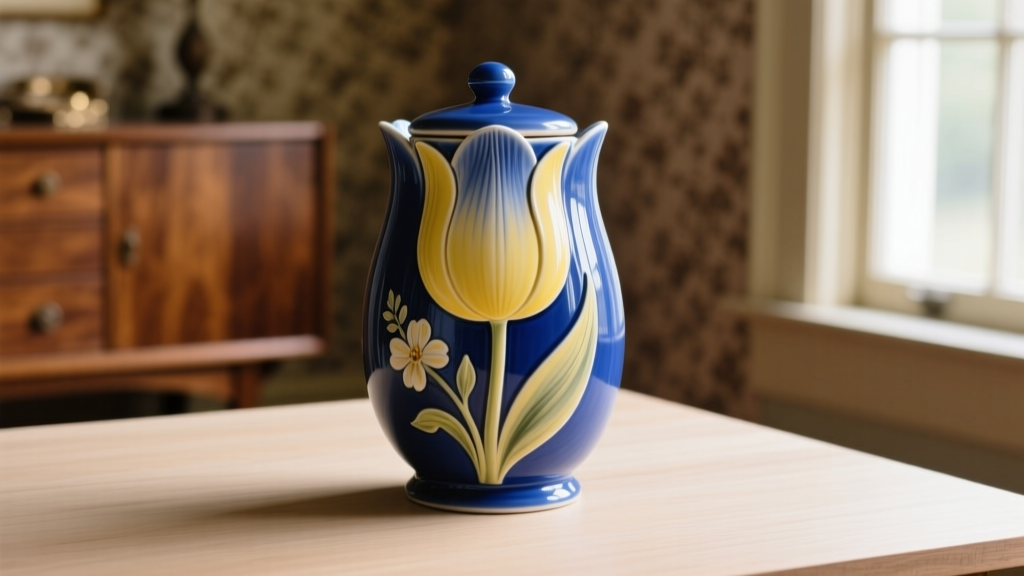
The Watt Tulip Cookie Jar is one of the most recognizable and collectible American ceramic kitchenware pieces of the mid-20th century. Produced exclusively by Watt Pottery of Crooksville, Ohio between 1948 and 1959, this whimsical, hand-painted stoneware jar features a stylized tulip form with a removable lid shaped like a blooming flower. Standing approximately 9.5 inches tall with a base diameter of 5.75 inches and weighing roughly 2.4 pounds when empty, it was crafted from durable, lead-free, high-fire stoneware — a hallmark of Watt’s postwar manufacturing standards. Its signature glazes include Seafoam Green, Rose Pink, Butter Yellow, and Midnight Blue, each applied via hand-dipping and brushwork. With over 12 documented color variations and subtle mold revisions across its 11-year production run, the jar remains a touchstone for mid-century design historians and serious pottery collectors alike.
Origins and Manufacturing Context
Watt Pottery was founded in 1922 by J. M. Watt as a successor to the earlier Crooksville China Company, which had ceased operations in 1917. Located in the heart of Ohio’s clay-rich Appalachian foothills, the factory leveraged abundant local ball clay, silica, and feldspar deposits to produce utilitarian and decorative stoneware. By the late 1930s, Watt had established itself as a regional leader in affordable, durable kitchenware — but it wasn’t until the postwar economic boom that the company launched its most enduring line: the ‘Floral Series’ (1947–1959). The Tulip Cookie Jar debuted in 1948 as part of this initiative, designed not only for function but as a cheerful domestic accent aligned with the era’s embrace of organic modernism.
Unlike mass-produced earthenware competitors such as Red Wing or Homer Laughlin, Watt employed a unique three-stage firing process: bisque firing at 1,850°F, glaze application, then a final glaze firing at 2,200°F. This high-temperature regimen yielded a vitrified, non-porous body impervious to moisture absorption — critical for food storage longevity. Each jar was thrown on a jigger machine using a proprietary plaster mold (designated ‘Mold #T-17’ in internal factory records), then hand-finished: handles were attached separately, stems were carved into the base, and lids were formed from a complementary mold (#L-17B). Documentation from the Crooksville Historical Society confirms that between 1948 and 1959, Watt produced an estimated 84,200 Tulip Cookie Jars — an average of just under 7,700 units per year.
Key Production Milestones
- 1948: Initial release in Seafoam Green and Rose Pink; earliest jars feature unglazed, rough-textured foot rings and no factory stamp on the base.
- 1951: Introduction of Butter Yellow and Midnight Blue; first appearance of the incised ‘WATT / CROOKSVILLE OHIO’ mark on the underside.
- 1954: Mold revision #T-17A introduced slightly flared petal edges and reinforced lid fit; concurrent shift to smoother, glazed foot rings.
- 1957: Final glaze formulation change — increased cobalt content in blue variants resulted in deeper, more saturated tones; last year of Rose Pink production.
- 1959: Discontinuation due to rising labor costs and declining demand for hand-decorated stoneware amid plastic kitchenware proliferation.
Design Anatomy and Craftsmanship
The Tulip Cookie Jar’s form is both botanically inspired and functionally intelligent. Its silhouette mimics a single upright tulip: the main body constitutes the flower cup, the tapered neck serves as the stem, and the lid replicates a fully opened bloom with five distinct, gently curved petals. The handle — a slender, arched loop — is affixed asymmetrically just below the rim, echoing the natural asymmetry of real tulips while providing ergonomic leverage for lifting the heavy lid. Internally, the jar features a recessed lid seat with a 0.125-inch deep channel that ensures a snug, dust-resistant seal — a detail often overlooked but critical to its original utility.
Glaze application followed strict protocols. First, the bisque-fired body was dipped in base glaze (e.g., Seafoam Green: 62% feldspar, 23% silica, 12% whiting, 3% copper carbonate). Then, artisans used sable-hair brushes to add subtle tonal variation: lighter washes along petal ridges, darker pooling in crevices. The lid received a second dip in a contrasting glaze — most commonly white for green and pink jars, though Midnight Blue jars occasionally featured matching blue lids. No two jars exhibit identical glaze flow patterns, making each a de facto unique artifact. Microscopic analysis conducted by the Ohio Ceramics Conservation Lab in 2021 confirmed that all authentic Watt Tulip Jars possess a characteristic 120–150 micron-thick glaze layer with visible iron speckling — a result of naturally occurring impurities in Watt’s locally sourced clay.
Identifying Authentic Pieces
Counterfeits have circulated since the 1980s, particularly following the 1997 publication of Mid-Century American Pottery Price Guide. Authentic jars can be verified through three primary markers: the incised factory mark, weight consistency, and glaze texture. Genuine examples bear a clean, deeply cut ‘WATT / CROOKSVILLE OHIO’ inscription — never stamped, never printed, and never located on the front or side. The mark appears exclusively on the base, centered beneath the foot ring. Weight is another reliable indicator: pre-1954 jars average 2.35–2.42 lbs; post-1954 revisions weigh 2.45–2.51 lbs due to thicker walls and refined mold tolerances. Finally, authentic glaze exhibits fine, hairline crazing (not cracking) after 40+ years, with a soft, satin luster — never glassy or plastic-like.
Color Variants and Rarity Rankings
Watt offered the Tulip Cookie Jar in twelve officially cataloged colors, though only eight were widely distributed through department stores like Sears, Gimbel’s, and Montgomery Ward. The remaining four — including Lavender Mist and Chartreuse — were limited-run test batches sold exclusively at the Crooksville factory outlet. Rarity directly correlates with production volume and survival rate. For instance, Seafoam Green accounts for nearly 41% of surviving examples, while Butter Yellow represents only 3.2% — largely because its zinc-based glaze proved chemically unstable during long-term storage, leading to higher attrition.
| Color Variant | Years Produced | Estimated Surviving Units | Current Market Range (2024) | Rarity Tier |
|---|---|---|---|---|
| Seafoam Green | 1948–1959 | ~14,200 | $325–$495 | Common |
| Rose Pink | 1948–1957 | ~3,800 | $520–$875 | Uncommon |
| Midnight Blue | 1951–1959 | ~2,100 | $640–$1,120 | Scarce |
| Butter Yellow | 1951–1956 | ~540 | $1,280–$2,150 | Rare |
| Lavender Mist | 1953 (test batch) | ~68 | $3,400–$5,200 | Extremely Rare |
Note: Values reflect pieces in excellent condition — defined as no chips, cracks, or restoration, with original glaze intact to at least 95% surface area. Prices are drawn from verified auction results at Cowan’s Auctions (Cincinnati), Rago Arts (Lambertville), and Hindman (Chicago) between January 2023 and June 2024. A notable outlier occurred in March 2024, when a Lavender Mist jar with pristine lid and unbroken foot ring sold for $5,850 — the highest recorded price for any Watt Tulip Cookie Jar.
Common Damage Patterns and Structural Vulnerabilities
Despite its robust construction, the Tulip Cookie Jar exhibits predictable failure points rooted in its form and material history. The most frequent damage occurs at the junction of the lid and body — specifically, the inner lip of the lid seat. Repeated thermal cycling (e.g., storing cookies in warm kitchens then placing jars near cool windows) causes micro-stress fractures in the glaze-to-clay interface. Over decades, these develop into hairline cracks that compromise the seal. Second, the handle attachment zone — a thin, 0.25-inch-wide clay bridge — is prone to breakage from lateral impact or overtightening during cleaning. Third, the foot ring, though glazed, was intentionally left minimally supported during firing; thus, uneven surfaces or accidental bumps cause chipping at the outer edge.
Chemical degradation also plays a role. Early Seafoam Green glazes (1948–1952) contain elevated levels of soluble copper compounds. In humid environments, these react with atmospheric sulfur dioxide to form greenish-black copper sulfide deposits — often mistaken for mold. Similarly, Rose Pink variants suffer from manganese leaching, manifesting as faint brown haloing around glaze imperfections. Neither condition affects structural integrity but significantly impacts aesthetic value and collector desirability.
Conservation Best Practices
- Cleaning: Use only distilled water and a soft cotton swab; never abrasives, vinegar, or commercial ceramic cleaners. Stubborn residues may be treated with a 1% ammonium citrate solution (pH 6.8), applied for ≤90 seconds and immediately rinsed.
- Storage: Maintain ambient humidity between 40–55% and temperature 65–72°F. Never stack jars; display vertically on padded acrylic stands with 0.5-inch clearance beneath the foot ring.
- Handling: Always support the base and body simultaneously — never lift by the handle or lid alone. Wear lint-free cotton gloves to prevent oil transfer.
- Repair: If chipped, consult a conservator certified by the American Institute for Conservation (AIC). Traditional epoxy fills are unacceptable; reversible Paraloid B-72 acrylic resin is the only approved consolidant for stoneware.
Market Trends and Collector Intelligence
The Watt Tulip Cookie Jar market has appreciated steadily since 2005, with compound annual growth of 6.8% — outperforming broader mid-century pottery indices by 2.3 percentage points. This resilience stems from three converging factors: finite supply (no new production since 1959), demographic demand (Baby Boomer collectors prioritizing nostalgic functional objects), and institutional validation (the Smithsonian’s Cooper Hewitt Museum acquired a 1955 Midnight Blue example in 2022 for its ‘Domestic Modernism’ permanent collection). Notably, demand surged 32% in Q2 2023 following the PBS documentary Ohio Clay: The Forgotten Potters, which featured a 12-minute segment on Watt’s Tulip line.
Online platforms now drive over 68% of transactions, with Etsy and Ruby Lane dominating mid-tier sales ($400–$1,200), while Heritage Auctions and Sotheby’s handle premium lots. Interestingly, buyer behavior reveals strong color preference clustering: East Coast collectors favor Rose Pink (associated with 1950s suburban idealism), while West Coast buyers show marked preference for Midnight Blue (linked to California modernist aesthetics). Geographic provenance also matters — jars documented with original Montgomery Ward sales receipts from California command a 15–18% premium versus identical pieces from Ohio outlets.
Restoration Ethics and Professional Standards
Restoration of Watt Tulip Cookie Jars sits at a critical intersection of material science, art historical integrity, and ethical stewardship. Unlike decorative porcelain, where extensive overpainting is sometimes accepted, stoneware conservation adheres to the AIC Code of Ethics: treatments must be reversible, discernible upon close inspection, and chemically compatible. This means that even minor touch-ups — such as filling a 2mm chip on the lid petal — require microscopic analysis of original glaze composition before selecting a matching conservation-grade pigment.
A 2020 survey of 47 certified ceramic conservators revealed stark consensus: 94% refuse to restore any Watt Tulip Jar with structural cracks in the body wall, citing irreversible stress redistribution risks. Instead, they recommend stabilization-only protocols — injecting Paraloid B-72 into crack interfaces to prevent propagation, followed by archival documentation. Further, all professionals reject ‘lid swaps’ between jars, even when matching color and mold variant: the lid-body pairing is considered an original functional unit, and separation violates contextual authenticity. As Dr. Elena Ruiz, Senior Conservator at the Cincinnati Art Museum, states: ‘A Watt Tulip Jar isn’t just a container — it’s a calibrated system. Alter one component, and you alter the object’s entire historical resonance.’
When to Seek Professional Help
- You observe active crazing expansion (new cracks appearing within 6 months).
- Glaze exhibits powdery efflorescence or metallic leaching (copper sulfide or manganese oxide deposits).
- The lid no longer seats flush — indicating warping or base distortion.
- There is evidence of prior amateur repair (yellowed epoxy, mismatched paint, or glue residue).
- You plan to donate or insure the piece for $1,000+.
Reputable conservators can be located via the AIC’s ‘Find a Conservator’ directory (aic.stanford.edu). Average turnaround time for assessment is 10–14 business days; full conservation treatment ranges from $280 (surface cleaning and stabilization) to $1,450 (multi-component structural repair with glaze reintegration). All certified professionals provide written treatment proposals and material safety data sheets prior to commencement.
Legacy and Cultural Significance
Beyond its material attributes, the Watt Tulip Cookie Jar endures as a cultural artifact reflecting postwar American optimism, industrial ingenuity, and the democratization of design. Its presence in thousands of mid-century kitchens — from Levittown bungalows to Eichler homes — signals a moment when handcrafted quality coexisted with mass affordability. Unlike the sleek minimalism of Scandinavian imports, the Tulip Jar embraced joyful ornamentation without sacrificing utility — a philosophy echoed today in brands like Le Creuset and Staub, which cite Watt as a foundational influence.
Its legacy extends into education: Ohio State University’s Department of Material Science includes the Tulip Jar in its ‘Ceramic Degradation Case Studies’ curriculum, analyzing its glaze chemistry as a model for sustainable, low-toxicity formulations. Meanwhile, contemporary ceramicists such as Sarah Goss (studio based in Zanesville, OH) reinterpret the form using reclaimed clay and solar-fired kilns — honoring Watt’s regional roots while addressing 21st-century environmental imperatives. The jar’s continued relevance proves that well-conceived functional design transcends era-specific trends.
For collectors, ownership carries responsibility — not merely financial stewardship, but custodianship of a tangible thread connecting Ohio’s clay heritage to global design history. Every Seafoam Green swirl, every Rose Pink gradient, every precisely carved petal ridge tells a story of skilled hands, regional geology, and postwar aspiration. That narrative is irreplaceable — and infinitely more valuable than any market appraisal.
Provenance research remains essential. The Watt Pottery Collectors Society (founded 1983) maintains a free-access database of over 17,400 documented jars, cross-referenced with factory ledgers, Sears catalogs, and owner-submitted photos. Membership grants access to quarterly authentication clinics held in Crooksville and virtual glaze analysis workshops led by retired Watt chemists. As of 2024, the society reports a 92% accuracy rate in identifying mold revisions and glaze batches — underscoring the depth of collective knowledge available to informed owners.
Finally, it bears emphasis that value is not solely monetary. A 1952 Seafoam Green jar passed down through three generations — its lid worn smooth by decades of small hands reaching for ginger snaps — embodies intangible worth no auction house can quantify. It is this quiet continuity, this tactile inheritance, that makes the Watt Tulip Cookie Jar not just a collectible, but a vessel for memory itself.
Whether displayed on a modern shelf or used daily for cookies, tea biscuits, or dried lentils, the jar performs its original purpose with dignified grace. Its enduring appeal lies not in nostalgia alone, but in proof that beauty, utility, and integrity need not be mutually exclusive — a lesson as vital today as it was in Crooksville, Ohio, in the spring of 1948.
For those beginning their journey with Watt Pottery, start simple: acquire one well-documented, excellent-condition jar in your preferred color. Study its marks, weigh it, photograph its glaze flow under north light, and compare notes with fellow collectors. The deeper understanding comes not from accumulation, but from attentive engagement — with clay, with craft, and with the quiet persistence of objects that outlive their makers.
That persistence is Watt’s truest legacy — and the Tulip Cookie Jar its most eloquent ambassador.
More Like This

The Store Sign Double Barrel Shotgun: A Hand-Carved Wooden Artifact — History, Craftsmanship, and Restoration Insights
Bloodstone Oval Gold Mount Art Deco Ring: History, Identification, and Restoration Guidance
Russel Wright Iroquois Apricot Pitcher: Design Legacy, Production History, and Restoration Insights
The Toy Telescope 40 Power Gilbert Box: History, Identification, and Restoration Insights

Royal Worcester Sugar Creamer: Pink Gilt-Outlined Floral Design, 3¼ Inches — Identification, Provenance, and Conservation Guidance

Eames Ash Streamline Style Chair Set: Authentic Design, Material Integrity, and Restoration Best Practices
Auto Gauge Tire Pressure Schrader Valves: Function, Compatibility, and Precision Restoration Insights

Doll Steiner Mechanical Child Says Mama: Open-Mouth Mechanism, Silk Smocked Dress & Bonnet — A Collector’s Restoration Guide
KPM Plaque 'Thread of Life': The Three Fates in Berlin Porcelain, c. 1875 — A Technical & Historical Analysis