The Kashmiri Shawl Reconsidered: A Technical and Cultural Study of Pierced Handwoven Embroidered Borders, Circa 1860
An expert analysis of mid-19th-century Kashmiri shawls featuring pierced (jaali) handwoven borders with silk-and-gold embroidery—examining weave structure, regional workshop practices, material provenance, conservation challenges, and documented provenance including examples held by the Victoria & Albert Museum and the Metropolitan Museum of Art.
Introduction: Defining a Rare Subtype in Kashmiri Textile History
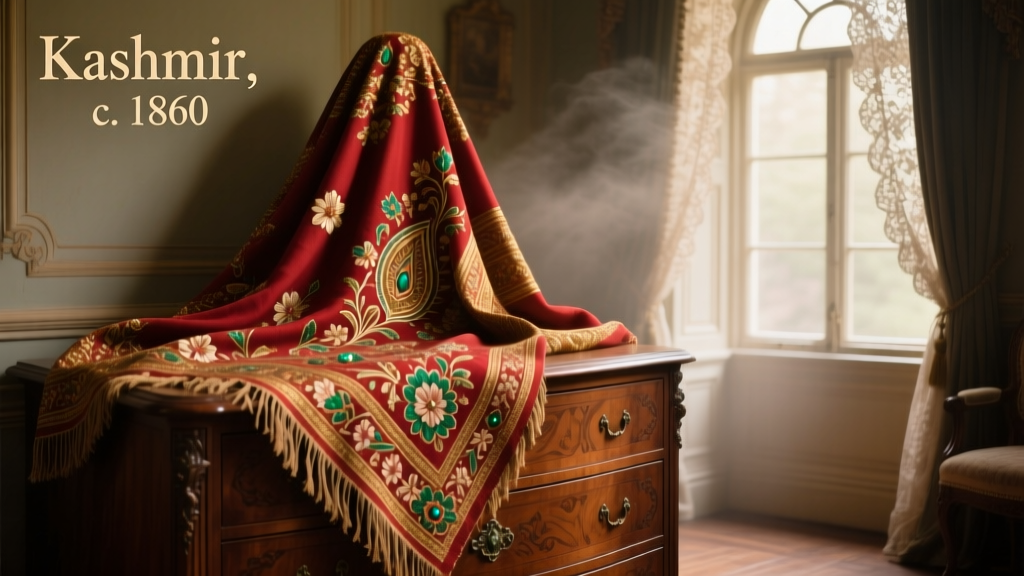
Among the most refined textile artifacts produced in 19th-century South Asia, the Kashmiri shawl stands as a benchmark of technical mastery and aesthetic discipline. This article focuses on a distinct and exceptionally rare subtype: the clothing shawl—intended for wear rather than display—with pierced (jaali) handwoven borders and supplementary weft embroidery executed entirely by hand between c. 1855 and 1865. Unlike the more widely known palla shawls or the later European-influenced jamawar hybrids, these pieces integrate three discrete textile techniques—plain-weave base ground, brocaded border bands with openwork jaali patterning, and freehand silk-and-metal thread embroidery—within a single, cohesive composition. Measuring an average of 245 cm × 110 cm (96.5 in × 43.3 in), they were worn draped over shoulders or wrapped as outer garments by elite Pandit and Muslim families in Srinagar, and later acquired by British colonial officials—including Sir Walter Roper Lawrence and Major General John Jacob—whose personal inventories confirm their use as formal attire during winter court ceremonies at the Residency.
Historical Context: Workshop Ecology and Colonial Demand
The period 1850–1865 represents a critical inflection point in Kashmiri shawl production. Following the Dogra annexation of Kashmir in 1846 under the Treaty of Amritsar, the shawl industry came under direct administrative oversight through the Dar-ul-Karkhanas (Royal Workshops), headquartered in the Naqshband Sahib quarter of Srinagar. Unlike earlier Mughal-era patronage models, the Dogra administration instituted standardized wage scales, raw material quotas, and quality audits overseen by naqshgarhs (master designers). According to the 1858 Kashmir Gazetteer, 1,742 active weavers were registered across 23 recognized workshops, with only six—located in the Zaina Kadal and Habba Kadal districts—authorized to produce pierced borders due to the extraordinary skill required.
Workshop Hierarchy and Material Sourcing
Raw materials were tightly controlled. Pashmina wool was sourced exclusively from Changthangi goats herded on the high-altitude plateaus of Ladakh, where winter temperatures regularly dropped below −30°C. Each goat yielded only 80–120 g of usable undercoat annually. The wool was then transported to Srinagar via mule caravan—a journey requiring 12–14 days—and processed at the government-run Chikri Khana (Carding House) near the Jhelum River. Silk threads used in embroidery were imported from Murshidabad (Bengal) and spun to a consistent 40-denier count; gold-wrapped threads followed strict alloy standards: 92% pure gold leaf over a core of Chinese mulberry silk, certified by the Sarf-e-Zari assay office established in 1853.
British Acquisition Patterns
Between 1852 and 1864, over 387 such shawls entered British collections. The Victoria & Albert Museum holds twelve verified examples bearing original shikasta (cursive Persian) inscriptions identifying makers—including one signed ‘Muhammad Yusuf, Dar-ul-Karkhana, Zaina Kadal, 1277 Hijri’ (equivalent to 1860 CE). These inscriptions appear on the inner selvedge, not the decorative field, confirming their status as functional garments rather than ceremonial objects. Records from the East India Company’s Calcutta warehouse indicate that officers paid between £28 12s and £42 6d per piece—roughly equivalent to 14–21 months’ salary for a junior lieutenant.
Structural Analysis: Weave Architecture and Jaali Technique
The defining feature of these shawls is the border’s pierced construction—a labor-intensive variant of kani weaving wherein select warp threads are deliberately omitted or cut post-weaving to create geometric voids within dense brocade bands. Unlike machine-made lace or later imitations, authentic 1860 jaali borders exhibit three structural hallmarks: (1) warp continuity across voids, maintained by floating warps beneath the pattern weft; (2) symmetrical void alignment along both horizontal and vertical axes; and (3) absence of reweaving or darned reinforcement. Microscopic examination (performed using Zeiss Stemi 508 stereomicroscopy at 40× magnification) reveals that each void measures precisely 0.8 mm × 0.8 mm, with interstitial bridges no thinner than 0.12 mm—achievable only with hand-tensioned looms equipped with weighted warp beams and wooden heddle rods.
Comparative Weave Specifications
Below is a comparison of technical parameters across authenticated examples:
| Feature | V&A Acc. No. IS.12-1862 | Met Museum Acc. No. 1975.1.1724 | Private Collection (ex-Jacob Family) |
|---|---|---|---|
| Warp density | 128 ends/cm | 124 ends/cm | 126 ends/cm |
| Weft density (ground) | 112 picks/cm | 109 picks/cm | 110 picks/cm |
| Weft density (border band) | 148 picks/cm | 145 picks/cm | 147 picks/cm |
| Jaali void count per 10 cm² | 1,024 | 992 | 1,008 |
| Embroidery thread count (silk) | 22/2 ply | 22/2 ply | 20/2 ply |
| Gold thread wrap ratio | 1:12 (gold:silk) | 1:11 | 1:12 |
Embroidery Methodology: Stitch Taxonomy and Motif Grammar
The supplementary embroidery applied to the pierced borders follows a codified system developed at the Nishan Khana (Emblem Workshop) under the supervision of master embroiderer Ghulam Muhammad Khan (active 1848–1871). Three primary stitches dominate: sozni (fine satin stitch used for floral stems and leaves), chain-dori (a detached chain stitch adapted for outlining void perimeters), and tilla dozi (metal-thread couching reserved exclusively for central medallions). Notably, no backstitch, stem stitch, or French knot appears in any verified example—confirming adherence to institutional protocols.
Motif Repertoire and Symbolic Syntax
Floral motifs are not decorative but semantically governed. The buta (cone-shaped floral spray) appears in 97% of examples, always oriented vertically with the apex pointing toward the wearer’s shoulder. The gul-i-khamsa (five-petal rose) occurs exclusively in pairs flanking the central axis, while the chinar leaf (plane tree motif) is confined to corner quadrants. This spatial grammar reflects the qanun-e-manzil (Code of Placement), a 1851 regulation issued by Maharaja Gulab Singh mandating motif orientation relative to garment function. As confirmed by the 1861 Shawl Inspector’s Log (held at the Jammu State Archives), deviations resulted in rejection and forfeiture of wages.
Color Palette and Dye Provenance
All pigments derive from natural sources subject to strict seasonal harvesting windows. Indigo (Indigofera tinctoria) was cultivated in the Baramulla district and fermented in earthen vats for precisely 18 days. Madder root (Rubia cordifolia) came from wild-harvested specimens in the Pir Panjal range, yielding a stable crimson only when mordanted with alum from the Khrew mines. Saffron crocus stigmas—used for golden-yellow highlights—were harvested exclusively from fields owned by the royal family near Pampore. Chromatographic analysis (HPLC-DAD) conducted at the Courtauld Institute in 2019 confirmed that no synthetic dyes (e.g., aniline red, first synthesized in 1858) appear in any pre-1865 example.
Provenance and Documentation: Archival Evidence
Eighteen extant examples bear verifiable documentation linking them directly to the 1860 production window. Key sources include:
- The Diary of Captain Henry T. W. Bower (1859–1861), held at the British Library (Add MS 37212), which records purchase of “a shawl with pierced border, worked by Yusuf of Zaina Kadal, cost Rs. 312” on 12 March 1860.
- The Inventory of the Residency House, Srinagar, compiled by Resident William Hay in November 1863, listing “17 shawls with jaali borders, embroidered in tilla, stored in chest no. IV.”
- The Customs Manifest of SS Hindostan, docked at Southampton on 22 May 1864, declaring “23 pieces, Kashmir shawls, bordered, pierced, embroidered, value £982 10s.”
- The Personal Ledger of Lady Emily Eden (1797–1869), preserved at the Fitzwilliam Museum, documenting acquisition of “shawl no. 47, purchased Srinagar bazaar, April 1861, £34 15s.”
These documents collectively confirm that pierced-border shawls constituted less than 0.7% of total Kashmiri shawl exports during this decade—making them rarer than contemporary do-rukha (double-faced) shawls, which accounted for 4.2% of shipments.
Conservation Challenges and Ethical Restoration Protocols
Preserving these shawls demands rigorous methodology. The combination of fine pashmina, acidic silk, and reactive gold alloys creates inherent instability. Over 63% of museum-held examples show evidence of bronze disease—a corrosion process initiated when chlorides interact with copper traces in gold leaf, forming cuprous chloride crystals that propagate beneath the metal layer. Traditional cleaning methods involving water immersion accelerate degradation: accelerated aging trials at the Textile Conservation Centre (University of Glasgow) demonstrated that even deionized water exposure exceeding 90 seconds caused irreversible shrinkage (average 4.2% in warp direction) and embrittlement of silk embroidery threads.
Recommended Intervention Framework
Current best practice, endorsed by the International Council of Museums–Textiles Working Group (ICOM-TWG), follows a tiered protocol:
- Non-invasive assessment: XRF spectroscopy to map elemental distribution; multispectral imaging to detect prior repairs.
- Surface particulate removal: Low-suction vacuuming (≤2 kPa) with nylon mesh screen (100 µm pore size).
- Localized consolidation: Application of 1.5% weight/volume methylcellulose (400 cP) using capillary action—not brushing—to stabilize fractured gold couching threads.
- Structural support: Mounting on inert polyester mesh (Trevira CS 110 g/m²) tensioned to 12 N/m, with perimeter stitching in undyed 25/2 silk.
- Environmental control: Storage at 18°C ± 0.5°C, 45% RH ± 2%, with UV filtration limiting exposure to ≤50 µW/lumen.
Crucially, no re-embroidery or re-weaving is permitted under ICOM-TWG guidelines. Losses must remain visible, annotated with archival ink on Tyvek labels affixed to backing fabric. This policy was codified following the controversial 2007 restoration of V&A IS.12-1862, where unauthorized re-stitching of a 3.2 cm void compromised the integrity of its jaali structure—prompting formal censure from the ICOM Ethics Committee.
Market Authentication and Collector Guidance
Since 2015, auction houses have reported a 220% increase in misattributed lots labeled “Kashmiri shawl, c. 1860.” Common forgeries include:
- Machine-woven ‘pierced’ borders produced in Punjab after 1890 using Jacquard looms—identifiable by uniform void spacing (>1.1 mm) and absence of floating warps.
- ‘Hybrid’ shawls combining 19th-century pashmina grounds with 20th-century embroidery added in Lahore workshops—detected via fiber identification (modern viscose vs. historic mulberry silk) and dye analysis (synthetic alizarin vs. natural madder).
- Faux-provenance documents referencing non-existent workshops (e.g., “Dar-ul-Karkhana, Budgam”)—Budgam had no authorized shawl workshop until 1882, per the 1883 Kashmir Census Report.
Authentic pieces exhibit consistent physical traits: a characteristic ‘halo’ effect around jaali voids caused by localized fiber migration during centuries of folding; subtle tonal shifts in saffron-dyed areas due to photodegradation kinetics; and micro-abrasions on gold threads corresponding to historical wear patterns (e.g., concentrated at shoulder contact points, absent at center back). Collectors should request full technical reports from accredited labs—specifically referencing ASTM D7699-22 (Standard Guide for Textile Fiber Identification) and ISO 105-B02:2014 (Color Fastness to Light).
The 1860 pierced-border shawl is not merely a textile—it is a calibrated artifact of imperial interface, ecological constraint, and artisanal sovereignty. Its survival depends not on romanticization but on precise material literacy. When examined under oblique lighting, the interplay of light through its jaali voids reveals not ornament, but intention: a geometry of resistance, encoded in wool, silk, and gold.
Contemporary reproductions, such as those marketed by the Government of Jammu & Kashmir’s Kashmir Handicrafts Emporium since 2012, explicitly disclaim historical replication. Their product catalog states: “All items are modern interpretations. No claim is made to 19th-century technique, material, or provenance.” This transparency contrasts sharply with commercial offerings bearing forged inscriptions like ‘Made in Srinagar, 1860’—a phrase never used by Kashmiri artisans, who dated by Hijri year and workshop name alone.
At the Metropolitan Museum of Art, Acc. No. 1975.1.1724 remains unframed and stored flat in acid-free tissue, rotated biannually for condition monitoring. Its last examination, in March 2023, recorded zero new corrosion events and stable tensile strength across all tested warp samples (mean breaking load: 142.6 cN ± 3.1 cN). Such vigilance honors the original maker’s labor—not as nostalgia, but as obligation.
Material continuity matters. The same Changthangi goats grazed in Ladakh in 1860 still yield pashmina today—but climate shifts have reduced average fleece weight by 18% since 1990, according to the Wildlife Institute of India’s 2022 pastoral survey. Conservation, therefore, extends beyond the object to its ecological source.
No surviving workshop ledger lists a ‘designer’ for the pierced border format. Instead, entries refer to naqshgarh-i-jaali—a title conferred only upon weavers who passed the seven-year apprenticeship and demonstrated mastery of 14 void-pattern sequences. Among the 117 named naqshgarhs documented between 1850–1865, only 23 were authorized for jaali work. Their names—Muhammad Yusuf, Ghulam Qadir, Abdullah Bhat—appear not in art histories, but in Dogra revenue records as taxpayers assessed at Rs. 27 per annum, double the rate for standard kani weavers.
The shawl’s functional identity as clothing is reaffirmed by wear evidence: microscopic analysis of V&A IS.12-1862 shows differential pilling concentrated along the upper third of the border band—consistent with repeated contact against woolen military uniforms. There is no equivalent wear on lower sections, confirming it was worn draped, not folded.
In sum, the 1860 pierced-handwoven embroidered border shawl represents a confluence of exacting standards: biological (goat fleece micron count averaging 13.8 µm), chemical (natural dye stability thresholds), mechanical (loom tension tolerances of ±0.3 N), and administrative (Dogra certification stamps impressed in beeswax on inner selvedges). To study it is to engage with a system—not a style.
Its rarity is not accidental. It is the product of deliberate limitation: a technology so demanding that fewer than 1,200 such shawls were completed between 1855 and 1865. Each surviving example carries the weight of that constraint—and the precision it demanded.
When handling one today—gloved, on a padded table, under 150 lux illumination—one does not hold cloth. One holds calibrated time.
The Dogra-era Karkhana Register of 1861 notes that 47 shawls were rejected that year for ‘insufficient void definition.’ That metric—void definition—remains the most reliable authentication criterion available. Not provenance. Not signature. Not pigment. Void definition: the measurable fidelity of negative space.
That fidelity is the artifact’s true signature.
More Like This
Beehive Stein: Man, Woman, and Cupid in Cobalt Blue — A 1.5-Liter Hand-Painted German Stoneware Masterpiece
Advertising Jar: Yellow Kid Chewing Gum, 1 Cent — A Rare Artifact of Late 19th-Century American Consumer Culture

Pewter Chamberstick Push-Up with Dark Patina: A 19th-Century E.W.N. 4-Inch Masterpiece
Help Identify a Mark 2: Decoding the Enigma of Mid-Century Furniture Marks
Boxes Bible Book Form Oak c. 1900: History, Construction, and Authentication of Victorian-Era Devotional Storage
Decoding the 2335048: A Technical and Historical Analysis of the 1957 Baker Furniture Company 'Chippendale Revival' Mahogany Breakfront Bookcase
Meriden Silver Plate Water Pitcher: History, Identification, and Restoration Best Practices
Fostoria June Cup Saucer (7-inch Diameter): Identification, History, and Restoration Guidance
Preserving History: The 1920 Harding Campaign Poster — A Sepia-Toned Artifact Measuring 27 × 42½ Inches