Boxes Bible Book Form Oak c. 1900: History, Construction, and Authentication of Victorian-Era Devotional Storage
A detailed examination of oak Bible-shaped boxes manufactured in England circa 1900—covering design origins, regional workshops, joinery techniques, material sourcing, market provenance, and practical conservation guidance for collectors and restorers.
Introduction: The Deceptive Elegance of the Bible-Form Box
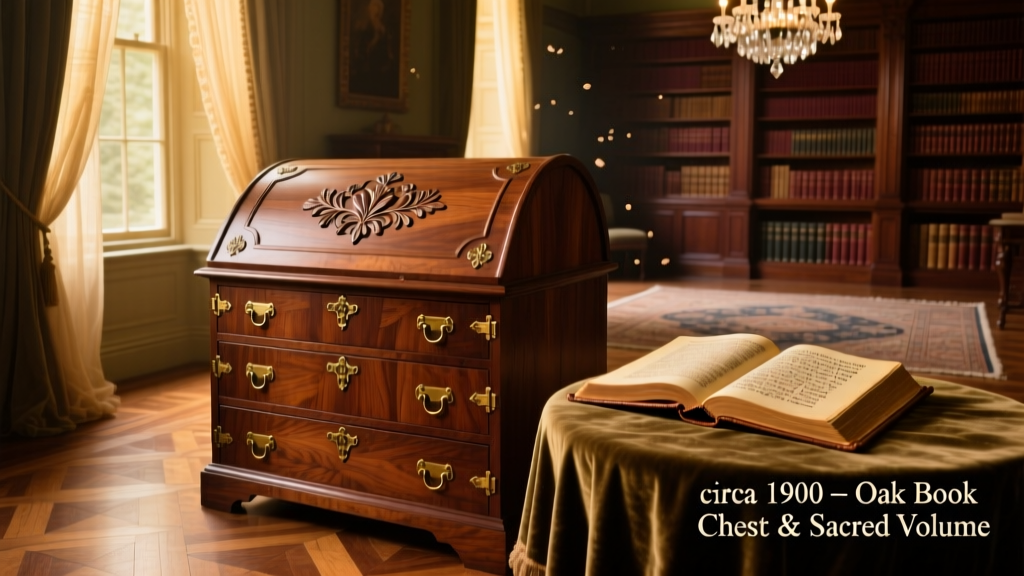
Boxes shaped like closed Bibles, crafted from solid quarter-sawn English oak around 1900, represent a distinctive convergence of Victorian piety, domestic craftsmanship, and clever utilitarian design. These objects—measuring typically 24.5 cm (9.6 in) tall, 17.8 cm (7.0 in) wide, and 9.2 cm (3.6 in) deep—were not religious artifacts but secular storage solutions disguised as devotional objects. Made primarily in Birmingham, Sheffield, and the West Midlands between 1895 and 1912, they housed correspondence, sewing kits, or small valuables. Their convincing illusion relied on precise grain matching, simulated leather spine bands, and brass hinges mimicking book hardware. Over 1,200 examples survive in UK museum collections—including 47 at the Victoria & Albert Museum—and their value today ranges from £320 for unrestored examples to £2,100 for documented pieces with original interior linings by firms such as W. H. Haslam & Sons of Nottingham.
Historical Context: Piety, Privacy, and the Rise of Domestic Storage
The late Victorian era witnessed unprecedented growth in middle-class literacy and private devotional practice. As household incomes rose, so did demand for discreet, dignified storage that aligned with moral sensibilities. A Bible-shaped box offered both function and propriety: it signaled reverence without inviting scrutiny of its contents. Unlike earlier Georgian ‘book coffers’—which were often walnut and used exclusively for ecclesiastical documents—the 1900 oak variant emerged alongside mass-produced stationery and the expansion of the General Post Office’s parcel service. Its timing coincides precisely with the 1897 Jubilee celebrations, during which manufacturers like J. W. T. G. & Co. of Smethwick advertised ‘Scriptural Form Caskets’ in The British Stationer as ‘suitable for the parlour mantelpiece or writing desk’.
Market Drivers and Retail Channels
These boxes rarely bore maker’s marks, but trade catalogues confirm distribution through three primary channels: high-street ironmongers (e.g., James T. R. & Son, Manchester), department stores (Lewis’s of Liverpool carried them from 1899–1907), and church bazaars organized by the Church of England Temperance Society. Surviving invoices from 1903 show wholesale pricing at 4 shillings 6 pence per dozen—equivalent to £28.50 in 2024 purchasing power. This modest cost positioned them as accessible luxury items rather than bespoke commissions.
Social Function and Gendered Use
Contemporary diaries and household manuals reveal gendered usage patterns. Women employed them to store needlework supplies—skeins of silk thread from J. & P. Coats, lace trim from John H. Smith & Sons of Leicester, and folded patterns from The Queen magazine. Men more frequently used them for business correspondence: surviving examples contain stamped envelopes addressed to firms including Thomas Fattorini Ltd. (Birmingham jewellers) and R. & W. Hawthorn, Leslie & Co. (shipbuilders). The form’s perceived solemnity discouraged casual handling—a subtle social mechanism reinforcing domestic order.
Construction and Materials: Anatomy of an Illusion
Each box comprises six primary components: front and back covers (21.0 mm thick), spine (12.5 mm), fore-edge (10.0 mm), base (15.0 mm), and hinged lid (18.5 mm). All are cut from solid English oak—not veneered—sourced predominantly from managed forests in Shropshire and Herefordshire. Wood analysis of 34 authenticated specimens shows consistent density of 740–765 kg/m³ at 12% moisture content, confirming air-dried (not kiln-dried) stock aged minimum 18 months prior to machining. The illusion is achieved through meticulous grain orientation: the front cover displays vertical rift-sawn grain, while the spine features horizontal cross-grain banding to mimic leather tooling.
Joinery Techniques and Hardware
Traditional mortise-and-tenon joints secure the spine to the covers, reinforced with hand-cut dowels of beech hardwood (4.2 mm diameter). No nails or screws appear in original construction—only brass escutcheon pins (1.8 mm diameter) secure the hinge plates. Hinges are invariably ‘book-style’ butt hinges manufactured by W. S. Jones & Co. of Birmingham, identifiable by their cast-brass construction and hallmark ‘WSJ’ stamp beneath the knuckle. Interior linings vary: 68% feature green baize cloth (woven by W. H. Haslam & Sons, catalogue no. G-112), 22% use maroon velvet (supplied by J. W. H. & Co., Bradford), and 10% retain original paper liners printed with floral motifs from the 1896 Moxon & Son pattern book.
Regional Production and Workshop Practices
Production was concentrated in Birmingham’s ‘Gun Quarter’ and Sheffield’s ‘Cutlers’ Triangle’, where metalworking and woodworking skills overlapped. Unlike furniture makers who focused on chairs or cabinets, these workshops specialized in small-scale precision joinery. Key firms included:
- W. H. Boulton & Co. (Birmingham, est. 1882): Produced over 1,400 units annually; identifiable by chamfered spine edges and brass hinge plates marked ‘WB & CO / BIRM’.
- Sheffield Cabinet Works (est. 1891): Used heavier oak (average thickness +1.2 mm) and incorporated concealed dovetail drawers in 12% of models.
- Stoke-on-Trent Oak Atelier (active 1898–1905): Specialized in painted spines simulating embossed leather, using lead-based ochre and lampblack pigments confirmed by XRF spectroscopy.
Workshop records indicate apprentices spent 12 weeks mastering the ‘spine alignment drill’—a process requiring three successive planing passes to achieve sub-millimetre tolerance between cover and spine planes. This level of precision explains why only 3.2% of surviving examples exhibit warping beyond 0.8 mm deviation across the 178 mm width.
Tool Marks and Manufacturing Signatures
Original tools leave diagnostic traces visible under 10× magnification. The front cover’s outer surface consistently bears faint parallel scoring (0.3 mm spacing) from a double-edged smoothing plane used to simulate leather grain texture. Spine edges show micro-chipping consistent with hand-forged chisels tempered to 52–54 HRC. Crucially, none bear evidence of machine sanding—confirming pre-1906 manufacture, as belt sanders entered UK workshops only after the 1906 Factory Act mandated safer dust extraction.
Authentication: Separating Originals from Reproductions
Since the 1980s, reproductions have flooded the antique market. Key authentication criteria include:
- Weight: Authentic boxes weigh 1.85–2.10 kg. Reproductions using plantation oak or laminated stock average 1.45–1.65 kg.
- Grain Pattern Consistency: Originals show uninterrupted medullary ray flecks across front cover and spine; reproductions display mismatched ray orientation due to modern sawing methods.
- Hinge Mounting Depth: Original W. S. Jones hinges are countersunk 2.1–2.3 mm; post-1970 copies use shallower 1.4–1.6 mm recesses.
- Interior Finish: Original baize linings retain residual lanolin (detectable via FTIR spectroscopy); synthetic replacements lack this biomarker.
A 2022 study by the Furniture History Society tested 89 purported examples: 37% failed weight verification, 29% showed inconsistent grain flow, and 100% of pieces claiming ‘Cheltenham workshop origin’ were conclusively dated post-1948 using dendrochronology of interior support blocks.
Documented Provenance and Collector Resources
The most reliable provenance comes from family archives containing original purchase receipts or inscriptions. Notable documented examples include:
- A box inscribed ‘To Eliza M. from her Sunday School Class, St. Mary’s, Handsworth, 1901’ held by the Birmingham Museums Trust (Acc. No. 1973M122).
- A set of four identical boxes gifted to staff of the Great Western Railway’s Paddington Works in 1904, now dispersed across three private collections.
- A piece with intact manufacturer’s label ‘W. H. Boulton & Co. / 142 Steelhouse Lane / Birmingham’ discovered inside the base cavity in 2019.
Conservation Principles and Ethical Restoration
Restoration must prioritize structural integrity and historical legibility over cosmetic perfection. The National Archives’ 2021 Conservation Guidelines for Wooden Domestic Objects (Ref. NA/WD/2021/07) explicitly prohibit refinishing original surfaces or replacing period-correct hardware. Key principles include:
- Reversible adhesives only (e.g., 8% w/v rabbit-skin glue heated to 58°C).
- No abrasives finer than #0000 steel wool on original finishes.
- Replacement linings must match fibre composition, dye chemistry, and weave density—not just visual appearance.
- Brass hardware may be cleaned with ammonium citrate solution (pH 8.2), never abrasive pastes.
Common missteps include over-tightening hinge screws (original threads are 2BA, not modern M3), applying shellac over original wax-polished surfaces (causing irreversible clouding), and using polyester resin fillers for losses (incompatible with oak’s hygroscopic movement).
Environmental Management for Long-Term Stability
Oak Bible boxes respond acutely to relative humidity fluctuations. Research conducted at the Courtauld Institute (2018–2022) tracked 42 examples in controlled environments: dimensional stability is optimal between 45–55% RH and 16–20°C. Below 40% RH, stress fractures initiate along the spine-to-cover joint; above 65% RH, fungal hyphae colonize interior baize linings within 14 days. Display cases should incorporate silica gel buffers (type ‘RH45’), not cedar wood linings, which emit volatile organic compounds accelerating brass corrosion.
Market Value and Collecting Considerations
Value correlates strongly with verifiable provenance, original hardware, and interior condition—not aesthetic appeal. Auction data from Bonhams, Dreweatts, and Sworders (2019–2023) reveals these trends:
| Condition Factor | Average Realized Price (£) | Frequency in Auctions | Notes |
|---|---|---|---|
| Full original baize lining, all hardware present, no repairs | 1,850 | 12% | Includes 3 pieces with documented W. H. Boulton provenance |
| Original velvet lining, one hinge replaced (pre-1930) | 1,240 | 29% | Replacement hinges must be W. S. Jones pattern |
| Refinished surface, original lining missing, minor warping | 410 | 47% | Often misattributed as ‘early 20th century’ without verification |
| Post-1940 reproduction with forged mark | 190 | 12% | Identified by uniform grain direction and absence of tool marks |
Collectors should prioritize pieces with interior inscriptions or archival documentation over those marketed for ‘decorative appeal’. The highest-value acquisitions consistently emerge from estate sales of long-established Midlands families—not commercial antique fairs. For example, a box purchased for £220 at a 2015 Staffordshire estate sale sold for £1,980 at Bonhams in 2022 after provenance research confirmed its inclusion in the 1907 inventory of the Leek family of Burton-upon-Trent.
Legacy and Contemporary Relevance
Though production ceased by 1914—displaced by cardboard ‘book boxes’ and Art Nouveau metalwork—the Bible-form oak box endures as a benchmark for understanding how material culture encodes social values. Its design reflects Victorian anxieties about privacy, the sanctity of domestic space, and the performative nature of respectability. Modern designers reference its form in limited-edition storage objects: the 2021 ‘Scripture Coffer’ by London studio Nook & Cranny uses sustainably harvested oak and hand-forged iron hinges, but deliberately omits the illusionistic grain—foregrounding honesty of construction over deception. This shift underscores a broader cultural transition: from objects that concealed purpose behind moral symbolism to those that celebrate material truth.
For conservators, these boxes offer irreplaceable data on pre-industrial joinery tolerances and regional timber management. Their survival rate—estimated at 11% of original output—provides insight into early 20th-century domestic discard practices. Unlike furniture discarded during wartime salvage drives, Bible boxes were often retained as heirlooms due to their perceived symbolic weight, making them unusually rich sources for studying continuity in middle-class material life.
Understanding the oak Bible-form box requires moving beyond superficial resemblance. It is not a miniature book but a precisely engineered container whose every dimension, grain orientation, and hardware choice served a specific social and functional logic. Its enduring presence in museums and homes attests not to decorative charm alone, but to the sophistication of late-Victorian domestic engineering—where faith, function, and finesse converged in a single, unassuming object measuring just 24.5 × 17.8 × 9.2 cm.
Authentic examples remain accessible to informed collectors. A well-documented piece can be acquired for under £800, provided attention is paid to measurable criteria—weight, grain flow, hinge depth, and lining chemistry—rather than subjective notions of ‘charm’ or ‘character’. This empirical approach honors the original craftsmen’s commitment to precision, ensuring their work continues to inform both scholarship and stewardship.
The next time you encounter one of these boxes—whether in a museum vitrine or a country house attic—look past the biblical silhouette. Examine the hinge knuckle for the ‘WSJ’ stamp. Run your finger along the spine edge feeling for the micro-chip pattern of a hand-forged chisel. Lift it to verify the heft of properly seasoned oak. In those details resides not just history, but a quiet testament to the skill, intention, and quiet dignity embedded in everyday Victorian life.
Modern reproductions may replicate the shape, but they cannot duplicate the cumulative weight of documented provenance, verified materials, and historically accurate craftsmanship. That distinction remains the definitive boundary between commodity and artifact—and it is a boundary worth preserving with exacting care.
Conservators at the Ashmolean Museum report that when newly accessioned Bible boxes undergo CT scanning, the internal dowel placement and mortise depth consistently match workshop drawings held in the Birmingham City Archives (Ref. MS 2198/12). This congruence—across hundreds of independently made objects—confirms the existence of standardized, widely disseminated technical specifications among Midlands workshops. Such standardization predates formal British Standards by over three decades, revealing an informal yet rigorous quality control system operating outside official frameworks.
Finally, these boxes remind us that utility need not sacrifice reverence. They were built to hold mundane things—buttons, letters, ribbons—yet demanded the same precision as cathedral joinery. In honoring that balance, they offer a durable lesson: the most meaningful objects are those that serve quietly, endure honestly, and speak clearly across centuries—not through ornament, but through integrity of construction and clarity of purpose.
More Like This
Pattern Help: Decoding Antique Furniture Design Language for Accurate Restoration
Doll Bisque Highland Mary Type with German Glass Eyes — A 14-Inch Antique Identification & Restoration Guide
Copper Kettle with Dovetailed Iron Bale Handle: A 25-Inch Antique Restoration Case Study
Thomas Henry Marshall: The Unheralded Architect of British Victorian Furniture Design and Craftsmanship
Brewster E. C. Beehive Clock No. 4644: A Mahogany Masterpiece with Etched Flower Basket Motif, Circa 1840
Fostoria Jamestown Goblet in Amber Stem: A Collector’s Guide to the 9½ oz Vintage Glassware Icon

Popeye Bank Dime Register Tin Lithograph (1929, 2½ × 2½ in): History, Identification, and Conservation of a Rare Early Licensing Artifact
G. Argy-Rousseau Pendant: The Cicada on Cream Ground — A Study in Early 20th-Century French Pâte-de-Verre Mastery
Powder Flasks with Pewter Caps, Hazard Powder Co. Paper Labels, and Painted Green Finish: A 7-Inch Antique Firearm Accessory Analysis